Every Silver Lining Has a Cloud

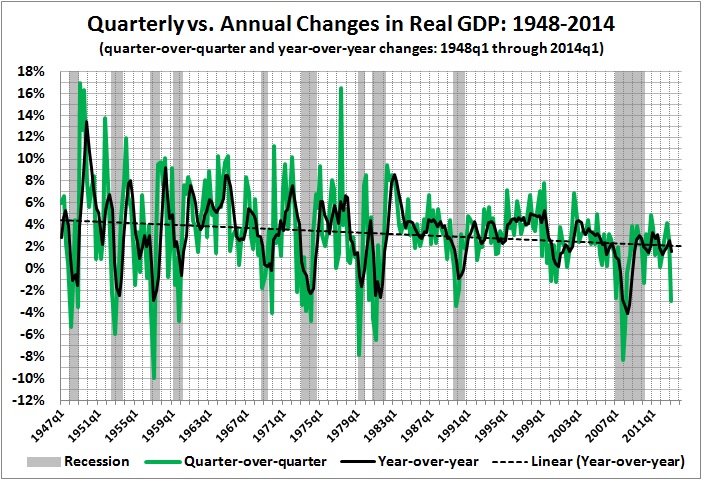
Today’s big economic news is the decline in real GDP reported by the Department of Commerce’s Bureau of Economic Analysis (BEA): an annualized rate of minus 2.9 percent from the fourth quarter of 2013 to the first quarter of 2014. Except for times when the economy was in or near recession, that’s the largest decline recorded since the advent of quarterly GDP estimates:

Quarterly vs annual changes in real GDP - 1948-2014
Derived from the “Current dollar and real GDP series” issued by BEA. See this post for my definition of a recession.

What’s the silver lining? Quarter-to-quarter changes in real GDP are more volatile than year-over-year and long-run changes. Some will take solace in the fact that real GDP rose by (a measly) 1.5 percent between the first quarter or 2013 and the first quarter of 2014. (Though they will conveniently ignore the long-run trend, marked by the dashed line in the graph.)

What’s the cloud? Well, as I pointed out above, the quarter-to-quarter decline in the first quarter of 2014 is unprecedented in the post-World War II era. Unless the sharp drop in the first quarter of 2014 is a one-off phenomenon (as suggested by some cheerleaders for Obamanomics), it points two possibilities:

  • The economy is in recession, as will become evident when the BEA reports on GDP for the second quarter of 2014.
  • The economy isn’t in recession — strictly speaking — but the dismal performance in the first quarter presages an acceleration of the downward trend marked by the dashed line in the graph. (For those of you who care about such things, the chance that the trend line reflects random “noise” in GDP statistics is less than 1 in 1 million.)

Even if there’s a rebound in the second quarter of 2014, the big picture is clear: The economy is in long-term decline, for reasons that I’ve discussed in the following posts:

The Laffer Curve, “Fiscal Responsibility,” and Economic Growth
The Causes of Economic Growth
In the Long Run We Are All Poorer
A Short Course in Economics
Addendum to a Short Course in Economics
The Price of Government
The Price of Government Redux
The Mega-Depression
As Goes Greece
Ricardian Equivalence Reconsidered
The Real Burden of Government
The Illusion of Prosperity and Stability
Taxing the Rich
More about Taxing the Rich
A Keynesian Fantasy Land
The Keynesian Fallacy and Regime Uncertainty
Why the “Stimulus” Failed to Stimulate
The “Jobs Speech” That Obama Should Have Given
Say’s Law, Government, and Unemployment
Unemployment and Economic Growth
Regime Uncertainty and the Great Recession
Regulation as Wishful Thinking
The Real Multiplier
The Commandeered Economy
We Owe It to Ourselves
In Defense of the 1%
Lay My (Regulatory) Burden Down
The Burden of Government
Economic Growth Since World War II
The Economy Slogs Along
Government in Macroeconomic Perspective
Keynesianism: Upside-Down Economics in the Collectivist Cause
The Price of Government, Once More
Economic Horror Stories: The Great “Demancipation” and Economic Stagnation
Economics: A Survey (also here)
Why Are Interest Rates So Low?
Vulgar Keynesianism and Capitalism
Estimating the Rahn Curve: Or, How Government Spending Inhibits Economic Growth
America’s Financial Crisis Is Now
The Keynesian Multiplier: Phony Math
The True Multiplier
The Obama Effect: Disguised Unemployment
Obamanomics: A Report Card

See especially “Regime Uncertainty and the Great Recession,” “Estimating the Rahn Curve: Or, How Government Spending Inhibits Economic Growth,” and “The True Multiplier.”

Has America Always Been Leftist?

Dr. John J. Ray, writing at Dissecting Leftism, enraged some Americans with two recent posts about America and leftism. I’m grateful to Dr. Ray for publishing, in a subsequent post, a message that I sent to him about the two posts in question. Herein, I elaborate on the points that I made in my message to Dr. Ray.

In “America Has Always Been Leftist,” Dr. Ray asserts the following:

As most Americans learn around the time of Thanksgiving, America was founded by fanatical communists.  They forbad [sic] private ownership of land and insisted that all produce be shared communally.  If that’s not communism, nothing is.  They were such fanatics that a third of them had to starve to death before they decided that communism wasn’t such a good idea and went back to the way things had always been done in stodgy old England.

So what should we expect of a nation dominated by the descendants of fanatical communists?  What we should expect is exactly what we actually got, I submit.

But before I get to that, let me  ensure complete clarity about what the core of Leftism is.  The content of Leftism changes from time to time.  Before WWII, Leftists world wide were energetic champions of eugenics, for instance.  Leftists now abhor it.  So what is constant in Leftism?  Anger.  Leftists in all eras are so dissatisfied with the society in which they live that they want sweeping changes to it. And they thirst for power to achieve that.  That is Leftism.

Pace Dr. Ray, it is well known that the “fanatical communists” of Plymouth Colony quickly abandoned their experiment in communism; for example, Jerry Bowyer writes:

…America was founded by socialists who had the humility to learn from their initial mistakes and embrace freedom.

One of the earliest and arguably most historically significant North American colonies was Plymouth Colony, founded in 1620 in what is now known as Plymouth, Massachusetts. As I’ve outlined in greater detail here before (Lessons From a Capitalist Thanksgiving), the original colony had written into its charter a system of communal property and labor.

As William Bradford recorded in his Of Plymouth Plantation, a people who had formerly been known for their virtue and hard work became lazy and unproductive. Resources were squandered, vegetables were allowed to rot on the ground and mass starvation was the result. And where there is starvation, there is plague. After 2 1/2 years, the leaders of the colony decided to abandon their socialist mandate and create a system which honored private property. The colony survived and thrived and the abundance which resulted was what was celebrated at that iconic Thanksgiving feast….

It is, moreover, an exaggeration to say that America is “a nation dominated by the descendants of fanatical communists.” First, as I’ve just pointed out, the inhabitants of Plymouth Colony were hardly fanatical. If they had been, they would have chosen the sure impoverishment (and probable death) of communism over the relative prosperity (and liberty) that came their way when they abandoned their infatuation with communism.

Second, only a small minority of today’s Americans — even of today’s white Americans — can count themselves as “full blooded” descendants of the inhabitants of Plymouth Colony or other early settlers might also have harbored socialistic delusions. There have been too many immigrants from continental Europe and too much “miscegenation” for that to be true.

Third, and fundamentally, it is meaningless to generalize about “Americans,” as I’ve explained at length here. There are and have been individual Americans of many political persuasions, most of them confused and contradictory.

That said, I do agree, generally, with Dr. Ray’s characterization of the motivations underlying the War of Independence. In his next post, “Has America Always Been Leftist?,” Dr. Ray says this:

I did learn something very important from [the critics of “America Has Always Been Leftist”].  It was vividly brought home to me how impressive fine words are to most people.  When even patriotic American conservatives can be taken in by them, it shows why Leftists have so much influence. Leftists are nothing but fine words.  To me fine words are only provisionally important.  They have to be backed up by deeds and it is the deeds that matter.

An excellent example of how fine words impress even conservatives  is the preamble to the Declaration of Independence.  It is full of fine words and noble sentiments.  Most political documents are.  Stalin’s Soviet constitution also was a high-minded document proclaiming all sorts of rights for Soviet citizens  — rights which were denied in fact.

So once you look past the grand generalizations of the Declaration’s introduction and get to the nitty gritty of what the Yankee grandees really wanted fixed, you see that it is very mundane, if not ignoble.  What was really bothering them was restrictions on their powers to legislate.  They wanted more laws, not less!   Very Leftist.

And from THAT starting point you can see why the war was fought and for whose benefit.  The grandees concerned had a lot of influence and were good at fine talk so they could muster an army — and they did.  And who benefited from the war?  Was it the poor farmers and tradesmen who died as foot-soldiers in it?  No way!  It was the grandees who started the war.  They emerged with exactly what they wanted:  More power.

I am sorry if that account sounds offensive to people who still believe the original propaganda, but if you ignore the fancy talk and just look at the facts, that is what happened.

Dr. Ray’s sweeping use of “Leftist” aside, his main point is well taken. I made a similar observation in response to a post by Timothy Sandefur, who was then guest-blogging at The Volokh Conspiracy. Sandefur, writing about his book The Conscience of the Constitution, asserted that “The American founders held that people are inherently free—that is, no person has a basic entitlement to dictate how other people may lead their lives.” I responded:

Did they, really? All of them, including the slave owners? Or did they simply want to relocate the seat of power from London to the various State capitals, where local preferences (including anti-libertarian ones) could prevail? Wasn’t that what the Declaration of Independence and Articles of Confederation were all about? The Constitution simply moved some of the power toward the national capital, mainly for the conduct of foreign policy and trade. Despite that, the Constitution was a “States’ rights” document, and remained that way until the ratification of Amendment XIV, from which much anti-libertarian mischief has emanated.

In response to Sandefur’s next post, I wrote:

Why can’t you [Sandefur] just admit that the Declaration of Independence was a p.r. piece, penned (in the main) by a slave-owner and subscribed to by various and sundry elites who (understandably) resented their treatment at the hands of a far-away sovereign and Parliament? You’re trying to make more of the Declaration — laudable as its sentiments are — than should be made of it….

In sum, the War of Independence isn’t all that it’s cracked up to be.

And there’s no doubt that liberty suffered in the long run as a result of the North’s victory in the Civil War. I return to Dr. Ray’s “America Has Always Been Leftist,” where he says this:

“Only” half a million men died [in the Civil War].  And for what?  EVERY other country on earth abolished slavery without the need for a war.  Does that not tell us something?  It should.  In his famous letter to Horace Greeley [link added], Lincoln himself admitted that slavery was not the main issue.  The issue was the dominance of central government.  V.I. Lenin call your office.  Lincoln didn’t call it “dominance of central government”, of course.  He called it “the union” but the result is the same.

And just about everything Lincoln did was without a shred of constitional justification and in fact breached the constitution.  Hitler at least had the grace to get an “enabling act” passed by the German parliament.  Lincoln just marched on regardless. He destroyed the liberty of the press (there goes your first amendment) and locked up thousands of war opponents (there goes your 4th amendment).  But most centrally, Lincoln’s whole enterprise was a defiance of the basic American constitutional dispensation that the states are sovereign, not the federal government.  Lincoln turned that on its head.  The feds now became the main source of power and authority.  There is no doubt that Lincoln talked a good talk.  He even used to persuade me once.  But his deeds reek of Fascism.

A good example of the large gap between his deeds and words is that masterpiece of propaganda, the Gettysburg address.  Goebbels admired it for good reason.  In case anybody hasn’t noticed, Lincoln claimed that his war was to ensure “government of the people, by the people, for the people” — which was exactly what he had just denied to the South!  Only Yankees are people, apparently.  Hitler thought certain groups weren’t people too.

Overwrought? Perhaps, but if Lincoln wasn’t a left-statist, he at least set an example for extra-constitutional activism that inspired Theodore Roosevelt’s hyper-activism (e.g., see this and this). TR, of course, set an example that was followed and enlarged upon by most of his successors, unto the present day.

Another anti-libertarian legacy of the Civil War is the false belief that it “proved” the unconstitutionality of secession. Balderdash! Secession is legal, Justice Scalia’s dictum to the contrary notwithstanding. (See this, this, and this, for example.) And the ever-present threat of secession might have helped to keep the central government from overstepping its constitutional bounds.

I must conclude, however, that the American Revolution and Civil War have little to do with “left” (or “right”) and much to do with human venality and power-lust, which are found in persons of all political persuasions.

The genius of the Constitution was that it provided mechanisms for curbing the anti-libertarian effects of venality and power-lust. The tragedy of the Constitution is that those mechanisms have been destroyed. If Dr. Ray were to say that Americans have gradually lost their liberty through successive and cumulative violations of the Constitution, I would agree with him

And if Dr. Ray were to say that Americans have become the captives of a leftist state, and are likely to remain so, I would agree with him.

*     *     *

Related posts:
FDR and Fascism
The Modern Presidency: A Tour of American History
An FDR Reader
The People’s Romance
Secession
The Near-Victory of Communism
A Declaration of Independence
Tocqueville’s Prescience
Invoking Hitler
The Left
The Constitution: Original Meaning, Corruption, and Restoration
I Want My Country Back
Our Enemy, the State
The Left’s Agenda
The Meaning of Liberty
The Southern Secession Reconsidered
The Left and Its Delusions
Burkean Libertarianism
A Declaration and Defense of My Prejudices about Governance
Society and the State
Why Conservatism Works
Liberty and Society
Tolerance on the Left
The Eclipse of “Old America”
A Contrarian View of Universal Suffrage
Defending Liberty against (Pseudo) Libertarians
Defining Liberty
Conservatism as Right-Minarchism
“We the People” and Big Government
Parsing Political Philosophy (II)
How Libertarians Ought to Think about the Constitution
Romanticizing the State
Libertarianism and the State

Income Inequality and Inherited Wealth: So What?

Greg Mankiw offers a refreshing take on  Thomas Piketty’s infamous thesis, Capital in the Twenty-First Century. Mankiw opens by asking, “Is inherited wealth making a comeback?” He continues:

Yes, says Thomas Piketty…. Inherited wealth has always been with us, of course, but Mr. Piketty believes that its importance is increasing. He sees a future that combines slow economic growth with high returns to capital. He reasons that if capital owners save much of their income, their wealth will accumulate and be passed on to their heirs. He concludes that individuals’ living standards will be determined less by their skill and effort and more by bequests they receive.

To be sure, one can poke holes in Mr. Piketty’s story. Since the book came out, numerous economists have been doing exactly that in book reviews, blog posts and academic analyses.

Moreover, given economists’ abysmal track record in forecasting, especially over long time horizons, any such prognostication should be taken with a shaker or two of salt. The Piketty scenario is best viewed not as a solid prediction but as a provocative speculation.

But it raises the question: So what? What’s wrong with inherited wealth?…

The bottom line is that inherited wealth is not an economic threat. Those who have earned extraordinary incomes naturally want to share their good fortune with their descendants. Those of us not lucky enough to be born into one of these families benefit as well, as their accumulation of capital raises our productivity, wages and living standards.

Unlike Mankiw, I would have stopped at “so what?” The incessant attacks on income inequality and inherited wealth arise not only from faulty economic reasoning, as Mankiw points out, but also from envy and resentment.

Envy and resentment are found among non-achievers, of course, but they are rampant in the ranks of the affluent. There we find pseudo-academic poseurs like Paul Krugman and Robert Reich, leftist pundits, well-heeled politicos, and cossetted bureaucrats who feast on the spoils of the welfare state. These hypocrites can’t attack “the rich” with a straight face, so they attack “the very rich,” a class that they define (conveniently) to exclude themselves.

That said, I can’t resist the temptation to add to Mankiw’s short list of links to posts and articles that are critical of Piketty’s analysis. Here’s a small sample of related readings:

Richard A. Epstein, “The Piketty Fallacy,” The Libertarian, May 5, 2014
Arnold Kling, “More Contra Piketty,” askblog, May 21, 2014
Scott Sumner, “The Middle Class Is Doing Fine,” EconLog, May 21, 2014
Pejman Yousefzedah, “Facts Are Stubborn Things … As Thomas Piketty Is Beginning to Find Out,” Pejman Yousefzedah, May 23, 2014
Ed Morrissey, “The Perils of Piketty,” Hot Air, May 25, 2014
Tim Worstall, “Why Income Inequality Is Really Very Good for Us Indeed,” The Adam Smith Institute, June 2, 2014
Mark J. Perry, “Sorry Krugman, Stiglitz, and Pikkety: Income Inequality for Individual Americans Has Been Flat for More Than 50 Years,” Carpe Diem, June 5, 2014

For many more readings, see the links at the bottom of “Mass (Economic) Hysteria: Income Inequality and Related Themes.” See also my many posts tagged “income inequality,” and follow the links therein.

(Full disclosure: I am an “unprivileged” child of “unprivileged”parents. I have inherited not so much as a penny. In 31 years of salaried, full-time employment, I earned above-average compensation. My earnings were in the top-5 percent of individual incomes for a few years at the end of my full-time working career.)

“Liberalism” and Personal Responsibility

As usual, I enclose “liberal” and its variants in quotation marks because such words refer to persons and movements whose statist policies are in fact destructive of liberty, that is, illiberal.

The unacknowledged core value of “liberalism” is its repudiation of personal responsibility. There is ample evidence of this; for example:

  • the treatment of material inequality as inequity, as if differences in intelligence, skills, ambition, and work habits are irrelevant
  • unblinking support for the redistribution of income and wealth, thus encouraging sloth and punishing intelligence, skill, ambition, and hard work
  • a preference for rehabilitation and second, third, and fourth chances, as opposed to sure, swift, and harsh punishment for criminal acts
  • the unsupported view that terrorism arises from poverty and is therefore “understandable,” and isn’t an act of war but merely a crime whose perpetrators must be accorded due process in American courts
  • the promotion of abortion, which is a way of escaping the consequences of imprudent sexual behavior — after-the-fact birth control, as it were
  • the disparagement and destruction of familial responsibility, through welfare programs, easy divorce, the advancement of gay “marriage,” and the subsidization of women’s work outside the home
  • a general disinclination to hold persons responsible for the consequences of their actions: various addictions are “diseases”; those who acquire lung cancer by smoking are “victims” of tobacco companies; those who engage in risky sex acts are “victims” of AIDS; those who borrow money and don’t repay it; and on and on
  • the treatment of straight, white males as”privileged,” to justify the indiscriminate bestowal of favors on “protected groups” (those who aren’t straight, white males) because all members of such groups are discriminated against,” “disadvantaged,” and “oppressed,” by definition.

Anthony Daniels (Theodore Dalyrmple) captures the essence of the “liberal” mindset:

In the United States, the National Institute on Drug Abuse defines addiction quite baldly as a chronic relapsing brain disease—and nothing else. I hesitate to say it, but this seems to me straightforwardly a lie, told to willing dupes in order to raise funds from the federal government.

Be that as it may, the impression has been assiduously created and peddled among the addicts that they are the helpless victims of something that is beyond their own control, which means that they need the technical assistance of what amounts to a substantial bureaucratic apparatus in order to overcome it. When heroin addicts just sentenced to imprisonment arrived, they said to me, “I would give up, doctor, if only I had the help.” What they meant by this was that they would give up heroin if some cure existed that could be administered to them that would by itself, without any resolution on their part, change their behavior. In this desire they appeared sincere—but at the same time they knew that such a cure did not exist, nor would most of them have agreed to take it if it did exist….

[A]ll the bases upon which heroin addiction is treated as if it is something that happens to people rather than something that people do are false, and easily shown to be false. This is so whatever the latest neuro-scientific research may supposedly show….

Dishonest passivity and dependence combined with harmful activity becomes a pattern of life, and not just among drug addicts. I remember going into a single mother’s house one day. The house was owned by the local council; her rent was paid, and virtually everything that she owned, or that she and her children consumed, was paid for from public funds. I noticed that her back garden, which could have been pretty had she cared for it, was like a noxious rubbish heap. Why, I asked her, do you not clear it up for your children to play in? “I’ve asked the council many times to do it,” she replied. The council owned the property; it was therefore its duty to clear up the rubbish that she, the tenant, had allowed to accumulate there—and this despite what she knew to be the case, that the council would never do so! Better the rubbish should remain there than that she do what she considered to be the council’s duty. At the same time she knew perfectly well that she was capable of clearing the rubbish and had ample time to do so. This is surely a very curious but destructive state of mind, and one that some politicians have unfortunately made it their interest to promote by promising secular salvation from relative poverty by means of redistribution….

[T]he notions of dependence and independence have changed. I remember a population that was terrified of falling into dependence on the state, because such dependence, apart from being unpleasant in itself, signified personal failure and humiliation. But there has been an astonishing gestalt switch in my lifetime. Independence has now come to mean independence of the people to whom one is related and dependence on the state. (“The Worldview That Makes the Underclass,” Imprimis, May/June 2014)

The deeper tragedy is that the denial of personal responsibility leads inevitably to the erosion of liberty. When the state becomes the arbiter of our morals, it becomes perforce the arbiter of our actions.

*     *     *

Related posts:
Diversity
The Cost of Affirmative Action
It Can Happen Here: Eugenics, Abortion, Euthanasia, and Mental Screening
Affirmative Action: A Modest Proposal
Affirmative Action: Two Views from the Academy
Affirmative Action, One More Time
A Contrarian View of Segregation
The Consequences of Roe v. Wade
The Old Eugenics in a New Guise
The Left, Abortion, and Adolescence
After the Bell Curve
A Footnote . . .
Schelling and Segregation
“Equal Protection” and Homosexual Marriage
Law, Liberty, and Abortion
Same-Sex Marriage
“Equal Protection” and Homosexual Marriage
Law, Liberty, and Abortion
Abortion and the Slippery Slope
An Argument Against Abortion
Singer Said It
A “Person” or a “Life”?
The Case against Genetic Engineering
Affirmative Action: Two Views from the Academy, Revisited
A Wrong-Headed Take on Abortion
“Family Values,” Liberty, and the State
On Liberty
Negative Rights, Social Norms, and the Constitution
Rights, Liberty, the Golden Rule, and the Legitimate State
Perry v. Schwarzenegger, Due Process, and Equal Protection
Rationalism, Social Norms, and Same-Sex “Marriage”
Our Enemy, the State
Pseudo-Libertarian Sophistry vs. True Libertarianism
Positivism, “Natural Rights,” and Libertarianism
What Are “Natural Rights”?
The Golden Rule and the State
Libertarian Conservative or Conservative Libertarian?
Evolution, Human Nature, and “Natural Rights”
More Pseudo-Libertarianism
More about Conservative Governance
The Meaning of Liberty
In Defense of Marriage
Understanding Hayek
Burkean Libertarianism
Rights: Source, Applicability, How Held
True Libertarianism, One More Time
Human Nature, Liberty, and Rationalism
Utilitarianism and Psychopathy
Abortion and Logic
The Myth That Same-Sex “Marriage” Causes No Harm
Society and the State
Are You in the Bubble?
Liberty, Negative Rights, and Bleeding Hearts
Conservatives vs. “Liberals”
Why Conservatism Works
Abortion, Doublethink, and Left-Wing Blather
Race and Reason: The Victims of Affirmative Action
Abortion, “Gay Rights,” and Liberty
Race and Reason: The Achievement Gap — Causes and Implications
Liberty and Society
The Eclipse of “Old America”
Genetic Kinship and Society
Liberty as a Social Construct: Moral Relativism?
Defending Liberty against (Pseudo) Libertarians
“Conversing” about Race
Defining Liberty
Conservatism as Right-Minarchism
“We the People” and Big Government
Evolution and Race
The Culture War
The Pseudo-Libertarian Temperament
Parsing Political Philosophy (II)
Getting Liberty Wrong
Surrender? Hell No!
Governmental Perversity
Libertarianism and the State

Playing the Social Security Trust Fund Shell Game

There’s a simple way to calculate the size of the federal government’s debt at any point in the future:

D’ = D – R + S – T

Where,

D’ = Amount of debt at a future date

D = Present debt

R = Federal government’s revenues from all sources (including Social Security taxes), from the present to the future date

S = Federal government’s spending for all purposes (including SS benefits), from the present to the future date

T = Value of Treasury securities redeemed by the SS trust fund to defray the gap between SS taxes collected and SS benefits paid

(For an explanation of how the redemption of securities by the trust fund can reduce the debt, see below.)

The present level of debt (D) is approximately equal to the debt ceiling. Therefore, as long as the deficit (R – S) is greater than the value of securities redeemed by the trust fund (T) to pay current benefits, the debt ceiling must rise or spending must be cut. (Aside: The ability of SS trustees to redeem trust fund holdings and pay benefits is simply a mechanism for ensuring the payment of full benefits until the trust fund is exhausted, regardless of any budget crunch. The trust fund, itself, is nothing more than a set of numbers in a government ledger. It isn’t an asset, any more than swampland is an asset to a sucker who buys it sight unseen.)

In theory, the trust fund could be exploited to get around the ceiling, by redeeming more holdings than required for the payment of current benefits. It’s a ploy was used in the past but is now illegal, Michael McConnell explained it in 2011:

The Social Security Trust Fund holds over $2 trillion [now over $2.7 trillion] in special Treasury securities, which it is legally entitled to redeem when necessary for the payment of benefits. When the Treasury redeems those bonds, the public debt will correspondingly be reduced, which will enable it to auction new bonds to investors, without violating the debt ceiling. This is precisely what happened during the debt ceiling crisis in 1985. Then, it was a Democratic House of Representatives that refused to raise the ceiling at the behest of a Republican President (an episode conveniently forgotten by those who wish to paint the Republican House today as uniquely evil for insisting that a debt ceiling increase be accompanied by spending reductions). The Social Security trustees cashed in some $9 billion in special Treasury securities for the payment of benefits, and the Treasury auctioned off the same amount in new U.S. bonds, without violating the debt ceiling. Here is how the Comptroller General described the event:

The Treasury Department estimated that it would have insufficient cash on November 1 to pay social security benefits and other government obligations. In order for these payments to be made, the Treasury needed to borrow money from the public, and in order to borrow the money, Treasury had to reduce its outstanding debt below the statutory limit. Therefore, on November 1 the Secretary redeemed $9.613 billion of the Trust Funds’ long-term securities, and $1.9 billion of securities held by certain other government-managed trust funds, to permit public borrowing of about $13 billion.

In this way, the Reagan Treasury was able to continue to pay Social Security benefits without interruption, despite the failure of Congress to raise the debt ceiling at the time.

The Comptroller General ruled that these redemptions were lawful, except that the trust fund redeemed more securities than were actually necessary for the payment of benefits. Some years later, Congress passed a statute codifying the Comptroller General’s decision. Public Law 104-121, section 107(a), prohibits redemption of special securities held by Social Security prior to maturity for any purpose other than the payment of benefits or administrative expenses. This statute is significant for two reasons. First, it confirms that the trustees have authority to redeem the special securities prior to maturity for the payment of benefits, and second, it prevents the executive from using the trust fund as a massive kitty to avoid the effect of the debt ceiling.

What could happen if the law were repealed? This:

1. Given the estimated size of the trust fund at the end of 2014 (as reported here), trust fund holdings could be liquidated as follows: FY 2015 — $469 billion; FY 2016 — $536 billion; FY 2017 — $576 billion; FY 2018 — $627 billion; FY 2019 — $722 billion; FY 2020 — $144 billion. The payout in FY 2020 would exhaust the trust fund. The total ($3.1 trillion) exceeds the estimated value of the trust fund at the end of 2014 ($2.8 trillion) because the trust fund would be credited with interest on its remaining holdings while those holdings were being drawn down.

2. The redemptions in 2015-2019 would entirely offset projected budget deficits for those years; the redemption in 2020 would offset about one-fifth of that year’s projected deficit. (See Table 1 here.) Thus it wouldn’t be necessary to reduce federal spending from currently projected levels until some time in 2020.

3. Under present law, however, depletion of the trust fund means that SS benefits must then be cut to a level that can be sustained by SS taxes. The cuts would be relatively small at first, but would grow steadily through the years. (Go here and compare the columns “non-interest income” and “cost” for the years 2020 and beyond.) For example, benefits in 2021 would have to be reduced to 90 percent of the level currently planned for that year; by 2030, benefits would have to be reduced to 80 percent of the planned level.

The good news — if the ploy could be executed — is that the Social Security crisis would be brought forward to the near future, instead of being deferred until 2033, when the trust fund is now expected to vanish. The undeniable urgency of the situation might compel Congress and the president to act — and perhaps to do something about the federal government’s entire fiscal mess — instead of continuing to kick the can down the road.

The bad news is that the federal government would run huge deficits for the next several years (at least). Programs that are unaffordable in the long run would be kept alive to acquire larger constituencies. Accordingly, it would be harder to curtail or kill them.

The real solution, of course, isn’t fiscal trickery; it’s fiscal responsibility. Let’s hope that 2017 brings with it a Congress and White House controlled by the non-RINO wing of the GOP.

*     *     *

Related posts:
Economics: A Survey (also here)
Why Are Interest Rates So Low?
Estimating the Rahn Curve: Or, How Government Spending Inhibits Economic Growth
America’s Financial Crisis Is Now
“Social Insurance” Isn’t Insurance — Nor Is Obamacare
The Keynesian Multiplier: Phony Math
The True Multiplier

Verbal Regression Analysis, the “End of History,” and Think-Tanks

There once was a Washington DC careerist with whom I crossed verbal swords. I won; he lost and moved on to another job. I must, however, credit him with at least one accurate observation: Regression analysis is a method of predicting the past with great accuracy.

What did he mean by that? Data about past events may yield robust statistical relationships, but those relationships are meaningless unless they accurately predict future events. The problem is that in the go-go world of DC, where rhetoric takes precedence over reality, analysts usually assume the predictive power of statistical relationships, without waiting to see if they have any bearing on future events.

Francis Fukuyama has just published an article in which he admits that his famous article, “The End of History” (1989), was a kind of verbal regression analysis — a sweeping prediction of the future based on a (loose) verbal analysis of the past.

What is the “end of history”? This, according to Wikipedia:

[A] political and philosophical concept that supposes that a particular political, economic, or social system may develop that would constitute the end-point of humanity’s sociocultural evolution and the final form of human government.

What did Fukuyama say about “the end of history” in 1989? This:

In watching the flow of events over the past decade or so, it is hard to avoid the feeling that something very fundamental has happened in world history….

What we may be witnessing in not just the end of the Cold War, or the passing of a particular period of post-war history, but the end of history as such: that is, the end point of mankind’s ideological evolution and the universalization of Western liberal democracy as the final form of human government. This is not to say that there will no longer be events to fill the pages of Foreign Affairs‘s yearly summaries of international relations, for the victory of liberalism has occurred primarily in the realm of ideas or consciousness and is as yet incomplete in the real or material world. But there are powerful reasons for believing that it is the ideal that will govern the material world in the long run. To understand how this is so, we must first consider some theoretical issues concerning the nature of historical change.

What does Fukuyama say now? This:

I argued [in 1989] that History (in the grand philosophical sense) was turning out very differently from what thinkers on the left had imagined. The process of economic and political modernization was leading not to communism, as the Marxists had asserted and the Soviet Union had avowed, but to some form of liberal democracy and a market economy. History, I wrote, appeared to culminate in liberty: elected governments, individual rights, an economic system in which capital and labor circulated with relatively modest state oversight….

Twenty-five years later, the most serious threat to the end-of-history hypothesis isn’t that there is a higher, better model out there that will someday supersede liberal democracy; neither Islamist theocracy nor Chinese capitalism cuts it. Once societies get on the up escalator of industrialization, their social structure begins to change in ways that increase demands for political participation. If political elites accommodate these demands, we arrive at some version of democracy.

The question is whether all countries will inevitably get on that escalator. The problem is the intertwining of politics and economics. Economic growth requires certain minimal institutions such as enforceable contracts and reliable public services before it will take off, but those basic institutions are hard to create in situations of extreme poverty and political division. Historically, societies broke out of this “trap” through accidents of history, in which bad things (like war) often created good things (like modern governments). It is not clear, however, that the stars will necessarily align for everyone….

A second problem that I did not address 25 years ago is that of political decay, which constitutes a down escalator. All institutions can decay over the long run. They are often rigid and conservative; rules responding to the needs of one historical period aren’t necessarily the right ones when external conditions change.

Moreover, modern institutions designed to be impersonal are often captured by powerful political actors over time. The natural human tendency to reward family and friends operates in all political systems, causing liberties to deteriorate into privileges….

As for technological progress, it is fickle in distributing its benefits. Innovations such as information technology spread power because they make information cheap and accessible, but they also undermine low-skill jobs and threaten the existence of a broad middle class.

No one living in an established democracy should be complacent about its survival. But despite the short-term ebb and flow of world politics, the power of the democratic ideal remains immense. We see it in the mass protests that continue to erupt unexpectedly from Tunis to Kiev to Istanbul, where ordinary people demand governments that recognize their equal dignity as human beings. We also see it in the millions of poor people desperate to move each year from places like Guatemala City or Karachi to Los Angeles or London.

Even as we raise questions about how soon everyone will get there, we should have no doubt as to what kind of society lies at the end of History.

And blah, blah, blah, blah, blah.

The “end of history” will be some kind of “democracy,” and it will arrive despite all of the very real obstacles in its way, which include sectional and sectarian conflict, the capture of governmental power by special interests, and economic realities (which are somehow “wrong,” despite the fact that they are just realities). In the end “hope and change” will prevail because, well, they ought to prevail, by golly.

In sum, Fukuyama has substituted a new verbal regression analysis for his old one.

You may have guessed by now that “verbal regression analysis” means “bullshit.” Fukuyama emitted bullshit in 1989, and he’s emitting it 25 years later. Why anyone would pay attention to him and his ilk is beyond me.

But there are organizations — so-called think-tanks — that specialize in converting your tax dollars into bullshit of the kind emitted by Fukuyama. It’s unfortunate that the output of those think-tanks can’t be bagged and used as fertilizer. It would then have real value.

“Wading” into Race, Culture, and IQ

Below, I offer a list of readings on the subject of (or closely related to) Nicholas Wade’s A Troublesome Inheritance: Genes, Race and Human History. These readings supplement and generally buttress the points that I make in “Race and Reason: The Achievement Gap — Causes and Implications” and “Evolution and Race.”

Steve Sailer, “2008 SAT Scores by Race and Income,” Steve Sailer: iSteve, March 15, 2014

Charles Murray, “Book Review: ‘A Troublesome Inheritance’ by Nicholas Wade,” WSJ.com, May 2, 2014

Arnold Kling, “Heritability of Social Status,” Library of Economics and Liberty, May 5, 2014

Alfred W. Clark, “Roundup of Book Reviews of Nicholas Wade’s ‘A Troublesome Inheritance,” Occam’s Razor, May 6, 2014

Robert VerBruggen, “Race Is Real. What Does That Mean for Society?,” RealClearScience, May 6, 2014

Steve Sailer, “The Race FAQ,” Steve Sailer: iSteve, May 6, 2014

Steve Sailer, “Gelman on ‘A Troublesome Inheritance in Slate,” Steve Sailer: iSteve, May 8, 2014

Steve Sailer, “From the Steveosphere on ‘A Troublesome Inheritance,” Steve Sailer: iSteve, May 8, 2014

Ashutosh Jogelekar, “Genes and Race: The Distant Footfalls of Evidence,” Scientific American, May 13, 2014*

James Thompson, “‘It’s the People Stupid’: A Review of Wade’s ‘A Troublesome Inheritance’,” Psychological Comments, May 14, 2014

Fred Reed, “‘A Troublesome Inheritance’: Wading in the Zeitgeist,” Fred on Everything, May 17, 2014

Greg Allmain and Wesley Morganston, “Gene Appears to Increase IQ and Memory,” Theden, May 22, 2014

Steven Malanga, “A Biological Basis for Race?,” City Journal, June 6, 2014

__________
Scientific American chastised Jogelekar for his politically incorrect views, and then fired him. How “scientific”!

Alienation

This much of Marx’s theory of alienation bears a resemblance to the truth:

The design of the product and how it is produced are determined, not by the producers who make it (the workers)….

[T]he generation of products (goods and services) is accomplished with an endless sequence of discrete, repetitive, motions that offer the worker little psychological satisfaction for “a job well done.”

These statements are true not only of assembly-line manufacturing. They’re also true of much “white collar” work — certainly routine office work and even a lot of research work that requires advanced degrees in scientific and semi-scientific disciplines (e.g., economics).

One result of alienation, especially among males, is the mid-life crisis, which often causes them to deplore the “rat race” and even to seek a way out of it. (I’ve been there.)

I thought of alienation because of a recent post at West Hunter. It’s short, so I’m reproducing it in full:

Many have noted how difficult it is to persuade hunter-gatherers to adopt agriculture, or more generally, to get people to adopt a more intensive kind of agriculture.

It’s worth noting that, given the choice, few individuals pick the more intensive, more ‘civilized’ way of life, even when their ancestors have practiced it for thousands of years.

Benjamin Franklin talked about this. “When an Indian Child has been brought up among us, taught our language and habituated to our Customs, yet if he goes to see his relations and makes one Indian Ramble with them, there is no perswading him ever to return. [But] when white persons of either sex have been taken prisoners young by the Indians, and lived a while among them, tho’ ransomed by their Friends, and treated with all imaginable tenderness to prevail with them to stay among the English, yet in a Short time they become disgusted with our manner of life, and the care and pains that are necessary to support it, and take the first good Opportunity of escaping again into the Woods, from whence there is no reclaiming them.”

I suspect that there’s a lot of truth in those observations. Why? Because the life of the hunter-gatherer, however fraught, is less rationalized than the kind of life that’s represented by intensive agriculture, let alone modern manufacturing and office work.

The hunter-gatherer isn’t “a cog in a machine,” he is the machine. He is the shareholder, the manager, the worker, and the consumer, all in one. His work with others is truly cooperative. It is like the execution of a game-winning touchdown by a football team, and unlike the passing of a product from stage to stage in an assembly line, or the passing of a virtual piece of paper from computer to computer.

No wonder so many males find relief from their alienation by watching sports on TV. There, they see real teamwork (however artificial the game), and they see that teamwork rewarded by victory (though not always victory by the home-town team). The beer helps, too.

“Settled Science” and the Monty Hall Problem

The so-called 97-percent consensus among climate scientists about anthropogenic global warming (AGW) isn’t evidence of anything but the fact that scientists are only human. Even if there were such a consensus, it certainly wouldn’t prove the inchoate theory of AGW, any more than the early consensus against Einstein’s special theory of relativity disproved that theory.

Actually, in the case of AGW, the so-called consensus is far from a consensus about the extent of warming, its causes, and its implications. (See, for example, this post and this one.) But it’s undeniable that a lot of climate scientists believe in a “strong” version of AGW, and in its supposedly dire consequences for humanity.

Why is that? Well, in a field as inchoate as climate science, it’s easy to let one’s prejudices drive one’s research agenda and findings, even if only subconsciously. And isn’t it more comfortable and financially rewarding to be with the crowd and where the money is than to stand athwart the conventional wisdom? (Lennart Bengtsson certainly found that to be the case.) Moreover, there was, in the temperature records of the late 20th century, a circumstantial case for AGW, which led to the development of theories and models that purport to describe a strong relationship between temperature and CO2. That the theories and models are deeply flawed and lacking in predictive value seems not to matter to the 97 percent (or whatever the number is).

In other words, a lot of climate scientists have abandoned the scientific method, which demands skepticism, in order to be on the “winning” side of the AGW issue. How did it come to be thought of as the “winning” side? Credit vocal so-called scientists who were and are (at least) guilty of making up models to fit their preconceptions, and ignoring evidence that human-generated CO2 is a minor determinant of atmospheric temperature. Credit influential non-scientists (e.g., Al Gore) and various branches of the federal government that have spread the gospel of AGW and bestowed grants on those who can furnish evidence of it. Above all, credit the media, which for the past two decades has pumped out volumes of biased, half-baked stories about AGW, in the service of the “liberal” agenda: greater control of the lives and livelihoods of Americans.

Does this mean that the scientists who are on the AGW bandwagon don’t believe in the correctness of AGW theory? I’m sure that most of them do believe in it — to some degree. They believe it at least to the same extent as a religious convert who zealously proclaims his new religion to prove (mainly to himself) his deep commitment to that religion.

What does all of this have to do with the Monty Hall problem? This:

Making progress in the sciences requires that we reach agreement about answers to questions, and then move on. Endless debate (think of global warming) is fruitless debate. In the Monty Hall case, this social process has actually worked quite well. A consensus has indeed been reached; the mathematical community at large has made up its mind and considers the matter settled. But consensus is not the same as unanimity, and dissenters should not be stifled. The fact is, when it comes to matters like Monty Hall, I’m not sufficiently skeptical. I know what answer I’m supposed to get, and I allow that to bias my thinking. It should be welcome news that a few others are willing to think for themselves and challenge the received doctrine. Even though they’re wrong. (Brian Hayes, “Monty Hall Redux” (a book review), American Scientist, September-October 2008)

The admirable part of Hayes’s statement is its candor: Hayes admits that he may have adopted the “consensus” answer because he wants to go with the crowd.

The dismaying part of Hayes’s statement is his smug admonition to accept “consensus” and move on. As it turns out the “consensus” about the Monty Hall problem isn’t what it’s cracked up to be. A lot of very bright people have solved a tricky probability puzzle, but not the Monty Hall problem. (For the details, see my post, “The Compleat Monty Hall Problem.”)

And the “consensus” about AGW is very far from being the last word, despite the claims of true believers. (See, for example, the relatively short list of recent articles, posts, and presentations given at the end of this post.)

Going with the crowd isn’t the way to do science. It’s certainly not the way to ascertain the contribution of human-generated CO2 to atmospheric warming, or to determine whether the effects of any such warming are dire or beneficial. And it’s most certainly not the way to decide whether AGW theory implies the adoption of policies that would stifle economic growth and hamper the economic betterment of millions of Americans and billions of other human beings — most of whom would love to live as well as the poorest of Americans.

Given the dismal track record of global climate models, with their evident overstatement of the effects of CO2 on temperatures, there should be a lot of doubt as to the causes of rising temperatures in the last quarter of the 20th century, and as to the implications for government action. And even if it could be shown conclusively that human activity will temperatures to resume the rising trend of the late 1900s, several important questions remain:

  • To what extent would the temperature rise be harmful and to what extent would it be beneficial?
  • To what extent would mitigation of the harmful effects negate the beneficial effects?
  • What would be the costs of mitigation, and who would bear those costs, both directly and indirectly (e.g., the effects of slower economic growth on the poorer citizens of thw world)?
  • If warming does resume gradually, as before, why should government dictate precipitous actions — and perhaps technologically dubious and economically damaging actions — instead of letting households and businesses adapt over time by taking advantage of new technologies that are unavailable today?

Those are not issues to be decided by scientists, politicians, and media outlets that have jumped on the AGW bandwagon because it represents a “consensus.” Those are issues to be decided by free, self-reliant, responsible persons acting cooperatively for their mutual benefit through the mechanism of free markets.

*     *     *

Recent Related Reading:
Roy Spencer, “95% of Climate Models Agree: The Observations Must Be Wrong,” Roy Spencer, Ph.D., February 7, 2014
Roy Spencer, “Top Ten Good Skeptical Arguments,” Roy Spencer, Ph.D., May 1, 2014
Ross McKittrick, “The ‘Pause’ in Global Warming: Climate Policy Implications,” presentation to the Friends of Science, May 13, 2014 (video here)
Patrick Brennan, “Abuse from Climate Scientists Forces One of Their Own to Resign from Skeptic Group after Week: ‘Reminds Me of McCarthy’,” National Review Online, May 14, 2014
Anthony Watts, “In Climate Science, the More Things Change, the More They Stay the Same,” Watts Up With That?, May 17, 2014
Christopher Monckton of Brenchley, “Pseudoscientists’ Eight Climate Claims Debunked,” Watts Up With That?, May 17, 2014
John Hinderaker, “Why Global Warming Alarmism Isn’t Science,” PowerLine, May 17, 2014
Tom Sheahan, “The Specialized Meaning of Words in the “Antarctic Ice Shelf Collapse’ and Other Climate Alarm Stories,” Watts Up With That?, May 21, 2014
Anthony Watts, “Unsettled Science: New Study Challenges the Consensus on CO2 Regulation — Modeled CO2 Projections Exaggerated,” Watts Up With That?, May 22, 2014
Daniel B. Botkin, “Written Testimony to the House Subcommittee on Science, Space, and Technology,” May 29, 2014

Related posts:
The Limits of Science
The Thing about Science
Debunking “Scientific Objectivity”
Modeling Is Not Science
The Left and Its Delusions
Demystifying Science
AGW: The Death Knell
Modern Liberalism as Wishful Thinking
The Limits of Science (II)
The Pretence of Knowledge
“The Science Is Settled”

The Compleat Monty Hall Problem

Wherein your humble blogger gets to the bottom of the Monty Hall problem, sorts out the conflicting solutions, and declares that the standard solution is the right solution, but not to the Monty Hall problem as it’s usually posed.

THE MONTY HALL PROBLEM AND THE TWO “SOLUTIONS”

The Monty Hall problem, first posed as a statistical puzzle in 1975, has been notorious since 1990, when Marilyn vos Savant wrote about it in Parade. Her solution to the problem, to which I will come, touched off a controversy that has yet to die down. But her solution is now widely accepted as the correct one; I refer to it here as the standard solution.

This is from the Wikipedia entry for the Monty Hall problem:

The Monty Hall problem is a brain teaser, in the form of a probability puzzle (Gruber, Krauss and others), loosely based on the American television game show Let’s Make a Deal and named after its original host, Monty Hall. The problem was originally posed in a letter by Steve Selvin to the American Statistician in 1975 (Selvin 1975a), (Selvin 1975b). It became famous as a question from a reader’s letter quoted in Marilyn vos Savant‘s “Ask Marilyn” column in Parade magazine in 1990 (vos Savant 1990a):

Suppose you’re on a game show, and you’re given the choice of three doors: Behind one door is a car; behind the others, goats. You pick a door, say No. 1, and the host, who knows what’s behind the doors, opens another door, say No. 3, which has a goat. He then says to you, “Do you want to pick door No. 2?” Is it to your advantage to switch your choice?

Here’s a complete statement of the problem:

1. A contestant sees three doors. Behind one of the doors is a valuable prize, which I’ll denote as $. Undesirable or worthless items are behind the other two doors; I’ll denote those items as x.

2. The contestant doesn’t know which door conceals $ and which doors conceal x.

3. The contestant chooses a door at random.

4. The host, who knows what’s behind each of the doors, opens one of the doors not chosen by the contestant.

5. The door chosen by the host may not conceal $; it must conceal an x. That is, the host always opens a door to reveal an x.

6. The host then asks the contestant if he wishes to stay with the door he chose initially (“stay”) or switch to the other unopened door (“switch”).

7. The contestant decides whether to stay or switch.

8. The host then opens the door finally chosen by the contestant.

9. If $ is revealed, the contestant wins; if x is revealed the contestant loses.

One solution (the standard solution) is to switch doors because there’s a 2/3 probability that $ is hidden behind the unopened door that the contestant didn’t choose initially. In vos Savant’s own words:

Yes; you [the contestant] should switch. The first [initially chosen] door has a 1/3 chance of winning, but the second [other unopened] door has a 2/3 chance.

The other solution (the alternative solution) is indifference. Those who propound this solution maintain that there’s a equal chance of finding $ behind either of the doors that remain unopened after the host has opened a door.

As it turns out, the standard solution doesn’t tell a contestant what to do in a particular game. But the standard solution does point to the right strategy for someone who plays or bets on a large number of games.

The alternative solution accurately captures the unpredictability of any particular game. But indifference is only a break-even strategy for a person who plays or bets on a large number of games.

EXPLANATION OF THE STANDARD SOLUTION

The contestant may choose among three doors, and there are three possible ways of arranging the items behind the doors: S x x; x $ x; and x x $. The result is nine possible ways in which a game may unfold:
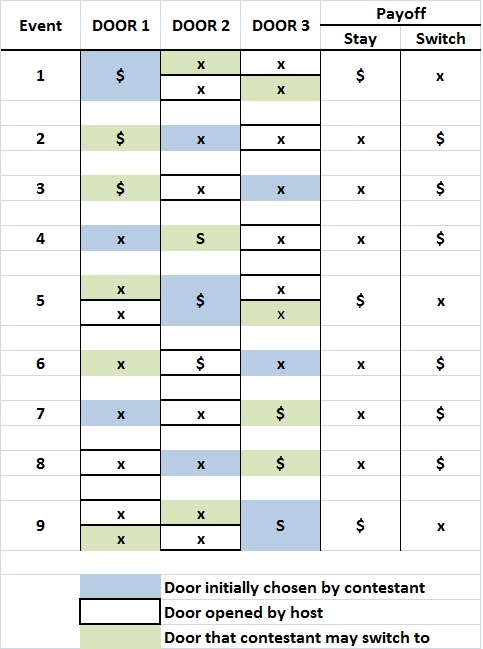
Equally likely outcomes

Events 1, 5, and 9 each have two branches. But those branches don’t count as separate events. They’re simply subsets of the same event; when the contestant chooses a door that hides $, the host must choose between the two doors that hide x, but he can’t open both of them. And his choice doesn’t affect the outcome of the event.

It’s evident that switching would pay off with a win in 2/3 of the possible events; whereas, staying with the original choice would off in only 1/3 of the possible events. The fractions 1/3 and 2/3 are usually referred to as probabilities: a 2/3 probability of winning $ by switching doors, as against a 1/3 probability of winning $ by staying with the initially chosen door.

Accordingly, proponents of the standard solution — who are now legion — advise the individual (theoretical) contestant to switch. The idea is that switching increases one’s chance (probability) of winning.

A CLOSER LOOK AT THE STANDARD SOLUTION

There are three problems with the standard solution:

1. It incorporates a subtle shift in perspective. The Monty Hall problem, as posed, asks what a contestant should do. The standard solution, on the other hand, represents the expected (long-run average) outcome of many events, that is, many plays of the game. For reasons I’ll come to, the outcome of a single game can’t be described by a probability.

2.  Lists of possibilities, such as those in the diagram above, fail to reflect the randomness inherent in real events.

3. Probabilities emerge from many repetitions of the kinds of events listed above. It is meaningless to ascribe a probability to a single event. In case of the Monty Hall problem, many repetitions of the game will yield probabilities approximating those given in the standard solution, but the outcome of each repetition will be unpredictable. It is therefore meaningless to say that a contestant has a 2/3 chance of winning a game if he switches. A 2/3 chance of winning refers to the expected outcome of many repetitions, where the contestant chooses to switch every time. To put it baldly: How does a person win 2/3 of a game? He either wins or doesn’t win.

Regarding points 2 and 3, I turn to Probability, Statistics and Truth (second revised English edition, 1957), by Richard von Mises:

The rational concept of probability, which is the only basis of probability calculus, applies only to problems in which either the same event repeats itself again and again, or a great number of uniform elements are involved at the same time. Using the language of physics, we may say that in order to apply toe theory of probability we must have a practically unlimited sequence of uniform observations. (p. 11)

*     *     *

In games of dice, the individual event is a single throw of the dice from the box and the attribute is the observation of the number of points shown by the dice. In the same of “heads or tails”, each toss of the coin is an individual event, and the side of the coin which is uppermost is the attribute. (p. 11)

*     *     *

We must now introduce a new term…. This term is “the collective”, and it denotes a sequence of uniform events or processes which differ by certain observable attributes…. All the throws of dice made in the course of a game [of many throws] from a collective wherein the attribute of the single event is the number of points thrown…. The definition of probability which we shall give is concerned with ‘the probability of encountering a single attribute [e.g., winning $ rather than x ] in a given collective [a series of attempts to win $ rather than x ]. (pp. 11-12)

*     *     *

[A] collective is a mass phenomenon or a repetitive event, or, simply, a long sequence of observations for which there are sufficient reasons to believe that the relative frequency of the observed attributed would tend to a fixed limit if the observations were indefinitely continued. The limit will be called the probability of the attribute considered within the collective [emphasis in the original]. (p. 15)

*     *     *

The result of each calculation … is always … nothing else but a probability, or, using our general definition, the relative frequency of a certain event in a sufficiently long (theoretically, infinitely long) sequence of observations. The theory of probability can never lead to a definite statement concerning a single event. The only question that it can answer is: what is to be expected in the course of a very long sequence of observations? It is important to note that this statement remains valid also if the calculated probability has one of the two extreme values 1 or 0 [emphasis added]. (p. 33)

To bring the point home, here are the results of 50 runs of the Monty Hall problem, where each result represents (i) a random initial choice between Door 1, Door 2, and Door 3; (ii) a random array of $, x, and x behind the three doors; (iii) the opening of a door (other than the one initially chosen) to reveal an x; and (iv) a decision, in every case, to switch from the initially chosen door to the other unopened door:

Results of 50 games

What’s relevant here isn’t the fraction of times that $ appears, which is 3/5 — slightly less than the theoretical value of 2/3.  Just look at the utter randomness of the results. The first three outcomes yield the “expected” ratio of two wins to one loss, though in the real game show the two winners and one loser would have been different persons. The same goes for any sequence, even the final — highly “improbable” (i.e., random) — string of nine straight wins (which would have accrued to nine different contestants). And who knows what would have happened in games 51, 52, etc.

If a person wants to win 2/3 of the time, he must find a game show that allows him to continue playing the game until he has reached his goal. As I’ve found in my simulations, it could take as many as 10, 20, 70, or 300 games before the cumulative fraction of wins per game converges on 2/3.

That’s what it means to win 2/3 of the time. It’s not possible to win a single game 2/3 of the time, which is the “logic” of the standard solution as it’s usually presented.

WHAT ABOUT THE ALTERNATIVE SOLUTION?

The alternative solution doesn’t offer a winning strategy. In this view of the Monty Hall problem, it doesn’t matter which unopened door a contestant chooses. In effect, the contestant is advised to flip a coin.

As discussed above, the outcome of any particular game is unpredictable, so a coin flip will do just as well as any other way of choosing a door. But randomly selecting an unopened door isn’t a good strategy for repeated plays of the game. Over the long run, random selection means winning about 1/2 of all games, as opposed to 2/3 for the “switch” strategy. (To see that the expected probability of winning through random selection approaches 1/2, return to the earlier diagram; there, you’ll see that $ occurs in 9/18 = 1/2 of the possible outcomes for “stay” and “switch” combined.)

Proponents of the alternative solution overlook the importance of the host’s selection of a door to open. His choice isn’t random. Therein lies the secret of the standard solution — as a long-run strategy.

WHY THE STANDARD SOLUTION WORKS IN THE LONG RUN

It’s commonly said by proponents of the standard solution that when the host opens a door, he gives away information that the contestant can use to increase his chance of winning that game. One nonsensical version of this explanation goes like this:

  • There’s a 2/3 probability that $ is behind one of the two doors not chosen initially by the contestant.
  • When the host opens a door to reveal x, that 2/3 “collapses” onto the other door that wasn’t chosen initially. (Ooh … a “collapsing” probability. How exotic. Just like Schrödinger’s cat.)

Of course, the host’s action gives away nothing in the context of a single game, the outcome of which is unpredictable. The host’s action does help in the long run, if you’re in a position to play or bet on a large number of games. Here’s how:

  • The contestant’s initial choice (IC) will be wrong 2/3 of the time. That is, in 2/3 of a large number of games, the $ will be behind one of the other two doors.
  • Because of the rules of the game, the host must open one of those other two doors (HC1 and HC2); he can’t open IC.
  • When IC hides an x (which happens 2/3 of the time), either HC1 and HC2 must conceal the $; the one that doesn’t conceal the $ conceals an x.
  • The rules require the host to open the door that conceals an x.
  • Therefore, about 2/3 of the time the $ will be behind HC1 or HC2, and in those cases it will always be behind the door (HC1 or HC2) that the host doesn’t open.
  • It follows that the contestant, by consistently switching from IC to the remaining unopened door (HC1 or HC2), will win the $ about 2/3 of the time.

The host’s action transforms the probability — the long-run frequency — of choosing the winning door from 1/2 to 2/3. But it does so if and only if the player or bettor always switches from IC to HC1 or HC2 (whichever one remains unopened).

You can visualize the steps outlined above by looking at the earlier diagram of possible outcomes.

That’s all there is. There isn’t any more.

Election 2014: Food for Thought

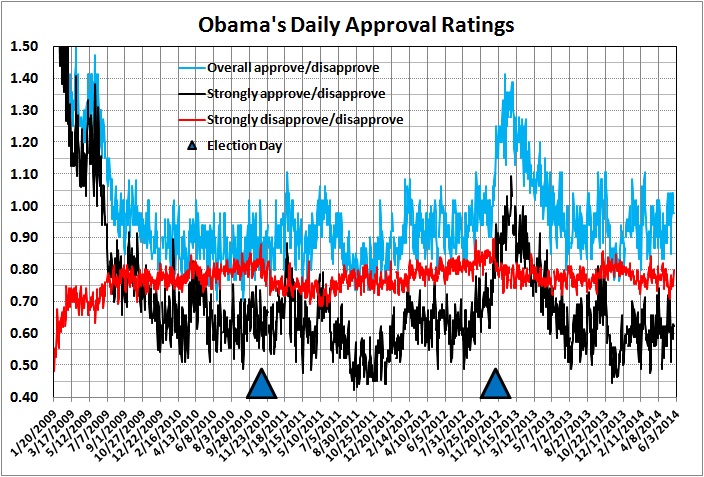
Will the GOP make big gains in the House and Senate this year? It seems to be the conventional wisdom that big gains will be made. But I don’t think it’s going to be quite the cakewalk that many commentators — and too many Republicans — are expecting. Consider the following graph, which I’ll translate and discuss below:

Obama's daily approval ratings_26 May 2014
Derived from Rasmussen Reports, Daily Presidential Tracking Poll.

First, what do the three lines mean?

The blue line represents the number of likely voters approving Obama’s performance divided by number of likely voters disapproving Obama’s performance. A ratio of 1.00 indicates parity — equal sentiment for and against Obama. A ratio below 1.00 means that likely voters, on balance, disapprove of Obama’s performance.

The black line represents the number of voters strongly approving divided by the number of voters strongly disapproving Obama’s performance. The post-reelection bandwagon aside, Obama has been on the wrong side of this crucial ratio since June 29, 2009.

The red line represents the intensity of disapproval. It’s the ratio of strong disapproval to overall disapproval.

In the election of 2010, when the GOP gained 64 House seats and 6 Senate seats, the trends were strongly anti-Obama. His overall approval/disapproval ratio had hovered around 0.9 for months; his strong approval/disapproval ratio had hovered around 0.6 for months; and the intensity of disapproval had been rising for months.

In 2012, when the GOP lost 8 House seats and 2 Senate seats, Obama’s stock had been on the rise for 3 months. It’s true that the strong disapproval/overall disapprove ratio was rising, but I attribute that to a smaller denominator, that is, a shrinking pool of likely voters who disapproved.

Which brings us to 2014. What’s happening now? Obama’s overall approval/disapproval ratio is higher than it was before the 2010 election, which could be a bad sign for the GOP. But — praise be — Obama’s strong approval/disapproval ratio seems to be a bit lower than it was in the runup to the 2010 election. If that ratio climbs, the GOP will have a fight on its hands, unless the “enthusiasm gap” keeps a lot of Democrats home on November 4.

So, in my view, 2014 isn’t guaranteed to be another 2010. And another 2010 is what’s needed if the GOP is to control both the House and Senate. Sure, the GOP can’t come close to a veto-proof majority in the Senate (and probably not in the House, either). But with control of the Senate, the GOP could stymie Obama’s court nominees. And with control of both houses, the GOP would face less pressure to comprise on defense spending, entitlement spending, and immigration — to name three salient issues. A weakened Obama would have less leverage in any showdown over those and other issues.

But to control Congress, the GOP has to hold the House and make big gains in the Senate. And for that to happen, the GOP must win the battle of enthusiasm; that is, it must take full advantage of disenchantment with Obama and his failed policies: the disaster that is Obamacare, the failure to deal with the looming disaster in entitlement spending, the naive reliance on diplomacy to secure national interests, and the high-handed pursuit of a radical social, economic, and environmental agenda.

“The Science Is Settled”

Thales (c. 620 – c. 530 BC): The Earth rests on water.

Aneximenes (c. 540 – c. 475 BC): Everything is made of air.

Heraclitus (c. 540 – c. 450 BC): All is fire.

Empodecles (c. 493 – c. 435 BC): There are four elements: earth, air, fire, and water.

Democritus (c. 460 – c. 370 BC): Atoms (basic elements of nature) come in an infinite variety of shapes and sizes.

Aristotle (384 – 322 BC): Heavy objects must fall faster than light ones. The universe is a series of crystalline spheres that carry the sun, moon, planets, and stars around Earth.

Ptolemey (90 – 168 AD): Ditto the Earth-centric universe,  with a mathematical description.

Copernicus (1473 – 1543): The planets revolve around the sun in perfectly circular orbits.

Brahe (1546 – 1601): The planets revolve around the sun, but the sun and moon revolve around Earth.

Kepler (1573 – 1630): The planets revolve around the sun in elliptical orbits, and their trajectory is governed by magnetism.

Newton (1642 – 1727): The course of the planets around the sun is determined by gravity, which is a force that acts at a distance. Light consists of corpuscles; ordinary matter is made of larger corpuscles. Space and time are absolute and uniform.

Rutherford (1871 – 1937), Bohr (1885 – 1962), and others: The atom has a center (nucleus), which consists of two elemental particles, the neutron and proton.

Einstein (1879 – 1955): The universe is neither expanding nor shrinking.

That’s just a small fraction of the mistaken and incomplete theories that have held sway in the field of physics. There are many more such mistakes and lacunae in the other natural sciences: biology, chemistry, and earth science — each of which, like physics, has many branches. And in all branches there are many unresolved questions. For example, the Standard Model of particle physics, despite its complexity, is known to be incomplete. And it is thought (by some) to be unduly complex; that is, there may be a simpler underlying structure waiting to be discovered.

Given all of this, it is grossly presumptive to claim that climate science is “settled” when the phenomena that it encompasses are so varied, complex, often poorly understood, and often given short shrift (e.g., the effects of solar radiation on the intensity of cosmic radiation reaching Earth, which affects low-level cloud formation, which affects atmospheric temperature and precipitation).

Anyone who says that climate science is “settled” is either ignorant, stupid, or a freighted with a political agenda.

The Passing of Red-Brick Schoolhouses and a Way of Life

My home town once boasted fifteen schoolhouses that were built between the end of the Civil War and 1899. All but the high school were named for presidents of the United States: Adams, Buchanan, Fillmore, Harrison, Jackson, Jefferson, Madison, Monroe, Pierce, Polk, Taylor, Tyler, Van Buren, and Washington. Another of their ilk came along sometime between 1904 and 1915; Lincoln was its name.

With the Adams School counting for two presidents — the second and sixth — there was a school for every president through Lincoln. Why Lincoln came late is a mystery to me. Lincoln was revered by us Northerners, and his picture was displayed proudly next to Washington’s in schools and municipal offices. We even celebrated Lincoln’s Birthday as a holiday distinct from Washington’s Birthday (a.k.a. President’s Day).

More schools — some named for presidents — followed well into the 20th century, but only the fifteen that I’ve named were built in the style of the classic red-brick schoolhouse: two stories, a center hall with imposing staircase, tall windows, steep roof, and often a tower for the bell that the janitor rang to summon neighborhood children to school. (The Lincoln, as a latecomer, was L-shaped rather than boxy, but it was otherwise a classic red-brick schoolhouse, replete with a prominent bell tower.)

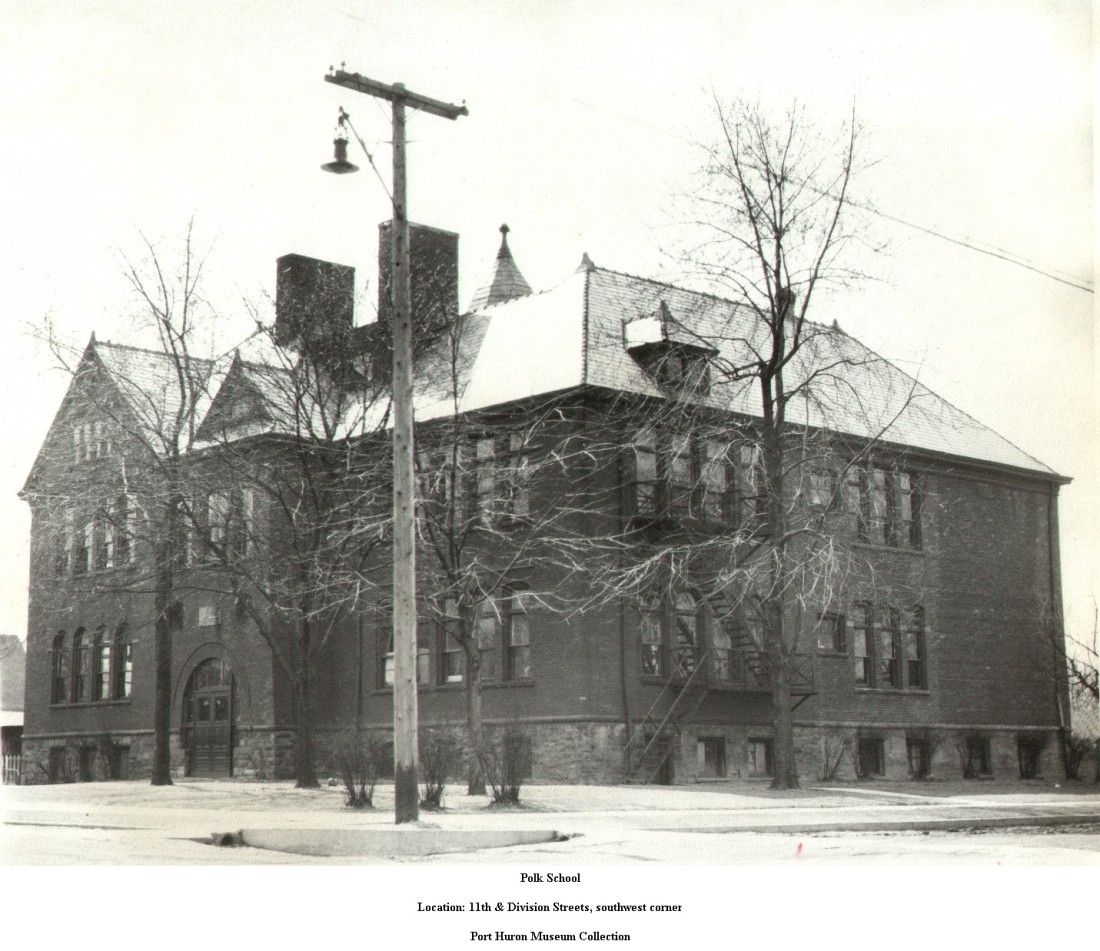
I attended three of the fifteen red-brick schoolhouses. My first was Polk School, where I began kindergarten two days after the formal surrender of Japan on September 2, 1945. (For the benefit of youngsters, that ceremony marked the official end of World War II.)

Here’s the Polk in its heyday:

PolkSch

Kindergarten convened in a ground-floor room at the back of the school, facing what seemed then like a large playground, with room for a softball field. The houses at the far end of the field would have been easy targets for adult players, but it would have been a rare feat for a student to hit one over the fence that separated the playground from the houses.

In those innocent days, students got to school and back home by walking. Here’s the route that I followed as a kindergartener:

Route to Polk School

A kindergartener walking several blocks between home and school, usually alone most of the way? Unheard of today, it seems. But in those days predation was unheard of. And, as a practical matter, most families had only one car, which the working (outside-the-home) parent (then known as the father and head-of-household) used on weekdays for travel to and from his job. Moreover, the exercise of walking as much as a mile each way was considered good for growing children — and it was.

The route between my home and Polk School was 0.6 mile in length, and it crossed one busy street. Along that street were designated crossing points, at which stood Safety Patrol Boys, usually 6th-graders, who ensured that students crossed only when it was safe to do so. They didn’t stand in the street and stop oncoming traffic; they simply judged when students could safely cross, and gave them the “green light” by blowing on a whistle. In the several years of my elementary-school career, I never saw or heard of a close call, let alone an injury or a fatality.

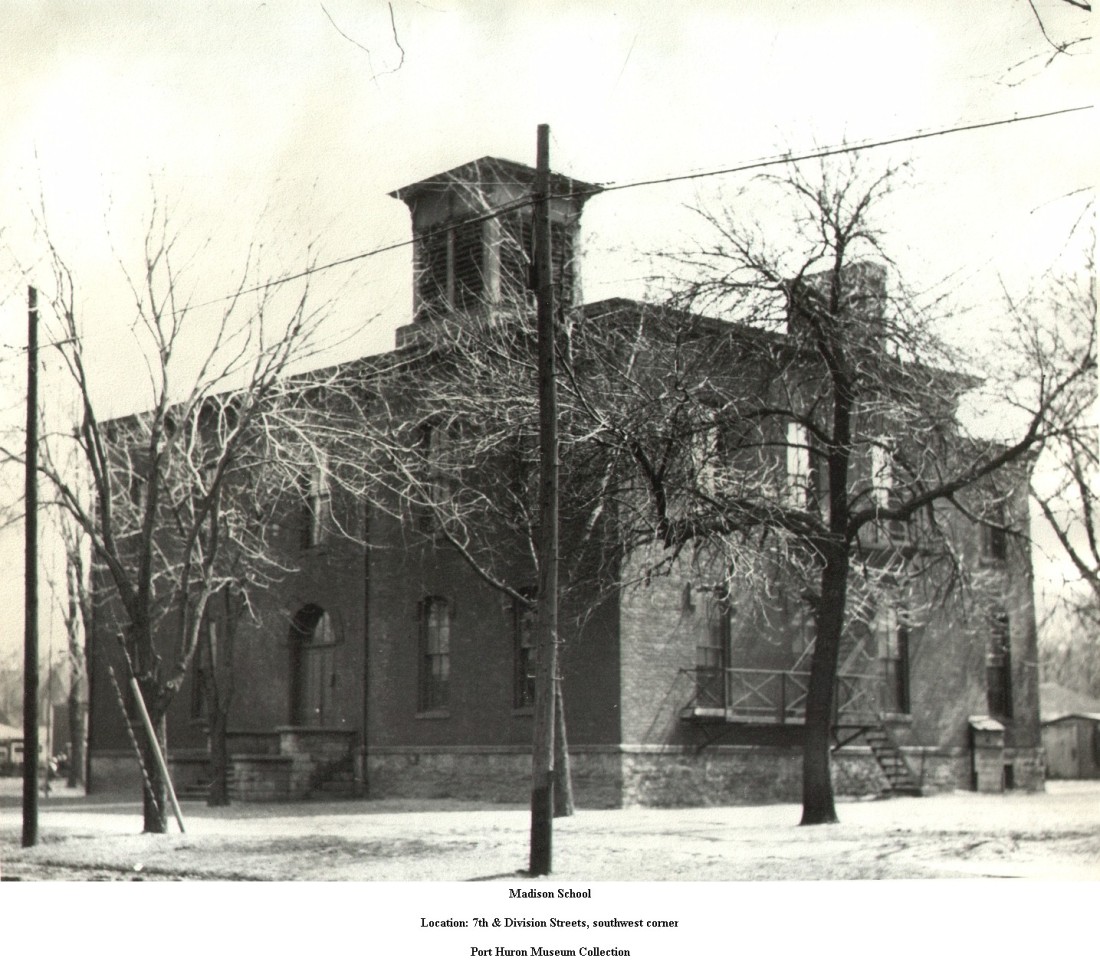
I began at Polk School because the school closest to my home, Madison School, didn’t have kindergarten. I went Madison for 1st grade. It was a gloomy pile:

MadisonSch

Madison was shuttered after my year there, so I returned to Polk for 2nd and 3rd grades. Madison stood empty for a few years, and was razed in the late 1940s or early 1950s. Polk was shuttered sometime in the 1950s, and eventually was razed after being used for many years as a school-district warehouse.

The former site of Madison School now hosts “affordable housing”:

Madison School site

There’s a public playground where Polk School stood:

Polk School site

I spent two more years — 4th and 5th grades — in another red-brick schoolhouse: Tyler School. It’s still there, though it hasn’t been used as a school for many decades. It looked like this in 2006, when it served as a halfway house:

Tyler School_2

It now stands empty and uncared for. It looked like this in 2013:

Tyler School 2013

The only other survivor among the fifteen red-brick schoolhouses is Monroe School, the present use of which I can’t ascertain. It seems to have been cared for, however. This image is from 2013:

Monroe School 2013

Tyler and Monroe Schools are ghosts from America’s past — a past that’s now seemingly irretrievable. It was a time of innocence, when America’s wars were fought to victory; when children could safely roam (large cities excepted, as always, from prevailing mores); when marriage was between man and woman, and usually for life; when deviant behavior was discouraged, not “celebrated”; when a high-school diploma and four-year degree meant something, and were worth something; when the state wasn’t the enemy of the church; when politics didn’t intrude into science; when people resorted to government in desperation, not out of habit; and when people had real friends, not Facebook “friends.”

Social Accounting: A Tool of Social Engineering

Steven Landsburg writes about social accounting here and here. In the first-linked post, Landsburg says:

Economic theory tells us that under quite general hypotheses, the private value of an activity is in synch with its social value. If growing an orange makes you a dollar richer, that’s because growing that orange makes the world a dollar richer. And that’s good, because it encourages people to grow all and only those oranges that are (socially) worth growing.

Here’s my version of the “general hypotheses”: People engage in voluntary exchange if it benefits them. The buyers of an orange is willing to pay the grower $1 for the orange because the benefit derived from the orange is worth (at least) $1 to the  buyer. At the same time, the grower is willing to sell oranges for $1 apiece because he expects (at least) to cover his costs if he sells oranges at that price. (His costs include the interest that he could have earned had he put his money into, say, an equally risky corporate bond instead of land, trees, and equipment.)

Now comes the hard part, which Landsburg skips. Does growing an orange and selling it for $1 really make the world a dollar richer? The buyer of the orange is “richer” (i.e., better off) only to the extent that the enjoyment/satisfaction/utility he derives from the orange is greater than the enjoyment/satisfaction/utility that he would have derived from an alternative use of his dollar. The alternatives include giving away the dollar, buying something other than an orange (maybe something less expensive that yields the buyer as much or more enjoyment/satisfaction/utility), and saving the dollar, that is, making it available for investment in, say, an orange grove.

It may be convenient to add the dollar values of final transactions and call the resulting number GDP (or GWP, gross world product). But adding $1 to GDP doesn’t mean that the world (or the U.S.) is $1 richer for it, even in the scenario described by Landsburg. For one thing, there’s no common denominator for enjoyment/satisfaction/utility, which are personal matters. For a second thing, the marginal gain in enjoyment/satisfaction/utility — the difference between first-best (buying an orange for $1) and second-best (e.g., saving $1) — is also a personal matter without a common denominator. (What’s more, there are many scenarios in which the addition of $1 to GDP makes the world poorer; for example: government entices workers into government service by offering above-market compensation, and then has those workers produce economy-stultifying regulations.)

As for the essential meaninglessness of GDP as a measure of anything, I borrow from an old post of mine:

Consider A and B, who discover that, together, they can have more clothing and more food if each specializes: A in the manufacture of clothing, B in the production of food. Through voluntary exchange and bargaining, they find a jointly satisfactory balance of production and consumption. A makes enough clothing to cover himself adequately, to keep some clothing on hand for emergencies, and to trade the balance to B for food. B does likewise with food. Both balance their production and consumption decisions against other considerations (e.g., the desire for leisure).

A and B’s respective decisions and actions are microeconomic; the sum of their decisions, macroeconomic. The microeconomic picture might look like this:

  • A produces 10 units of clothing a week, 5 of which he trades to B for 5 units of food a week, 4 of which he uses each week, and 1 of which he saves for an emergency.
  • B, like A, uses 4 units of clothing each week and saves 1 for an emergency.
  • B produces 10 units of food a week, 5 of which she trades to A for 5 units of clothing a week, 4 of which she consumes each week, and 1 of which she saves for an emergency.
  • A, like B, consumes 4 units of food each week and saves 1 for an emergency.

Given the microeconomic picture, it is trivial to depict the macroeconomic situation:

  • Gross weekly output = 10 units of clothing and 10 units of food
  • Weekly consumption = 8 units of clothing and 8 units of food
  • Weekly saving = 2 units of clothing and 2 units of food

You will note that the macroeconomic metrics add no useful information; they merely summarize the salient facts of A and B’s economic lives — though not the essential facts of their lives, which include (but are far from limited to) the degree of satisfaction that A and B derive from their consumption of food and clothing.

The customary way of getting around the aggregation problem is to sum the dollar values of microeconomic activity. But this simply masks the aggregation problem by assuming that it is possible to add the marginal valuations (i.e., prices) of disparate products and services being bought and sold at disparate moments in time by disparate individuals and firms for disparate purposes. One might as well add two bananas to two apples and call the result four bapples.

The essential problem is that A and B will derive different kinds and amounts of enjoyment from clothing and food, and that those different kinds and amounts of enjoyment cannot be summed in any meaningful way. If meaningful aggregation is impossible for A and B, how can it be possible for an economy that consists of millions of economic actors and an untold variety of goods and services? And how is it possible when technological change yields results such as this?

GDP, in other words, is nothing more than what it seems to be on the surface: an estimate of the dollar value of economic output. It is not a measure of “social welfare” because there is no such thing.

And yet, Landsburg (among many economists) seems to believe that it’s possible to measure “social welfare,” that is, to measure how much “richer” the world is because of voluntary exchange. (I wouldn’t think of accusing Landsburg or any other economist — Paul Krugman and Brad DeLong excepted — of equating government spending and “social welfare.”)

This isn’t a first for Landsburg. About four years ago he wrote this:

Suppose you live next door to Bill Gates. Bill likes to play loud music at night. You’re a light sleeper. Should he be forced to turn down the volume?

An efficiency analysis would begin, in principle (though it might not be so easy in practice) by asking how much Bill’s music is worth to him (let’s say we somehow know that the answer is $10,000) and how much your sleep is worth to you (let’s say $25). It is important to realize from the outset that no economist thinks those numbers in any way measure Bill’s subjective enjoyment of his music or your subjective annoyance. Only a crazy person would think such a thing, and I’ve never met anybody who’s that crazy in that particular way. Instead, these numbers primarily reflect the fact that Bill is a whole lot richer than you are. Nevertheless, the economist will surely declare it inefficient to take $10,000 worth of enjoyment from Bill in order to give you $25 worth of sleep. We call that a $9,975 deadweight loss.

Landsburg properly denies the commensurability of the two experiences, and then turns around and declares them commensurate. My comment, at the time:

The problem with this kind of thinking should be obvious to anyone with the sense God gave a goose. The value of Bill’s enjoyment of loud music and the value of “your” enjoyment of sleep, whatever they may be, are irrelevant because they are incommensurate. They are separate, variably subjective entities. Bill’s enjoyment (at a moment in time) is Bill’s enjoyment. “Your” enjoyment (at a moment in time) is your enjoyment. There is no way to add, subtract, divide, or multiply the value of those two separate, variably subjective things. Therefore, there is no such thing (in this context) as a deadweight loss because there is no such thing as “social welfare” — a summation of the state of individuals’ enjoyment (or utility, as some would have it).

Prices serve the useful purpose of helping individual persons and firms to move toward maximum utility and maximum profits. (I say “move toward” because the vagaries of life seldom accommodate the attainment of nirvana.) Prices do not — do not — enable the attainment of “efficiency,” that is, the maximization of “social welfare.” They cannot because there is no such thing.

Only a dedicated social engineer could believe that it’s possible to sum degrees of happiness across individuals, or claim that a public project is justified because the costs (imposed on one set of persons) exceed the benefits (enjoyed by a mostly different set of persons).

*     *      *

Related posts:
Socialist Calculation and the Turing Test
Income and Diminishing Marginal Utility
Greed, Cosmic Justice, and Social Welfare
Positive Rights and Cosmic Justice
Utilitarianism, ‘Liberalism,’ and Omniscience
Utilitarianism vs. Liberty
Accountants of the Soul
Rawls Meets Bentham
The Case of the Purblind Economist
Enough of ‘Social Welfare’
Macroeconomics and Microeconomics
Social Justice
Positive Liberty vs. Liberty
More Social Justice
Luck Egalitarianism and Moral Luck
Utilitarianism and Psychopathy

Flummoxed by Firefox 29?

SEE UPDATES AT BOTTOM OF POST

I recently — and unhappily — updated to Firefox 29, which is yet another in a long string of software-engineer-friendly “upgrades” by the boys and girls at Mozilla. Now, I have to admit that Firefox, on the whole, is a more user-friendly browser than the several others that I’ve tried: Comodo Dragon, Google Chrome, Internet Explorer, Opera, and Safari — each of which has a serious-to-fatal flaw (e.g., vulnerable to malware, hard to customize, can’t open groups of tabs, can’t import bookmarks).

But being user-friendly is a relative thing, and Firefox seems bent on joining the ranks of its less-friendly peers. Firefox 29, for example, incorporates the page-reload button in the navigation bar (the place where a site’s URL appears). That’s neither a convenient nor intuitive place for the page-reload button. It’s true that one can reload a tab by right-clicking the tab and selecting “Reload Tab” from the pop-up menu. But it’s actually easier to point one’s mouse at a reload button that’s located in a fixed position that’s close to the tab strip — usually on the left.

Speaking of the tab strip, why have tabs if you can’t see them? I exaggerate, but just a bit. In the default mode of Firefox 29, tabs (other than the one that’s currently open) are almost invisible. Navigating from tab to tab involves a lot of squinting. The tabless look may be aesthetic, but it’s worse than useless.

I will say that other than the fixed position of the reload button — which is immovable, even after installing the Classic Theme Restorer add-on — Firefox 29 is more readily customizable than its predecessors. (One exception: It takes some Googling to learn how to put the tab strip back where it belongs, which is just above the page, not at the top of the screen.) But why “upgrade” Firefox to a “look” that many users will immediately try to customize to something more useful? Many (most?) Firefox users cut their teeth on earlier versions of Firefox, and they grew used to the “look” and “feel” of those earlier versions.

What’s wrong with that? Everything, apparently, if you’re a software engineer with fascistic tendencies. Consider this thread from the Firefox non-support forum:

Can I go back to Firefox 28. I have Firefox 29 now. I don’t like it.

Posted
4/29/14 6:36 AM

I want Firefox 28 back. How do I do that?

Chosen solution

Since the original question was Can I go back to Firefox 28, I don’t see how my response constitutes a hijacking. Everything else in your post is lawyer-speak.

Read this answer in context 0

Moses

  • Top 10 Contributor
  • Moderator

198 solutions 1862 answers

Hi,

Is there a particular reason you want to go back to 28? If this is about the new user interface looks then you can restore the way Firefox acted and looked with this add-on

OldRogue 0 solutions 4 answers

Why can’t someone answer the question asked? How do you download version 28 and revert to before 29. Classic Theme Restorer goes about 10% of the way to making FF useful again. Specifically, what needs to be remove from my Profile to get it back.

Moses

  • Top 10 Contributor
  • Moderator

198 solutions 1862 answers

Hi OldRogue,

1) We don’t link to old Firefox versions simply because of the latest version’s bug fixes/security patches, etc.
2) See #1 and We don’t HAVE to link to version 28. I’m pretty sure you’re capable of finding a little download link yourself.
3) You should create your own thread as you’re technically hijacking another person’s thread. Please create a new one at /questions/new

OldRogue 0 solutions 4 answers

Chosen Solution

Since the original question was Can I go back to Firefox 28, I don’t see how my response constitutes a hijacking. Everything else in your post is lawyer-speak.

Modified April 30, 2014 11:00:48 AM PDT by OldRogue

Moses

  • Top 10 Contributor
  • Moderator

198 solutions 1862 answers

I’m not going to argue with you and waste my time. I’m just going to say this:

  • From the Forum rules and guidelines For support requests, do not re-use existing threads started by others, even if they are seemingly on the same subject.

I’m not a Mozilla developer or employee so my “lawyer-speak” is all my words. I don’t work for Mozilla in case you haven’t noticed.

Also, to the OP, I’ve already answered their question. They can find the download link on their own. Takes maybe 2 minutes to find it…literally. But just in case someone doesn’t want to take their time and look for it, here it is:

Thread closed as I’ve given the download link!

Modified April 30, 2014 11:22:34 AM PDT by Moses

He may be Moses the lawgiver — with a vengeance — but he’s not the Moses that you want in charge when you’re looking for the promised land of browserdom. What a jerk!

Moses’s protestations to the contrary notwithstanding, he was being legalistic and OldRogue wasn’t hijacking the thread. How “big” of Moses to finally answer the original question. If he’d done that in the first place, he wouldn’t have revealed himself as a first-class a**hole.

Anyway, there’s your answer. If Mozilla slips in a new version of Firefox while you’re not looking, install an earlier version. In fact, take your pick from all of the earlier versions at the Index of pub/mozilla.org/firefox/releases/. If you happen upon a page that leads you to the Index, you’ll probably see something like this: “Warning: Using old versions of Firefox poses a significant security risk.”

Yeah, well, thanks for the warning. But I keep my firewall turned on, and I have a good anti-malware program (Malwarebytes Anti-Malware), and you should, too. When a version of Firefox gets too old, it stops working properly, which is a good sign that you should upgrade to a newer version, though not the newest one.

One last, important thing. Don’t let Mozilla slip in a new version of Firefox while you’re not looking. Go to “Tools” in the menu bar of Firefox (which I display for ease of use, despite Mozilla’s attempt to hide it), select Options, select the “Update” tab, and then choose either “Check for updates, but let me choose when to install them” or “Never check for updates.” If you choose “Check for updates,” read about an update before you install it — look especially for information about the ability to customize the new version. Don’t rely on Mozilla’s pitch; look for reviews on sites that specialize in computing and internet matters (e.g., PCMag.com and C|Net). And look especially for independent reviews of the kind you can find with a search engine; the lone-wolf reviewer is more likely to be critical than the establishment press.

By the way, I tried Firefox 29 on a gamble, and lost. I then rolled back to Firefox 28, which I had already tweaked to my taste.

Happy browsing.

UPDATE (05/07/14)

A reader kindly pointed me to Pale Moon, a Mozilla-based browser that works like Firefox used to. I’m now using Pale Moon, and loving it. (If I encounter glitches, I’ll add updates to this post.)

Why would I (or anyone) want a browser that works just like Firefox, but isn’t Firefox? Well, here’s one reason: the ousting of Mozilla CEO Brendan Eich for having made a donation to the Proposition 8 campaign in California. (See my post, “Surrender? Hell No!” and the articles I link to at the end of the post.)

And what does that have to do with Pale Moon? This from Pale Moon’s FAQ (as of today):

Will Firefox and Pale Moon work together in the future?

Since Mozilla has obviously chosen to follow a different path at the management level, it doesn’t seem likely that Pale Moon and Firefox will ever see a unification or joining of forces….


Read between the lines.

Nor is Pale Moon a mere copy of Firefox. This is from the same FAQ entry:

[T]here have been and are growing conflicts of interests between Pale Moon and Firefox as far as the so-called UX (User eXperience) developments are concerned. This results in a different user interface approach in Pale Moon. For example, less stress is put on minimizing the size of UI elements or saving every pixel possible to benefit the content area – in this day and age of full HD monitors and laptops that seems to be very counter-intuitive. Australis is considered unacceptable, and will not be aimed for – quite the opposite.

In other words, Australis-based Firefox 29 is a step in the wrong direction if you care about users. (Right on!) And Pale Moon isn’t going in that direction. Indeed, when I say that Pale Moon works like Firefox used to, I mean that it works like Firefox 28, to which I had returned after uninstalling Firefox 29.

If you want to try Pale Moon, you can download it here. If you’re currently a Firefox user and want to import your Firefox profile to Pale Moon, select the “don’t import anything” option at the end of the installation. There’s a separate tool for importing Firefox profiles, which you can download here. I used the tool, and it worked perfectly.

Happier browsing.

UPDATE (05/08/14)

My transition from Firefox 28 to Pale Moon has been seamless, as they say. So seamless, in fact, that I’ve made Pale Moon my default browser and unpinned Firefox from my Windows task bar. At this point I can’t see a reason to return to Firefox.

My next step will be to switch from Mozilla Thunderbird to Pale Moon’s FossaMail.

UPDATE (05/12/14)

I am now using FossaMail. After some unsuccessful attempts to copy my Thunderbird profile into Fossamail, I found a migration tool that works perfectly. During the migration, you might get a message saying that a script is taking longer than expected to run. If you do, select “continue” and let it run; it won’t take much longer for the tool to finish the job.

When you’re alerted that migration is complete, FossaMail may not respond immediately. The migration seems to continue in the background. Wait a few minutes, then try to open FossaMail. If your experience is like mine, when FossaMail opens it will contain an exact duplicate of your Thunderbird folders and messages.

Bye-bye, Mozilla.

A Guide to the Pronunciation of General American English

This post, originally published as “Phonetic Spelling: A Modest Proposal,” is drastically different from the original. I am indebted to commenter Jim Hlavac for his criticisms, which are reflected in this version of the post. In the course of revising the post, I made extensive changes to the pronunciation key. As before, comments about this work in progress are welcome.

When you’re in doubt about how to pronounce a word in American English, you may consult a source that relies on the International Phonetic Alphabet (IPA). The IPA is cumbersome, to say the least. It requires one to distinguish among dozens of tiny symbols, and then decode them by going to a rather busy page full of symbols and their translations.

Standard phonetic symbols for American English — the symbols we were supposed to learn in high school — aren’t much better. For example, go to The Free Dictionary and look up phonetic → fə-nĕt′ĭk,. Not only is the schwa (ə, an “uh” sound) incorrect (in my view), but to grasp the pronunciation of the word, you must still turn to a separate pronunciation key.

A proper guide to the pronunciation of American English should enable anyone who speaks or understands General American to grasp the proper (or generally accepted) pronunciation of a word simply by looking at a phonetic spelling that consists entirely of letters (e.g., word → werd, refuel → re-few-uhl). And the relationship between the phonetic spellings and the sounds that they represent should be intuitively obvious — again, if you speak or understand General American.

I emphasize General American (GA) for two reasons. First, GA — in the guise of “television English” — is heard across the country, not just in the Midwest and areas where similar accents dominate (e.g., the Great Plains and West Coast). Second, because most Americans understand “television English” (even if many of them don’t speak it), a guide that is keyed to GA should be useful to (almost) everyone.

In the rest of this post, I propose and demonstrate the application of a pronunciation guide that is based on GA, as I understand it. The guide comprises 50 sounds, which is five more sounds than are given in a standard guide (e.g., here). I’ve added several sounds that the standard guide merges with dissimilar sounds. And I’ve merged (or dropped) a few sounds that the standard guide mistakenly or unnecessarily lists as separate sounds.

In any event, the guide that I propose consists entirely letters of the alphabet. It is therefore more accessible than guides that rely heavily on symbols.

Here is the key, which for ease of use omits syllabic emphasis:

Phonetic pronunciation key

As noted, the key omits syllabic emphasis. In the following spellings of the 100 most commonly spoken words in English, I indicate emphasis with CAPS:

Phonetic spellings of 100 most common words

And here are ten words chosen from a list of 100 elegant words:

Phonetic spelllings of 10 elegant words

The Obama Effect: Disguised Unemployment

REVISED AND UPDATED 12/02/16 — A COMPANION PIECE TO “ECONOMIC GROWTH SINCE WORLD WAR II” (REVISED AND UPDATED 05/31/16)

By the measure of real unemployment, the Great Recession is still with us. Nor is it likely to end anytime soon, given the anti-business and anti-growth policies and rhetoric of the Obama administration.

Officially, the unemployment rate stands at 4.6 percent, as of November 2016. Unofficially — but in reality — the unemployment rate stands 6.6 percentage points higher at 11.2 percent. While the official unemployment rate has dropped by 5.4 percentage points from its peak in 2009, the real unemployment rate has dropped by only 2.3 percentage points since then.

No amount of “stimulus” or “quantitative easing” will create jobs when employers and entrepreneurs are loath to take the risk of expanding and starting businesses, given Obama’s penchant for regulating against success and taxing it when it is achieved. The job-killing effects of Obamacare will only worsen the situation. And, of course, taxing “the rich” is a sure way to hamper economic growth by stifling productive effort, innovation, and investment.

How can I say that the real unemployment rate is 6.6 percentage points above the real rate? Easily. Just follow this trail of definitions, provided by the official purveyor of unemployment statistics, the Bureau of Labor Statistics:

Unemployed persons (Current Population Survey)
Persons aged 16 years and older who had no employment during the reference week, were available for work, except for temporary illness, and had made specific efforts to find employment sometime during the 4-week period ending with the reference week. Persons who were waiting to be recalled to a job from which they had been laid off need not have been looking for work to be classified as unemployed.

Unemployment rate
The unemployment rate represents the number unemployed as a percent of the labor force.

Labor force (Current Population Survey)
The labor force includes all persons classified as employed or unemployed in accordance with the definitions contained in this glossary.

Labor force participation rate
The labor force as a percent of the civilian noninstitutional population.

Civilian noninstitutional population (Current Population Survey)
Included are persons 16 years of age and older residing in the 50 States and the District of Columbia who are not inmates of institutions (for example, penal and mental facilities, homes for the aged), and who are not on active duty in the Armed Forces.

In short, if you are 16 years of age and older, not confined to an institution or on active duty in the armed forces, but have not recently made specific efforts to find employment, you are not (officially) a member of the labor force. And if you are not (officially) a member of the labor force because you have given up looking for work, you are not (officially) unemployed — according to the BLS. Of course, you are really unemployed, but your unemployment is well disguised by the BLS’s contorted definition of unemployment.

What has happened is this: Since the first four months of 2000, when the labor-force participation rate peaked at 67.3 percent, it has declined to 62.7 percent:

labor-force-participation-rate
Source: See next graph.

Why the decline, which had came to a halt during G.W. Bush’s second term but resumed in late 2008? The slowdown of 2000 (coincident with the bursting of the dot-com bubble) and the shock of 9/11 can account for the decline from 2000 to 2004, as workers chose to withdraw from the labor force when faced with dimmer employment prospects. But what about the sharper decline that began near the end of Bush’s second term?

There we see not only the demoralizing effects of the Great Recession but also the lure of incentives to refrain from work, namely, extended unemployment benefits, the relaxation of welfare rules, the aggressive distribution of food stamps, and “free” healthcare” for an expanded Medicaid enrollment base and 20-somethings who live in their parents’ basements.* Need I add that both the prolongation of the Great Recession and the enticements to refrain from work are Obama’s doing? (That’s on the supply side. On the demand side, of course, there are the phony and even negative effects of “stimulus” spending, the chilling effects of regime uncertainty, which has persisted beyond the official end of the Great Recession, and the expansion of government spending.)

If the labor-force participation rate had remained at its peak of 67.3 percent, so that the disguised unemployed was no longer disguised, the official unemployment rate would have reached 13.5 percent in December 2009, as against the nominal peak of 10 percent in October 2009. Further, instead of declining to the phony rate of 4.6 percent in November 2016, the official unemployment rate would have stayed almost constant — hovering between 11 percent and 13.5 percent.

The growing disparity between the real and nominal unemployment rates is evident in this graph:

actual-vs-nominal-unemployment-rate
Derived from Series LNS12000000, Seasonally Adjusted Employment Level; Series LNS11000000, Seasonally Adjusted Civilian Labor Force Level; and Series LNS11300000, Seasonally Adjusted Civilian labor force participation rate. All are available at BLS, Labor Force Statistics from the Current Population Survey.

_________
* Contrary to some speculation, the labor-force participation rate is not declining because older workers are retiring earlier. The participation rate among workers 55 and older rose steadily from 1994 to 2014. The decline is concentrated among workers under the age of 55, and especially workers in the 16-24 age bracket. (See this table at BLS.gov.) Why? My conjecture: The Great Recession caused a shakeout of marginal (low-skill) workers, many of whom simply dropped out of the labor market. And it became easier for them to drop out because, under Obamacare, many of them became eligible for Medicaid and many others enjoy prolonged coverage (until age 26) under their parents’ health plans.

Signature

*     *     *

Related reading:

Randall Holcombe, “Long-Term Unemployment Benefits Expire; Long-Term Unemployment Falls,” Mises Economics Blog, September 10, 2014

Arnold Kling, “The State of the Economy,” askblog, October 12, 2014

Stephen Moore, “Why Are So Many Employers Unable to Fill Jobs?The Daily Signal, April 6, 2015

Related posts: See the list here.

Obamanomics: A Report Card

See this post.

Wrong for the Wrong Reasons

When in search of provocative material, I often flip through the pages of The Great Quotations — a left-slanted tome compiled by the late and long-lived George Seldes. Today, I came across this:

Overthrow of the Government by force and violence is certainly a substantial enough interest for the Government to limit speech. Indeed, this is the ultimate value of any society, for if a society cannot protect its very structure from armed internal attack, it must follow that no subordinate value can be protected.

That’s from Chief Justice Fred M. Vinson’s majority opinion in Dennis v. United States (1951). Here’s an outline of the case and its aftermath, as given at Wikipedia:

In 1948, eleven Communist Party leaders were convicted of advocating the violent overthrow of the U.S. government and for the violation of several points of the Smith Act. The party members who had been petitioning for socialist reforms claimed that the act violated their First Amendment rights to freedom of speech and that they served no clear and present danger to the nation….

[In the original trial] Prosecutor John McGohey did not assert that the defendants had a specific plan to violently overthrow the U.S. government, but rather alleged that the CPUSA’s philosophy generally advocated the violent overthrow of governments.[7] To prove this, the prosecution proffered articles, pamphlets and books (such as The Communist Manifesto) written by authors such as Karl Marx and Joseph Stalin.[8] The prosecution argued that the texts advocated violent revolution, and that by adopting the texts as their political foundation, the defendants were also personally guilty of advocating violent overthrow of the government.[9]

Petitioners were found guilty by the trial court and the decision was affirmed by the Second Circuit Court of Appeals. The Supreme Court granted writ of certiorari, but limited it to whether section two or three of the Smith Act violated the First Amendment and whether the same two sections violated the First and Fifth Amendments because of indefiniteness….

Handed down as a 6-2 decision by the Court on June 4, 1951, the judgment and a plurality opinion was delivered by Chief Justice of the United States Fred M. Vinson, who was joined by Justices Stanley Forman Reed, Sherman Minton, and Harold H. Burton. Separate concurring opinions were delivered by Justices Felix Frankfurter and Robert H. Jackson. Justices Hugo Black and William O. Douglas wrote separate dissenting opinions. Justice Tom C. Clark did not participate in this case.

The Court rule affirmed the conviction of the petitioner, a leader of the Communist Party in the United States. Dennis had been convicted of conspiring and organizing for the overthrow and destruction of the United States government by force and violence under provisions of the Smith Act. In affirming the conviction, a plurality of the Court adopted Judge Learned Hand’s formulation of the clear and probable danger test, an adaptation of the clear and present danger test:

In each case [courts] must ask whether the gravity of the “evil,” discounted by its improbability, justifies such invasion of free speech as necessary to avoid the danger….

[I]n 1969, Brandenburg v. Ohio held that “mere advocacy” of violence was per se protected speech. Brandenburg was a de facto overruling of Dennis, defining the bar for constitutionally unprotected speech to be incitement to “imminent lawless action”.[20]

This is from Wikipedia‘s account of Brandenburg v. Ohio:

The Court held that government cannot punish inflammatory speech unless that speech is directed to inciting, and is likely to incite, imminent lawless action.[1]

Brandenburg completely did away with Denniss central holding and held that “mere advocacy” of any doctrine, including one that assumed the necessity of violence or law violation, was per se protected speech.

And this is from the final paragraph of the Court’s ruling in Brandenburg:

[W]e are here confronted with a statute which, by its own words and as applied, purports to punish mere advocacy and to forbid, on pain of criminal punishment, assembly with others merely to advocate the described type of action. 4 Such a statute falls within the condemnation of the First and Fourteenth Amendments.

So, in effect (though not in so many words), the Brandenburg Court found the Dennis Court to be wrong. Not wrong about the wrongness of overthrowing the government, just wrong about when the wrongness may be prosecuted. The Dennis Court was prematurely protective.

To put it another way, it’s all right to advocate wrong-doing, as long as the advocacy doesn’t lead directly to the wrong-doing.

Well, the Dennis Court may have been wrong, but not for the reason cited by the Brandenburg Court, which is also wrong. Why? Because it invites endless hair-splitting about the point at which advocacy translates to action. If the action being advocated is wrong, isn’t it also wrong — constitutional niceties aside — to advocate the action? I’m certainly not advocating thought-crime prosecution, but I am not satisfied with the Brandenburg Court’s conclusion.

If the purpose of the United States, as originally constituted, was to foster liberty, why should the government of the United States tolerate the promulgation of anti-libertarian views? Freedom of speech, after all, is just one manifestation of liberty. And that manifestation could vanish, with the rest, under an anti-libertarian regime.

Here’s the counter-argument: If government is allowed to suppress speech that promulgates the overthrow of America’s constitutional values in favor of anti-libertarian ones (e.g., communism), couldn’t the government then suppress speech that might have a tenuous connection with the idea of overthrowing America’s constitutional values? Government could, for example, suppress speech that proposes the establishment of a socialistic scheme that isn’t contemplated in the Constitution, such as Social Security. And if government could suppress speech of that kind, it could also suppress speech aimed at amending the Constitution to legalize socialistic schemes.

That wouldn’t be so bad, but the power to suppress speech is easily adapted to anti-libertarian uses. Untoward speech and thoughts about “protected groups” could be outlawed. Oops! Such speech and thoughts have been outlawed. “Hate thoughts” may be inferred as the unspoken motivation for a crime, given the personal characteristics of the (supposed) victim of the crime.

By now, you may have concluded that the problem isn’t the Constitution, it’s government. Or, more concretely, the persons and groups who are able to command the power of government. No piece of paper can protect liberty from the anti-libertarian machinations of government officials and the voting blocs to which they are beholden.

Which brings me back to the quotation at the beginning of this post, Chief Justice Vinson’s muddled rationale for the Supreme Court’s holding in Dennis v. United States:

Overthrow of the Government by force and violence is certainly a substantial enough interest for the Government to limit speech. Indeed, this is the ultimate value of any society, for if a society cannot protect its very structure from armed internal attack, it must follow that no subordinate value can be protected.

Government is not society. Nor does the United States comprise a single society, but rather multitudes of societies and interest groups: some desirous of liberty, others desirous of domination. The latter have prevailed, and have come to dominate those that desire liberty. Accordingly, “subordinate” values (e.g., free speech, property rights, and freedom of association) have not been protected by government.

Government, as it now stands, is unworthy of protection by the friends of liberty. In fact, it is (or should be) in need of protection from the friends of liberty. And may they prevail.

*     *     *

Related posts:
An Agenda for the Supreme Court
Liberals and the Rule of Law
The Slippery Slope of Constitutional Revisionism
A Hypothetical Question
The Real Constitution and Civil Disobedience
A Declaration of Independence
First Principles
Zones of Liberty
The Constitution: Original Meaning, Corruption, and Restoration
A Declaration of Civil Disobedience
Rethinking the Constitution: “Freedom of Speech, and of the Press”
Society and the State
Our Perfect, Perfect Constitution
Reclaiming Liberty throughout the Land
A New Constitution for a New Republic
Restoring Constitutional Government: The Way Ahead
“We the People” and Big Government
How Libertarians Ought to Think about the Constitution

Libertarianism and the State

The version of libertarianism that I address here is minarchism: the belief that the state — whether necessary or inevitable — is legitimate only if its functions are limited to the defense of its citizens from foreign and domestic predators. Anarchism — an extreme form of libertarianism — is a pipe dream, for reasons I detail in several posts; e.g., here.

Under minarchism, the order that is necessary to liberty — peaceful, willing coexistence and its concomitant: beneficially cooperative behavior — is fostered by the institutions of civil society: family, church, club, and the like. Those institutions inculcate morality and enforce it through “social pressure.” The state (ideally) deals only with those persons who violate fundamental canons of behavior toward other persons (e.g., the last six of the Ten Commandments), and also defends the populace from foreign enemies.

Though America is a long way from minarchism, something like it was possible under the Articles of Confederation and in the early decades under the Constitution, when the central government was relatively unobtrusive and most legal constraints on human action were levied by State and local governments. In those conditions, Americans could rid themselves of unwanted social and legal strictures by leaving one State for another or venturing into the relatively ungoverned frontier territories.

Having defined libertarianism (for the purpose of this post), I will now state the surprising conclusion to which I have come: Its adherents are unwitting statists.

Obviously, you will expect — and get — an explanation of that startling statement. I’ll begin with the central tenet of mainstream libertarianism: Individual persons may not be coerced by anyone — state or society — except as their actions may cause harm to others.

That seems like a reasonable position, until you ask what “harm” means. Here’s the author of the harm principle, John Stuart Mill:

[N]either one person, nor any number of persons, is warranted in saying to another human creature of ripe years, that he shall not do with his life for his own benefit what he chooses to do with it. He is the person most interested in his own well-being: the interest which any other person, except in cases of strong personal attachment, can have in it, is trifling, compared with that which he himself has; the interest which society has in him individually (except as to his conduct to others) is fractional, and altogether indirect: while, with respect to his own feelings and circumstances, the most ordinary man or woman has means of knowledge immeasurably surpassing those that can be possessed by any one else. The interference of society to overrule his judgment and purposes in what only regards himself, must be grounded on general presumptions; which may be altogether wrong, and even if right, are as likely as not to be misapplied to individual cases, by persons no better acquainted with the circumstances of such cases than those are who look at them merely from without. In this department, therefore, of human affairs, Individuality has its proper field of action. In the conduct of human beings towards one another, it is necessary that general rules should for the most part be observed, in order that people may know what they have to expect; but in each person’s own concerns, his individual spontaneity is entitled to free exercise….

I fully admit that the mischief which a person does to himself may seriously affect, both through their sympathies and their interests, those nearly connected with him, and in a minor degree, society at large…. No person ought to be punished simply for being drunk; but a soldier or a policeman should be punished for being drunk on duty. Whenever, in short, there is a definite damage, or a definite risk of damage, either to an individual or to the public, the case is taken out of the province of liberty, and placed in that of morality or law.

But with regard to the merely contingent, or, as it may be called, constructive injury which a person causes to society, by conduct which neither violates any specific duty to the public, nor occasions perceptible hurt to any assignable individual except himself; the inconvenience is one which society can afford to bear, for the sake of the greater good of human freedom…. (On Liberty, Chapter IV)

To begin at the end of the quotation, Mill arbitrarily places a higher value on freedom, as an abstract ideal, than he does on the harms that can occur in its name. This kind of mindless devotion to the abstract ideal of freedom, without regard for costs or consequences, is common among libertarians. But freedom means nothing if it can’t be described without reference to the real-world conditions of human existence. To appeal to freedom as an abstract desideratum — superior to whatever alternative is being rejected in its name — is to commit the fallacy of misplaced concreteness and, simultaneously, the nirvana fallacy. Freedom, as philosopher Jamie Whyte would say, is a “hooray word”: “Declare you are in favor of” freedom “and everyone will cheer his agreement, even if he disagrees with you in every particular question of what” freedom means (Bad Thoughts, p. 61).

What about the harms that Mill (and his followers unto this day) dismiss as “neither violat[ing] any specific duty … nor occasion[ing] perceptible hurt to any assignable individual except himself”? Who is fit to make the judgment as to whether a particular action constitutes a “hurt,” the members of the society whose norms have been violated or “rational” observers, like Mill? Society — properly understood — is a tightly woven fabric, individual strands of which can’t be plucked without damaging the whole. Rationalists and “reformers” tend to focus on the parts of society that they want to change, without considering the effects of change on the well-being of society. (I will come to a salient example, below.)

Friedrich Hayek sees through Mill’s rationalism:

[T]rue individualism … began its modern development with John Locke, and particularly with Bernard Mandeville and David Hume, and achieved full stature for the first time in the work of Josiah Tucker, Adam Ferguson, and Adam Smith and in that of their great contemporary, Edmund Burke–the man whom Smith described as the only person he ever knew who thought on economic subjects exactly as he did without any previous communication having passed between them. In the nineteenth century I find it represented most perfectly in the work of two of its greatest historians and political philosophers: Alexis de Tocqueville and Lord Acton…. [T]he classical economists of the nineteenth century, or at least the Benthamites or philosophical radicals among them, came increasingly under the influence of another kind of individualism of different origin.

This second and altogether different strand of thought, also known as individualism, is represented mainly by French and other Continental writers–a fact due, I believe, to the dominant role which Cartesian rationalism plays in its composition…. [T]his rationalistic individualism always tends to develop into the opposite of individualism, namely, socialism or collectivism. It is because only the first kind of individualism is consistent that I claim for it the name of true individualism, while the second kind must probably be regarded as a source of modern socialism as important as the properly collectivist theories….

What, then, are the essential characteristics of true individualism? The first thing that should be said is that it is primarily a theory of society, an attempt to understand the forces which determine the social life of man, and only in the second instance a set of political maxims derived from this view of society. This fact should by itself be sufficient to refute the silliest of the common misunderstandings: the belief that individualism postulates (or bases its arguments on the assumption of) the existence of isolated or self-contained individuals, instead of starting from men whose whole nature and character is determined by their existence in society. If that were true, it would indeed have nothing to contribute to our understanding of society. But its basic contention is quite a different one; it is that there is no other way toward an understanding of social phenomena but through our understanding of individual actions directed toward other people and guided by their expected behavior. This argument is directed primarily against the properly collectivist theories of society which pretend to be able directly to comprehend social wholes like society, etc., as entities sui generis which exist independently of the individuals which compose them….

Quite as important for the functioning of an individualist society … are the traditions and conventions which evolve in a free society and which, without being enforceable, establish flexible but normally observed rules that make the behavior of other people predictable in a high degree. The willingness to submit to such rules, not merely so long as one understands the reason for them but so long as one has no definite reasons to the contrary, is an essential condition for the gradual evolution and improvement of rules of social intercourse… That the existence of common conventions and traditions among a group of people will enable them to work together smoothly and efficiently with much less formal organization and compulsion than a group without such common background, is, of course, a commonplace….

This brings me to … the necessity, in any complex society in which the effects of anyone’s action reach far beyond his possible range of vision, of the individual submitting to the anonymous and seemingly irrational forces of society–a submission which must include not only the acceptance of rules of behavior as valid without examining what depends in the particular instance on their being observed but also a readiness to adjust himself to changes which may profoundly affect his fortunes and opportunities and the causes of which may be altogether unintelligible to him. It is against these that modern man tends to revolt unless their necessity can be shown to rest upon “reason made clear and demonstrable to every individual.”

Yet it is just here that the understandable craving for intelligibility produces illusory demands which no system can satisfy….

The unwillingness to tolerate or respect any social forces which are not recognizable as the product of intelligent design, which is so important a cause of the present desire for comprehensive economic planning, is indeed only one aspect of a more general movement…. The belief that only a synthetic system of morals, an artificial language, or even an artificial society can be justified in an age of science, as well as the increasing unwillingness to bow before any moral rules whose utility is not rationally demonstrated, or to conform with conventions whose rationale is not known, are all manifestations of the same basic view which wants all social activity to be recognizably part of a single coherent plan… They are the results of that same rationalistic “individualism” which wants to see in everything the product of conscious individual reason. They are certainly not, however, a result of true individualism and may even make the working of a free and truly individualistic system difficult or impossible….

This cult of the distinct and different individuality has, of course, deep roots in the German intellectual tradition and, through the influence of some of its greatest exponents, especially Goethe and Wilhelm von Humboldt, has made itself felt far beyond Germany and is clearly seen in J. S. Mill’s [On] Liberty. This sort of “individualism” not only has nothing to do with true individualism but may indeed prove a grave obstacle to the smooth working of an individualist system…. [I]f people are too “individualistic” in the false sense, if they are too unwilling voluntarily to conform to traditions and conventions, and if they refuse to recognize anything which is not consciously designed or which cannot be demonstrated as rational to every individual. It is at least understandable that the prevalence of this kind of “individualism” has often made people of good will despair of the possibility of achieving order in a free society and even made them ask for a- dictatorial government with the power to impose on society the order which it will not produce itself. (Individualism and Economic Order, Chapter I)

Consider Mill’s defense of the drunkard. Mill speaks of “punishment” as if that were the only alternative, and he sets up dereliction of duty as the only kind of act stemming from drunkenness that ought to be punished. But an habitual drunk does great damage to those around him, by failing to provide properly for his wife and children, by performing his job to less than his ability, by causing accidents that can harm others as well as himself, and so on. When there was such a thing as society — before it was constructively eradicated by the state’s usurpation and suppression of traditional functions of civil society (e.g., education, charity, religious expression) — a drunkard would have been an object of scorn and opprobrium. Whether or not a particular drunkard would have changed his ways because of scorn and opprobrium, observant fellows would have seen in his treatment an object lesson.

In any event, social justice of the true kind — the reaction of society to those who offend against its norms — serves a civilizing function that the state simply cannot duplicate. The state is a rule-bound, reactive institution, unlike the kind of living institution that is found in true society: an enduring and cooperating social group whose members have developed organized patterns of relationships through interaction with one another.

This brings me to the example that I promised earlier: abortion. At the time of the founding of the United States, abortion was widely prohibited under common law. Statutory prohibitions followed throughout the 19th century. Before Roe v. Wade (1973), only four States allowed abortions without restrictions; 16 States allowed abortions in cases of rape, incest, danger to the mother’s health, or fetal damage; abortion was simply not allowed in the other 30 States. The prevailing restrictions are consistent with the historical condemnation of abortion (at some stage of fetal development) by most religions. (It is irrelevant to this discussion that some faiths and denominations have, in the years since Roe v. Wade, changed their dogmas in an attempt to be “relevant.”)

In sum, the widespread proscription of abortion in the United States enjoyed broad and deep support for almost two centuries. One could reasonably call condemnation of abortion a social norm. Special pleading in favor of abortion, which led to the pro-abortion ruling in Roe v. Wade, contributed greatly to the division of America that runs along the fault lines of the culture war and the proper role of government.

Did the social engineers who foisted legalized abortion on America mean to weaken the already strained bonds of trust among Americans? Probably not, but neither is it likely that they gave the prospect of social division much thought, or if they did they probably didn’t care about it. (I have no doubt about the equally reckless and insouciant attitudes of the social engineers who put the full force of law behind reverse racism, and who are now trying to do the same for homosexual “marriage.”)

This is what happens when social norms are overturned by do-gooders. Which brings me to the do-gooders who call themselves libertarians. They claim to be against the intrusion of the state into social arrangements — except when those social arrangements don’t suit them. They are the false individualists of whom Hayek writes.

The widespread prohibition of abortion, by law, reflected a deep-seated social norm. The desire of most whites to avoid forced association with blacks reflected (and reflects) valid observations about differences in culture, behavior, and intelligence. The desire of most heterosexuals to preserve the traditional definition of marriage reflected (and still reflects) their rightful abhorrence of a perverse “lifestyle” and visceral understanding that redefining marriage will weaken it, and thus weaken its civilizing influence. But such truths matter not to a false individualist, who cannot see the forest of society for the trees of their individual whims.

And so, when a libertarian (really a pseudo-libertarian) wants to enact his particular anti-social social agenda, where does he turn? He turns to the state and implores it to intervene in social matters, without thinking of or caring about the consequences. Because the (psuedo) libertarian — like Mill — is bedazzled by “freedom” from social restraints. In that respect, it’s hard to tell a (pseudo) libertarian from a “liberal; both want to strike down social restraints that they dislike, in favor of state-imposed restraints that are to their liking.

Thus do (pseudo) libertarians (and “liberal”) shred the bonds of trust that enable a people to live in liberty, which is not the same thing as “freedom” from social restraints. As Hayek puts it:

[T]he existence of common conventions and traditions among a group of people … enable them to work together smoothly and efficiently with much less formal organization and compulsion than a group without such common background.

Or, as I have said, liberty is a state of peaceful, willing coexistence and its concomitant: beneficially cooperative behavior. Such a state is unattainable where the “conventions and traditions” that underlie mutual trust are demolished willy-nilly in the name of “freedom.”

*     *     *

Related posts:
Diversity
The Cost of Affirmative Action
It Can Happen Here: Eugenics, Abortion, Euthanasia, and Mental Screening
Affirmative Action: A Modest Proposal
Affirmative Action: Two Views from the Academy
Affirmative Action, One More Time
A Contrarian View of Segregation
The Consequences of Roe v. Wade
The Old Eugenics in a New Guise
The Left, Abortion, and Adolescence
After the Bell Curve
A Footnote . . .
Schelling and Segregation
“Equal Protection” and Homosexual Marriage
Law, Liberty, and Abortion
Same-Sex Marriage
“Equal Protection” and Homosexual Marriage
Law, Liberty, and Abortion
Abortion and the Slippery Slope
An Argument Against Abortion
Singer Said It
A “Person” or a “Life”?
The Case against Genetic Engineering
Affirmative Action: Two Views from the Academy, Revisited
A Wrong-Headed Take on Abortion
“Family Values,” Liberty, and the State
On Liberty
Negative Rights, Social Norms, and the Constitution
Rights, Liberty, the Golden Rule, and the Legitimate State
Perry v. Schwarzenegger, Due Process, and Equal Protection
Rationalism, Social Norms, and Same-Sex “Marriage”
Our Enemy, the State
Pseudo-Libertarian Sophistry vs. True Libertarianism
Positivism, “Natural Rights,” and Libertarianism
What Are “Natural Rights”?
The Golden Rule and the State
Libertarian Conservative or Conservative Libertarian?
Evolution, Human Nature, and “Natural Rights”
More Pseudo-Libertarianism
More about Conservative Governance
The Meaning of Liberty
In Defense of Marriage
Understanding Hayek
Burkean Libertarianism
Rights: Source, Applicability, How Held
True Libertarianism, One More Time
Human Nature, Liberty, and Rationalism
Utilitarianism and Psychopathy
Abortion and Logic
The Myth That Same-Sex “Marriage” Causes No Harm
Society and the State
Are You in the Bubble?
Liberty, Negative Rights, and Bleeding Hearts
Conservatives vs. “Liberals”
Why Conservatism Works
Abortion, Doublethink, and Left-Wing Blather
Race and Reason: The Victims of Affirmative Action
Abortion, “Gay Rights,” and Liberty
Race and Reason: The Achievement Gap — Causes and Implications
Liberty and Society
The Eclipse of “Old America”
Genetic Kinship and Society
Liberty as a Social Construct: Moral Relativism?
Defending Liberty against (Pseudo) Libertarians
“Conversing” about Race
Defining Liberty
Conservatism as Right-Minarchism
“We the People” and Big Government
Evolution and Race
The Culture War
The Pseudo-Libertarian Temperament
Parsing Political Philosophy (II)
Getting Liberty Wrong
Surrender? Hell No!