Freespace and Me

This is the introduction to “Freespace and Me”, one of the pages listed at the top of this blog. It gives a place of prominence to two subjects about which I’ve often blogged: “natural rights” (the quotation marks connote their fictional status) and the connection between race and intelligence.

Late in 2004, I was asked by Timothy Sandefur to guest-blog for a week at Freespace. By combing the archives of Mr. Sandefur’s blog and using The Wayback Machine, I have reconstructed that week and its sequel, in which Sandefur and I continue an exchange that began during my guest-blogging stint. I reproduce the entire sequence of posts here.

Some of my posts are culled from my old blog, Liberty Corner, where I had cross-posted from Freespace, My name appears as Fritz at the bottom of those posts because I was using it as my handle when I culled the posts.

The attentive and determined reader who slogs through the posts reproduced here will note that Sandefur didn’t thank me for guest-blogging at Freespace. It is my view that Sandefur regretted having asked me to guest-blog because of my less-than-pure view of rights — which I take to be social constructs, not timeless entities — and my candid and accurate (but negative) take on the relative intelligence of blacks. For more on that, see “Race and Reason: The Victims of Affirmative Action“, “Race and Reason: The Achievement Gap — Causes and Implications“, “Evolution and Race“, ““Wading” into Race, Culture, and IQ“, “The Harmful Myth of Inherent Equality“, “Let’s Have That “Conversation” about Race“, “Non-Judgmentalism as Leftist Condescension“, “Affirmative Action Comes Home to Roost“, “The IQ of Nations“, “Race and Social Engineering“, “More about Intelligence“, “Leftist Condescension“, “Who’s Obsessing, Professor McWhorter?“, and “Racism on Parade“.

Among the posts reproduced below are some early ones in a prolonged exchange between Sandefur and me on the question of “natural rights”. I answered him definitively in “Evolution, Human Nature, and ‘Natural Rights’“, and he never responded, as far as I am able to tell. He has addressed “natural rights” only once since I wrote “Evolution…”, but persists in error; thus:

Of course, philosophy probably knows no more complicated word than “natural,” but when used in the context of rights, the word is meant to signify that rights are not merely conventional—they are not privileges accorded to people by the state. Instead, their origin is in something real about them: in the objective characteristics of human beings qua human beings. I know of no better word for that than “natural.” Rand contends that “[t]he source of man’s rights is not divine law or congressional law, but the law of identity, A is A—and Man is Man. Rights are conditions of existence required by nature for his proper survival…. If life on earth is his purpose, he has a right to live as a rational being: nature forbids him the irrational.” (Emphasis altered).

To understand the error –a common one among doctrinaire leftists, who justify all kinds of coercion and theft in the name of “natural rights” — read “Evolution, Human Nature, and ‘Natural Rights’“, “The Futile Search for Natural Rights’“, “Natural Law, Natural Rights, and the Real World“, and “Natural Law and Natural Rights Revisited“.

“Capitalism” Is a Dirty Word

Dyspepsia Generation points to a piece at reason.com, which explains that capitalism is a Marxist coinage. In fact, capitalism

is what the Dutch call a geuzennaam—a word assigned by one’s sneering enemies, such as Quaker or Tory or Whig, but later adopted proudly by the victims themselves.

I have long viewed it that way. Capitalism conjures the greedy, coupon-clipping, fat-cat of Monopoly:

Thus did a board-game that vaulted to popularity during the Great Depression signify the identification of capitalism with another “bad thing”: monopoly. And, more recently, capitalism has been conjoined with yet another “bad thing”: income inequality.


In fact, capitalism

is a misnomer for the system of free markets that could deliver abundant prosperity and happiness, were markets left free. Free does not mean unfettered; competition for the favor of consumers exerts strong discipline on markets. And laws against theft, deception, and fraud would serve amply to keep markets honest, the worrying classes to the contrary notwithstanding.

What the defenders of capitalism are defending — or should be — is voluntary, market-based exchange. It doesn’t roll off the tongue, but that’s no excuse for continuing to use a Marxist smear-word for the best of all possible economic systems.


Related posts:
More Commandments of Economics (#13 and #19)
Monopoly and the General Welfare
Monopoly: Private Is Better than Public
Some Inconvenient Facts about Income Inequality
Mass (Economic) Hysteria: Income Inequality and Related Themes
Income Inequality and Economic Growth
A Case for Redistribution, Not Made
McCloskey on Piketty
Nature, Nurture, and Inequality
Diminishing Marginal Utility and the Redistributive Urge
Capitalism, Competition, Prosperity, and Happiness
Economic Mobility Is Alive and Well in America
The Essence of Economics
“Rent” Is Indispensable

“Rent” Is Indispensable

Economic rent, which economists simply call “rent”, has nothing to do with the monthly fee that you might pay a landlord in exchange for the use of a dwelling owned by him. Economic rent

means the payment to a factor of production in excess of what is required to keep that factor in its present use. So, for example, if I am paid $150,000 in my current job but I would stay in that job for any salary over $130,000, I am making $20,000 in rent.

The quotation comes from David Henderson’s article on rent-seeking. Henderson continues:

What is wrong with rent seeking? Absolutely nothing. I would be rent seeking if I asked for a raise. My employer would then be free to decide if my services are worth it. Even though I am seeking rents by asking for a raise, this is not what economists mean by “rent seeking.” They use the term to describe people’s lobbying of government to give them special privileges. A much better term is “privilege seeking.”

With that crucial distinction in mind, consider the firm that makes millions of dollars in “rent” because it was the first (and still only or dominant) producer of a gee-whiz widget. The prospect of making “rent” is one of the things that causes inventors, innovators, and entrepreneurs to risk their time and money in devising and bringing to market new and improved products and processes.

The role of “rent” in economic progress has been long understood. The Framers of the Constitution clearly understood it. This is one of the enumerated powers of Congress, from Article I, Section 8, of the Constitution:

To promote the Progress of Science and useful Arts, by securing for limited Times to Authors and Inventors the exclusive Right to their respective Writings and Discoveries

The extension of the life of patents and copyrights over the years, and the misuse of patents to block competition, are examples of “privilege-seeking”. It is probably the case that patent and copyright protections have been extended well beyond what is needed to incentivize invention, innovation, and entrepreneurship.

But let us not throw out the baby with the bath water. The prospect of “rent” is a vital to economic progress. “Rent” is good; “privilege” is bad. The trick is to reduce or eliminate the latter without sacrificing the former.

“Conservative” Collabos

Collabo is French slang for collaborateur, or collaborator. I occasionally drop in in The American Conservative (TAC) just to see what the collabos there are up to.

They’re up to their old tricks:

Trying to discredit conservatives who (correctly) identify “liberalism” with fascism by cherry-picking some (alleged) mistakes in their writings. This is on a par with acquitting O.J. Simpson because he made a good show of “proving” that the gloves (shrunken with disuse) didn’t easily fit his hands.

Attacking Nikki Haley for (God forbid) taking firm, pro-U.S. and pro-Israeli stands at the UN.

Proclaiming that Trump’s “weakness” explains the harshness of his foreign-policy rhetoric. This is a classic case of psychological projection. Trump is simply the anti-Obama who refuses to allow second- and third-rate powers to push the U.S. around. But being pushed around is exactly what the wusses at TAC seem to enjoy.

Celebrating the UN’s “repudiation” of the Trump administration’s recognition of Jerusalem as the capital of Israel. In fact, it was Trump who repudiated the UN by daring to do what his feckless predecessors were too weak to do.

If TAC is good for anything, it’s a good test of the effectiveness of my blood-pressure medication.

Immigration Blues

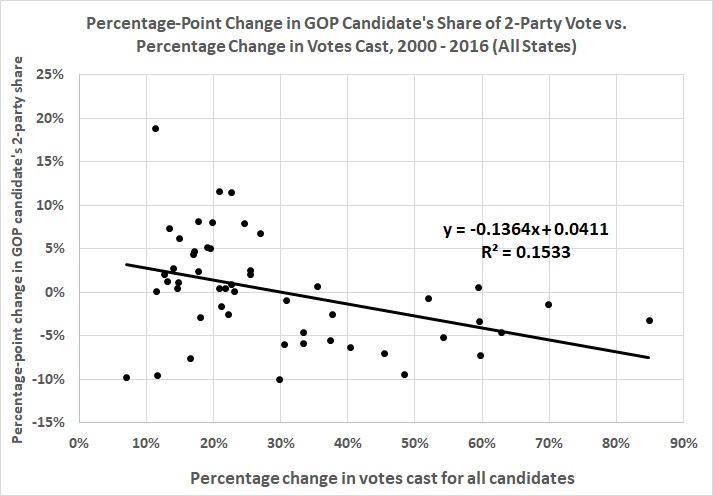
Enemies of big government and high taxes are right to fear the long-run consequences of massive immigration. The record of the last five presidential elections (2000-2016) is rather clear: Democrats prosper as the vote-count rises.

The following graph shows what happened in the 50 States and D.C. between 2000 and 2016. The percentage-point change in the GOP presidential candidate’s share of the two-party popular vote is on the vertical axis; the percentage change in the number of votes case for all candidates is on the horizontal axis.

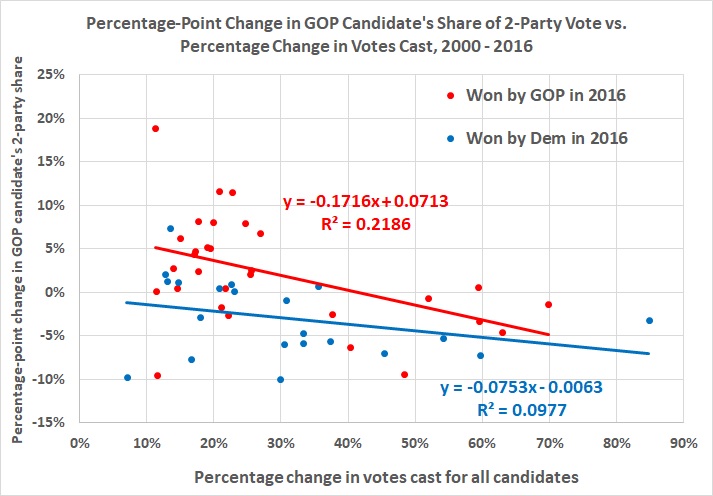
And it happens not just in States that vote Democrat; it happens in GOP-leaning States, too:

Immigration isn’t the only explanation for the relationship, of course. It’s long been observed that people in big cities tend to vote for more government, whereas people in rural areas tend to vote against it. Population growth means bigger and bigger cities, and therefore a greater tendency to turn to the party of big government.

Who knows whether the relationship between population and voting is due to the “need” for more government as people are crowded together, contagion by the acolytes of big government (e.g., schoolteachers and “civic leaders”), or a mix of the two? Whatever the case, it can’t be denied that more voters means a bigger share of votes for the party of big government.

Conservatives are right to resist massive immigration, and the bestowal of voting privileges that surely follows it.

What Blue Wave?

Are Democrat spinmeisters or the mainstream media (pardon the redundancy) correct in believing that Roy Moore’s loss in Alabama means that 2018 will see a “Blue Wave”, in which Democrats retake one or both houses of Congress? Wasn’t Moore’s loss a continuation of the Dems’ “stunning” sweep of statewide offices in Virginia? Doesn’t all of that portend a repudiation of Trump in 2020?

The answers are “no”, “no”, and “no”. Moore’s loss was a one-off event that had everything to do with Roy Moore and nothing to do with the political leanings of Alabamans. It is ludicrous to believe that Alabama has suddenly become a Purple State when Trump’s 64-percent share of the two-party vote surpassed the share received by any GOP candidate since Richard Nixon in 1972.

It is similarly ludicrous to believe anything about the elections in Virginia other than their consistency with that State’s burgeoning blueness. Bush II, for example, took 54 percent of Virginia’s two-party vote in 2000 and 2004, but McCain, Romney, and Trump won only 47-48 percent in 2008-2016. The Old Dominion is increasingly dominated by the rapidly growing cities and counties of Northern Virginia that are political appendages to Washington DC. (The same is true of Maryland and its rapidly growing appendages to DC.)

The 2018 elections will hinge manly on how voters feel about what the GOP-controlled Congress has done for them. And by election day 2018, most of them will be feeling a lot better because the government is taking a lot less from their paychecks. Continued revival of the economy will also help to buoy voters’ spirits. Unless something very bad happens between now and election day, a pro-incumbent mood will sweep most of the land. There will be exceptions, of course, as this or that Representative or Senator is exposed as a philanderer, swindler, or something else unseemly. But those exceptions tend to affect Democrats just as much as Republicans.

What is actually happening, in the grand scheme of things?

A naive forecast of the 2016 presidential election, based on State-by-State trends between 2008 and 2012, produces 245 electoral votes for Trump. The naive forecast doesn’t predict a Trump win in any State that he lost. Moreover, it under-predicts the extent of the pro-GOP movement in Iowa, Michigan, Ohio, and Pennsylvania — States that Trump won, and the electoral votes of which put Trump over the top.

A naive forecast of the 2020 outcome,  based on State-by-State trends from 2008 through 2016, produces 329 electoral votes for the GOP candidate. Iowa, Michigan, Ohio, and Pennsylvania will be joined by Maine, Minnesota, Nevada, and New Hampshire as Red States.

As an old saying (of mine) goes, trends are made to be broken. But the betting here is that the 2018 and 2020 elections are the Republicans’ to lose.

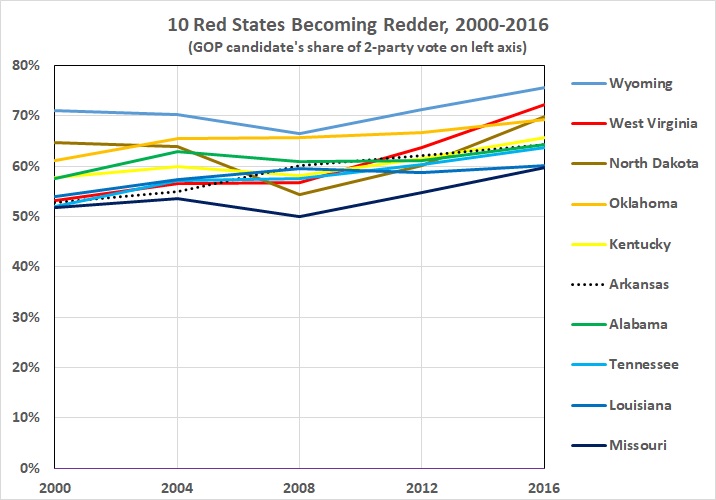
Speaking of trends, here are some relevant graphs:

The first graph covers 10 States that were Red in 2000 and have led the way in becoming Redder since then. Note that all 10 have rebounded from the Obama effect in 2008, which was the occasion of temporary insanity among many voters who usually pull the lever for GOP candidates.

The second graph covers the 10 States that have led the way in turning Blue or Bluer since 2000. You will note that even among some of these States Obama-mania shows signs of wearing off. Only California and DC seem determined to plunge deeper into political madness.

California, by the way, more than accounts for Clinton’s popular-vote “victory” over Trump. (Clinton won California by 4.3 million votes, as against her meaningless nationwide margin of 2.9 million votes.) This is further proof, if proof were needed, of the Framers’ wisdom in creating the Electoral College. It is also a big point in favor of my fearless forecast for 2020.


Related posts:
“Blue Wall” Hype
Polarization and De-facto Partition
The Midwest Is a State of Mind

Trump Catches Obama

GRAPH UPDATED FOR POLLING THROUGH 01/04/2018

For many years, Rasmussen Reports has published a daily poll of likely voters’ views of the incumbent president. Respondents are asked if they approve or disapprove the performance of the incumbent, and whether their approval or disapproval is strong. Rasmussen derives a presidential approval rating for each polling day by subtracting the percentage of respondents who strongly disapprove from the percentage who strongly approve. The complete polling history for Obama is here; the polling history for Trump, to date, is here.

The following graph shows, by day of presidency, the approval ratings for Obama (blue line) and Trump (red line). The difference between the two — Obama’s rating minus Trump’s rating — is plotted as a black line. Obama was well ahead of Trump for about 200 days. Trump has since closed the gap, and is now slightly more popular (or less unpopular) than Obama was at this stage (the 336th  350th day).


Jerks and Psychopaths

Regarding jerks, here’s Eric Schwitzgebel, writing in “How to Tell if You’re a Jerk” (Nautilus, November 16, 2017):

Jerks are people who culpably fail to appreciate the perspectives of the people around them, treating others as tools to be manipulated or fools to be dealt with, rather than as moral and epistemic peers….

Jerks see the world through goggles that dim others’ humanity. The server at the restaurant is not a potentially interesting person with a distinctive personality, life story, and set of goals to which you might possibly relate. Instead, he is merely a tool by which to secure a meal or a fool on which you can vent your anger.

Why is it jerky to view a server waiter as a “tool” (loaded word) by which to secure a meal? That’s his job, just as it’s the job of a clerk to ring up your order, the job of a service advisor to see that your car is serviced, etc. Pleasantness and politeness are called for in dealings with people in service occupations — as in dealings with everyone — though it may be necessary to abandon them in the face of incompetence or rudeness.

What’s not called for is a haughty or dismissive air, as if the waiter, clerk, etc., were a lesser being. I finally drew a line (mentally) through a long-time friendship when the friend — a staunch “liberal” who, by definition, doesn’t view people as mere tools — was haughty and dismissive toward a waiter, and a black one at that. His behavior exemplified jerkiness. Whatever he thought about the waiter as a human being (and I have no way of knowing that), he acted the way he did because he sees himself as a superior being — an attitude to which I can attest by virtue of long acquaintance. (When haughtiness wasn’t called for, condescension was. Here‘s a perfect example of it.)

That’s what makes a jerk a jerk: an overt attitude of superiority. It usually comes out as rudeness, pushiness, or loudness — in short, dominating a situation by assertive behavior rather than on merit. The merit is all in the mind of the jerk.

Does the jerk have an inferiority complex for which he is compensating? Was he a spoiled child? Is he a neurotic who tries to conquer his insecurity by behaving more assertively than necessary? Does he fail to appreciate the perspectives of other people, as Schwitzgebel puts it?

Who knows? And why does it matter? When confronted with a jerk, I deal with the behavior — or avoid it. The cause would matter only if I could do something about it. Jerks (like the relatively poor) are always with us.

So are psychopaths, though they must be dealt with differently.

Schwitzgebel addresses the connection between jerkiness and psychopathy, but gets it wrong:

People with psychopathic personalities are selfish and callous, as is the jerk, but they also incline toward impulsive risk-taking, while jerks can be calculating and risk-averse.

Note the weasel-wording: “can be”. Schwitzgebel is trying too hard to distinguish jerkiness from psychopathy.

The jerk who doesn’t care (or think) about his treatment of other people in mundane settings is just getting away with what he can get away with at the moment; that is, he is being impulsive. Nor is jerky behavior necessarily risk-averse; it often invites a punch in the mouth. By contrast, a criminal psychopath who seeks to avoid detection, and carefully plans his foul deeds, is calculating and risk averse.

Psychopathy is

characterized by persistent antisocial behavior, impaired empathy and remorse, and bold, disinhibited, egotistical traits.

Which could be thought of as extreme, sustained jerkiness.

If there is a distinction between a jerk and a psychopath, it is in the extremity of the psychopath’s acts. He doesn’t just do irritating or insulting things. He takes people’s lives, liberty, and property.

But, contrary to definition quoted above, a psychopath doesn’t do such things because he is devoid of empathy. A successful criminal psychopath is skilled at “reading” his victims — empathizing with them — in order to entice them into a situation where he gets what he wants from them. Moreover, his “bold, disinhibited, egotistical traits” may surface only when he has sprung his trap and no longer needs to gull his victim.

In evidence, I turn to Paul Bloom’s “The Root of All Cruelty?” (The New Yorker, November 27, 2017):

The thesis that viewing others as objects or animals enables our very worst conduct would seem to explain a great deal. Yet there’s reason to think that it’s almost the opposite of the truth.

At some European soccer games, fans make monkey noises at African players and throw bananas at them. Describing Africans as monkeys is a common racist trope, and might seem like yet another example of dehumanization. But plainly these fans don’t really think the players are monkeys; the whole point of their behavior is to disorient and humiliate. To believe that such taunts are effective is to assume that their targets would be ashamed to be thought of that way—which implies that, at some level, you think of them as people after all.

Consider what happened after Hitler annexed Austria, in 1938. Timothy Snyder offers a haunting description in Black Earth: The Holocaust as History and Warning:

The next morning the “scrubbing parties” began. Members of the Austrian SA, working from lists, from personal knowledge, and from the knowledge of passersby, identified Jews and forced them to kneel and clean the streets with brushes. This was a ritual humiliation. Jews, often doctors and lawyers or other professionals, were suddenly on their knees performing menial labor in front of jeering crowds. Ernest P. remembered the spectacle of the “scrubbing parties” as “amusement for the Austrian population.” A journalist described “the fluffy Viennese blondes, fighting one another to get closer to the elevating spectacle of the ashen-faced Jewish surgeon on hands and knees before a half-dozen young hooligans with Swastika armlets and dog-whips.” Meanwhile, Jewish girls were sexually abused, and older Jewish men were forced to perform public physical exercise.

The Jews who were forced to scrub the streets—not to mention those subjected to far worse degradations—were not thought of as lacking human emotions. Indeed, if the Jews had been thought to be indifferent to their treatment, there would have been nothing to watch here; the crowd had gathered because it wanted to see them suffer. The logic of such brutality is the logic of metaphor: to assert a likeness between two different things holds power only in the light of that difference. The sadism of treating human beings like vermin lies precisely in the recognition that they are not.

As with jerkiness, I don’t care what motivates psychopathy. If jerks are to be avoided, psychopaths are to be punished — good and hard.

Come to think of it, if jerks were punched in the mouth more often, perhaps there would be less jerky behavior. And, for most of us, it is jerks — not psychopaths — who make life less pleasant than it could be.


Related guest post by LP: Getting Real about Empathy — Part 2 of 5: Critical Roles and Contributions of the Less Empathetic


Look Out for That Slippery Slope

In the truly disgusting department:

Bestiality brothels are spreading through Germany faster than ever thanks to a law that makes animal porn illegal but sex with animals legal, a livestock protection officer has warned….

‘There are now animal brothels in Germany,’ Martin told the paper, adding that people were playing down the issue by by describing it as a ‘lifestyle choice’.

Armed with a host of similar case studies, Ms Martin is now calling for the government to categorically ban bestiality across the country….

German ‘zoophile’ group ZETA has announced it will mount a legal challenge should a ban on bestiality become law.

‘Mere concepts of morality have no business being law,’ said ZETA chairman Michael Kiok.

If inter-species “dating” catches on in the U.S., there is bound to be a legal movement to legalize inter-species marriage. If that happens while Anthony Kennedy is still the swing (pun intended) justice, I can easily imagine what his deciding opinion will say:

No union is more profound than marriage, for it embodies the highest ideals of love, fidelity, devotion, sacrifice, and family, pack, flock, herd, etc. In forming a marital union, two animals (one of them human) become something greater than once they were. As some of the petitioners in these cases demonstrate, inter-species marriage embodies a love that may endure even past death. It would misunderstand these animals to say they disrespect the idea of marriage. Their plea (sometimes expressed by piteous looks rather than words) is that they do respect it, respect it so deeply that they seek to find its fulfillment for themselves. Their hope is not to be condemned to live in loneliness (in a pasture, stable, doghouse, etc.), excluded from one of civilization’s oldest institutions. They ask for equal dignity in the eyes of the law. The Constitution grants them that right. Amen, baa, arf, moo, whinny, etc.

Oh, wait, that’s what he said in Obergefell v. Hodges (with a few immaterial changes). Well, recycling is an essential aspect of the “progressive” religion, is it not?

What greater tribute to the social benefits of traditional marriage than to extend it to different sexes and different species? In fact, why discriminate against pond scum and compost?

In the brave new world to which Justice Kennedy has led us, it can be literally true that a man is married to his golf game.

Hot Is Better Than Cold: A Small Case Study

I’ve been trying to find wandering classmates as the 60th anniversary of our graduation from high school looms. Not all are enthusiastic about returning to our home town in Michigan for a reunion next August. Nor am I, truth be told.

A sunny, August day in Michigan is barely warm enough for me. I’m far from alone in holding that view, as anyone with a casual knowledge of inter-State migration knows.

Take my graduating class, for example. Of the 79 living graduates whose whereabouts are known, 45 are still in Michigan; 24 are in warmer States (Arizona, California, Florida, Georgia, Kentucky, Louisiana, Mississippi, Tennessee, and Texas — moi); and 10 (inexplicably) have opted for other States at about the same latitude. In sum: 30 percent have opted for warmer climes; only 13 percent have chosen to leave a cold State for another cold State.

It would be a good thing if the world were warming a tad, as it might be.

Union of Conservative Bloggers

See the sidebar, and go here.

Sexual Misconduct: A New Crime, A New Kind of Justice

Not all bad behavior is, or should be, the subject of official investigation, prosecution, and punishment. It should be enough, in the vast majority of cases, to stop bad behavior and discourage its repetition by simply saying “no”, administering a spanking, or subjecting the miscreant to social scorn.

These time-honored methods gave way decades ago to the sob-sister school of pseudo-psychology, which instructs all and sundry that it is harmful to young psyches to say “no” without a long explanation (couched in psychological rather than moral terms), to spank (or otherwise administer corporal punishment), or to squelch “creativity” (i.e., mischief-making) by any method of communication, from frowning to screaming.

It should therefore come as no surprise that several generations of persons born after World War II — which includes almost all of today’s practicing politicians, lawyer, judges, and celebrities — have lacked the benefit of moral guidance. What they seem to have learned is not to eschew bad behavior, but to feign contrition for it when caught. Pseudo-contrition can be made to seem genuine by a method-acting technique: converting mortification for being caught into sorrow for having committed the offending deed.

Meanwhile, the broader system of justice, which encompasses the kinds of social censure discussed above, is shifting away from the inculcation of traditional morality (which would reinforce “white privilege” and “patriarchy”) and becoming a delivery vehicle for socio-political vengeance. This perversion seemed to have peaked with the Obama-Holder regime’s penchant for launching federal investigations of shootings by police when the persons shot were black, under the rubric of “civil rights”, and with the refusal of campus and municipal officials to curb violence committed by leftists and their protégés (e.g., Antifa and BLM).

But the perversion of justice has reached a new low with the wave of public accusations of sexual misconduct fomented by the #MeToo campaign,

to denounce sexual assault and harassment, in the wake of sexual misconduct allegations against film producer and executive Harvey Weinstein. The phrase, long used in this sense by social activist Tarana Burke, was popularized by actress Alyssa Milano, who encouraged women to tweet it to publicize experiences to demonstrate the widespread nature of misogynistic behavior.

Dozens of prominent or high-ranking men in politics, entertainment, and business have been accused of various acts of sexual misconduct. Many of them have lost their jobs as a result of the accusations. Roy Moore probably lost the special election in Alabama because of the accusations. It is a widely held view on the left that Donald Trump should lose his job because of accusations that have been leveled against him, and also because he’s a creepy loud-mouth who mainly takes a conservative political stance and is a “racist” to boot. (“Racist” is the go-to word for leftists who want to open the southern border to more waves of future Democrat voters.)

In other words, there’s a new crime on the block: sexual misconduct. It consists not only of actual crimes — such as rape — that ought to be prosecuted, and have been prosecuted since long before the #MeToo campaign. It also consists of any perceived sexism or slight on the part of a male toward a female.

This new, ill-defined crime is in the mind of the beholder. She may perceive a crime simply because she hates men or finds it psychologically satisfying to think of them as the enemy — along with Republicans, Israelis, “the rich” (one of which she may well be), climate-change “deniers”, NASCAR fans, and on and on.

In fact, it’s the old double-standard at work: Misogyny (real or imagined) is bad, but man-hating is good. Or so it has become among many women (and their male sycophants) who, with unintentional irony, call themselves “liberal” and “progressive”.  It is illiberal in the extreme to deprive someone of life, liberty, property, or a job based on mere accusations, but that is what is happening. It is regressive in the extreme to wage war against half the population (minus the mental cuckolds who are their allies) when it is the half of the population that does the really hard and dangerous jobs that make it possible for them to live in a hypocritical state of comfort and security.

So, despite my schadenfreude about the comeuppance of many left-wing males (most of whom probably deserve it), I am unenthusiastic about this latest incarnation of the Salem witch-trials. It is too much of a piece with the many memes that have captured the fickle attentions of neurotic leftists in recent decades, years, months, weeks, and days; for example, eugenics, prohibition, repeal of prohibition, peace through unilateral disarmament, overpopulation, global cooling, peak oil, global warming, carbon footprints, recycling, income inequality, unconscious racism, white privilege, forced integration, forces segregation (if blacks want it), coeducation, mixed-sexed dorms, single-sex schools, any reference to or image of a firearm, keeping score, winning, cultural appropriation, diversity, globalization, free speech (not), homophobia, same-sex “marriage”, smoking, gender “assignment” at birth, “free” college for all, “settled science”, collective guilt (but only of straight, white, conservative males of European descent, and Germans in 1933-1945), racial profiling and stereotyping (except when leftists do it), etc., etc., etc.

Each “good” can be attained and each “bad” averted simply by enacting laws, regulations, and punishments. Though nature and human nature are not so easily controlled (let alone changed), the neurotic appetite for action can be sated temporarily by the mere enactment of laws, regulations, and punishments. And when these have been piled one on top of the other for decades, the results are as predicted by conservatives and libertarians: the suppression of liberty and economic growth.

There’s real crime for you.


Related posts:
Greed, Cosmic Justice, and Social Welfare
Positive Rights and Cosmic Justice
Liberalism and Sovereignty
Fascism with a “Friendly” Face
Penalizing “Thought Crimes”
Democracy and Liberty
The Interest-Group Paradox
Inventing “Liberalism”
Civil Society and Homosexual “Marriage”
Fascism and the Future of America
The Indivisibility of Economic and Social Liberty
The Near-Victory of Communism
Tocqueville’s Prescience
Accountants of the Soul
In Defense of Marriage
The Left
Rationalism, Social Norms, and Same-Sex “Marriage”
Our Enemy, the State
“Intellectuals and Society”: A Review
The Left’s Agenda
The Left and Its Delusions
“Occupy Wall Street” and Religion
Merit Goods, Positive Rights, and Cosmic Justice
The Spoiled Children of Capitalism
Politics, Sophistry, and the Academy
Subsidizing the Enemies of Liberty
More about Merit Goods
The Morality of Occupying Private Property
Prohibition, Abortion, and “Progressivism”
Liberty, Negative Rights, and Bleeding Hearts
Our Perfect, Perfect Constitution
Liberty and Society
Tolerance on the Left
The Eclipse of “Old America”
The Fallacy of Human Progress
Fighting Modernity
Defining Liberty
The Culture War
Modern Liberalism as Wishful Thinking
Getting Liberty Wrong
Romanticizing the State
Governmental Perversity
The Pretence of Knowledge
“The Science Is Settled”
Ruminations on the Left in America
No Wonder Liberty Is Disappearing
Academic Ignorance
More About Social Norms and Liberty
The Euphemism Conquers All
Defending the Offensive
Superiority
The War on Conservatism
Whiners
A Dose of Reality
God-Like Minds
The Authoritarianism of Modern Liberalism, and the Conservative Antidote
Society, Polarization, and Dissent
Non-Judgmentalism as Leftist Condescension
An Addendum to (Asymmetrical) Ideological Warfare
The Rahn Curve Revisited
Social Justice vs. Liberty
The Left and “the People”
Why Conservatives Shouldn’t Compromise
Liberal Nostrums
Liberty and Social Norms Re-examined
Retrospective Virtue-Signalling
The Left and Violence
Four Kinds of “Liberals”
Leftist Condescension
If Men Were Angels
The Vast Left-Wing Conspiracy
The Left and Evergreen State: Reaping What Was Sown
Liberty in Chains
Leftism
Leftism As Crypto-Fascism: The Google Paradigm
What Is Going On? A Stealth Revolution
Libertarianism, Conservatism, and Political Correctness
“Liberalism” and Leftism
Disposition and Ideology
Much Ado about the Unknown and Unknowable
A (Long) Footnote about Science
Down the Memory Hole
The Dumbing-Down of Public Schools
Cakes and Liberty

Will Unhinged

George F. Will, the pseudo-don of political punditry, began to unravel last year when faced with Donald Trump’s candidacy, nomination, and electoral victory. Inasmuch as I don’t read Will as religiously as I used to — when he had sensible things to say about Barack Obama — I failed to witness the point at which he became unhinged. But unhinged he is, as evidenced by a recent column in The Washington Post. It’s about the possibility of a Trump-ordered first strike against North Korea:

A U.S. war of choice against North Korea would not be a pre emptive war launched to forestall an imminent attack. Rather, it would be a preventive war supposedly justified by the fact that, given sophisticated weapons and delivery systems, imminence might be impossible to detect.

Will ends the column with this:

It would be interesting to hear the president distinguish a preventive war against North Korea from a war of aggression. The first two counts in the indictments at the 1946 Nuremberg trials concerned waging “aggressive war.”

The counts refer to the aggression against Poland. There is no parallel between Poland, with its relatively primitive armed forces and lack of bellicosity, and Kim Jong-un’s North Korea.

Further, though there was moral justification for war-crimes prosecutions of Nazis after World War II, the legal footing of the Nuremberg trials is on shaky ground. Here are some passages from the Wikipedia article about the trials:

Critics of the Nuremberg trials argued that the charges against the defendants were only defined as “crimes” after they were committed and that therefore the trial was invalid as a form of “victor’s justice”. The alleged double standards associated with putative victor’s justice are also evident from the indictment of German defendants for conspiracy to commit aggression against Poland in 1939, while no one from the Soviet Union was charged for being part of the same conspiracy. As Biddiss observed, “the Nuremberg Trial continues to haunt us. … It is a question also of the weaknesses and strengths of the proceedings themselves.”…

Chief Justice of the United States Supreme Court Harlan Fiske Stone called the Nuremberg trials a fraud. “(Chief U.S. prosecutor) Jackson is away conducting his high-grade lynching party in Nuremberg,” he wrote. “I don’t mind what he does to the Nazis, but I hate to see the pretense that he is running a court and proceeding according to common law. This is a little too sanctimonious a fraud to meet my old-fashioned ideas.”

Jackson, in a letter discussing the weaknesses of the trial, in October 1945 told U.S. President Harry S. Truman that the Allies themselves “have done or are doing some of the very things we are prosecuting the Germans for. The French are so violating the Geneva Convention in the treatment of prisoners of war that our command is taking back prisoners sent to them. We are prosecuting plunder and our Allies are practising it. We say aggressive war is a crime and one of our allies asserts sovereignty over the Baltic States based on no title except conquest.”

Associate Supreme Court Justice William O. Douglas charged that the Allies were guilty of “substituting power for principle” at Nuremberg. “I thought at the time and still think that the Nuremberg trials were unprincipled,” he wrote. “Law was created ex post facto to suit the passion and clamor of the time.”

U.S. Deputy Chief Counsel Abraham Pomerantz resigned in protest at the low caliber of the judges assigned to try the industrial war criminals such as those at I.G. Farben.

Will himself has questioned the legality of the Nuremberg trials. It was an act of intellectual desperation to bring them into the discussion.

All in all, Will’s recent column is weak on the facts and weak as a matter of historical analysis. The main impetus for the column seems to be Will’s fixation on Trump. His doubts about Trump’s stability and soundness of judgment may be justified. But Will ought to have stuck to those doubts, and elaborated on them.

Cakes and Liberty

Mark David Hall yesterday posted “Phillips Likely to Win Masterpiece Cakeshop Case, Five Votes to Four” at Law & Liberty. I fervently hope that Phillips wins, and by a greater margin than 5-4 (though that’s probably too much to hope for).

I must say, however, that I do not much care for the First-Amendment grounding of Phillips’s case. As Hall points out, Phillips was found guilty of violating Colorado’s public accommodation statute by the state’s Civil Rights Commission when he refused to provide a cake for a same-sex wedding.

And therein lies the real injustice, which stems from the Civil Rights Act of 1964. That law (among several things) prohibits racial discrimination in “public accommodations“, which are

generally defined as facilities, both public and private, used by the public. Examples include retail stores, rental establishments and service establishments as well as educational institutions, recreational facilities, and service centers.

What is going on with Masterpiece Cakeshop, and similar cases involving florists and photographers, is what has been going on since the enactment of the Civil Rights Act of 1964 and the U.S. Supreme Court’s subsequent rulings to uphold the law: the abrogation of property rights, liberty of contract, and freedom of association.

The only excuse for pursing Phillips’s cause as a First Amendment issue is that it is far too late to restore property rights, liberty of contract, and freedom of association — all of which have been smothered by the dense web of legislative, executive, and judicial decrees that suppresses liberty in the name of liberty.

Freedom of speech and freedom of religion are hanging on by the barest of threads. If Phillips loses in the Supreme Court, they will go the way of property rights, liberty of contract, and freedom of association.


Related posts:
Substantive Due Process, Liberty of Contract, and the States’ Police Power
The Constitution: Original Meaning, Corruption, and Restoration
Our Perfect, Perfect Constitution
Restoring Constitutional Government: The Way Ahead
“We the People” and Big Government
Getting “Equal Protection” Right
The Writing on the Wall
How to Protect Property Rights and Freedom of Association and Expression
The Principles of Actionable Harm
Judicial Supremacy: Judicial Tyranny
The Beginning of the End of Liberty in America
Substantive Due Process, Liberty of Contract, and States’ “Police Power”
Why Liberty of Contract Matters
The Answer to Judicial Supremacy
There’s More to It Than Religious Liberty
Turning Points
Equal Protection in Principle and Practice
Freedom of Speech and the Long War for Constitutional Governance
Equality
Academic Freedom, Freedom of Speech, and the Demise of Civility

“Why Can’t We All Just Get Along?”

That’s how a correspondent characterized an op-ed by Mitch Daniels* that appeared yesterday in the online edition of The Washington Post. Daniels says, in part, that

ours is an era when it seems no one ever confesses to being wrong. Moreover, everyone is so emphatically right that those who disagree are not merely in error but irredeemably so, candidates not for persuasion but for castigation and ostracism….

John Maynard Keynes is frequently credited with the aphorism “When I find I’m wrong, I change my mind. What do you do?” Today, the problem may less be an attitude of stubbornness than that fewer people than ever recognize their mistakes in the first place.

In a well-documented fashion, steady doses of viewpoint reinforcement lead not only to a resistance to alternative positions but also to a more entrenched and passionate way in which thoughts are held and expressed. When those expressions are launched in the impersonal or even anonymous channels of today’s social — or is it antisocial? — media, vitriol often becomes the currency of discourse and second thoughts a form of tribal desertion or defeat. Things people would not say face to face are all too easy to post in bouts of blogger or tweeter one-upmanship.

I doubt that it’s possible to return to the “golden days” of political comity, whenever they were. The U.S. hasn’t come close to attaining a sense of national unity since World War II. And even then, FDR’s popular vote share dropped between 1940 and 1944, and the GOP picked up House and Senate seats in 1942 and 1944. At any rate, things have gotten a lot worse since then — there’s no doubt about it.

How might they get better? Someone — an extremely influential someone — has to make the first move, and be willing to lose on an important issue. And he has to bring influential allies with him, or else his move will likely be nullified by a stiffening of his side’s position on the issue.

I submit that the stakes are too high for this to happen, unless a greater objective than “winning” a political debate emerges. Right after 9/11, it appeared that such an objective had emerged, but the sense of unity against a common enemy didn’t last. And it wasn’t entirely Bush’s fault for pushing the war in Iraq. I witnessed (on TV) HRC’s eye-rolling performance during Bush’s post-9/11 speech to Congress, a performance aimed not only at the Dem colleagues near her but also at anti-Bush zealots around the country. (Bush’s “theft” of the election less than a year earlier was still a sore spot for a lot of Democrat politicians and voters.)

It would be the same again with Trump in office. In fact, he’d be blamed (by Democrats) for whatever dire thing happens, and polarization would strengthen instead of weakening.

I shudder to think what it might take to achieve real and lasting unity, or at least a willingness to engage in honest and open discourse. The nation may be better off if the status quo persists. I certainly do not want compromise if it means giving any more ground to the left.


* I came to know Mitch slightly when we had business dealings about 30 years ago. He is the anti-Trump in size, thoughtfulness, articulateness, and manner. He is exactly the kind  of person who might be able to put the country more or less back together. But having said that, I am glad that Trump is in the White House now. His uncompromising push for conservative policies and judges is exactly what’s needed to counterbalance the Dems’ continuing slide into loony leftism.


Related posts:
September 20, 2001: Hillary Clinton Signals the End of “Unity”
I Want My Country Back
Undermining the Free Society
Government vs. Community
The Destruction of Society in the Name of “Society”
Society and the State
Well-Founded Pessimism
America: Past, Present, and Future
IQ, Political Correctness, and America’s Present Condition
The Barbarians Within and the State of the Union
The View from Here
“We the People” and Big Government
The Culture War
The Fall and Rise of American Empire
O Tempora O Mores!
Presidential Treason
A Home of One’s Own
The Criminality and Psychopathy of Statism
Surrender? Hell No!
Romanticizing the State
Governmental Perversity
Democracy, Human Nature, and the Future of America
1963: The Year Zero
Society
How Democracy Works
“Cheerful” Thoughts
How Government Subverts Social Norms
Turning Points
The Twilight’s Last Gleaming?
How America Has Changed
Civil War?
The “H” Word, the Left, and Donald Trump
Red-Diaper Babies and Enemies Within
The Vast Left-Wing Conspiracy
The Left and Evergreen State: Reaping What Was Sown
Academic Freedom, Freedom of Speech, and the Demise of Civility
Death of a Nation
The Invention of Rights
Leftism
Leftism As Crypto-Fascism: The Google Paradigm
What Is Going On? A Stealth Revolution
Politics Trumps Economics
Down the Memory Hole
Dining with “Liberals”

Further Thoughts about Probability

BACKGROUND

A few weeks ago I posted “A Bayesian Puzzle”. I took it down because Bayesianism warranted more careful treatment than I had given it. But while the post was live at Ricochet (where I cross-posted in September-November), I had an exchange with a reader who is an obdurate believer in single-event probabilities, such as “the probability of heads on the next coin flip is 50 percent” and “the probability of 12 on the next roll of a pair of dice is 1/18”. That wasn’t the first such exchange of its kind that I’ve had; “Some Thoughts about Probability” reports an earlier and more thoughtful exchange with a believer in single-event probabilities.

DISCUSSION

A believer in single-event probabilities takes the view that a single flip of a coin or roll of dice has a probability. I do not. A probability represents the frequency with which an outcome occurs over the very long run, and it is only an average that conceals random variations.

The outcome of a single coin flip can’t be reduced to a percentage or probability. It can only be described in terms of its discrete, mutually exclusive possibilities: heads (H) or tails (T). The outcome of a single roll of a die or pair of dice can only be described in terms of the number of points that may come up, 1 through 6 or 2 through 12.

Yes, the expected frequencies of H, T, and and various point totals can be computed by simple mathematical operations. But those are only expected frequencies. They say nothing about the next coin flip or dice roll, nor do they more than approximate the actual frequencies that will occur over the next 100, 1,000, or 10,000 such events.

Of what value is it to know that the probability of H is 0.5 when H fails to occur in 11 consecutive flips of a fair coin? Of what value is it to know that the probability of rolling a  7 is 0.167 — meaning that 7 comes up every 6 rolls, on average — when 7 may not appear for 56 consecutive rolls? These examples are drawn from simulations of 10,000 coin flips and 1,000 dice rolls. They are simulations that I ran once — not simulations that I cherry-picked from many runs. (The Excel file is at https://drive.google.com/open?id=1FABVTiB_qOe-WqMQkiGFj2f70gSu6a82 — coin flips are on the first tab, dice rolls are on the second tab.)

Let’s take another example, which is more interesting, and has generated much controversy of the years. It’s the Monty Hall problem,

a brain teaser, in the form of a probability puzzle, loosely based on the American television game show Let’s Make a Deal and named after its original host, Monty Hall. The problem was originally posed (and solved) in a letter by Steve Selvin to the American Statistician in 1975…. It became famous as a question from a reader’s letter quoted in Marilyn vos Savant’s “Ask Marilyn” column in Parade magazine in 1990 … :

Suppose you’re on a game show, and you’re given the choice of three doors: Behind one door is a car; behind the others, goats. You pick a door, say No. 1, and the host, who knows what’s behind the doors, opens another door, say No. 3, which has a goat. He then says to you, “Do you want to pick door No. 2?” Is it to your advantage to switch your choice

Vos Savant’s response was that the contestant should switch to the other door…. Under the standard assumptions, contestants who switch have a 2/3 chance of winning the car, while contestants who stick to their initial choice have only a 1/3 chance.

Vos Savant’s answer is correct, but only if the contestant is allowed to play an unlimited number of games. A player who adopts a strategy of “switch” in every game will, in the long run, win about 2/3 of the time (explanation here). That is, the player has a better chance of winning if he chooses “switch” rather than “stay”.

Read the preceding paragraph carefully and you will spot the logical defect that underlies the belief in single-event probabilities: The long-run winning strategy (“switch”) is transformed into a “better chance” to win a particular game. What does that mean? How does an average frequency of 2/3 improve one’s chances of winning a particular game? It doesn’t. As I show here, game results are utterly random; that is, the average frequency of 2/3 has no bearing on the outcome of a single game.

I’ll try to drive the point home by returning to the coin-flip game, with money thrown into the mix. A $1 bet on H means a gain of $1 if H turns up, and a loss of $1 if T turns up. The expected value of the bet — if repeated over a very large number of trials — is zero. The bettor expects to win and lose the same number of times, and to walk away no richer or poorer than when he started. And for a very large number of games, the better will walk away approximately (but not necessarily exactly) neither richer nor poorer than when he started. How many games? In the simulation of 10,000 games mentioned earlier, H occurred 50.6 percent of the time. A very large number of games is probably at least 100,000.

Let us say, for the sake of argument, that a bettor has played 100,00 coin-flip games at $1 a game and come out exactly even. What does that mean for the play of the next game? Does it have an expected value of zero?

To see why the answer is “no”, let’s make it interesting and say that the bet on the next game — the next coin flip — is $10,000. The size of the bet should wonderfully concentrate the bettor’s mind. He should now see the situation for what it really is: There are two possible outcomes, and only one of them will be realized. An average of the two outcomes is meaningless. The single coin flip doesn’t have a “probability” of 0.5 H and 0.5 T and an “expected payoff” of zero. The coin will come up either H or T, and the bettor will either lose $10,000 or win $10,000.

To repeat: The outcome of a single coin flip doesn’t have an expected value for the bettor. It has two possible values, and the bettor must decide whether he is willing to lose $10,000 on the single flip of a coin.

By the same token (or coin), the outcome of a single roll of a pair of dice doesn’t have a 1-in-6 probability of coming up 7. It has 36 possible outcomes and 11 possible point totals, and the bettor must decide how much he is willing to lose if he puts his money on the wrong combination or outcome.

CONCLUSION

It is a logical fallacy to ascribe a probability to a single event. A probability represents the observed or computed average value of a very large number of like events. A single event cannot possess that average value. A single event has a finite number of discrete and mutually exclusive outcomes. Those outcomes will not “average out” — only one of them will obtain, like Schrödinger’s cat.

To say that the outcomes will average out — which is what a probability implies — is tantamount to saying that Jack Sprat and his wife were neither skinny nor fat because their body-mass indices averaged to a normal value. It is tantamount to saying that one can’t drown by walking across a pond with an average depth of 1 foot, when that average conceals the existence of a 100-foot-deep hole.


Related posts:
Understanding the Monty Hall Problem
The Compleat Monty Hall Problem
Some Thoughts about Probability
My War on the Misuse of Probability
Scott Adams Understands Probability

The Dumbing-Down of Public Schools

You may have read stories about the difficulty of tests given to public-school students in the late 1800s and early 1900s. Some of the questions would have challenged even the brighter seniors in today’s schools. This anecdotal evidence suggests that educational standards were generally much higher in the public schools of yore than they are now. One reason, I suspect, is the dumbing-down of schools that probably accompanied the social and legal push to keep children in school through the 12th grade.

In Michigan, when my father was of school age, it wasn’t uncommon for children (especially boys) to drop out after the 8th grade. High school, in those days, seemed to be considered preparatory for college. Boys like my father, who was intelligent but of a poor family, weren’t considered college material and would often drop out after completing the 8th grade in order to go to work, perhaps even to learn a trade that would pay more than they could earn from manual labor. (When my father dropped out, the Great Depression was at its depth and it was all the more necessary for him to take whatever job he could get, to help support his family.)

The prep-school thesis came to me when I was browsing old yearbooks and found a yearbook for 1921 in which my high-school principal is pictured as a high-school senior. (It was the high school that my father would have attended had he gone beyond the 8th grade.) One page of the yearbook gives a list of the 1920 graduates and tells what each of them is doing (e.g., attending the University of Michigan, working at a particular factory, at home without a job). Here are some things I gleaned from the page:

The class of 1920 consisted of 28 males and 50 females. This is an improbable male-female ratio, which supports my thesis that dropping out to work was common among males. (Most male members of the class of 1920 would have been only 16 at the end of World War I ended, so it is unlikely that the war had more than a minute effect on the number of males who reached graduation age.)

A year after graduation, two-thirds of the males (19 of the 28) were enrolled in college (mostly at the University of Michigan), and another one was attending a technical school in Chicago. That two-thirds of the males were in college in 1921, long before the insane push for universal higher education, support the idea that most males who went to high school were considered college material.

Of the 50 females, only 8 were definitely in college, with 5 of them at teachers’ colleges (then called “normal schools”). Several others gave locations that might have indicated college attendance (e.g., Oberlin, Albion). But there were at most 14 collegians among the 50 females.

Two females were already teaching, presumably in small, rural schools. But the fact that they were teaching at the age of 19 (not uncommon in the “old days”) is testimony to the quality of high-school education in those days. It also says a lot about the needless inflation of standards for teaching young children.

It pains me to think of the tens of millions of young persons — male and female alike — who have been pushed into high school, and then into college, instead of being allowed to find their own way in life. They have been denied the opportunity to learn a trade through apprenticeship, or just by working hard; the opportunity to learn self-reliance and responsibility; and the opportunity to contribute more to the well-being of others than most of them will contribute by going to college.

Smaller high-school enrollments would also mean fewer public-school teachers and administrators to feed at the public trough and fuel the expensive (and largely fruitless) war among school systems to see which one can spend the most per pupil.  Fewer students pushed into college would also mean fewer college-professors and administrators to feed at the public trough, and to spew their pseudo-intellectual nonsense.

The best thing about smaller high-school enrollments would be the reduction in the number of impressionable young persons who are indoctrinated in left-wing views by high-school teachers, and then by college professors.


Related posts:
School Vouchers and Teachers’ Unions
Whining about Teachers’ Pay: Another Lesson about the Evils of Public Education
I Used to Be Too Smart to Understand This
The Higher-Education Bubble
The Public-School Swindle
Is College for Everyone?
A Sideways Glance at Public “Education”