Trump and Election 2018

GO TO “TRUMP IN THE POLLS: AN UPDATE” FOR LATER POLLING DATA.

This was a final update before election day. The Dems won a majority in the House, though  a narrow one. Meanwhile, the GOP has increased its majority in the Senate. That is the better half of the loaf because control of the Senate means that Trump can continue to remake the judiciary in a conservative image. Further, the House will be perceived as the obstructionist body for the next two years, setting the stage for a GOP restoration there. Barring the unforeseeable, a largely successful Trump presidency will set the stage for Republican dominance in 2020.

How is Trump’s popularity these days? And how will his standing with voters affect the outcome of tomorrow’s elections?

Trump’s approval ratings have been fairly steady since early in the year, with a recent uptick that bodes well for GOP candidates:

FIGURE 1
Derived from Rasmussen Reports approval ratings for Trump.

Lest you believe that those numbers are weak, consider this comparison with Obama’s numbers:

FIGURE 2
Derived from Rasmussen Reports approval ratings for Obama and Trump.

In this age of polarization, it’s hard for any president to routinely attain high marks:

FIGURE 3
Source: Same as figure 2.

The good news, again, is that Trump’s strong approval rating has been significantly higher than Obama’s for the past several months.

Ratios of the ratios in figure 2 yield enthusiasm ratios: the strength of strong approval ratings relative to overall approval ratings:

FIGURE 4
Source: Same as figure 2.

Since the spike associated with the Singapore summit, Trump”s enthusiasm ratio has settled into a range that is comfortably higher than Obama’s.

There is a different poll that is more revealing of Trump’s popularity. Every week since the first inauguration of Obama, Rasmussen Reports has asked 2,500 likely voters whether they see the country as going in the “right direction” or being on the “wrong track”. The following graph shows the ratios of “right direction”/”wrong track” for Trump and Obama:

FIGURE 5
Source: Rasmussen Reports, “Right Direction or Wrong Track“.

The ratio for Trump, after a quick honeymoon start, fell into the same range as Obama’s. But it jumped with the passage of the tax cut in December 2017, and has remained high since then, despite the faux scandals concocted by the leftist media and their concerted attack on Trump.

Figure 5 suggests that the squishy center of the electorate is lining up behind Trump, despite the incessant flow of negative “reporting” about him and his policies. (See “related reading” at the end of this post.) His base is with him all the way.

Trump’s coattails may be be decisive in November. Based on an analysis of the relationships between Obama’s popularity (or unpopularity) and the outcome of House elections, it looks like the GOP will hold the House while losing about 10 seats. (This is a very rough estimate with a wide margin of error.)

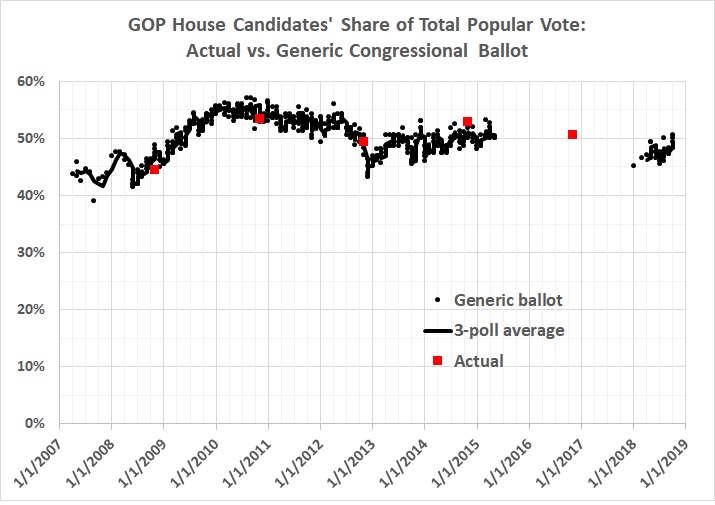
Rasmussen’s generic congressional ballot affords a similar view. The polling data, which are behind a paywall, span April 2007 to May 2015 (when the poll was discontinued), and January 2018 (when the poll was resumed) to the present.

This graph compares the polling results to date with the actual nationwide vote shares compiled by House candidates in the general elections of 2008, 2010, 2010, and 2014:

FIGURE 6

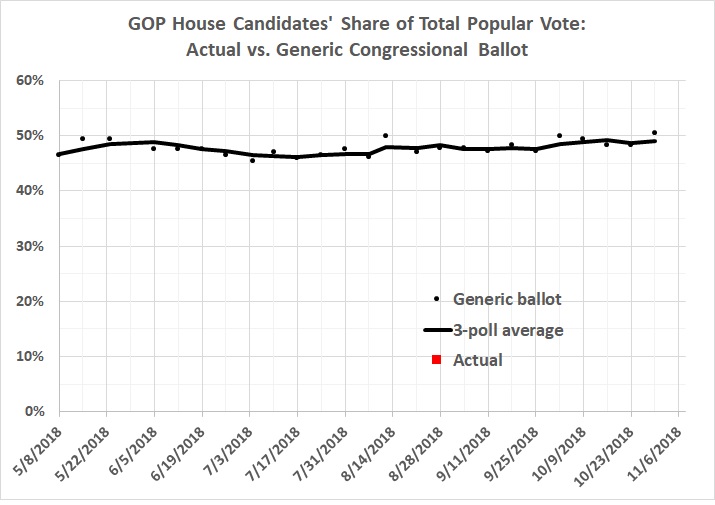
Taking a closer look:

FIGURE 7

Rasmussen advertises a 2-percentage-point margin of error, which is borne out by the results for the elections of 2008-2014. In fact, the generic congressional ballot was spot-on in 2010 and 2012, while the GOP under-performed slightly in 2008 (the year of the financial crisis) and over-performed slightly in 2014 (a mid-term referendum on Obama).

Let’s say, for the sake of argument, that this year’s polls are spot-on. The latest poll (figure 7) gives the GOP 51 percent of the two-party vote. How does that translate into House seats? Recent history is probably the best guide:

FIGURE 8

A 51-percent share of the vote would give the GOP about 52 percent of House seats; that is, the GOP would hold the House. In fact, two years ago the GOP won more than 55 percent of House seats with 50.5 percent of the two-party vote.

There’s more evidence against the loss of the House:

1. I correlated measures of Obama’s popularity (or lack thereof) with with the outcomes of House mid-terms during his presidency. I then applied those correlations to measures of Trump’s popularity (or lack thereof), which is markedly higher than Obama’s at this stage of their respective presidencies (according to Rasmussen, at least).

2. I correlated the outcomes of post-WWII mid-terms during GOP presidencies with the GOP presidents’ shares of the 2-party vote in the preceding elections. I then applied that result to Trump’s share of the 2-party vote in 2016.

Both methods yield the same result for 2018: a loss of 4 House seats by the GOP (yes, four seats, not 4 percent of seats). The estimates are surrounded by a wide margin of error. Given that, the results support the view that the GOP will hold the House.

In the end, the outcome will depend on turnout. Are Democrats more charged up than Republicans? I don’t think so.

Stay tuned.


Related reading:

Alex Castellanos, “How Trump Has Managed to Defy Gravity“, RealClearPolitics, July 31, 2018

Selwyn Duke, “Media Collusion: 100-Plus Papers Agree to Simultaneously Run Anti-Trump Editorials“, The New American, August 14, 2018

Dennis Prager, “The Greatest Hysteria in American History“, RealClearPolitics, July 24, 2018

Ned Ryun, “None Dared Call It Treason … When It Was a Democrat“, American Greatness, July 24, 2018

“Proof” of the Connection between Trump and Violence

Left-wing logic:

I (a hysterical leftist) have a violent reaction to Trump.

Some people are committing violent acts.

Therefore, Trump is responsible for violent acts.


A Flawed Ideological Taxonomy

UPDATED, 11/04/18

Arnold Kling points to

a study by Stephen Hawkins, Daniel Yudkin, Miriam Juan-Torres, and Tim Dixon, helpfully summarized by Yascha Mounk, who writes,

According to the report, 25 percent of Americans are traditional or devoted conservatives, and their views are far outside the American mainstream. Some 8 percent of Americans are progressive activists, and their views are even less typical. By contrast, the two-thirds of Americans who don’t belong to either extreme constitute an “exhausted majority.” Their members “share a sense of fatigue with our polarized national conversation, a willingness to be flexible in their political viewpoints, and a lack of voice in the national conversation.”

Hawkins et al. devised this ideological taxonomy, which they call The Hidden Tribes of America (percentages refer to the sample of almost 8,000 persons on which the results are based):

Progressive Activists: younger, highly engaged, secular, cosmopolitan, angry (8%).

Traditional Liberals: older, retired, open to compromise, rational, cautious (11%).

Passive Liberals: unhappy, insecure, distrustful, disillusioned (15%).

Politically Disengaged: young, low income, distrustful, detached, patriotic, conspiratorial (26%).

Moderates: engaged, civic-minded, middle-of-the-road, pessimistic, Protestant (15%).

Traditional Conservatives: religious, middle class, patriotic, moralistic (19%).

Devoted Conservatives: white, retired, highly engaged, uncompromising, patriotic (6%).

The “wings” — or “extremes” — consist of Progressive Activists (on the left) and Traditional and Devoted Conservatives (on the right). The groups in between, according to the authors, make up the “exhausted majority”. Who are they? This is from the executive summary of the paper:

These are people who believe that Americans have more in common than that which divides them. While they differ on important issues, they feel exhausted by the division in the United States. They believe that compromise is necessary in politics, as in other parts of life, and want to see the country come together and solve its problems.

Kling questions the authors’ ideological taxonomy:

I am skeptical of this breakdown. Where do African-Americans or Hispanics fit? Libertarians and others who with some beliefs that align left and other beliefs that align right?

I also question the taxonomy because I don’t fit into it neatly. I am:

Highly engaged (by blogging), secular, cosmopolitan, angry (about the intrusive role of government) — Progressive Activist

Older, retired, rational, cautious (which is really a Traditional Conservative trait) — Traditional Liberal

Distrustful (mainly of politicians and their promises), disillusioned (about governance in America) — Passive Liberal

Distrustful (mainly of politicians and their promises), patriotic — Politically Disengaged

Patriotic, moralistic (Judeo-Christian morality as traditionally observed in America: marriage before children, etc.) — Traditional Conservative

White, retired, highly engaged (by blogging) uncompromising, patriotic — Devoted Conservative.

What am I, really? A traditional conservative (small “t”, small “c”).

In any event, I don’t understand the authors’ designation of Traditional Conservatives as part of the “extreme” on the right. Traditional Conservatives, as define by the authors, are no more “extreme” than Traditional Liberals. And it wasn’t long ago — 1990, say — that Traditional Conservatives were a main part of the “mainstream”.  Further, I expect Traditional Conservatives to be just as “exhausted” as any other group in the “exhausted majority”. If there are “wings”, they are the highly engaged ones: Progressive Activists and Devoted Conservatives (whatever that means).

The authors offer a tantalizing thesis, which Kling pounces on:

The old left/right spectrum, based on the role of government and markets, is being supplanted by a new polarization between ‘open’ cosmopolitan values and ‘closed’ nationalist values.

This observation has superficial appeal, but it comes up short — like the authors’ political taxonomy.

The left-right spectrum is based on much more than the role of government and markets. The juxtaposition suggests that the left favors government over markets, while the right favors markets over government. By that definition, so-called libertarians belong on the right. The fact that they do not consider themselves as being on the right — but are floating in an exalted state above the fray — points to one flaw in the simplistic government vs. markets. metric.

The left-right divide is also about the role of civilizing social institutions — family, church, club, etc. — which inculcate social norms and enforce them through social means. (Leaving government as the enforcer and defender of last resort.) The left wants a different set of social norms than those that have arisen voluntarily and slowly — by trial and error — over the eons. (The battles over same-sex marriage and transgendersism are but two of the many that have pitted and continue to pit left vs. right.)

The left wants government to enforce its version of social norms, mainly because they’re not the norms of their ancestors. (Leftism is an extension of adolescent rebellion.) The right believes that social institutions should continue to do the job. In this matter, so-called libertarians often align with the left. (Government is the villain of libertarian ideology, except when it isn’t.)

There are other differences, too, which are addressed at length in many of the items listed below (especially those marked with an asterisk, which directly address ideological distinctions). The starkest difference these days (other than in matters sexual) has to do with sovereignty. Leftists are all for unfettered immigration and generally against maintaining strong defenses. Those positions are consistent with their disdain for the European Judeo-Christian culture upon which America was founded, and which is responsible for its economic and social (yes, social) vitality.

In their dangerous flirtation with socialistic one-worldism, leftists are spoiled children of capitalism. They believe that they can flirt with impunity because they are protected by the police and defense forces that they disdain, and cosseted by the capitalism that they profess to despise.

In the end, if leftists succeed in destroying society and disarming the forces that protect them, their comeuppance at the hands of the string-pullers behind the mob will be richly deserved. But, unfortunately, everyone else will go down with them.

UPDATE:

I took the quiz on which Hawkins et al. base their findings. I am, according to the underlying algorithm, a “Traditional Conservative”. But to echo Arnold Kling: Ugh! What a terrible survey instrument. It’s a terrible as the terrible taxonomy discussed above.


Related pages and posts (items marked * specifically address ideological distinctions):

Leftism
Social Norms and Liberty

The Adolescent Rebellion Syndrome
* Parsing Political Philosophy
* Pseudo-Libertarian Sophistry vs. True Libertarianism
“Intellectuals and Society”: A Review
The Left’s Agenda
The Left and Its Delusions
* True Libertarianism, One More Time
The Spoiled Children of Capitalism
Politics, Sophistry, and the Academy
Why Conservatism Works
Liberty and Society
Tolerance on the Left
The Eclipse of “Old America”
Genetic Kinship and Society
Liberty as a Social Construct: Moral Relativism?
Defending Liberty against (Pseudo) Libertarians
IQ, Political Correctness, and America’s Present Condition
The Culture War
The Pseudo-Libertarian Temperament
* Parsing Political Philosophy (II)
Modern Liberalism as Wishful Thinking
Romanticizing the State
Libertarianism and the State
“Liberalism” and Personal Responsibility
Round Up the Usual Suspects
Evolution, Culture, and “Diversity”
Ruminations on the Left in America
The Harmful Myth of Inherent Equality
* My View of Libertarianism
Academic Ignorance
The Euphemism Conquers All
Defending the Offensive
Superiority
The War on Conservatism
A Dose of Reality
Immigration and Crime
God-Like Minds
Old America, New America, and Anarchy
The Authoritarianism of Modern Liberalism, and the Conservative Antidote
Society, Polarization, and Dissent
* Another Look at Political Labels
Non-Judgmentalism as Leftist Condescension
An Addendum to (Asymmetrical) Ideological Warfare
* Consistent Conservatism
Social Justice vs. Liberty
The Left and “the People”
Why Conservatives Shouldn’t Compromise
Liberal Nostrums
The Harm Principle Revisited: Mill Conflates Society and State
Retrospective Virtue-Signalling
Natural Law, Natural Rights, and the Real World
FDR and Fascism: More Data
Natural Law and Natural Rights Revisited
* Rescuing Conservatism
If Men Were Angels
Libertarianism, Conservatism, and Political Correctness
Immigration Blues
“Tribalists”, “Haters”, and Psychological Projection
My View of Mill, Endorsed
Social Norms, the Left, and Social Disintegration
Suicide or Destiny?
“Liberalism” and Virtue-Signaling
* Conservatism vs. Ideology
O.J.’s Glove and the Enlightenment
James Burnham’s Misplaced Optimism
Do We “Belong” to Government?

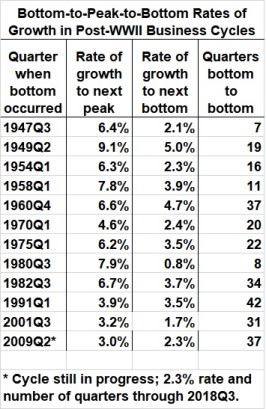
Economic Growth Since World War II, Updated

Here, using data through September 2018. I will tantalize you with a few tid-bits:

(Note: The first, and brief, post-war cycle is omitted.)

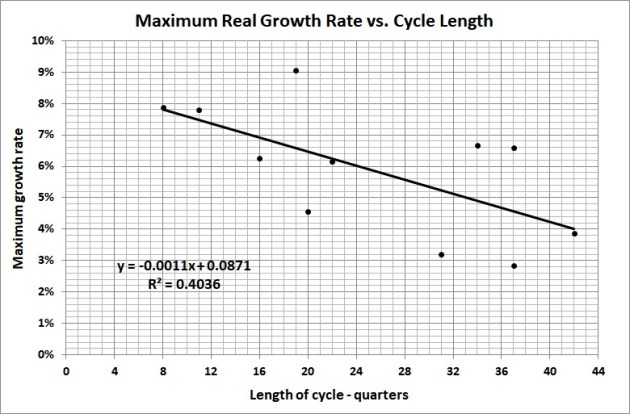
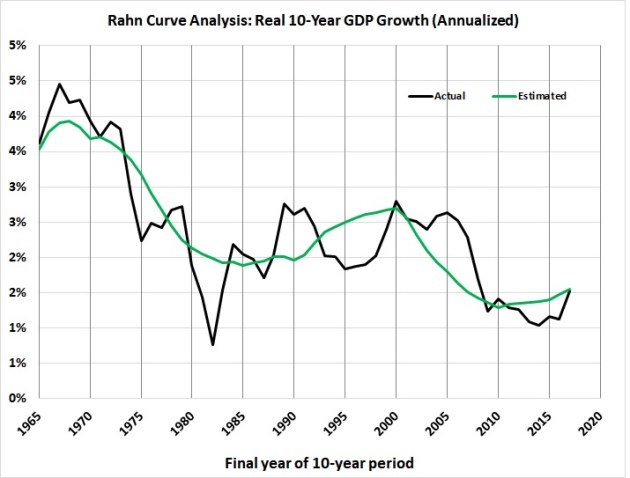
The Rahn Curve depicts the relationship between government spending, as a share of the economy, and the rate of growth. My analysis, which takes into account more than government spending, yields this result:

For a full explanation, go to III. The Rahn Curve in Action.

Enough, Already!

In “Trump Defies Gravity“, and other posts about electoral trends, I contrast President Trump’s approval ratings with and those of his predecessor, over whom the media fawned ad nauseum. As I often note, Trump’s ratings are higher than Obama’s, despite the anti-Trump hysteria in which most of the media engage.

A new page at this blog, “Trump Coverage” A Chronology“, summarizes events related to Donald Trump’s presidency that have drawn media attention. The chronology is taken from Wikipedia‘s pages about newsworthy events in the United States during 2016, 2017, and 2018.

The summary begins with the aftermath of the election of November 8, 2016. Not all of the events listed in Wikipedia‘s chronologies occurred in the U.S., which leads me to wonder why the “migrant caravans” of 2018 aren’t included. They were and are clearly aimed at challenging Trump’s stance on immigration, and provoking incidents that cast Trump in a bad light.

At any rate, the tone of Wikipedia‘s narratives — which I copied verbatim — reflects the one-sided, negative, and apocalyptic coverage that bombards those Americans who bother to read or view mainstream media outlets.

JFK and the Cuban Missile Crisis

Speaking of JFK, as I do tangentially in the preceding post, I am reminded by Humberto Fontava, writing at FrontPage Mag, that the Cuban Missile Crisis was drawing to an inglorious end 56 years ago:

Those who think “Fake News” started with Trump’s term and the media’s “slobbering love affair” with a U.S. president started during Obama’s should have seen John F. Kennedy’s term.

Imagine Obama’s term with no Fox News, internet or talk radio. That’s about what JFK enjoyed. And tragically, the fairy tales Kennedy’s court scribes (with their media cohorts of the time) concocted about JFK’s Pattonesque handling of the Cuban Missile Crisis prevail in media/academic circles even today.

In fact, that Khrushchev swept the floor with cowed Kennedy during the Cuban Missile Crisis was mainstream conservative conclusion throughout much of the Cold War. Richard Nixon and Barry Goldwater, for instance, represented opposite poles of the Republican establishment of their time.

“We locked Castro’s communism into Latin America and threw away the key to its removal,” growled Barry Goldwater about the JFK’s Missile Crisis “solution.”

“Kennedy pulled defeat out of the jaws of victory,” complained Richard Nixon. “Then gave the Soviets squatters rights in our backyard.”

Generals Curtis Le May and Maxwell Taylor represented opposite poles of the military establishment.

“The biggest defeat in our nation’s history!” bellowed Air Force chief Curtis Lemay while whacking his fist on his desk upon learning the details of the deal.

“We missed the big boat,” complained Gen. Maxwell Taylor after learning of same.

“We’ve been had!” yelled then Navy chief George Anderson upon hearing on October 28, 1962, how JFK “solved” the missile crisis. Adm. Anderson was the man in charge of the very “blockade” against Cuba.

“It’s a public relations fable that Khrushchev quailed before Kennedy,” wrote Alexander Haig. “The legend of the eyeball to eyeball confrontation invented by Kennedy’s men paid a handsome political dividend. But the Kennedy-Khrushchev deal was a deplorable error resulting in political havoc and human suffering through the America’s.”

William Buckley’s National Review devoted several issues to exposing and denouncing Kennedy’s appeasement. The magazine’s popular “The Third World War” column by James Burnham roundly condemned Kennedy’s Missile Crisis solution as “America’s Defeat.”

Even Democratic luminary Dean Acheson despaired: “This nation lacks leadership,” he grumbled about the famous “Ex-Comm meetings” so glorified in the movie Thirteen Days. “The meetings were repetitive and without direction. Most members of Kennedy’s team had no military or diplomatic experience whatsoever. The sessions were a waste of time.”

But not for the Soviets. “We ended up getting exactly what we’d wanted all along,” snickered Nikita Khrushchev in his diaries, “security for Fidel Castro’s regime and American missiles removed from Turkey and Italy. Until today the U.S. has complied with her promise not to interfere with Castro and not to allow anyone else to interfere with Castro. After Kennedy’s death, his successor Lyndon Johnson assured us that he would keep the promise not to invade Cuba.”

There’s much more. Read the whole thing.

My own views, which span several posts, are gathered here:

The botched [Bay of Pigs] invasion pushed Castro closer to the USSR, which led to the Cuban missile crisis.

JFK’s inner circle was unwilling to believe that Soviet missile facilities were enroute to Cuba, and therefore unable to act before the facilities were installed. JFK’s subsequent unwillingness to attack the missile facilities made it plain to Kruschev that the the Berlin Wall (erected in 1961) would not fall and that the U.S. would not risk armed confrontation with the USSR (conventional or nuclear) for the sake of the peoples behind the Iron Curtain. Thus the costly and tension-ridden Cold War persisted for almost another three decades. (“Whose Incompetence Do You Trust?“)

*   *   *

I should add that Kennedy’s willingness to withdraw missiles from Turkey — a key element of the settlement with the USSR — played into Nikita Krushchev‘s hands, further emboldening the Soviet regime. (“Presidential Legacies“)

*   *   *

JFK succeeded Eisenhower before the [Bay of Pigs] invasion took place, in April 1961. JFK approved changes in the invasion plan that resulted in the failure of the invasion. The most important change was to discontinue air support for the invading forces. The exiles were defeated, and Castro has remained firmly in control of Cuba.

The failed invasion caused Castro to turn to the USSR for military and economic assistance. In exchange for that assistance, Castro agreed to allow the USSR to install medium-range ballistic missiles in Cuba. That led to the so-called Cuban Missile Crisis in 1962. Many historians give Kennedy credit for resolving the crisis and avoiding a nuclear war with the USSR. The Russians withdrew their missiles from Cuba, but JFK had to agree to withdraw American missiles from bases in Turkey. (“The Modern Presidency: A Tour of American History since 1900“)

*   *   *

The Cold War had some “hot” moments and points of high drama. Perhaps the most notable of them was the so-called Cuban Missile Crisis of 1962, which was not the great victory proclaimed by the Kennedy administration and its political and academic sycophants… That the U.S. won the Cold War because the USSR’s essential bankruptcy was exposed by Ronald Reagan’s defense buildup is a fact that only left-wingers and dupes will deny. They continue to betray their doomed love of communism by praising the hapless Mikhail Gorbachev for doing the only thing he could do in the face of U.S. superiority: surrender and sunder the Soviet empire. America’s Cold War victory owes nothing to LBJ (who wasted blood and treasure in Vietnam), Richard Nixon (who would have sold his mother for 30 pieces of silver), or Jimmy Carter (whose love for anti-American regimes and rebels knows no bounds). (“Rating America’s Wars“)

How does JFK stack up against other presidents? I still like my 14-year-old debunking of historians’ perennial ranking of presidents. Here’s my pithy commentary about JFK, who was placed in the “above average” category

Spent most of his time in bed (sick or with mistresses), so how can he be ranked?

Nothing became JFK’s presidency like the pomp and undeserved encomiums that ensued his leaving of it.

Remember Lee Harvey Oswald?

There’s a lot of this going around:

In the wake of a series of bomb scares targeting prominent Democrat leaders, Steve Schmidt, a former campaign strategist for the late Sen. John McCain (R-AZ), called President Donald Trump the “greatest demagogue” in U.S. history — who has stoked a “cold civil war.”

“Trump has stoked a cold civil war in this Country. His rallies brim with menace and he has labeled journalists as enemies of the people,” Schmidt began in a series of tweets Wednesday. “That someone would seek to kill their political enemies is not aberrational but rather the inevitable consequence of Trumps [sic] incitement.”

That — and the accompanying rush by leftists (media included, of course) to blame the “bomb scare” on right-wingers — reminds me of the immediate aftermath of the assassination of JFK. He must have been killed by a right-wing fanatic, spurred on by the “atmosphere of hate” in Dallas (right-wing hate, of course).

Well, Lee Harvey Oswald was no right-wing fanatic. Nor was he spurred on by the “atmosphere of hate” in Dallas. He was spurred on by his inner demons.

How did the media-invented “atmosphere of hate” cause Oswald to shoot JFK? By “atmospheric” induction? There’s a conspiracy theory for you.

Ford, Kavanaugh, and Probability

I must begin by quoting the ever-quotable Theodore Dalrymple. In closing a post in which he addresses (inter alia) the high-tech low-life lynching of Brett Kavanaugh, he writes:

The most significant effect of the whole sorry episode is the advance of the cause of what can be called Femaoism, an amalgam of feminism and Maoism. For some people, there is a lot of pleasure to be had in hatred, especially when it is made the meaning of life.

Kavanaugh’s most “credible” accuser — Christine Blasey Ford (CBF) — was incredible (in the literal meaning of the word) for many reasons, some of which are given in the items listed at the end of “Where I Stand on Kavanaugh“.

Arnold Kling gives what is perhaps the best reason for believing Kavanaugh’s denial of CBF’s accusation, a reason that occurred to me at the time:

[Kavanaugh] came out early and emphatically with his denial. This risked having someone corroborate the accusation, which would have irreparably ruined his career. If he did it, it was much safer to own it than to attempt to get away with lying about it. If he lied, chances are he would be caught–at some point, someone would corroborate her story. The fact that he took that risk, along with the fact that there was no corroboration, even from her friend, suggests to me that he is innocent.

What does any of this have to do with probability? Kling’s post is about the results of a survey conducted by Scott Alexander, the proprietor of Slate Star Codex. Kling opens with this:

Scott Alexander writes,

I asked readers to estimate their probability that Judge Kavanaugh was guilty of sexually assaulting Dr. Ford. I got 2,350 responses (thank you, you are great). Here was the overall distribution of probabilities.

… A classical statistician would have refused to answer this question. In classical statistics, he is either guilty or he is not. A probability statement is nonsense. For a Bayesian, it represents a “degree of belief” or something like that. Everyone who answered the poll … either is a Bayesian or consented to act like one.

As a staunch adherent of the classical position (though I am not a statistician), I agree with Kling.

But the real issue in the recent imbroglio surrounding Kavanaugh wasn’t the “probability” that he had committed or attempted some kind of assault on CBF. The real issue was the ideological direction of the Supreme Court:

  1. With the departure of Anthony Kennedy from the Court, there arose an opportunity to secure a reliably conservative (constitutionalist) majority. (Assuming that Chief Justice Roberts remains in the fold.)
  2. Kavanaugh is seen to be a reliable constitutionalist.
  3. With Kavanaugh in the conservative majority, the average age of that majority would be (and now is) 63; whereas, the average age of the “liberal” minority is 72, and the two oldest justices (at 85 and 80) are “liberals”.
  4. Though the health and fitness of individual justices isn’t well known, there are more opportunities in the coming years for the enlargement of the Court’s conservative wing than for the enlargement of its “liberal” wing.
  5. This is bad news for the left because it dims the prospects for social and economic revolution via judicial decree — a long-favored leftist strategy. In fact, it brightens the prospects for the rollback of some of the left’s legislative and judicial “accomplishments”.

Thus the transparently fraudulent attacks on Brett Kavanaugh by desperate leftists and “tools” like CBF. That is to say, except for those who hold a reasoned position (e.g., Arnold Kling and me), one’s stance on Kavanaugh is driven by one’s politics.

Scott Alexander’s post supports my view:

Here are the results broken down by party (blue is Democrats, red is Republicans):

And here are the results broken down by gender (blue is men, pink is women):

Given that women are disproportionately Democrat, relative to men, the second graph simply tells us the same thing as the first graph: The “probability” of Kavanaugh’s “guilt” is strongly linked to political persuasion. (I am heartened to see that a large chunk of the female population hasn’t succumbed to Femaoism.)

Probability, in the proper meaning of the word, has nothing to do with question of Kavanaugh’s “guilt”. A feeling or inclination isn’t a probability, it’s just a feeling or inclination. Putting a number on it is false quantification. Scott Alexander should know better.

No Recession on the Horizon — As of Now

UPDATED 03/02/19

Henry Hazlett explains the relationship between inflation and recession:

[W]hen an inflation has long gone on at a certain rate, the public expects it to continue at that rate. More and more people’s actions and demands are adjusted to that expectation. This affects sellers, buyers, lenders, borrowers, workers, employers. Sellers of raw materials ask more from fabri­cators, and fabricators are willing to pay more. Lenders ask more from borrowers. They put a “price premium” on top of their normal interest rate to offset the ex­pected decline in purchasing pow­er of the dollars they lend. Workers insist on higher wages to compensate them not only for present higher prices but against their expectation of still higher prices in the future.

The result is that costs begin to rise at least as fast as final prices. Real profit margins are no longer greater than before the inflation began. In brief, inflation at the old rate has ceased to have any stimulative effect. Only an in­creased rate of inflation, only a rate of inflation greater than gen­erally expected, only an acceler­ative rate of inflation, can con­tinue to have a stimulating effect.

But in time even an accelerative rate of inflation is not enough. Expectations, which at first lagged behind the actual rate of inflation, begin to move ahead of it. So costs often rise faster than final prices. Then inflation actu­ally has a depressing effect on business.

This would be the situation even if all retail prices tended to go up proportionately, and all costs tended to go up proportionately. But this never happens — a crucial fact that is systematically con­cealed from those economists who chronically fix their attention on index numbers or similar aver­ages. These economists do see that the average of wholesale prices usually rises faster than the aver­age of retail consumer prices, and that the average of wage-rates also usually rises faster than the average of consumer prices. But what they do not notice until too late is that market prices and costs are all rising unevenly, dis­cordantly, and even disruptively. Price and cost relationships be­come increasingly discoordinated. In an increasing number of in­dustries profit margins are being wiped out, sales are declining, losses are setting in, and huge layoffs are taking place. Unem­ployment in one line is beginning to force unemployment in others. [“How Inflation Breeds Recession“, Foundation for Economic Education, March 1, 1975]

Inflation is a symptom — or early-warning signal — of disruptions that lead to recessions. It does not cause recessions. Here’s some evidence, based on post-World War II experience:


Derived from GDP statistics available here and CPI statistics available here. The correlation coefficient is highly significant, with a p-value <.0001.

Correlations where the change in CPI leads the change in GDP are uniformly and significantly better than correlations where there is no lead or the change in GDP leads the change in CPI. Further, the correlation where the change in CPI leads the change in GDP by 3 quarters is better than correlations with 1, 2, and 4-quarter lead — but not by much. So there is good statistical evidence on which to base my claim that the change CPI is a leading indicator of recessions.

Specifically, the strongest signal is a rising quarterly change in CPI:


Recessions are defined here, in the discussion that follows figure 1.

The good news is that, as of now, CPI isn’t signalling a recession: annualized quarterly changes aren’t on the rise.

Why I Don’t Believe in “Climate Change”

UPDATED AND EXTENDED, 11/01/18

There are lots of reasons to disbelieve in “climate change”, that is, a measurable and statistically significant influence of human activity on the “global” temperature. Many of the reasons can be found at my page on the subject — in the text, the list of related readings, and the list of related posts. Here’s the main one: Surface temperature data — the basis for the theory of anthropogenic global warming — simply do not support the theory.

As Dr. Tim Ball points out:

A fascinating 2006 paper by Essex, McKitrick, and Andresen asked, Does a Global Temperature Exist.” Their introduction sets the scene,

It arises from projecting a sampling of the fluctuating temperature field of the Earth onto a single number (e.g. [3], [4]) at discrete monthly or annual intervals. Proponents claim that this statistic represents a measurement of the annual global temperature to an accuracy of ±0.05 ◦C (see [5]). Moreover, they presume that small changes in it, up or down, have direct and unequivocal physical meaning.

The word “sampling” is important because, statistically, a sample has to be representative of a population. There is no way that a sampling of the “fluctuating temperature field of the Earth,” is possible….

… The reality is we have fewer stations now than in 1960 as NASA GISS explain (Figure 1a, # of stations and 1b, Coverage)….

Not only that, but the accuracy is terrible. US stations are supposedly the best in the world but as Anthony Watt’s project showed, only 7.9% of them achieve better than a 1°C accuracy. Look at the quote above. It says the temperature statistic is accurate to ±0.05°C. In fact, for most of the 406 years when instrumental measures of temperature were available (1612), they were incapable of yielding measurements better than 0.5°C.

The coverage numbers (1b) are meaningless because there are only weather stations for about 15% of the Earth’s surface. There are virtually no stations for

  • 70% of the world that is oceans,
  • 20% of the land surface that are mountains,
  • 20% of the land surface that is forest,
  • 19% of the land surface that is desert and,
  • 19% of the land surface that is grassland.

The result is we have inadequate measures in terms of the equipment and how it fits the historic record, combined with a wholly inadequate spatial sample. The inadequacies are acknowledged by the creation of the claim by NASA GISS and all promoters of anthropogenic global warming (AGW) that a station is representative of a 1200 km radius region.

I plotted an illustrative example on a map of North America (Figure 2).

clip_image006

Figure 2

Notice that the claim for the station in eastern North America includes the subarctic climate of southern James Bay and the subtropical climate of the Carolinas.

However, it doesn’t end there because this is only a meaningless temperature measured in a Stevenson Screen between 1.25 m and 2 m above the surface….

The Stevenson Screen data [are] inadequate for any meaningful analysis or as the basis of a mathematical computer model in this one sliver of the atmosphere, but there [are] even less [data] as you go down or up. The models create a surface grid that becomes cubes as you move up. The number of squares in the grid varies with the naïve belief that a smaller grid improves the models. It would if there [were] adequate data, but that doesn’t exist. The number of cubes is determined by the number of layers used. Again, theoretically, more layers would yield better results, but it doesn’t matter because there are virtually no spatial or temporal data….

So far, I have talked about the inadequacy of the temperature measurements in light of the two- and three-dimensional complexities of the atmosphere and oceans. However, one source identifies the most important variables for the models used as the basis for energy and environmental policies across the world.

“Sophisticated models, like Coupled General Circulation Models, combine many processes to portray the entire climate system. The most important components of these models are the atmosphere (including air temperature, moisture and precipitation levels, and storms); the oceans (measurements such as ocean temperature, salinity levels, and circulation patterns); terrestrial processes (including carbon absorption, forests, and storage of soil moisture); and the cryosphere (both sea ice and glaciers on land). A successful climate model must not only accurately represent all of these individual components, but also show how they interact with each other.”

The last line is critical and yet impossible. The temperature data [are] the best we have, and yet [they are] completely inadequate in every way. Pick any of the variables listed, and you find there [are] virtually no data. The answer to the question, “what are we really measuring,” is virtually nothing, and what we measure is not relevant to anything related to the dynamics of the atmosphere or oceans.

I am especially struck by Dr. Ball’s observation that the surface-temperature record applies to about 15 percent of Earth’s surface. Not only that, but as suggested by Dr. Ball’s figure 2, that 15 percent is poorly sampled.

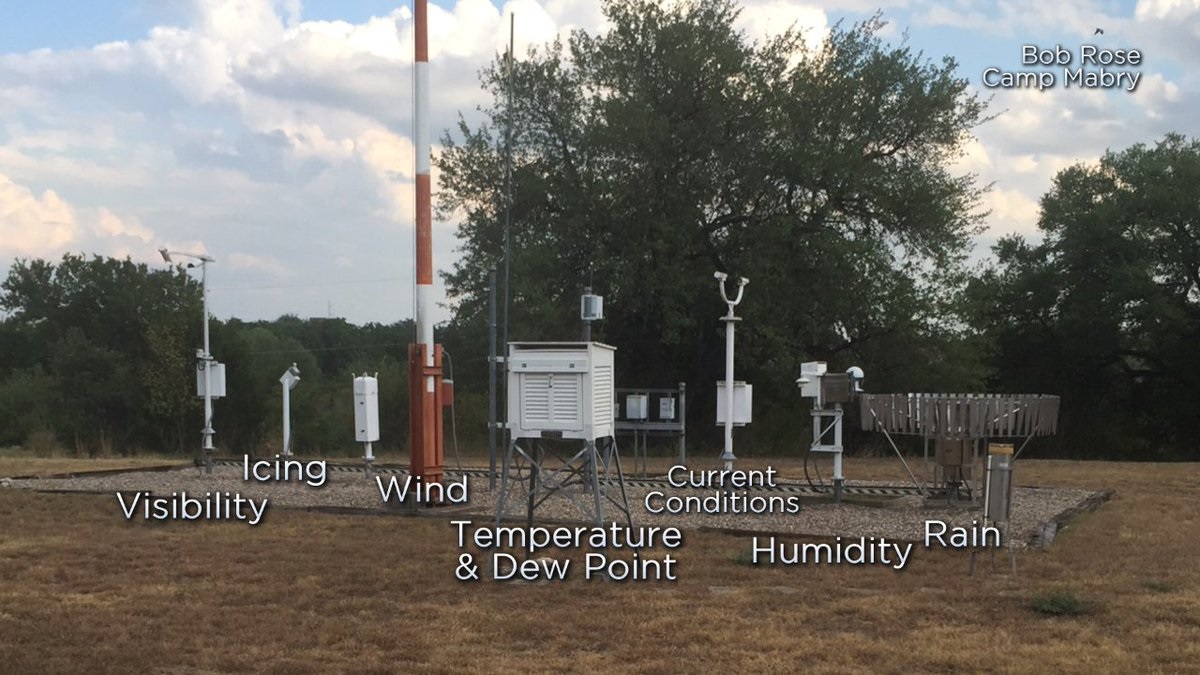
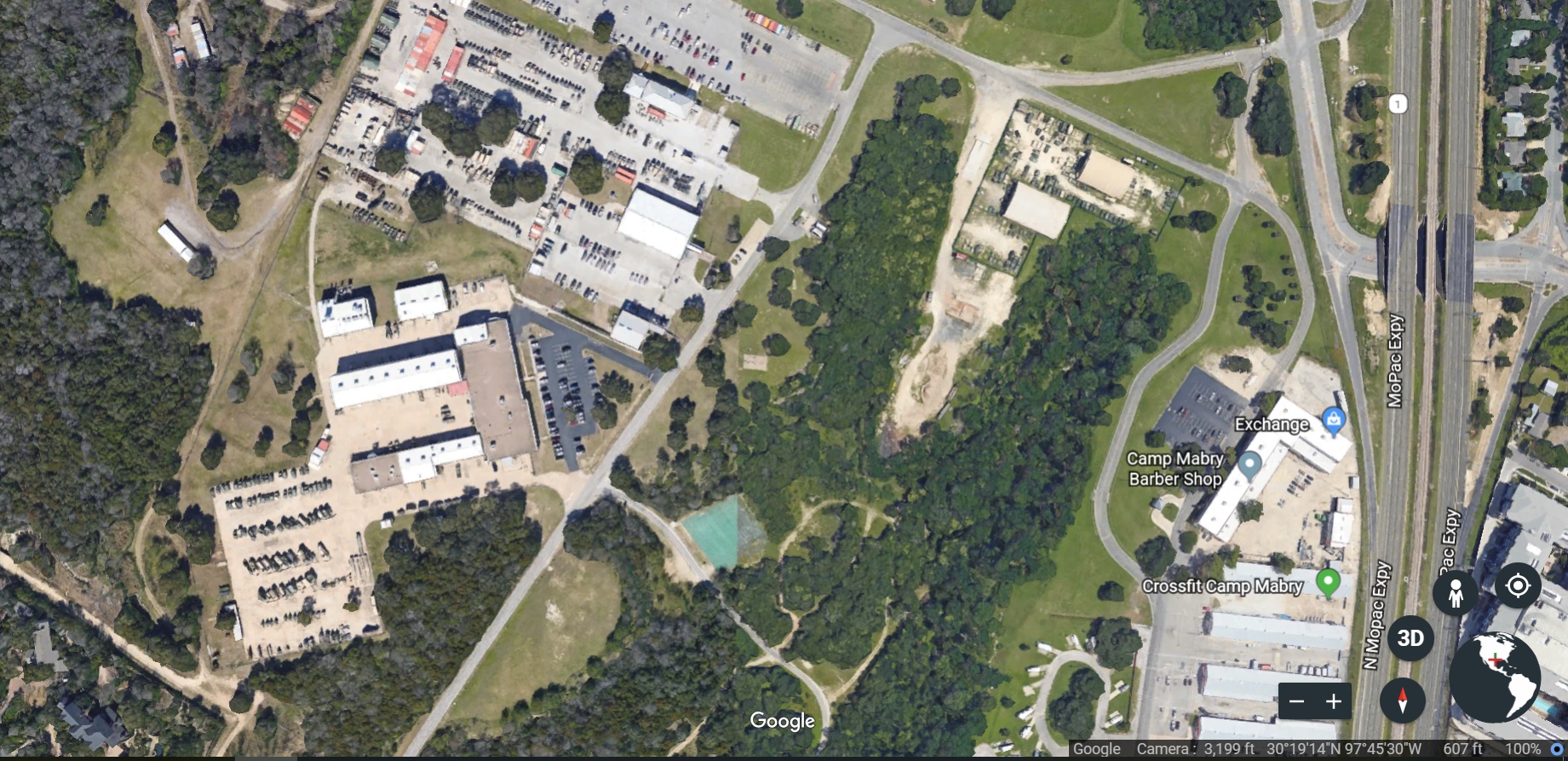
Take the National Weather Service station for Austin, Texas, which is located 2.7 miles from my house. The station is on the grounds of Camp Mabry, a Texas National Guard base near the center of Austin, the fastest-growing large city in the U.S. The base is adjacent to a major highway (Texas Loop 1) that traverses Austin. The weather station is about 1/4 mile from the highway,100 feet from a paved road on the base, and near a complex of buildings and parking areas.

Here’s a ground view of the weather station:

And here’s an aerial view; the weather station is the tan rectangle at the center of the photo:

As I have shown elsewhere, the general rise in temperatures recorded at the weather station over the past several decades is fully explained by the urban-heat-island effect due to the rise in Austin’s population during those decades.

Further, there is a consistent difference in temperature and rainfall between my house and Camp Mabry. My house is located farther from the center of Austin — northwest of Camp Mabry — in a topographically different area. The topography in my part of Austin is typical of the Texas Hill Country, which begins about a mile east of my house and covers a broad swath of land stretching as far as 250 miles from Austin.

The contrast is obvious in the next photo. Camp Mabry is at the “1” (for Texas Loop 1) near the lower edge of the image. Topographically, it belongs with the flat part of Austin that lies mostly east of Loop 1. It is unrepresentative of the huge chunk of Austin and environs that lies to its north and west.

Getting down to cases. I observed that in the past summer, when daily highs recorded at Camp Mabry hit 100 degrees or more 52 times, the daily high at my house reached 100 or more only on the handful of days when it reached 106-110 at Camp Mabry. That’s consistent with another observation; namely, that the daily high at my house is generally 6 degrees lower than the daily high at Camp Mabry when it is above 90 degrees there.

As for rainfall, my house seems to be in a different ecosystem than Camp Mabry’s. Take September and October of this year: 15.7 inches of rain fell at Camp Mabry, as against 21.0 inches at my house. The higher totals at my house are typical, and are due to a phenomenon called orographic lift. It affects areas to the north and west of Camp Mabry, but not Camp Mabry itself.

So the climate at Camp Mabry is not my climate. Nor is the climate at Camp Mabry typical of a vast area in and around Austin, despite the use of Camp Mabry’s climate to represent that area.

There is another official weather station at Austin-Bergstrom International Airport, which is in the flatland 9.5 miles to the southeast of Camp Mabry. Its rainfall total for September and October was 12.8 inches — almost 3 inches less than at Camp Mabry — but its average temperatures for the two months were within a degree of Camp Mabry’s. Suppose Camp Mabry’s weather station went offline. The weather station at ABIA would then record temperatures and precipitation even less representative of those at my house and similar areas to the north and west.

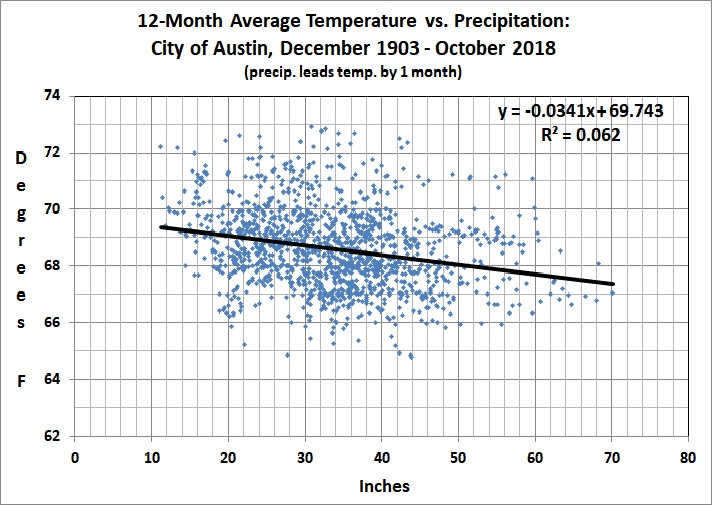
Speaking of precipitation — it is obviously related to cloud cover. The more it rains, the cloudier it will be. The cloudier it is, the lower the temperature, other things being the same (e.g., locale). This is true for Austin:

12-month avg temp vs. precip

The correlation coefficient is highly significant, given the huge sample size. Note that the relationship is between precipitation in a given month and temperature a month later. Although cloud cover (and thus precipitation) has an immediate effect on temperature, precipitation has a residual effect in that wet ground absorbs more solar radiation than dry ground, so that there is less heat reflected from the ground to the air. The lagged relationship is strongest at 1 month, and considerably stronger than any relationship in which temperature leads precipitation.

I bring up this aspect of Austin’s climate because of a post by Anthony Watts (“Data: Global Temperatures Fell As Cloud Cover Rose in the 1980s and 90s“, Watts Up With That?, November 1, 2018):

I was reminded about a study undertaken by Clive Best and Euan Mearns looking at the role of cloud cover four years ago:

Clouds have a net average cooling effect on the earth’s climate. Climate models assume that changes in cloud cover are a feedback response to CO2 warming. Is this assumption valid? Following a study withEuan Mearns showing a strong correlation in UK temperatures with clouds, we  looked at the global effects of clouds by developing a combined cloud and CO2 forcing model to sudy how variations in both cloud cover [8] and CO2 [14] data affect global temperature anomalies between 1983 and 2008. The model as described below gives a good fit to HADCRUT4 data with a Transient Climate Response (TCR )= 1.6±0.3°C. The 17-year hiatus in warming can then be explained as resulting from a stabilization in global cloud cover since 1998.  An excel spreadsheet implementing the model as described below can be downloaded from http://clivebest.com/GCC.

The full post containing all of the detailed statistical analysis is here.

But this is the key graph:

CC-HC4

Figure 1a showing the ISCCP global averaged monthly cloud cover from July 1983 to Dec 2008 over-laid in blue with Hadcrut4 monthly anomaly data. The fall in cloud cover coincides with a rapid rise in temperatures from 1983-1999. Thereafter the temperature and cloud trends have both flattened. The CO2 forcing from 1998 to 2008 increases by a further ~0.3 W/m2 which is evidence that changes in clouds are not a direct feedback to CO2 forcing.

In conclusion, natural cyclic change in global cloud cover has a greater impact on global average temperatures than CO2. There is little evidence of a direct feedback relationship between clouds and CO2. Based on satellite measurements of cloud cover (ISCCP), net cloud forcing (CERES) and CO2 levels (KEELING) we developed a model for predicting global temperatures. This results in a best-fit value for TCR = 1.4 ± 0.3°C. Summer cloud forcing has a larger effect in the northern hemisphere resulting in a lower TCR = 1.0 ± 0.3°C. Natural phenomena must influence clouds although the details remain unclear, although the CLOUD experiment has given hints that increased fluxes of cosmic rays may increase cloud seeding [19].  In conclusion, the gradual reduction in net cloud cover explains over 50% of global warming observed during the 80s and 90s, and the hiatus in warming since 1998 coincides with a stabilization of cloud forcing.

Why there was a decrease in cloud cover is another question of course.

In addition to Paul Homewood’s piece, we have this WUWT story from 2012:

Spencer’s posited 1-2% cloud cover variation found

A paper published last week finds that cloud cover over China significantly decreased during the period 1954-2005. This finding is in direct contradiction to the theory of man-made global warming which presumes that warming allegedly from CO2 ‘should’ cause an increase in water vapor and cloudiness. The authors also find the decrease in cloud cover was not related to man-made aerosols, and thus was likely a natural phenomenon, potentially a result of increased solar activity via the Svensmark theory or other mechanisms.

Case closed. (Not for the first time.)

Do We “Belong” to Government?

A video that played during the Democrat National Convention in 2012 includes this infamous line: “Government is the only thing we all belong to.” I used to reject as literal-minded the kind of interpretation offered by Chris Christie:

I watched [the video] and I didn’t find a whole lot noteworthy about it, except for this: the Democratic National Convention, this is what they said about what Democrats believe. They said, ‘Government is the only thing we all belong to.’

Now I want you to listen to that again. I’m gonna say it slowly. I want you to listen to it again. This is what the Democrats under Barack Obama believe: ‘Government is the only thing we all belong to.’…

[T]he Constitution doesn’t start by saying, ‘We the government,’ does it? It says, ‘We the people.’ All power and authority emanates from the people, and that power and authority, which through that document and our other laws we delegate to the government is the power and authority they have. They belong to us.

You see, that’s what we believed from the founding of our country, but Barack Obama believes something very, very different. He absolutely believes we belong to him. He believes that we are just pawns to be moved around his giant chessboard of government. He’s gonna pick the winners and the losers.

In my guile, I ascribed a different meaning to the statement: “We the people” belong to government in the same way that a Rotarian belongs to the Rotary Club, a Boy Scout belongs to the Boy Scouts, etc. That is, “we the people” are members of a huge club known as the government of the United States. “Our” membership in the club ensures that it works for “our” collective benefit.

Not that I agreed with that interpretation. What would happen to you if you stopped paying your “dues”, that is, your taxes? You wouldn’t be kicked out of the club, you’d be put in a special place that the club maintains for recalcitrant members: prison. It’s a crazy kind of club that admits new members who don’t pay dues, and who sponge off other members. I’m talking about illegal immigrants, of course.

But I was wrong, and Christie was right, as I will come to.

First, I must point out the vast difference between love of country and “belonging” to the apparatus that runs it.

There are patriots who love the United States and swear allegiance to it. But their love is love of country, not love of government. In particular, it’s love of “old America” — still alive (or fondly remembered) in many places:

Old America‘s core constituents, undeniably, were white, and they had much else in common: observance of the Judeo-Christian tradition; British and north-central European roots; hard work and self-reliance as badges of honor; family, church, and club as cultural transmitters, social anchors, and focal points for voluntary mutual aid. The inhabitants of Old America were against “entitlements” (charity was real and not accepted lightly); for punishment (as opposed to excuses about poverty, etc.); overtly religious or respectful of religion (and, in either case, generally respectful of the Ten Commandments, especially the last six of them); personally responsible (stuff happens, and it is rarely someone else’s fault); polite, respectful, and helpful to strangers (who are polite and respectful); patriotic (the U.S. was better than other countries and not beholden to international organizations, wars were fought to victory); and anti-statist (even if communitarian in a voluntary way). Living on the dole, weirdness for its own sake, open hostility to religion, habitual criminality, “shacking up,” and homosexuality were disgraceful aberrations, not “lifestyles” to be tolerated, celebrated, or privileged.

All of that has long been under attack by leftists of the kind who believe that we all “belong” to government in the way that Chris Christie understood. Government is leftists’ poor substitute for the social and cultural richness of real America. It is their religion-substitute, as well.

Hegel saw it coming:

The State subsumes family and civil society and fulfills them…. An individual’s “supreme duty is to be a member of the state”…. Members of a Hegelian State are happy even to sacrifice their lives for the State.

As Bertrand de Jouvenel puts it,

[Hegel’s] novel conception of society had momentous consequences. The idea of the common good now gets a completely different content from its former one. It is no longer a question simply of helping each individual to realize his own private good … but of achieving a social good of much less definite character…. [A]ll is changed when the rights that belong to individuals … give place to an ever more exalted morality which must needs be realized in society….

… There is now a collective being, which is of far greater importance than individuals: clearly, then, the right transcendent of sovereignty belongs to non other. It is the sovereignty of the nation which is, as has often been stressed, a very different thing from the sovereignty of the people…. [S]ociety fulfills itself as a whole only to the extent that partakers of it know themselves for members and see it in their end; from which it follows logically that those only who have attained to this knowledge are steering society toward its fulfillment. In them is all guidance and leadership; the general will coincides with their will only; theirs is the general will. [On Power: The Natural History of its Growth, Liberty Press edition (1993), pp. 54-55]

So, yes, it is true that in the left’s view we do “belong” to government. Not the government “of the people”, but the government of the administrative state championed by Woodrow Wilson:

Wilson insisted that “administration lies outside the proper sphere of politics” and that “general laws which direct these things to be done are as obviously outside of and above administration.” He likened administration to a machine that functions independent of the changing mood of its leaders. Such a line of demarcation is intended to focus responsibility for actions taken on the people or persons in charge. As Wilson put it, “public attention must be easily directed, in each case of good or bad administration, to just the man deserving of praise or blame. There is no danger in power, if only it be not irresponsible. If it be divided, dealt out in share to many, it is obscured”. Essentially, he contended that the items under the discretion of administration must be limited in scope, as to not block, nullify, obfuscate, or modify the implementation of governmental decree made by the executive branch.

Which suits leftists as long as the decrees are theirs, and do not inconvenience them too much. Leftists have this way of believing that they will survive the “revolution”, unlike their counterparts in the France of the 1790s and the Russia of Lenin and Stalin. The tragedy is that they will take the rest of us with them.


Related pages and posts:

Leftism
Leftism: A Bibliography

Liberty and Society
The Eclipse of “Old America”
Genetic Kinship and Society
“We the People” and Big Government
An Ideal World
James Burnham’s Misplaced Optimism

What Happens Next?

In what direction will leftists move after next month’s elections?

1. Will they be chastened by defeat and tone down their verbal and physical violence?

2. Will they be frustrated by defeat and keep it up?

3. Will they tone it down if broadly victorious?

4. Will they keep it up if broadly victorious, in the belief that more of the same will yield more of the same.

5. Or will they just keep it up because leftism and violence are intertwined?

The left isn’t monolithic, of course. The loony-left fringe — which is much more than a fringe — will choose #5.

Most left-wing politicians, on the other hand, will probably tone it down — win, lose, or draw. That is, they will choose #1 or #3.

I expect that it will come down to #1. This is from a recent article (behind a paywall) at Rasmussen Reports:

Republicans are madder about the Kavanaugh controversy than Democrats are and more determined to vote in the upcoming elections because of it.

A new Rasmussen Reports national telephone and online survey finds that 54% of all Likely U.S. Voters say they are more likely to vote in the upcoming midterm elections because of the controversy surrounding President Trump’s U.S. Supreme Court nominee. Only nine percent (9%) say they are less likely to vote. Thirty-four percent (34%) say the controversy will have no impact on their vote.

Sixty-two percent (62%) of Republicans are more likely to vote because of the Kavanaugh controversy, compared to 54% of Democrats and 46% of voters not affiliated with either major political party.

Sixty-two percent (62%) of all voters are angry about the U.S. Senate’s treatment of Kavanaugh, with 42% who are Very Angry. Fifty-six percent (56%) are angry about how the Senate treated Christine Blasey Ford, the woman who accused Kavanaugh of sexual assault, including 35% who are Very Angry.

Sixty-four percent (64%) of Republicans are Very Angry about the Senate’s treatment of Kavanaugh, a view shared by 30% of Democrats and 34% of unaffiliated voters. By comparison, fewer Democrats (48%) are Very Angry about the Senate’s treatment of Ford; 28% of GOP voters and 30% of unaffiliateds agree.

Democrats’ five-point lead on the weekly Rasmussen Reports Generic Congressional Ballot has vanished. The two parties are now tied with less than a month until Election Day. We’ll be watching to see if this is the beginning of a post-Kavanaugh trend.


Related posts:

Trump Defies Gravity
The House Hangs in the Balance

Election 2018 — Latest Updates

Trump Defies Gravity” — Note especially the “Right Direction”/”Wrong Track” ratio in figure 5 (and in the sidebar). It’s near its post-honeymoon peak for Trump. And it’s about twice as large as the ratio of eight years earlier, when BHO was running ruining the country.

The House Hangs in the Balance” — Signs that the House will remain in GOP hands.

The Decline of Collegiality

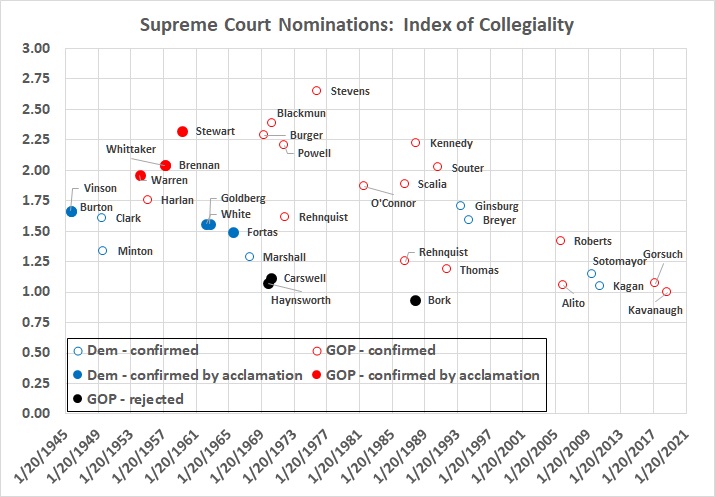
Since the end of World War II there have been 35 floor votes in the Senate to confirm or reject Supreme Court nominees. Unsurprisingly, the outcome of the 35 votes reveals a striking decline in the Senate’s collegiality.

To quantify the decline, I constructed an index of collegiality (C):

C = Fraction of votes in favor of confirming a nominee/fraction of Senate seats held by the nominating president’s party

A C score greater than 1 implies some degree of (net) support from the opposing party. The higher the C score, the greater the degree of support from the opposing party.

Examples:

  1. Tom Clark, nominated by Democrat Harry Truman, was confirmed on August 18, 1949, by a vote of 73-8; that is, he received 90 percent of the votes cast. Democrats then held a 54-42 majority in the Senate, just over 56 percent of the Senate’s 96 seats. Dividing Clark’s share of the vote by the Democrats’ share of Senate seats yields C = 1.60. Clark, in other words, received 1.6 times the number of votes controlled by the party of the nominating president.
  2. Samuel Alito, nominated by Republican George W. Bush, was confirmed on January 31, 2006, by a vote of 58-42; that is, he received 58 percent of the votes cast. Republicans then held 55 percent of the Senate’s 100 seats. The C score for Alito’s nomination is 1.05 (0.58/0.55).

Nine nominees were approved by acclamation, that is, by a unanimous voice vote. In such cases, the value of the numerator in C is 1. But C varies, even in cases of acclamation, because of variations in the fraction of seats held by the party of the nominating president. In any event, the last confirmation by acclamation was in 1965 — an ill omen for collegiality.

Three nominations were rejected in an “up or down” vote. (Several others failed, by withdrawal or lack of cloture, before reaching a final vote.) Two of the rejections were of Nixon nominees: Clement Haynsworth (1969) and G. Harold Carswell (1970). One was a Reagan nominee: Robert Bork (1987). Because the GOP held such a small fraction of Senate seats in 1969 and 1970, the C values for Haynsworth and Carswell actually exceed 1. But Bork was so roundly defeated that the C value for his nomination is less than 1 — the only such case. Kavanaugh’s nomination came close, at 1.004 — the lowest C value for a confirmation in the past 73 years.

All of this, and more, is captured in the following graph:

C peaked in 1975 with the confirmation of John Paul Stevens, a nominee of Republican Gerald Ford. (One of many disastrous nominations by GOP presidents.) It has gone downhill since then. The treatment of Brett Kavanaugh caps four decades of generally declining collegiality.

The decline began in Reagan’s presidency, and gained momentum in the presidency of Bush Sr. Clinton’s nominees fared about as well (or badly) as those of his two predecessors. But new lows (for successful nominations) were reached during the presidencies of Bush Jr., Obama, and Trump.

None of this is surprising given the deterioration of political discourse over the past several decades — and especially given the demonization of Republicans by Democrats and their allies in the media. What is surprising — gratifying, really — is that Republicans seem to be waking up to the fact that playing Mr. Nice Person will not win them any points with Democrats, the media, or their base.

The only way to win, in the present and foreseeable political climate, is to fight hard, and fight to the bitter (or sweet) end.


Related pages and posts:

Constitution: Myths and Realities (see especially “The Framers’ Fatal Error”)
Leftism
Spygate
U.S. Supreme Court: Lines of Succession and Ideological Alignmen

Liberty and Society
The Eclipse of “Old America”
Genetic Kinship and Society
America: Past, Present, and Future
IQ, Political Correctness, and America’s Present Condition
The Barbarians Within and the State of the Union
The World Turned Upside Down
The View from Here
“We the People” and Big Government
The Culture War
The Fall and Rise of American Empire
O Tempora O Mores!
Presidential Treason
A Home of One’s Own
The Criminality and Psychopathy of Statism
Decline
Two-Percent Tyranny
A Sideways Glance at Public “Education”
Greed, Conscience, and Big Government
Democracy, Human Nature, and the Future of America
1963: The Year Zero
The Beginning of the End of Liberty in America
Society
How Democracy Works
“Cheerful” Thoughts
How Government Subverts Social Norms
Turning Points
The Twilight’s Last Gleaming?
Polarization and De-facto Partition
How America Has Changed
Civil War?
Freedom of Speech and the Long War for Constitutional Governance
Retrospective Virtue-Signalling
The Left and Violence
Leftist Condescension
Red-Diaper Babies and Enemies Within
Equality
The Vast Left-Wing Conspiracy
Academic Freedom, Freedom of Speech, and the Demise of Civility
Leftism As Crypto-Fascism: The Google Paradigm
What Is Going On? A Stealth Revolution
Down the Memory Hole
“Why Can’t We All Just Get Along?”
Mass Murder: Reaping What Was Sown
“Democracy” Thrives in Darkness — and Liberty Withers
Preemptive (Cold) Civil War
The Framers, Mob Rule, and a Fatal Error
Whence Polarization?
Social Norms, the Left, and Social Disintegration
The Lesson of Alfie Evans
Can Left and Right Be Reconciled?
Freedom of Speech: Getting It Right
Justice Thomas on Masterpiece Cakeshop
Suicide or Destiny?
“Liberalism” and Virtue-Signaling
Freedom of Speech, to What End?
Conservatism vs. Ideology
O.J.’s Glove and the Enlightenment
James Burnham’s Misplaced Optimism
Where I Stand on Kavanaugh
No More SCOTUS “Swing Vote”? Good!

No More SCOTUS “Swing Vote”? Good!

NOTE: I HAVE UPDATED “U.S. SUPREME COURT: LINES OF SUCCESSION AND IDEOLOGICAL ALIGNMENT” TO REFLECT THE CONFIRMATION OF BRETT MICHAEL KAVANAUGH AS AN ASSOCIATE JUSTICE OF THE U.S. SUPREME COURT.

Justice Elena Kagan — voicing the fears of leftists — says this about the replacement of Anthony Kennedy by Brett Kavanaugh:

I think it’s been an extremely important thing for the court that in the last, really 30 years, starting with Justice O’Connor and continuing with Justice Kennedy, there has been a person who people — found the center where people couldn’t predict in that sort of way. And that’s enabled the court to look as though it was not owned by one side or another, and was indeed impartial and neutral and fair. And it’s not so clear that — I think, going forward, that sort of middle position — you know, it’s not so clear whether we’ll have it.

All of us need to be aware of that — every single one of us — and to realize how precious the court’s legitimacy is….

It’s an incredibly important thing for the court to guard is this reputation of being impartial, being neutral and not being simply an extension of a terribly polarizing process.

So the job of the Supreme Court isn’t to uphold the Constitution, but to find a middle ground between constitutional and anti-constitutional views.

I am hopeful — but not yet certain — that the addition of Justice Kavanaugh to the Court’s lineup will end the three decades of uncertainty praised by Kagan, and that it will put the Court back in the business of firmly upholding the Constitution. A business that it began to abandon in earnest during the New Deal.

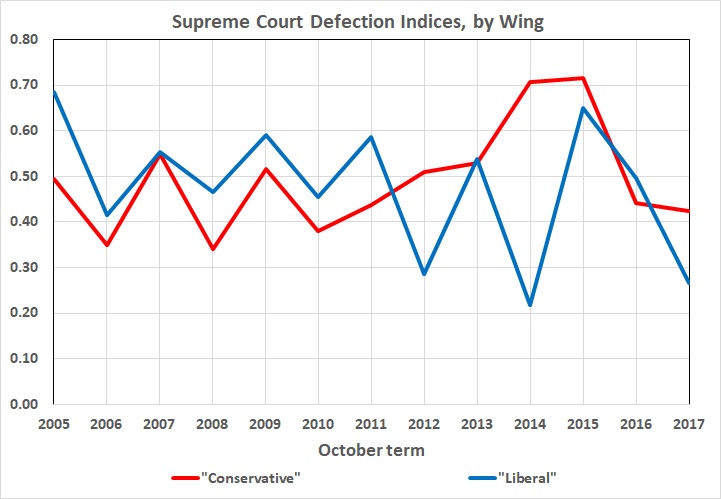
Drawing on statistics kept at SCOTUSblog, I have constructed an index of defection (D) for each justice, for the 2005-2017 terms:

D = percentage disagreement (in non-unanimous cases) with members of own wing/percentage disagreement with members of opposite wing.

The wings are the “conservative” wing (Gorsuch, Alito, Thomas, Scalia, Roberts, and Kennedy) and the “liberal” wing (Breyer, Ginsburg, Kagan, Sotomayor, Souter, and Stevens).

The lower the index, the more prone is a justice to vote with the other members of his or her wing; the higher the index, the more prone is a justice to vote with members of the opposing wing. Here’s a graph of the indices, by term:

Kennedy’s long-standing proneness to defect more often than his colleagues grew markedly in the 2014-2015 terms and receded a bit in the 2016 term. His turnaround in the 2017 term restored him to the Court’s “conservative” wing.

Roberts slipped a bit in the 2017 term but was still more in step with the “conservative” wing than he had been in the 2014-2015 terms.

Gorsuch started out strongly in his abbreviated 2016 term (he joined the Court in April 2017). His slippage in the 2017 term may have been due to the mix of cases at stake.

What’s most striking about the preceding graphs, other than Kennedy’s marked departure from the “conservative” wing after the 2010 term, is the increasing coherence (ideological, not logical) of the “liberal” wing. This graph captures the difference between the wings:

The record of the past six terms (2012-2017) is clear. The “liberals” stick together much more often than the “conservatives”. Perhaps that will change with Justice Kavanough on the Court.

Is the Unemployment Rate Really at a 49-Year Low?

I give due credit to President Trump, whose pro-business rhetoric and policies are fueling a robust recovery from the Obama-induced economic doldrums. But I am compelled to note that there is a long row to hoe when it comes to removing decades’ worth of regulatory shackles from the economy.

As it happens, the real unemployment rate, as I measure it, has receded not to its 1969 level, as advertised, but to a level attained in 2009:

Here’s my explanation:

Since the first four months of 2000, when the labor-force participation rate peaked at 67.3 percent, it declined to 62.3 percent in 2015 before rebounding slightly to a range between 62.7 and 63 percent. It now stands at 62.7 percent.

Further, workers who were pushed into part-time status during the Great Recession were not as fully employed as they were when they were full-time workers. The nominal unemployment rate doesn’t reflect that shift, thus further understating the real unemployment rate.

I constructed the actual unemployment rate by adjusting the nominal rate for (a) the change in the labor-force participation rate and (b) the change in the fraction of workers in full-time status.

The sad fact is that the real unemployment rate didn’t peak at 10 percent in 2010, nor has it declined steadily since then. In fact, the rate peaked in the range of 13 to 14 percent, and remained in that range (with a few exceptions) from September 2009 to February 2014.

The real rate is now 10.3 percent — not the 3.7 percent advertised by the Bureau of Labor Statistics. The last time the real rate was lower than 10.3 percent was in January 2009.

MAD and McNamara

With the anti-Kavanaugh anti-Constitution circus almost over (temporarily), it is time to revisit the weighty matter of defense strategy. In particular, there are some loose threads hanging from my earlier posts (here and here) about mutually assured destruction (MAD).

I have been using this definition of MAD:

[It] is a doctrine of military strategy and national security policy in which a full-scale use of nuclear weapons by two or more opposing sides would cause the complete annihilation of both the attacker and the defender…. It is based on the theory of deterrence, which holds that the threat of using strong weapons against the enemy prevents the enemy’s use of those same weapons.

Implicit in that definition is the sensible view that mutually assured deterrence obtains even where there is a significant disparity in the strengths of opposing forces, as long as the weaker of the forces is strong enough to wreak vast devastation on an enemy. This view is consistent with the concept of overkill: a destructive nuclear capacity exceeding the amount needed to destroy an enemy.

At any rate, I recently discovered something about MAD that I should have learned long ago. The lesson came from Roger Barnett — a professional strategist and esteemed correspondent — who sent me a copy of a chapter that he contributed to American National Security Policy: Essays in Honor of William R. Van Cleave.

Armed with what Dr. Barnett says about MAD (in the course of a deservedly scathing critique of Robert S. McNamara), I went further into the Wikipedia article quoted above, and found this:

The doctrine [MAD] requires that neither side construct shelters on a massive scale. If one side constructed a similar system of shelters, it would violate the MAD doctrine and destabilize the situation, because it would not have to fear the consequences of a second strike. The same principle is invoked against missile defense.

In other words, there is a strict (and improbable) version of MAD that implies a fine balance of strategic-nuclear offenses and defenses. The purpose of this fine balance isn’t mutually assured deterrence; it is mutually assured destruction. Anything that changes the balance is thought to be dangerously destabilizing, thus inviting a preemptive strategic-nuclear attack by the party against which the fine balance has tipped.

This flies in the face of experience and logic. There was no such fine balance throughout the years of the Cold War. The U.S. and USSR had quantitatively and qualitatively different offensive and defensive strategic-nuclear forces. Despite that state of affairs, MAD (in my loose sense of the term) held together for decades. Nothing that the U.S. or USSR did during those decades upset the rough balance of forces. Not the construction of air-raid shelters. Not efforts to develop missile defenses, Not pronouncements about a U.S. strategy of attacking Soviet ballistic-missile submarines in their bastion. Not exercises aimed at demonstrating the ability to undertake such attacks. And so on, into the night.

None of the those things — predictably decried by hand-wringers (mainly appeasing leftists who begrudge defense spending) — was, and is, enough to upset the rough balance of forces that held, and holds, MAD in place. U.S. leaders, for example, could not know with enough certainty that an anti-missile defense system would thwart a retaliatory strike by the USSR, and thus enable the U.S. to launch an devastating first strike. (Nor have U.S. leaders ever been blood-thirsty enough to contemplate such a thing.)  The same kinds of uncertainties (if not lack of blood-thirstiness) have held Soviet and Russian leaders in check.

As I say here (using Russia to stand for the USSR, as well):

The main lesson of the Cold War and its sequel in the US-Russia relationship is that MAD works among major powers.

MAD works mainly because of ASSF – assuredly survivable strategic forces, or enough of them to retaliate (perhaps more than once). It was and is impossible, even with first strikes against all three legs of Russia’s strategic-nuclear triad, to nullify Russia’s strategic retaliatory capability. The same goes for the U.S. triad and retaliatory capability.

These truths have been and are understood by U.S. and Russian leaders. Were they not understood, MAD might have failed at any of the several stress points that arose in the past 70 years.

Mr. McNamara nevertheless hewed to the strict version of MAD. Why, and to what end? I call upon Dr. Barnett for the why:

What underlay McNamara’s thinking about assured destruction was complex. It was a combination of a myopic trust in systems analysis and cost-effectiveness based on an overweening belief in the primacy of technology in the conduct of warfare; a deficiency of knowledge about, a thoroughgoing disinterest in, and a total want of respect for Soviet strategic thought; and, most importantly, an absence of faith and confidence in the rightness of America’s cause and the ability of U.S. leaders to make correct, humane, moral judgments. This combination set the United States on a course for humiliation and political failure in Vietnam, and imposed on the world a false and deeply immoral understanding of strategic interactions among states….

… Mr. McNamara rationalized [assured destruction] initially by arguing publicly that the Soviet Leaders‘ have decided they have lost the quantitative race, and they are not seeking to engage us in that contest…. There is no indication that the Soviets are seeking to develop a strategic nuclear force as large as ours.” Earlier, at the time of the Cuban Missile Crisis. McNamara claimed that parity in strategic weapons had already been attained by the Soviet Union, even though the actual balance of strategic weapons disproportionately favored the United States…..

… Later, assured destruction was said to be the controlling factor to prevent a spiraling out-of-control action-reaction strategic arms race. There was no need to continue to add offensive weapons to the U.S. arsenal so long as an assured assured-destruction capability was maintained.

In spite of such blatant contradiction, McNamara’s henchmen went on to argue that imbalances in the size of strategic arsenals was “destabilizing.” If Country A had appreciably more strategic weapons than Country B, then deterrence was unstable. There would be a temptation on the part of the stronger to launch a disarming strike against the weaker, especially in time of crisis. Furthermore, so long as large differences in inventories of strategic weapons existed, arms control would be impossible; for the weaker side would have no incentive to agree not to build up to equal the stronger, and the latter would have no incentive to reduce its superiority through negotiations. This led to Mr. McNamara’s welcoming the Soviet buildup in strategic weapons: as a consequence the strategic balance would be stabilized, any temptation by the United States to strike first would be scotched, and the foundation for arms control would be put in place.

To what end? I return to Dr. Barnett:

[T]o McNamara, MAD was a horrific bluff — indeed the most terrifying bluff ever issued. Given much of what McNamara said, then and since, there was no intention to carry out the threat posed by assured destruction. It was merely a device to limit the size of the U.S. offensive nuclear arsenal, promote arms control, and prevent the dedicated pursuit of strategic defenses.

As a veteran of the Pentagon during the McNamara regime, I concur wholeheartedly in Dr. Barnett’s judgment:

McNamara’s great, inexcusable moral blunder was to abandon strategic defenses and to lay MAD [mutually assured destruction] as the cornerstone of strategic stability. The damage that wrongheaded course has already caused is immeasurable, and the potential for even greater harm to the United States is truly frightening. At the time McNamara, as Secretary of Defense!, turned away from the key concept of defending U.S. citizens, the entire prospect of space-basing of defenses, for example, had hardly been conceived. Perhaps MAD was necessary as a stop-gap, temporary solution in the absence of defenses. To argue that strategic defenses can never work, can always be overcome, will fuel arms races, and will run contrary to arms control is to be absolutely wrong, and immoral on all counts.

Amen.


Related posts:

The McNamara Legacy: A Personal Perspective
The Decision to Drop the Bomb
The “Predator War” and Self-Defense
Delusions of Preparedness
A Grand Strategy for the United States
Transnationalism and National Defense
The War on Terror, As It Should Have Been Fought
Some Thoughts and Questions about Preemptive War
Defense as an Investment in Liberty and Prosperity
Defense Spending: One More Time
My Defense of the A-Bomb
Pacifism
Today’s Lesson in Economics: How to Think about War
Much Ado about Civilian Control of the Military
LBJ’s Dereliction of Duty
A Rearview Look at the Invasion of Iraq and the War on Terror
Preemptive War Revisited
Bellicosity or Bargaining Strategy?
It’s a MAD, MAD, MAD, MAD World
The Folly of Pacifism (III)
MAD, Again
“MAD, Again”: A Footnote


Remembering an Anniversary

A year ago I forgot to commemorate the 20th anniversary of my retirement on this date in 1997. I will compensate for my lapse by commenting at length this year.

Today is the 21st anniversary of my retirement from full-time employment at a defense think-tank. (I later, and briefly, ventured into part-time employment for the intellectual fulfillment it offered. But it became too much like work, and so I retired in earnest.) If your idea of a think-tank is an outfit filled with hacks who spew glib, politically motivated “policy analysis“, you have the wrong idea about the think-tank where I worked. For most of its history, it was devoted to rigorous, quantitative analysis of military tactics, operations, and systems. Most of its analysts held advanced degrees in STEM fields and economics — about two-thirds of them held Ph.D.s.

I had accumulated 30 years of employment at the think-tank when I retired. (That was in addition to four years as a Pentagon “whiz kid” and owner-operator of a small business.) I spent my first 17 years at the think-tank in analytical pursuits, which included managing other analysts and reviewing their work. I spent the final 13 years on the think-tank’s business side, and served for 11 of those 13 years as chief financial and administrative officer.

I take special delight in observing the anniversary of my retirement because it capped a subtle campaign to arrange the end of my employment on favorable financial terms. The success of the campaign brought a profitable end to a bad relationship with a bad boss.

I liken the campaign to fly-fishing: I reeled in a big fish by accurately casting an irresistible lure then playing the fish into my net. I have long wondered whether my boss ever grasped what I had done and how I had done it. The key was patience; more than a year passed between my casting of the lure and the netting of the fish (early retirement with a financial sweetener). Without going into the details of my “fishing expedition,” I can translate them into the elements of success in any major undertaking:

  • strategy — a broad and feasible outline of a campaign to attain a major objective
  • intelligence — knowledge of the opposition’s objectives, resources, and tactical repertoire, supplemented by timely reporting of his actual moves (especially unanticipated ones)
  • resources — the physical and intellectual wherewithal to accomplish the strategic objective while coping with unforeseen moves by the opposition and strokes of bad luck
  • tactical flexibility — a willingness and ability to adjust the outline of the campaign, to fill in the outline with maneuvers that take advantage of the opposition’s errors, and to compensate for one’s own mistakes and bad luck
  • and — as mentioned — a large measure of patience, especially when one is tempted either to quit or escalate blindly.

My patience was in the service of my felt need to quit the think-tank as it had become under the direction of my boss, the CEO. He had politicized an organization whose effectiveness depended upon its long-standing (and mostly deserved) reputation for independence and objectivity. That reputation rested largely on the organization’s emphasis on empirical research, as opposed to the speculative “policy analysis” that he favored. Further, he — as an avowed Democrat — was also in thrall to political correctness (e.g., a foolish and futile insistence on trying to give blacks a “fair share” of representation on the research staff, despite the paucity of qualified blacks with requisite qualifications). There are other matters that are best left unmentioned, despite the lapse of 21 years.

Because of a special project that I was leading, I could have stayed at the think-tank for at least another three years, had I the stomach for it. And in those three years my retirement fund and savings would have grown to make my retirement more comfortable. But the stress of working for a boss whom I disrespected was too great, so I took the money and ran. And despite occasional regrets, which are now well in the past, I am glad of it.

All of this is by way of prelude to some lessons that I gleaned from my years of work — lessons that may be of interest and value to readers.

If you are highly conscientious (as I am), your superiors will hold a higher opinion of your work than you do. You must constantly remind yourself that you are probably doing better than you think you are. In other words, you should be confident of your ability, because if you feel confident (not self-deluded or big-headed, just confident), you will be less fearful of making mistakes and more willing to venture into new territory. Your value to the company will be enhanced by your self-confidence and by your (justified) willingness to take on new challenges.

When you have established yourself as a valued contributor, you will be better able to stand up to a boss who is foolish, overbearing, incompetent (either singly or in combination). Rehearse your grievances carefully, confront the boss, and then go over his head if he shrugs off your complaints or retaliates against you. But go over his head only if you are confident of (a) your value to the company, (b) the validity of your complaints, and (c) the fair-mindedness of your boss’s boss. (I did this three times in my career. I succeeded in getting rid of a boss the first two times. I didn’t expect to succeed the third time, but it was worth a try because it positioned me for my cushioned exit.)

Patience, which I discussed earlier, is a key to successfully ridding yourself of a bad boss. Don’t push the boss’s boss. He has to admit (to himself) the mistake that he made in appointing your boss. And he has to find a graceful way to retract the mistake.

Patience is also a key to advancement. Never openly campaign for someone else’s job. I got my highest-ranking job simply by positioning myself for it. The big bosses took it from there and promoted me.

On the other hand, if you can invent a job at which you know you’ll succeed — and if that job is clearly of value to the company — go for it. I did it once, and my performance in the job that I invented led to my highest-ranking position.

Through all of that, be prepared to go it alone. Work “friendships” are usually transitory. Your colleagues are (rightly) concerned with their own preservation and advancement. Do not count on them when it comes to fighting battles — like getting rid of a bad boss. More generally, do not count on them. (See the first post listed below.)

Finally, having been a manager for more than half of my 30 years at the think-tank, I learned some things that are spelled out in the third post listed below. Read it if you are a manager, aspiring to be a manager, or simply intrigued by the “mystique” of management.


Related posts:

The Best Revenge
Analysis for Government Decision-Making: Hemi-Science, Hemi-Demi-Science, and Sophistry
How to Manage
Not-So-Random Thoughts (V) (first entry)

Where I Stand on Kavanaugh

As I acquire new information about Christine Blasey Ford’s porous and perjurious memory, I will add links at the bottom of this post.

The cold civil war that rages in America became a bit hotter on September 27, 2018, when Judge Brett Kavanaugh bared his righteous outrage and dared to attack the Democrats who are hypocritically attacking him. Hypocritically? Yes, because Ted Kennedy, Bill Clinton, and Keith Ellison (among many others) have been spared the wrath of Democrats for having committed acts during their adulthood that are far better documented than the charges leveled against Judge Kavanaugh.

Now, Kavanaugh is under attack for having bared his outrage. As if he were not entitled to outrage because, after all, “women must be believed”. There’s a syllogism in there somewhere. It probably goes like this:

Women never lie.

Christine Blasey Ford is a women.

Therefore, Christine Blasey Ford isn’t lying.

That’s a logically valid statement. But, as any respectable professor of logic would tell you, a logically valid statement isn’t necessarily a true statement. The truth of a logically valid statement depends on the truth of its premises. The major premise — women never lie — is prima facie untrue. “Women must be believed” doesn’t pass the smell test.

That’s not to say that sexual assault doesn’t happen. It does, and it should be reported to the police and investigated by the police — as soon as possible after it happens.

Nor do I rule out the possibility that something like the events retailed by CBF happened in 1982. Though there is vast room for doubt given the vagueness and lateness of CBF’s recovered memory, and the lack (thus far) of corroboration by persons she has named as participants in the “party” where she was purportedly attacked. UPDATE: CBF  may soon join the ranks of exposed hoaxers. See this.

If (most of) the Republicans on the Senate Judiciary Committee accept Kavanaugh’s denial of CBF’s allegation, it is only because the Democrats on the committee are bent on convicting Kavanaugh on the flimsiest of evidence, so as to deny the “conservative wing” of the Court a majority.. This is another battle in the cold civil war, which is about control of government and, ultimately, control of our lives. The Republicans, for all of their many faults, are on the side of liberty. The Democrats, for all of their much worse faults, are on the side of oppression. That’s what it comes down to.

In any event, with respect to CBF’s allegation, what is the worst-case scenario? It is that Kavanaugh — as a 17-year-old — did something in a drunken state that he would not have done when sober. What does that have to do with his qualifications for sitting on the Supreme Court if, as seems to be the case, he has never come close to doing something similar in the ensuing 36 years, drunk or sober?

The correct answer is “nothing”. As lawprof blogger Tom Smith says,

a lot of people in positions of high authority are not very nice at all. Some of the Dems on the Senate Judiciary Committee make me want a long, hot shower after listening to them. I care about the environment, so I don’t listen to them. Some of the judges I have known were frankly a**holes, always jockeying for political advantage and not caring deeply about the law. Indeed, we seem to have entered an era in which few people care deeply about the law, attributable mostly it seems to me, and ironically, to law professors. Judge K seems ambitious but to at least care about the law.

In politics, you reach a point, usually near the beginning but almost always by the end, where you have to choose the greater good or the lesser evil. That’s where we are with Judge K. It’s possible he did sexually assault Ford long ago and does not remember it or half-remembers it now. It’s possible Ford has confabulated her memory of this possibly fictional incident. Lots of things are possible. Few lives, except mine of course, could stand up to the sort of hyperpartisan de- and reconstruction that K’s has been subject to. K seems to have been clean as a whistle since at least his graduation from law school. If he was something of a frat boy aggressor while drunk against young women, he seems to have gotten over that a long time ago, if indeed he actually had anything to get over. And yes, I realize this tags me as one of those old white guys who does not think it’s practical to dredge up 30+ year old accusations against an otherwise outstanding-seeming judge in a hyper-political context.

Here’s the bottom line:

But just hypothetically [emphasis added], whom would you choose: a guy who was perhaps, maybe, based on far from ideal memories from 30+ years ago, a heavy drinker and sexual assaulter, but who would uphold the basic structure of the republic, versus another Sotomayor, who is arguendo personally morally upstanding, but who would gnaw obsessively at the pilings under-girding our form of government? Given the choice, I know what I would do.

As the saying goes: Me, too.


CBF’s incredibility:

Sean Davis, “Christine Blasey Ford’s Ex-Boyfriend Told Senate Judiciary He Witnessed Her Coach A Friend On Polygraphs“, The Federalist, October 2, 2018

Christopher DGroot: “Christine Ford: A Singular Fraud“, FrontPage Mag, October 9, 2018

Quin Hillyer, “Ford: Confused. Kavanaugh: Innocent“, The American Spectator, October 3, 2018

Scott Johnson, “Visualize This“, Power Line, October 3, 2018

Kimberlee Kaye, “Grassley’s Gloves are Off: Third Request for Withheld Evidence Mentions Recently Uncovered Information’“, Legal Insurrection, October 5, 2018

R. Corl Kirkwood, “Multiple Perjury Counts For Kavanaugh Accuser Ford? Records, Boyfriend Contradict Sworn Testimony“, The New American, October 3, 2018

Thomas Lifson, “Blasey Ford Facing Perjury Trap?“, American Thinker, October 3, 2018

Patricia McCarthy, “The Kavanaugh Setup Becomes Clear“, American Thinker, October 5, 2018

Ilana Mercer, “Christine Blah-Blah Ford and Her Hiippocampus“, American Greatness, October 5, 2018

Tyler Watkins, “On the Fallibility of Memory and Importance of Evidence“, Quillette, October 4, 2018

Michael Thau, “Did the Deep State Recruit Christine Blasey Ford?“, American Greatness, October 15, 2018

Chistopher DeGroot, “Christine Ford, Washington Post, and Junk Science“, FrontPage Mag, October 19, 2018

Michael Thau, “Christine Blasey Ford’s Polygraph Was B.S.”, American Greatness, October 21, 2018

Lisa Boothe, “The Media’s Orchestrated Smear of Brett Kavanaugh“, Fox News, October 30, 2018

Kristina Wong, “Senate Report Reveals Christine Blasey Ford Had an Encounter Similar to Her Kavanaugh Claim“, Breitbart.com, November 4, 2018

Margot Cleveland, “7 Top Takeaways from Grassley’s Report about Kavanaugh’s Accusers“, The Federalist, November 5, 2018

Atheistic Scientism Revisited

I recently had the great pleasure of reading The Devil’s Delusion: Atheism and Its Scientific Pretensions, by David Berlinksi. (Many thanks to Roger Barnett for recommending the book to me.) Berlinski, who knows far more about science than I do, writes with flair and scathing logic. I can’t do justice to his book, but I will try to convey its gist.

Before I do that, I must tell you that I enjoyed Berlinski’s book not only because of the author’s acumen and biting wit, but also because he agrees with me. (I suppose I should say, in modesty, that I agree with him.) I have argued against atheistic scientism in many blog posts (see below).

Here is my version of the argument against atheism in its briefest form (June 15, 2011):

  1. In the material universe, cause precedes effect.
  2. Accordingly, the material universe cannot be self-made. It must have a “starting point,” but the “starting point” cannot be in or of the material universe.
  3. The existence of the universe therefore implies a separate, uncaused cause.

There is no reasonable basis — and certainly no empirical one — on which to prefer atheism to deism or theism. Strident atheists merely practice a “religion” of their own. They have neither logic nor science nor evidence on their side — and eons of belief against them.

As for scientism, I call upon Friedrich Hayek:

[W]e shall, wherever we are concerned … with slavish imitation of the method and language of Science, speak of “scientism” or the “scientistic” prejudice…. It should be noted that, in the sense in which we shall use these terms, they describe, of course, an attitude which is decidedly unscientific in the true sense of the word, since it involves a mechanical and uncritical application of habits of thought to fields different from those in which they have been formed. The scientistic as distinguished from the scientific view is not an unprejudiced but a very prejudiced approach which, before it has considered its subject, claims to know what is the most appropriate way of investigating it. [The Counter Revolution Of Science]

As Berlinski amply illustrates and forcibly argues, atheistic scientism is rampant in the so-called sciences. I have reproduced below some key passages from Berlinski’s book. They are representative, but far from exhaustive (though I did nearly exhaust the publisher’s copy limit on the Kindle edition). I have forgone the block-quotation style for ease of reading, and have inserted triple asterisks to indicate (sometimes subtle) changes of topic.

*   *   *

Richard Dawkins, the author of The God Delusion, … is not only an intellectually fulfilled atheist, he is determined that others should be as full as he. A great many scientists are satisfied that at last someone has said out loud what so many of them have said among themselves: Scientific and religious belief are in conflict. They cannot both be right. Let us get rid of the one that is wrong….

Because atheism is said to follow from various scientific doctrines, literary atheists, while they are eager to speak their minds, must often express themselves in other men’s voices. Christopher Hitchens is an example. With forthcoming modesty, he has affirmed his willingness to defer to the world’s “smart scientists” on any matter more exigent than finger-counting. Were smart scientists to report that a strain of yeast supported the invasion of Iraq, Hitchens would, no doubt, conceive an increased respect for yeast….

If nothing else, the attack on traditional religious thought marks the consolidation in our time of science as the single system of belief in which rational men and women might place their faith, and if not their faith, then certainly their devotion. From cosmology to biology, its narratives have become the narratives. They are, these narratives, immensely seductive, so much so that looking at them with innocent eyes requires a very deliberate act. And like any militant church, this one places a familiar demand before all others: Thou shalt have no other gods before me.

It is this that is new; it is this that is important….

For scientists persuaded that there is no God, there is no finer pleasure than recounting the history of religious brutality and persecution. Sam Harris is in this regard especially enthusiastic, The End of Faith recounting in lurid but lingering detail the methods of torture used in the Spanish Inquisition….

Nonetheless, there is this awkward fact: The twentieth century was not an age of faith, and it was awful. Lenin, Stalin, Hitler, Mao, and Pol Pot will never be counted among the religious leaders of mankind….

… Just who has imposed on the suffering human race poison gas, barbed wire, high explosives, experiments in eugenics, the formula for Zyklon B, heavy artillery, pseudo-scientific justifications for mass murder, cluster bombs, attack submarines, napalm, intercontinental ballistic missiles, military space platforms, and nuclear weapons?

If memory serves, it was not the Vatican….

What Hitler did not believe and what Stalin did not believe and what Mao did not believe and what the SS did not believe and what the Gestapo did not believe and what the NKVD did not believe and what the commissars, functionaries, swaggering executioners, Nazi doctors, Communist Party theoreticians, intellectuals, Brown Shirts, Black Shirts, gauleiters, and a thousand party hacks did not believe was that God was watching what they were doing.

And as far as we can tell, very few of those carrying out the horrors of the twentieth century worried overmuch that God was watching what they were doing either.

That is, after all, the meaning of a secular society….

Richard Weikart, … in his admirable treatise, From Darwin to Hitler: Evolutionary Ethics, Eugenics, and Racism in Germany, makes clear what anyone capable of reading the German sources already knew: A sinister current of influence ran from Darwin’s theory of evolution to Hitler’s policy of extermination.

*   *   *

It is wrong, the nineteenth-century British mathematician W. K. Clifford affirmed, “always, everywhere, and for anyone, to believe anything upon insufficient evidence.” I am guessing that Clifford believed what he wrote, but what evidence he had for his belief, he did not say.

Something like Clifford’s injunction functions as the premise in a popular argument for the inexistence of God. If God exists, then his existence is a scientific claim, no different in kind from the claim that there is tungsten to be found in Bermuda. We cannot have one set of standards for tungsten and another for the Deity….

There remains the obvious question: By what standards might we determine that faith in science is reasonable, but that faith in God is not? It may well be that “religious faith,” as the philosopher Robert Todd Carroll has written, “is contrary to the sum of evidence,” but if religious faith is found wanting, it is reasonable to ask for a restatement of the rules by which “the sum of evidence” is computed….

… The concept of sufficient evidence is infinitely elastic…. What a physicist counts as evidence is not what a mathematician generally accepts. Evidence in engineering has little to do with evidence in art, and while everyone can agree that it is wrong to go off half-baked, half-cocked, or half-right, what counts as being baked, cocked, or right is simply too variable to suggest a plausible general principle….

Neither the premises nor the conclusions of any scientific theory mention the existence of God. I have checked this carefully. The theories are by themselves unrevealing. If science is to champion atheism, the requisite demonstration must appeal to something in the sciences that is not quite a matter of what they say, what they imply, or what they reveal.

*   *   *

The universe in its largest aspect is the expression of curved space and time. Four fundamental forces hold sway. There are black holes and various infernal singularities. Popping out of quantum fields, the elementary particles appear as bosons or fermions. The fermions are divided into quarks and leptons. Quarks come in six varieties, but they are never seen, confined as they are within hadrons by a force that perversely grows weaker at short distances and stronger at distances that are long. There are six leptons in four varieties. Depending on just how things are counted, matter has as its fundamental constituents twenty-four elementary particles, together with a great many fields, symmetries, strange geometrical spaces, and forces that are disconnected at one level of energy and fused at another, together with at least a dozen different forms of energy, all of them active.

… It is remarkably baroque. And it is promiscuously catholic. For the atheist persuaded that materialism offers him a no-nonsense doctrinal affiliation, materialism in this sense comes to the declaration of a barroom drinker that he will have whatever he’s having, no matter who he is or what he is having. What he is having is what he always takes, and that is any concept, mathematical structure, or vagrant idea needed to get on with it. If tomorrow, physicists determine that particle physics requires access to the ubiquity of the body of Christ, that doctrine would at once be declared a physical principle and treated accordingly….

What remains of the ideology of the sciences? It is the thesis that the sciences are true— who would doubt it?— and that only the sciences are true. The philosopher Michael Devitt thus argues that “there is only one way of knowing, the empirical way that is the basis of science.” An argument against religious belief follows at once on the assumptions that theology is not science and belief is not knowledge. If by means of this argument it also follows that neither mathematics, the law, nor the greater part of ordinary human discourse have a claim on our epistemological allegiance, they must be accepted as casualties of war.

*   *   *

The claim that the existence of God should be treated as a scientific question stands on a destructive dilemma: If by science one means the great theories of mathematical physics, then the demand is unreasonable. We cannot treat any claim in this way. There is no other intellectual activity in which theory and evidence have reached this stage of development….

Is there a God who has among other things created the universe? “It is not by its conclusions,” C. F. von Weizsäcker has written in The Relevance of Science, but by its methodological starting point that modern science excludes direct creation. Our methodology would not be honest if this fact were denied . . . such is the faith in the science of our time, and which we all share” (italics added).

In science, as in so many other areas of life, faith is its own reward….

The medieval Arabic argument known as the kalam is an example of the genre [cosmological argument].

Its first premise: Everything that begins to exist has a cause.

And its second: The universe began to exist.

And its conclusion: So the universe had a cause.

This is not by itself an argument for the existence of God. It is suggestive without being conclusive. Even so, it is an argument that in a rush covers a good deal of ground carelessly denied by atheists. It is one thing to deny that there is a God; it is quite another to deny that the universe has a cause….

The universe, orthodox cosmologists believe, came into existence as the expression of an explosion— what is now called the Big Bang. The word explosion is a sign that words have failed us, as they so often do, for it suggests a humanly comprehensible event— a gigantic explosion or a stupendous eruption. This is absurd. The Big Bang was not an event taking place at a time or in a place. Space and time were themselves created by the Big Bang, the measure along with the measured….

Whatever its name, as far as most physicists are concerned, the Big Bang is now a part of the established structure of modern physics….

… Many physicists have found the idea that the universe had a beginning alarming. “So long as the universe had a beginning,” Stephen Hawking has written, “we could suppose it had a creator.” God forbid!

… Big Bang cosmology has been confirmed by additional evidence, some of it astonishing. In 1963, the physicists Arno Penzias and Robert Wilson observed what seemed to be the living remnants of the Big Bang— and after 14 billion years!— when in 1962 they detected, by means of a hum in their equipment, a signal in the night sky they could only explain as the remnants of the microwave radiation background left over from the Big Bang itself.

More than anything else, this observation, and the inference it provoked, persuaded physicists that the structure of Big Bang cosmology was anchored into fact….

“Perhaps the best argument in favor of the thesis that the Big Bang supports theism,” the astrophysicist Christopher Isham has observed, “is the obvious unease with which it is greeted by some atheist physicists. At times this has led to scientific ideas, such as continuous creation or an oscillating universe, being advanced with a tenacity which so exceeds their intrinsic worth that one can only suspect the operation of psychological forces lying very much deeper than the usual academic desire of a theorist to support his or her theory.”…

… With the possibility of inexistence staring it in the face, why does the universe exist? To say that universe just is, as Stephen Hawking has said, is to reject out of hand any further questions. We know that it is. It is right there in plain sight. What philosophers such as ourselves wish to know is why it is. It may be that at the end of these inquiries we will answer our own question by saying that the universe exists for no reason whatsoever. At the end of these inquiries, and not the beginning….

Among physicists, the question of how something emerged from nothing has one decisive effect: It loosens their tongues. “One thing [that] is clear,” a physicist writes, “in our framing of questions such as ‘How did the Universe get started?’ is that the Universe was self-creating. This is not a statement on a ‘cause’ behind the origin of the Universe, nor is it a statement on a lack of purpose or destiny. It is simply a statement that the Universe was emergent, that the actual Universe probably derived from an indeterminate sea of potentiality that we call the quantum vacuum, whose properties may always remain beyond our current understanding.”

It cannot be said that “an indeterminate sea of potentiality” has anything like the clarifying effect needed by the discussion, and indeed, except for sheer snobbishness, physicists have offered no reason to prefer this description of the Source of Being to the one offered by Abu al-Hassan al Hashari in ninth-century Baghdad. The various Islamic versions of that indeterminate sea of being he rejected in a spasm of fierce disgust. “We confess,” he wrote, “that God is firmly seated on his throne. We confess that God has two hands, without asking how. We confess that God has two eyes, without asking how. We confess that God has a face.”…

Proposing to show how something might emerge from nothing, [the physicist Victor Stenger] introduces “another universe [that] existed prior to ours that tunneled through . . . to become our universe. Critics will argue that we have no way of observing such an earlier universe, and so this is not very scientific” (italics added). This is true. Critics will do just that. Before they do, they will certainly observe that Stenger has completely misunderstood the terms of the problem that he has set himself, and that far from showing how something can arise from nothing, he has shown only that something might arise from something else. This is not an observation that has ever evoked a firestorm of controversy….

… [A]ccording to the many-worlds interpretation [of quantum mechanics], at precisely the moment a measurement is made, the universe branches into two or more universes. The cat who was half dead and half alive gives rise to two separate universes, one containing a cat who is dead, the other containing a cat who is alive. The new universes cluttering up creation embody the quantum states that were previously in a state of quantum superposition.

The many-worlds interpretation of quantum mechanics is rather like the incarnation. It appeals to those who believe in it, and it rewards belief in proportion to which belief is sincere….

No less than the doctrines of religious belief, the doctrines of quantum cosmology are what they seem: biased, partial, inconclusive, and largely in the service of passionate but unexamined conviction.

*   *   *

The cosmological constant is a number controlling the expansion of the universe. If it were negative, the universe would appear doomed to contract in upon itself, and if positive, equally doomed to expand out from itself. Like the rest of us, the universe is apparently doomed no matter what it does. And here is the odd point: If the cosmological constant were larger than it is, the universe would have expanded too quickly, and if smaller, it would have collapsed too early, to permit the appearance of living systems….

“Scientists,” the physicist Paul Davies has observed, “are slowly waking up to an inconvenient truth— the universe looks suspiciously like a fix. The issue concerns the very laws of nature themselves. For 40 years, physicists and cosmologists have been quietly collecting examples of all too convenient ‘coincidences’ and special features in the underlying laws of the universe that seem to be necessary in order for life, and hence conscious beings, to exist. Change any one of them and the consequences would be lethal.”….

Why? Yes, why?

An appeal to still further physical laws is, of course, ruled out on the grounds that the fundamental laws of nature are fundamental. An appeal to logic is unavailing. The laws of nature do not seem to be logical truths. The laws of nature must be intrinsically rich enough to specify the panorama of the universe, and the universe is anything but simple. As Newton remarks, “Blind metaphysical necessity, which is certainly the same always and everywhere, could produce no variety of things.”

If the laws of nature are neither necessary nor simple, why, then, are they true?

Questions about the parameters and laws of physics form a single insistent question in thought: Why are things as they are when what they are seems anything but arbitrary?

One answer is obvious. It is the one that theologians have always offered: The universe looks like a put-up job because it is a put-up job.

*   *   *

Any conception of a contingent deity, Aquinas argues, is doomed to fail, and it is doomed to fail precisely because whatever He might do to explain the existence of the universe, His existence would again require an explanation. “Therefore, not all beings are merely possible, but there must exist something the existence of which is necessary.”…

… “We feel,” Wittgenstein wrote, “that even when all possible scientific questions have been answered, the problems of life remain completely untouched.” Those who do feel this way will see, following Aquinas, that the only inference calculated to overcome the way things are is one directed toward the way things must be….

“The key difference between the radically extravagant God hypothesis,” [Dawkins] writes, “and the apparently extravagant multiverse hypothesis, is one of statistical improbability.”

It is? I had no idea, the more so since Dawkins’s very next sentence would seem to undercut the sentence he has just written. “The multiverse, for all that it is extravagant, is simple,” because each of its constituent universes “is simple in its fundamental laws.”

If this is true for each of those constituent universes, then it is true for our universe as well. And if our universe is simple in its fundamental laws, what on earth is the relevance of Dawkins’s argument?

Simple things, simple explanations, simple laws, a simple God.

Bon appétit.

*   *   *

As a rhetorical contrivance, the God of the Gaps makes his effect contingent on a specific assumption: that whatever the gaps, they will in the course of scientific research be filled…. Western science has proceeded by filling gaps, but in filling them, it has created gaps all over again. The process is inexhaustible. Einstein created the special theory of relativity to accommodate certain anomalies in the interpretation of Clerk Maxwell’s theory of the electromagnetic field. Special relativity led directly to general relativity. But general relativity is inconsistent with quantum mechanics, the largest visions of the physical world alien to one another. Understanding has improved, but within the physical sciences, anomalies have grown great, and what is more, anomalies have grown great because understanding has improved….

… At the very beginning of his treatise Vertebrate Paleontology and Evolution, Robert Carroll observes quite correctly that “most of the fossil record does not support a strictly gradualistic account” of evolution. A “strictly gradualistic” account is precisely what Darwin’s theory demands: It is the heart and soul of the theory.

But by the same token, there are no laboratory demonstrations of speciation either, millions of fruit flies coming and going while never once suggesting that they were destined to appear as anything other than fruit flies. This is the conclusion suggested as well by more than six thousand years of artificial selection, the practice of barnyard and backyard alike. Nothing can induce a chicken to lay a square egg or to persuade a pig to develop wheels mounted on ball bearings….

… In a research survey published in 2001, and widely ignored thereafter, the evolutionary biologist Joel Kingsolver reported that in sample sizes of more than one thousand individuals, there was virtually no correlation between specific biological traits and either reproductive success or survival. “Important issues about selection,” he remarked with some understatement, “remain unresolved.”

Of those important issues, I would mention prominently the question whether natural selection exists at all.

Computer simulations of Darwinian evolution fail when they are honest and succeed only when they are not. Thomas Ray has for years been conducting computer experiments in an artificial environment that he has designated Tierra. Within this world, a shifting population of computer organisms meet, mate, mutate, and reproduce.

Sandra Blakeslee, writing for the New York Times, reported the results under the headline “Computer ‘Life Form’ Mutates in an Evolution Experiment: Natural Selection Is Found at Work in a Digital World.”

Natural selection found at work? I suppose so, for as Blakeslee observes with solemn incomprehension, “the creatures mutated but showed only modest increases in complexity.” Which is to say, they showed nothing of interest at all. This is natural selection at work, but it is hardly work that has worked to intended effect.

What these computer experiments do reveal is a principle far more penetrating than any that Darwin ever offered: There is a sucker born every minute….

… Daniel Dennett, like Mexican food, does not fail to come up long after he has gone down. “Contemporary biology,” he writes, “has demonstrated beyond all reasonable doubt that natural selection— the process in which reproducing entities must compete for finite resources and thereby engage in a tournament of blind trial and error from which improvements automatically emerge— has the power to generate breathtakingly ingenious designs” (italics added).

These remarks are typical in their self-enchanted self-confidence. Nothing in the physical sciences, it goes without saying— right?— has been demonstrated beyond all reasonable doubt. The phrase belongs to a court of law. The thesis that improvements in life appear automatically represents nothing more than Dennett’s conviction that living systems are like elevators: If their buttons are pushed, they go up. Or down, as the case may be. Although Darwin’s theory is very often compared favorably to the great theories of mathematical physics on the grounds that evolution is as well established as gravity, very few physicists have been heard observing that gravity is as well established as evolution. They know better and they are not stupid….

… The greater part of the debate over Darwin’s theory is not in service to the facts. Nor to the theory. The facts are what they have always been: They are unforthcoming. And the theory is what it always was: It is unpersuasive. Among evolutionary biologists, these matters are well known. In the privacy of the Susan B. Anthony faculty lounge, they often tell one another with relief that it is a very good thing the public has no idea what the research literature really suggests.

“Darwin?” a Nobel laureate in biology once remarked to me over his bifocals. “That’s just the party line.”

In the summer of 2007, Eugene Koonin, of the National Center for Biotechnology Information at the National Institutes of Health, published a paper entitled “The Biological Big Bang Model for the Major Transitions in Evolution.”

The paper is refreshing in its candor; it is alarming in its consequences. “Major transitions in biological evolution,” Koonin writes, “show the same pattern of sudden emergence of diverse forms at a new level of complexity” (italics added). Major transitions in biological evolution? These are precisely the transitions that Darwin’s theory was intended to explain. If those “major transitions” represent a “sudden emergence of new forms,” the obvious conclusion to draw is not that nature is perverse but that Darwin was wrong….

Koonin is hardly finished. He has just started to warm up. “In each of these pivotal nexuses in life’s history,” he goes on to say, “the principal ‘types’ seem to appear rapidly and fully equipped with the signature features of the respective new level of biological organization. No intermediate ‘grades’ or intermediate forms between different types are detectable.”…

… [H[is views are simply part of a much more serious pattern of intellectual discontent with Darwinian doctrine. Writing in the 1960s and 1970s, the Japanese mathematical biologist Motoo Kimura argued that on the genetic level— the place where mutations take place— most changes are selectively neutral. They do nothing to help an organism survive; they may even be deleterious…. Kimura was perfectly aware that he was advancing a powerful argument against Darwin’s theory of natural selection. “The neutral theory asserts,” he wrote in the introduction to his masterpiece, The Neutral Theory of Molecular Evolution, “that the great majority of evolutionary changes at the molecular level, as revealed by comparative studies of protein and DNA sequences, are caused not by Darwinian selection but by random drift of selectively neutral or nearly neutral mutations” (italics added)….

… Writing in the Proceedings of the National Academy of Sciences, the evolutionary biologist Michael Lynch observed that “Dawkins’s agenda has been to spread the word on the awesome power of natural selection.” The view that results, Lynch remarks, is incomplete and therefore “profoundly misleading.” Lest there be any question about Lynch’s critique, he makes the point explicitly: “What is in question is whether natural selection is a necessary or sufficient force to explain the emergence of the genomic and cellular features central to the building of complex organisms.”…

When asked what he was in awe of, Christopher Hitchens responded that his definition of an educated person is that you have some idea how ignorant you are. This seems very much as if Hitchens were in awe of his own ignorance, in which case he has surely found an object worthy of his veneration.

*   *   *

Do read the whole thing. It will take you only a few hours. And it will remind you — as we badly need reminding these days — that sanity reigns in some corners of the universe.


Related posts:

Same Old Story, Same Old Song and Dance
Atheism, Religion, and Science
The Limits of Science
Beware of Irrational Atheism
The Thing about Science
Evolution and Religion
Words of Caution for Scientific Dogmatists
The Legality of Teaching Intelligent Design
Science, Logic, and God
Debunking “Scientific Objectivity”
Science’s Anti-Scientific Bent
The Big Bang and Atheism
Atheism, Religion, and Science Redux
Religion as Beneficial Evolutionary Adaptation
A Non-Believer Defends Religion
The Greatest Mystery
Landsburg Is Half-Right
Evolution, Human Nature, and “Natural Rights”
More Thoughts about Evolutionary Teleology
A Digression about Probability and Existence
Existence and Creation
Probability, Existence, and Creation
The Atheism of the Gaps
Demystifying Science
Religion on the Left
Scientism, Evolution, and the Meaning of Life
Something from Nothing?
Something or Nothing
My Metaphysical Cosmology
Further Thoughts about Metaphysical Cosmology
Nothingness
Pinker Commits Scientism
Spooky Numbers, Evolution, and Intelligent Design
The Limits of Science (II)
The Pretence of Knowledge
“The Science Is Settled”
The Limits of Science, Illustrated by Scientists
Some Thoughts about Evolution
Rationalism, Empiricism, and Scientific Knowledge
Fine-Tuning in a Wacky Wrapper
Beating Religion with the Wrong End of the Stick
Quantum Mechanics and Free Will
“Science” vs. Science: The Case of Evolution, Race, and Intelligence
The Fragility of Knowledge
Altruism, One More Time
Religion, Creation, and Morality
The Pretence of Knowledge
Evolution, Intelligence, and Race