
Caulfield (smartass character in Frazz)


Road Runner (Wile E. Coyote’s nemesis)

Hillary Clinton (the Harold Stassen of the 21st century)

Caulfield (smartass character in Frazz)
Road Runner (Wile E. Coyote’s nemesis)
Hillary Clinton (the Harold Stassen of the 21st century)
If you can’t think of a good reason why someone is more successful than you, blame it on luck. That’s the moral of this story:
Don’t you look at rich people and find too many of them, well, dull?
Don’t you listen to rich people and think: “What have they got that I haven’t? Other than money?”
In fact, doesn’t it astonish you a little that you know so much, see so much, and can do so much, yet you really don’t have much money at all?
A new study offers you a reason for your lack of wealth.
It’s one that’s going to hurt.
The study, entitled “Talent vs Luck: The Role of Randomness in Success and Failure,” looked at people over a 40-year period.
Alessandro Pluchino of the University of Catania in Italy and his colleagues created a computer model of talent.
I can’t imagine that was easy or, to every mind, entirely satisfying.
After all, one person’s idea of talent is another person’s idea of Simon Cowell.
Still, Pluchino and friends mapped such apparent basics as intelligence, skill, and ability in various fields.
They then looked at people over a 40-year period, discerned what sort of things had happened to them, and compared that with how wealthy they had become.
They discovered that the conventional distribution of wealth — 20 percent of humanity enjoys 80 percent of the wealth — held true.
But then they offered painful words.
They still hurt, even though we know they’re true: “The maximum success never coincides with the maximum talent, and vice-versa.”
Never.
It’s galling, isn’t it, to look at some of the relatively talentless quarterwits who bathe in untold piles of lucre?
“So what is it that makes the difference?” I hear you pant, with an agonious grimace.
Are you ready for this?
“Our simulation clearly shows that such a factor is just pure luck,” say the researchers.
That kind of crap-thinking underlies Barack Hussein Obama’s infamous statement, “You didn’t build that”, which I dissected here. It’s just another justification for income redistribution, also known as the punishment of success.
Sure, success involves some degree of luck. But it’s not blind luck. One doesn’t succeed by being near the bottom of the talent heap in a given field. Nor does one succeed by sitting on the sidelines, that is, by hiding one’s talent under a bushel.
It is inconceivable that the authors of the study in question found a way to summarize intelligence, knowledge, skill, and effort in a single field of endeavor, let alone a large number of fields. In fact, they didn’t do that. (BHO would be right in this instance.) The authors simulated “reality” without the benefit of data. That’s a good thing; otherwise, they would have been guilty of manufacturing a lot of data about things that are difficult or impossible to quantify. The “empirical” justification of the results consists of anecdotal evidence.
The bottom line: The results of the simulations reflect the assumptions underlying the authors’ model — not reality. A key assumption is that the model of success accounts for all relevant variables. When outcomes favor the less-intelligent, less-talented, etc., over the more-intelligent, more-talented, etc., this is attributed to luck. But that is just another assumption. In fact, “unexpected” outcomes simply reflect the vagaries of sampling from ersatz probability distributions. This is the kind of study that should be hidden under a bushel, and forgotten.
The authors’ obvious agenda is to push for rewards based on something other than actual accomplishment: theoretical rather than actual merit. What institution has the power to make that happen? It goes without saying in the article, but you can be sure that there will be plenty of support for the idea of using government to detect and eliminate “luck”. (Shades of affirmative action, “diversity” programs, etc.)
As I have said, “luck” is mainly an excuse and rarely an explanation. Attributing outcomes to “luck” is an easy way of belittling success when it accrues to a rival. “White privilege” and “patriarchy” are in the same category as “luck”.
Related posts:
Moral Luck
Fooled by Non-Randomness
Randomness Is Over-Rated
Luck-Egalitarianism and Moral Luck
Luck and Baseball, One More Time
More about Luck and Baseball
Obama’s Big Lie
Pseudoscience, “Moneyball,” and Luck
Diminishing Marginal Utility and the Redistributive Urge
Taleb’s Ruinous Rhetoric
Pattern-Seeking
Babe Ruth and the Hot-Hand Hypothesis
Leftists love to invoke “diversity” and “inclusion”. How does that square with this?


I could have called this post “Pronoun Confusion”, given what I found at Wikipedia:

And here:

I suppose there are other variations, but I quit digging before I became terminally confused. (UPDATE: Here are some new variations hot off the web. Read ’em and weep.)
It used to be that a person didn’t care what he (the generic kind) was called, as long as he wasn’t called late for dinner. That’s a tired joke, of course. People do care what they’re called, but it’s usually when they’re called something demeaning (e.g., “hey, you” to a general, “Harvey” to a doctor you don’t know as a friend) or insulting (e.g., “jerk” and worse).
I guess it’s insulting to (some) persons who have “chosen” a sex other than the one that they were born with (not “assigned at birth”) to be mistaken for persons of that sex. But give me a break. How am I supposed to know that you’re “really” a man if you look like a woman who’s trying to look like a man, or you’re “really” a woman who looks like a man who’s trying to look like a woman?
Sane persons — which is about 98 percent of the population, aside from posturing leftists and the gender-confused — are by definition in touch with reality. The traditional pronouns given in the first part of the Wikipedia table reflect that reality. They cover everything. I therefore reject all that follows, in the name of accuracy, clarity, and simplicity. (I would invoke Occam’s razor, but that might be taken as an endorsement of genital mutilation.)
So here’s the deal. If you don’t want to be called “he” or “she”, or any of their cognates, I will comply politely and use “you”, “your”, “yours”, or “yourself” when speaking or writing to you. When speaking or writing about one of you, I will use “it”, “its”, or “itself”; for more than one of you, I will use “they”, “them”, “their”, “theirs”, or “themselves”.
There’s absolutely nothing insulting about such neutral usages. If you believe that there is, please consider the possibility that you are nuts (whether or not you have any). But don’t insult my intelligence by trying to make me believe that you’ve acquired a gender other than the one you were born with — or none at all.
Related reading:
Gregory Cochran, “Transsexuals“, West Hunter, May 8, 2013
Gregory Cochran, “Internal Contradictions“, West Hunter, December 12, 2015
Related posts:
1963: The Year Zero
The Transgender Fad and Its Consequences
Some Notes about Psychology and Intelligence
Several weeks ago I happened upon a statement by Keith Burgess-Jackson (KBJ) about an blog post that he published in November 2017, which became a cause célèbre:

(That is the entire blog post, as reproduced in Alex Macon’s “UT-Arlington Professor: ‘What’s the Big Deal’ About Adult Men Dating Underage Girls?“, Dmagazine.com, November 30, 2017.)
There is presumably a connection between that post and the demise of Keith Burgess-Jackson (KBJ’s eponymous blog), where it was posted. But it is to KBJ’s credit that he quickly resumed blogging at Just Philosophy, and wasn’t cowed by the notoriety resulting from his post.
But I must say that my own reaction was similar to that of KBJ’s detractors:
I was trying to find a way into Keith Burgess-Jackson’s eponymous blog, which seems to have been closed to public view since he defended Roy Moore’s courtship of a 14-year-old person. (Perhaps Moore might have been cut some slack by a segment of the vast left-wing conspiracy had the person been a male.)
That is to say, I read KBJ’s post as a defense of Roy Moore’s “courtship” of a 14-year-old girl (or young woman). KBJ argues strenuously in his statement that he wasn’t defending Moore, who had been accused of more than “courting” the young woman. This account, from Wikipedia, refers to reportage that predates KBJ’s post:
On November 9, 2017, The Washington Post outlined an account of a woman, Leigh Corfman, who said that Moore initiated a sexual encounter with her in 1979, when she was 14 and he was 32 years old.[18] Corfman said that Moore met her and her mother in the hallway of the county courthouse, where Moore was working as an assistant district attorney, and offered to sit with Corfman while her mother went into a courtroom to testify.[18] Corfman said that during that discussion he asked for her phone number, which she gave him, they later went on two dates, for each date he picked her up in his car around the corner from her house and drove her to his house, and on the first date he “told her how pretty she was and kissed her”. On a second date, Moore allegedly “took off her shirt and pants and removed his clothes … touched her over her bra and underpants … and guided her hand to touch him over his underwear”.[18]
The incident, as described by Ms. Corfman, doesn’t resemble courtship as I have understood it in my lifetime, and I am older than KBJ and Roy Moore. Christian minister Patricia Bootsma explains that
in contrast to the modern conception of dating, in “courtship, time together in groups with family or friends is encouraged, and there is oversight by and accountability to parents or mentors”.[7] She further states that with courtship, “commitment happens before intimacy”.[7]
That is courtship, and I’m surprised when an erudite man who uses language precisely (i.e., KBJ) doesn’t know the difference between it and “making out“, which is more or less what Moore was (allegedly) bent on doing. Perhaps KBJ picked up the term from another news story, or perhaps he chose to use it as a euphemism for the acts described in the Post‘s story (which were repeated throughout the news media).
But I can understand the objections to KBJ’s post because (a) the story wasn’t about “courtship”, it was about a 32-year-old man (allegedly) making sexual advances to a 14-year-old girl-woman. Moreover, the alleged behavior took place in 1979, not in 1922, when KBJ’s maternal grandparents were “courting” or courting, as the case may be.
In 1922, legislative battles about age-of-consent laws had only recently been settled (for the most part):
While the general age of consent is now set between 16 and 18 in all U.S. states, the age of consent has widely varied across the country in the past. In 1880, the age of consent was set at 10 or 12 in most states, with the exception of Delaware where it was 7.[2] The ages of consent were raised across the U.S. during the late 19th century and the early 20th century.[3][4] By 1920 ages of consent generally rose to 16-18 and small adjustments to these laws occurred after 1920. As of 2015 the final state to raise its age of general consent was Hawaii, which changed it from 14 to 16 in 2001.[5]
By contrast, Alabama’s age of consent (which was 10 in 1880) had been 16 since 1920. Sexual behavior that might have been deemed acceptable in 1922, when old ways were a fresh memory, was surely beyond the pale in 1979 — 59 years after Alabama’s age of consent had been raised to 16.
So to answer KBJ’s question: It was a very big deal if Moore had in fact done the things that he is accused of having done with a 14-year-old girl-woman. Things were different in 1979 than in 1922. As someone who is older than KBJ, I will even say that things were nearly as different in 1979 as they were in 2017. The Mad Men days were by 1979 almost a faint memory. (Not in Hollywood, politics, or the upper echelons of the business world, but the Mad Men days never ended there — or not until recently, maybe. I’m talking about the workaday world of real people, when sexual harassment had by 1979 become widely frowned on, if not always suppressed.)
KBJ’s outrage about “people imposing their own moral standards on people of the past” is obviously misplaced. Because of that, any reasonable reader — even a leftist — could conclude that KBJ was attempting to excuse Moore’s alleged behavior.
I can’t quote portions of KBJ’s long, copyrighted statement because of the terms of the copyright (“Publishable in Its Entirety or Not at All”). I will just say that it struck me as an after-the-fact justification of a reflexive defense of Roy Moore (widely considered a conservative) by a conservative blogger who is (rightly) exasperated by the torrent of abuse that is heaped continuously on (actual and self-styled) conservatives.
Having said all of that, I should add that I am very much a fan of KBJ. I’m glad that he quickly resumed blogging, despite the barrage of criticism that was aimed at him — much of it, I’m sure, by leftists who attacked him reflexively because of his conservatism.
Incorporated in this page.
Bruce Heiden correctly observes that
the Left (whom [he’d] rather call Utopians) won’t take up arms against evil enemies, or even raise a fist; nor will they allow others to do it on their behalf. But the reason isn’t usually that they harbor sympathy for the evil (although a minority, the ideological Marxists, sometimes do). It’s that they consider the world’s conflicts to be in themselves a greater evil for which they, as Utopians, bear no responsibility and by which they wish to remain uncontaminated. What disturbs them about guns—including toy guns—is not that they are unsafe and perhaps need to be made safer, but that they are impurities forbidden to Utopian hands and minds, and thus entirely beyond the scope of a dialogue with moral inferiors about mere practicalities.
The same kind of thinking pervades the many other issues on which leftists lavish religious fervor. Leftism never sleeps. A leftist is always armed and ready for a new cause du jour, be it eugenics, prohibition, repeal of prohibition, peace through unilateral disarmament, overpopulation, global cooling, peak oil, global warming, carbon footprints, recycling, income inequality, unconscious racism, white privilege, forced integration, forced segregation (if blacks want it), coeducation, mixed-sexed dorms, single-sex schools, any reference to or image of a firearm, keeping score, winning, cultural appropriation, diversity, globalization, free speech (not), homophobia, same-sex “marriage”, smoking, gender “assignment” at birth, “free” college for all, “settled science”, collective guilt (but only of straight, white, conservative males of European descent, and Germans in 1933-1945), racial profiling and stereotyping (except when leftists do it), etc., etc., etc.
This depressing litany amply illustrates leftists’ sharply honed ability to spot imperfection (except where leftism is the source). The ability is sharply honed because utopian perfection is leftism’s religion: a spiritual philosophy with tenets meant to describe the nature of reality and form a vision of the good life in the context of that reality.
Leftists then reflexively turn to government for perfection, just as believers in eschatological religions turn to God for salvation. But it is government with the emphasis on govern, not the kind of limited, checked, and balanced central government bequeathed by the Framers of the Constitution. That kind of government is imperfect, too, because it doesn’t produce the results sought by leftists. The power of the central government is too limited, and too subject to checks and balances (though far less so than it was before the New Deal Court began to undo the limitations on power, cede legislative and judicial power to the executive, and use the Commerce Clause to annihilate State sovereignty).
What leftists really want is dictatorship, as long as the dictator is someone like FDR, LBJ, or Barack Obama, who will bend the Constitution until it breaks. The dictator needn’t openly dictate (though Obama did in several notable instances, including but not limited to illegal immigration). But he will cynically use political power to push government action in the “right” direction. And he will — above all — create and sustain a bureaucracy that unilaterally makes law, executes it, and penalizes transgressions of it. This bureaucracy — the administrative state — operates mostly below the radar and goes about its dictatorial duties while the media pay attention to the sideshows in the Capitol, White House, and Supreme Court Building.
Ironically, administrative dictatorship was the program of Woodrow Wilson. (I say ironically because Wilson is no longer persona grata among leftists because of his notorious racism.) Wilson, the only American president with an earned doctorate, embraced the administrative state long before he became president, and proceeded to expand it (with gusto) after he ascended to the presidency.
In any event, leftism’s utopian agenda has a chance of success only if everyone is forced to hew to its dictates. There’s no room in utopia for dissent or learning by trial and error — the kind of learning that fuels economic progress and yields stabilizing social norms.
The fact that a dictated utopian agenda really has no chance of success is beyond the imagining of a leftist. We have already seen what such an agenda does to economic progress, social comity, and liberty in places like the Soviet Union, Eastern Europe, China, Cuba, and Venezuela.
It is no coincidence that American leftists have always been quick to rationalize, dismiss, and cover up the brutal consequences of the regimes in those places. They have had exactly the kind of governance that leftists seek to bring to the United States as a whole, and have almost succeeded in imposing on many large cities and not a few Blue States.
Leftists are utopians, driven by impossible dreams and hooked on the nirvana fallacy. They are therefore immune to facts, and doomed to repeat the harsh lessons of history. Which would be fine if leftists governed only their ilk, but they are intent on making their fellow citizens suffer along with them — and they have succeeded far too well.
Related posts:
Academic Bias
Intellectuals and Capitalism
“Intellectuals and Society”: A Review
The Left’s Agenda
The Left and Its Delusions
The Ideal as a False and Dangerous Standard
The Spoiled Children of Capitalism
Politics, Sophistry, and the Academy
Subsidizing the Enemies of Liberty
Are You in the Bubble?
Why Conservatism Works
Tolerance on the Left
The Eclipse of “Old America”
The Culture War
Parsing Political Philosophy (II)
Ruminations on the Left in America
Academic Ignorance
The Euphemism Conquers All
Defending the Offensive
Superiority
Whiners
A Dose of Reality
God-Like Minds
Society, Polarization, and Dissent
Another Look at Political Labels
Non-Judgmentalism as Leftist Condescension
An Addendum to (Asymmetrical) Ideological Warfare
Khizr Khan’s Muddled Logic
Social Justice vs. Liberty
The Left and “the People”
Why Conservatives Shouldn’t Compromise
Liberal Nostrums
Liberty and Social Norms Re-examined
The Left and Violence
Four Kinds of “Liberals”
FDR and Fascism: More Data
Leftist Condescension
The Vast Left-Wing Conspiracy
The Left and Evergreen State: Reaping What Was Sown
Liberty in Chains
Libertarianism, Conservatism, and Political Correctness
The Rahn Curve Revisited
Leftism
Leftism As Crypto-Fascism: The Google Paradigm
What Is Going On? A Stealth Revolution
“Liberalism” and Leftism
Disposition and Ideology
The Social Security Mess Revisited
The Public-Goods Myth
Down the Memory Hole
“Capitalism” Is a Dirty Word
Big Government and Disguised Unemployment
Politics and Prosperity: A Natural Experiment
Andrew Sullivan Almost Gets It
“Tribalists”, “Haters”, and Psychological Projection
In January 2013, Congress passed and Barack Obama jubilantly signed what The Wall Street Journal called “the largest tax increase in the past two decades”:
More than three-quarters of American households would see a tax increase from their 2012 tax levels, according to an analysis by the Tax Policy Center, a joint venture of the Brookings Institution and the Urban Institute.
In December 2017, Congress passed and Donald Trump jubilantly signed a bill that cut corporate income taxes and almost every taxpayer’s federal income taxes.
If you take the view taxpayers’ money really belongs to the government — as “liberals” are wont to do — you would have to concede that Mr. Obama was niggardly toward taxpayers, in comparison with Mr. Trump.
Related posts:
Ignorance Abounds
Defending the Offensive
Tout Austin (i.e., Austin’s civic and cultural elites) turned out for the grand opening of the late Ellsworth Kelly’s “Austin”, described and depicted here as a chapel of light for “contemplation”. Not contemplation, mind you, but “contemplation”, which must be something akin to “mindfulness“.
Kelly’s “chapel” has taken up residence at the Blanton Museum of Art, which belongs to the University of Texas at Austin. (The prepositional modifier is the official but unnecessary place designator for the intellectual and social blight known as UT).
What does “Austin” look like? This:


Impressive, no? No, not impressive.
About a mile away — an easy walk or bike ride for a contemplative student, faculty member, or taxpayer — is a real work of art, Austin’s Cathedral of St. Mary:




To quote myself:
In the early decades of the twentieth century, the various arts became an “inside game”. Painters, sculptors, composers (of “serious” music), and choreographers began to create works not for the enjoyment of audiences but for the sake of exploring “new” forms. Given that the various arts had been perfected by the early 1900s (at the outside), the only way to explore “new” forms was to regress toward primitive ones — toward a lack of structure…. Aside from its baneful influence on many true artists, the regression toward the primitive has enabled persons of inferior talent (and none) to call themselves “artists”. Thus modernism is banal when it is not ugly.
Painters, sculptors, etc., have been encouraged in their efforts to explore “new” forms by critics, by advocates of change and rebellion for its own sake (e.g., “liberals” and “bohemians”), and by undiscriminating patrons, anxious to be au courant. Critics have a special stake in modernism because they are needed to “explain” its incomprehensibility and ugliness to the unwashed.
The unwashed have nevertheless rebelled against modernism, and so its practitioners and defenders have responded with condescension, one form of which is the challenge to be “open minded” (i.e., to tolerate the second-rate and nonsensical). A good example of condescension is heard on Composers Datebook, a syndicated feature that runs on some NPR stations. Every Composers Datebook program closes by “reminding you that all music was once new.” As if to lump Arnold Schoenberg and John Cage with Johann Sebastian Bach and Ludwig van Beethoven.
All music, painting, sculpture, and dance were once new, but new doesn’t necessarily mean good. Much (most?) of what has been produced since 1900 (if not before) is inferior, self-indulgent crap.
I ended “Rethinking Free Trade” with this:
To put it bluntly but correctly, the national government exists not for the benefit of the people of the whole world or any part of it outside the United States, but for the benefit of the citizens of the United States.
Yes, some Americans benefit from free trade… But not all Americans do. And it is the job of the national government to serve all of the people. A balance needs to be struck. And those who pay the price of free trade … must be compensated in some way.
How and how much? Those are questions that I will grapple with in future posts.
I must first acknowledge some rather good points that I made in “Gains from Trade“, a nine-year-old post in which I address objections to free trade made by Keith Burgess-Jackson (KBJ):
How is “free trade” a “disaster for this country” [as KBJ puts it] when, thanks to the lowering of barriers to trade, but not their abandonment (thus “free trade”), millions of Americans now own better automobiles, electronic gadgets, and other goodies than they had access to before “free trade.” Not only that, but they have been able to purchase those goodies to which they had access before “free trade” at lower real prices than in the days before “free trade.” On top of that, millions of Americans make a better living than than they did before “free trade” because of their employment in industries that became stronger or rose up because of “free trade.”…
… KBJ seems to acknowledge as much in a [later] post … , where he gives a bit more ground:
Free trade is efficient, in the sense that it increases (or even maximizes) aggregate material welfare. The key words are “aggregate” and “material.” As for the first of these words, free trade produces losers as well as gainers. The gainers could compensate the losers, but they are not made to do so. I’m concerned about the losers. In other words, I care about justice (how the pie is distributed) as well as efficiency (how big the pie is). As for the second word, there is more to life than material welfare. Free trade has bad effects on valuable nonmaterial things, such as community, culture, tradition, and family. As a conservative, I care very much about these things.
… KBJ focuses on American losers, but there are many, many American gainers from free trade, as discussed above. Are their communities, cultures, traditions, and families of no import to KBJ? It would seem so. On what basis does he prefer some Americans to others?…
… KBJ seems to ignore the fundamental fact of life that human beings try to better their lot in ways that often, and inescapably, result in change….
Perhaps (in KBJ’s view) it was a mistake for early man to have discovered fire-making, which undoubtedly led to new communal alignments, cultural totems, traditions, and even familial relationships. Methinks, in short, that KBJ has been swept away by a kind of self-indulgent romanticism for a past that was not as good as we remember it. (I’ve been there and done that, too.)…
“Free trade” works because there are gains to all participants. If that weren’t the case, Americans wouldn’t buy foreign goods and foreigners wouldn’t buy American goods. Moreover, “free trade” has been a boon to American consumers and workers (though not always the workers KBJ seems to be worried about). To the extent that “wealthy American entrepreneurs” have gained from “free trade,” it’s because they’ve risked their capital to create jobs (in the U.S. and overseas) that have helped people (in the U.S. and overseas) attain higher standards of living. The “worldwide pool of cheap labor” is, in fact, a worldwide pool of willing labor, which earns what it does in accordance with the willingness of Americans (and others) to buy its products….
If “free trade” is such a bad thing, I wonder if KBJ buys anything that’s not made in Texas, where he lives. Trade between the States, after all, is about as “free” as it gets (except when government bans something, of course). Suppose Texas were to be annexed suddenly by Mexico. Would KBJ immediately boycott everything that’s made in the remaining 49 States? Would it have suddenly become unclean?…
Putting an end to “free trade” would make Americans poorer, not richer. And I doubt that it would do anything to halt the natural evolution of “community, culture, tradition, and family” away from the forms sentimentalized by KBJ and toward entirely new but not necessarily inferior forms.
The biggest threat to “community, culture, tradition, and family” lies in the non-evolutionary imposition of new social norms by the Left. That’s where the ire of KBJ and company should be directed.
There are a few chinks in my argument.
First, there will be in the short run (and sometimes even in the long run) a downward shift in the demand for labor in some sectors of the economy due to actions taken by foreign governments. Those actions consist of direct subsidies to industries that export goods to the U.S., and indirect subsidies in the form of tariffs and quotas on goods imported from the U.S.
I have seen “libertarian” economists justify direct subsidies because they benefit American consumers. (The same economists are glaringly silent about the disbenefits to American workers whose jobs are lost because of the subsidies.) It is jarring to read justifications of that kind from “libertarians”, who are usually quick to put Americans and foreigners on the same plane; for example, by promoting and praising “open borders” despite considerable disbenefits to some Americans. (I am thinking of those whose neighborhoods are threatened by gangs of illegals. I am also thinking of those who pay higher taxes to subsidize the education, shelter, sustenance, and schooling of illegals — but who, unlike more affluent Americans, don’t engage the services of low-priced nannies and yard workers.)
And I must point out that those foreign-government subsidies aren’t free. They’re paid for, one way or another, by the citizens of foreign countries. Why would a “libertarian” transnationalist overlook such a thing? To justify “free trade” I guess.
It’s only fair to note that the U.S. government subsidizes American industries in ways that harm foreigners, that is, through direct subsidies, tariffs on imports, and import quotas. But any gains to workers in the industries thus subsidized do not offset the harm that foreign-government subsidies do to workers in other American industries.
All in all, international trade is a real mess. (So is domestic trade, given the myriad distortions wrought by taxes and regulations.) But it’s fair to say that some American workers are harmed by what can only be called unfair practices in international trade. The harm to them isn’t offset by the gains to other Americans. Only an economist or socialist would think otherwise.
In sum, I have come around to Mr. Trump’s view of this issue. Trade should be conducted on a level playing field. Given that that won’t happen soon — if ever — what should be done for American workers who are harmed by unfair trade? Stay tuned.
Incorporated in this post.
The list of related readings is updated occasionally.
The history of the United States since the 1960s supports the proposition that the nation is going to hell in a handbasket. And hell includes not just mass shootings, but mass murder by various means.
As Malcolm Pollock points out, in the context of mass shootings,
When I was a boy, all the households around me had a gun or two. We boys used to stack up hay-bales and put targets on them (a charcoal briquette was a favorite choice) to shoot at with a .22. Schools and scout-troops often had rifle ranges; I myself got a marksmanship Merit Badge while at summer camp with the Boy Scouts. I don’t recall being aware of any gun laws at all; you could buy ammo at the general store. (Gun safety was a big deal, though, and kids were taught to handle firearms carefully and respectfully.)
This was the state of normal (non-urban, middle-class, predominantly white) American culture half a century ago. Guns were an unexceptional part of that bygone world, and were easily accessible to all of us (you could order pretty much any gun you liked through the mail, by sending cash in an envelope!). Somehow, though, we hardly ever murdered each other, and mass shootings were very, very rare.
Something has changed, obviously. And it isn’t access to guns.
What is it? Malcolm has answers. As do the many other writers whose articles and posts are also listed below in “related reading”. Here’s a sample of Andrew Klavan’s analysis:
It was after a school shooting near Spokane last September that Spokane Sheriff Ozzie Knezovich addressed a clutch of reporters:
When I was in high school, every one of those rigs in the high school parking lot had a gun in the gun rack. Why? We went hunting on the way home. None of those guns ever walked into a school, none of those guns ever shot anybody… Did the gun change or did you as a society change? I’ll give you odds it was you as a society. Because you started glorifying cultures of violence. You glorified the gang culture, you glorified games that actually gave you points for raping and killing people. The gun didn’t change, we changed.
It seems clear to me the sheriff was speaking about rap music with its hateful, violent and misogynistic lyrics, and video games like Grand Theft Auto, where you can have sex with a prostitute then strangle her or pull an innocent person out of a car, beat him, then steal his vehicle.
… I don’t argue that there’s a straight line between any specific cultural creation and bad acts. But surely, a culture in which those in authority approve of and argue for things like gangsta rap and GTA — and indeed for the use of violence to silence speech that offends them — well, such a culture becomes a machine for transforming madness into murder….
The left wants to defend gangstas and “transgressive” art and antifa thugs — but when the shooting starts, they blame the guns….
Now the left wants to legitimize disrespect for the flag and for Christianity. They want to ignore the rule of law at the border and silence protests against Islamic ideas that are antithetical to every good thing the west stands for….
For fifteen years and more, I have been complaining that the right is silenced in our culture — blacklisted and excluded and ignored in entertainment, mainstream news outlets, and the universities. But the flip side of that is this: the degradation of our culture is almost entirely a leftist achievement. Over the last fifty years, it’s the left that has assaulted every moral norm and disdained every religious and cultural restraint.
The left owns the dismal tide. They don’t like the results? They’re looking for someone or something to blame? Maybe they should start by hunting up a mirror.
There are other counts that I would add to Klavan’s indictment. Here are some of them:
It all adds up to more violence than would otherwise have occurred in this country. Mass murder gets a lot of attention because, like the crash of a commercial airliner, it is a dramatic event that claims many lives at once. But even in the worst year on record (1995) the number of deaths in mass murders (180, mostly in the Oklahoma City bombing) accounted for only 8/10 of 1 percent of that year’s deaths by murder and non-negligent manslaughter.
It is therefore entirely reasonable to suggest that mass murder — as a “marginal” phenomenon — is of a piece with violence in America, which increased rapidly after 1960 and has been contained only by dint of massive incarceration. Violence in general and mass-murder in particular flow from the subversion and eradication of civilizing social norms, which began in earnest in the 1960s. The numbers bear me out.
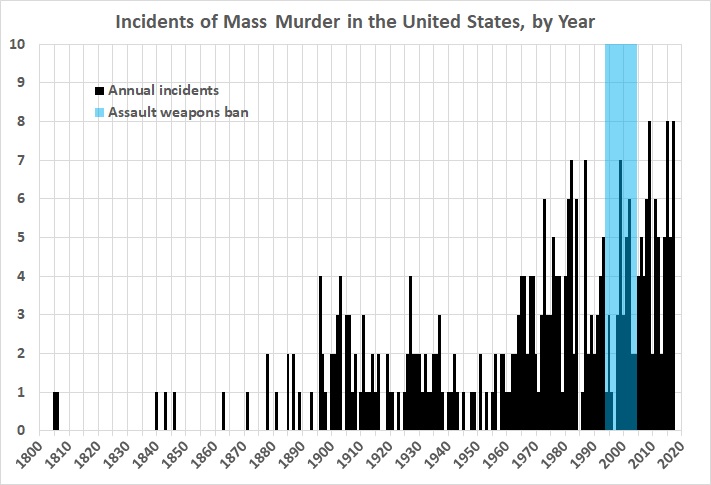
Drawing on Wikipedia, I compiled a list of 317 incidents of mass murder in the United States from the early 1800s through 2017. (I excluded 2018 because it is still early in the year.) My consolidated list encompasses school massacres; familicides; religious, political, or racial crimes; workplace killings; and two miscellaneous categories of rampage killings (here and here). I omitted two incidents that are wrongly included by Wikipedia: the 1944 circus fire in Hartford, Connecticut, and the 2013 fertilizer-plant explosion in West, Texas.
These graphs are derived from the consolidated list of incidents:
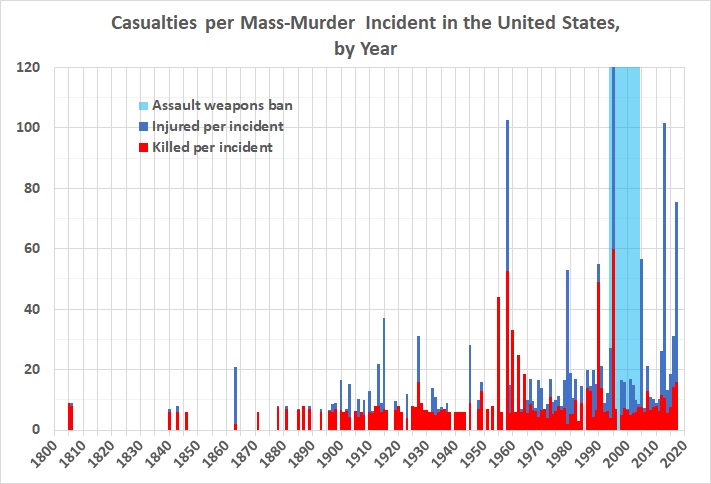
The vertical scale is truncated to allow for a better view of the variations in the casualty rate. In 1995, there were 869 casualties in 3 incidents (an average of 290); about 850 of the casualties resulted from the Oklahoma City bombing.
The federal assault weapons ban — really a ban on the manufacture of new weapons of certain kinds — is highlighted because it is often invoked as the kind of measure that should be taken to reduce the incidence of mass murders and the number of casualties they produce. Even Wikipedia — which is notoriously biased toward the left — admits (as of today) that “the ban produced almost no significant results in reducing violent gun crimes and was allowed to expire.”
There is no compelling, contrary evidence in the graphs. The weapons-ban “experiment” was too limited in scope and too-short lived to have had any appreciable effect on mass murder. For one thing, mass-murderers are quite capable of using weapons other than firearms. The years with the three highest casualty rates (second graph) are years in which most of the carnage was caused by arson (1958) and bombing (1995 and 2013).
The most obvious implication of this analysis is found in the upper graph. The incidence of mass murders was generally declining from the early 1900s to the early 1960s. Then all hell broke loose.
I rest my case.
Related reading:
Bill Vallicella, “Deriving Gun Rights from the Right to Life“, Maverick Philosopher, November 10, 2009
Crime Prevention Research Center, “Comparing Murder Rates and Gun Ownership Across Countries“, March 31, 2014
Jayman, “Guns & Violence, Again…“, The Unz Review, June 11, 2014
Malcolm Pollack, “Troubleshooting Gun Violence“, Motus Mentis, July 4, 2015
J. Christian Adams, “Flashback 30 Years: Guns Were in Schools … and Nothing Happened“, PJ Media, February 15, 2018
Dov Fischer, “When Do We Get to Talk About the Other Reasons?“, The American Spectator, February 16, 2018
Andrew Klavan, “The Left Is Reaping the Whirlwind of the Culture They Made“, PJ Media, February 16, 2018
Malcolm Pollack, “Reaping the Whirlwind“, Motus Mentis, February 16, 2018
Susan L.M. Goldberg, “When Will We Have the Guts to Link Fatherlessness to School Shootings?“, PJ Media, February 17, 2018
Steve Chapman, “A Cure for Mass Shootings Doesn’t Exist“, Reason.com, February 18. 2018
Karen Townsend, “Shocker: WaPo Fact Check Agrees with Rubio’s Statement on New Gun Laws“, Hot Air, February 18, 2018
Dave Bohon, “A Common-Sense Strategy for Protecting Schools“, New American, February 19, 2018
Rafael Mangual, “Second, Third, and Fourth Chances — at What Price?“, City Journal, February 20, 2018
Mark Meckler, “Of the 27 Deadliest Mass Shooters, 26 of Them Had One Thing in Common“, Patheos, February 20, 2018
Fred Reed, “Kids: Now and Then“, Fred on Everything, February 21, 2018
Brandon J. Weichert, “Toxic Liberalism Created Nikolas Cruz“, The American Spectator, February 21, 2018
Melissa Mackenzie, “Twenty Reasons Mass Killings Happen“, The American Spectator, February 23, 2018
Daniel Greenfield, “Muslim Terrorists Topped Mass Shootings in 2 Out Of 3 Years“, Frontpage Mag, February 26, 2018
Allie Nicodemo and Lia Petronio, “Schools Are Safer than They Were in the 90s, and School Shootings Are Not More Common than They Used to Be, Researchers Say“, News@Northeastern, February 26, 2018
Lloyd Billingsley, “Enabling Killer Cruz“, Frontpage Magazine, February 27, 2018
Dennis Prager, “Why the Left Opposes Arming Teachers“, American Greatness, February 27, 2018
Brandon J. Weichert, “Our Kids Are Not All Right“, The American Spectator, February 27, 2018
David Kopel, “The History of the ‘Assault Weapon’ Hoax. Part I: The Crime That Started It All“, The Volokh Conspiracy, March 2, 2018
George Neumayr, “Relativistic America: Neither Safe nor Free“, The American Spectator, March 2, 2018
Bruce Heiden, “Utopia, Pacifism, and Guns“, American Greatness, March 3, 2018
Larry Elder, “How Many Lives Are Saved by Guns, and Why Don’t Gun Controllers Care?“, Frontpage Mag, March 6, 2018
Greg Jones, “Political Correctness Is to Blame for Parkland“, The American Spectator, March 6, 2018
Mark Overstreet,” Safety Is Not the Reason Democrats Are Pushing Gun Control“, American Greatness, March 17, 2018
Ironman, “Firearms, Homicides, and Suicides in America“, Political Calculations, June 27, 2018
Related posts:
Less Punishment Means More Crime
Why Stop at the Death Penalty?
Free Will, Crime, and Punishment
Poverty, Crime, and Big Government
Crime Revisited
Democracy, Human Nature, and the Future of America
1963: The Year Zero
Society
How Democracy Works
“Cheerful” Thoughts
How Government Subverts Social Norms
Turning Points
The Twilight’s Last Gleaming?
The Opposition and Crime
How America Has Changed
Red-Diaper Babies and Enemies Within
The Vast Left-Wing Conspiracy
The Left and Evergreen State: Reaping What Was Sown
Death of a Nation
Leftism
“Why Can’t We All Just Get Along?”
Scapegoating in Baltimore
As the World Lurches
A Not-So-Stealthy Revolution
The City of Austin, the blue boil on the butt of Texas, recently hired a new city manager. The previous city manager, who left for greener pastures 15 months earlier, was a black man.
Austin’s “leaders” (the sneer quotes mean that they’re not my leaders) are nothing if not au courant in politically correct virtue-signaling. But their political correctness stops at the water’s edge of transparency. Austin’s taxpayers were kept in the dark about the candidates being considered for the city manager’s job until near the very end, when two finalists were unveiled:

Two white males. How could it be?
Never fear. Austin’s “leaders” salvaged their reputation for politically correct virtue-signaling by choosing the one on the left, who has a husband. The one on the right is married to a woman who has produced children and is therefore an actual female*. How boring.
And so the day was saved for “diversity” in Austin. But not for diversity of thought, of which there’s precious little here.
__________
* As opposed to a delusional male who “identifies as” a female, or an impressionable boy-child whose criminally negligent parents have convinced him that he is really a girl. I “identify as” a 6’6″, 250-pound bodybuilder with X-ray vision who is able to leap the Freedom Tower in a single bound and understands the mysteries of the Universe. Alas, what I “identify as” and what I really am are entirely different things.
Related posts:
Driving and Politics (1)
Life in Austin (1)
Life in Austin (2)
Life in Austin (3)
Driving and Politics (2)
AGW in Austin?
Democracy in Austin
AGW in Austin? (II)
The Hypocrisy of “Local Control”
Amazon and Austin
It is no secret — except to leftists — that they engage in psychological projection of their own authoritarianism when they try to pin the authoritarian label on conservatives. (See this, this, this, this, this, this, this, this, and this, for example.)
Another label — which so-called libertarians also like to throw at conservatives — is “tribalists”. And another one is “haters”. The usual targets of these labels are white, heterosexual, conservative males of European descent.
Yes, aren’t we just so, so tribal and hate-driven? Unlike (not) like Black Muslims, Hispanic reconquistas, feminazis, queer persecutors of cake-makers, illiberal-arts professors, campus radicals, “liberal” yuppies in their chi-chi enclaves, MSM and Hollywood hypocrites, Silicon Valley smuglies, and many another identity-group that takes advantage of America’s liberty and prosperity to spew hate against increasingly powerless white, heterosexual, conservative males of European descent.
It’s psychological projection on steroids.
EDITED 02/15/18
It is my long-held view that States have a constitutional right to secede from the union without the approval of other States or the central government. (See this post, for example.) If the Yes California movement succeeds, the political benefits to the rest of the United States (or at least the conservative parts of it) will be substantial; for example:
The last presidential election in which the GOP candidate won California’s electoral votes was in 1988. There wouldn’t have been a Bush-Gore controversy in 2000 with California out of the picture. And in 2016, Hillary would have lost the nationwide popular-vote tally by 1.4 million, thus putting to rest another baseless claim that the Democrat candidate was “robbed”.
The GOP would hold a bigger majority in the Senate (4 seats instead of 2) and House (74 seats instead of 47), thus enabling Republicans to move national policy to the right with less interference from RINOs.
Illegal immigrants will flock in greater numbers to welcoming California, thus reducing tax burdens and crime rates in Arizona, New Mexico, Texas, and the many States farther north that also absorb illegal immigrants.
According to the Yes California campaign, federal receipts from California are about equal to (perhaps a bit higher than) federal spending in California. Even a slight deficit would be worth it. That could easily be covered by spending cuts that might not otherwise occur because of the California Democrats in Congress.
And even more importantly, as commenter Timoid says, California’s wacky environmentalists wouldn’t be setting policy for the rest of the nation.
Last but best, Nancy Pelosi would no longer be a Congress-critter.
I have long supported free trade as beneficial. But I have also long derided utilitarianism, which is the doctrinal basis for claiming that free trade is beneficial. And I have long opposed the idea of open borders, in part because of the utilitarian claims of its supporters. It is time for me to resolve these contradictions.
Which way should I go? Should I sustain my anti-utilitarian position and oppose free trade as well as open borders? Or should I become a consistent utilitarian and support both free trade and open borders?
A digression about utilitarianism is in order. Utilitarianism, in this context, implies a belief in an aggregate social-welfare function (SWF) — a mystical summing of the states of happiness (or unhappiness) of myriad persons over an infinite series of points in time. It is the aim of utilitarians (who are mainly leftists and economists, though the categories overlap) to push SWF upward, toward (imaginary) collective nirvana. In so doing, the utilitarian makes himself the judge of whether an increase in A’s happiness at the expense of B (e.g., income redistribution) will result in an increase or decrease in SWF. An argument for this presumption (which is familiar mainly to economists), is based on the hypothesis of diminishing marginal utility (DMU) — a hypothesis that I have refuted at length. Suffice it to say that if A gains pleasure by poking B in the eye, no one — not even a Ph.D. economist — can prove that A’s pleasure outweighs B’s pain. In fact, common sense — which is embedded in eons of tradition — tells us that the act that brings pleasure to A should be punished precisely because of the way in which that pleasure is gained.
How does all of that pertain to free trade and open borders? Like this: Economists defend free trade and open borders because, in the aggregate, such things — in the long run — lead to greater economic efficiency and thus to greater total output (measured in constant dollars). And they are right about that. I have no doubt of it. But, to paraphrase John Maynard Keynes, in the long run we are all dead, and in the meantime some of us pay for the betterment of others.
Moreover, there are economists and others who like to conjoin the economic truth about the long-run consequences of free trade and open borders with statements about liberty: People ought to be free to exchange goods and services voluntarily. People ought to be free to live where they like.
Only a jejune anarchist will take such pronouncements as absolutes. Murder for hire is almost almost universally disapproved, as are many other crimes, even in this “enlightened”age. And I am unaware of a movement among affluent leftists to open their living rooms to the homeless, nor to repeal laws against trespass.
The question is, as always, where to strike a balance between the interests of those who benefit from free trade and open borders, and the interests of those for whom such things mean loss of income or higher taxes. How do the gains that accrue to some (e.g., less-expensive Lexi and abundant, low-priced nanny services) offset the burdens borne by working-class taxpayers whose jobs move overseas and whose school taxes rise to cover the costs of educating migrant children?
I ask these questions in connection with a broader issue: the purpose of our national government. It exists precisely for the reasons stated in the Preamble to the Constitution:
We the People of the United States, in Order to form a more perfect Union, establish Justice, insure domestic Tranquility, provide for the common defence, promote the general Welfare, and secure the Blessings of Liberty to ourselves and our Posterity, do ordain and establish this Constitution for the United States of America.
To put it bluntly but correctly, the national government exists not for the benefit of the people of the whole world or any part of it outside the United States, but for the benefit of the citizens of the United States.
Yes, some Americans benefit from free trade, and some Americans benefit from massive immigration. But not all Americans do. And it is the job of the national government to serve all of the people. A balance needs to be struck. And those who pay the price of free trade and massive immigration must be compensated in some way.
How and how much? Those are questions that I will grapple with in future posts.
Related posts:
Liberalism and Sovereignty
Utilitarianism, “Liberalism,” and Omniscience
Gains from Trade
Utilitarianism vs. Liberty
Diminishing Marginal Utility and the Redistributive Urge
Utilitarianism vs. Liberty (II)
Not-So-Random Thoughts (XVIII) – third item
Prosperity Isn’t Everything
In case you were wondering:
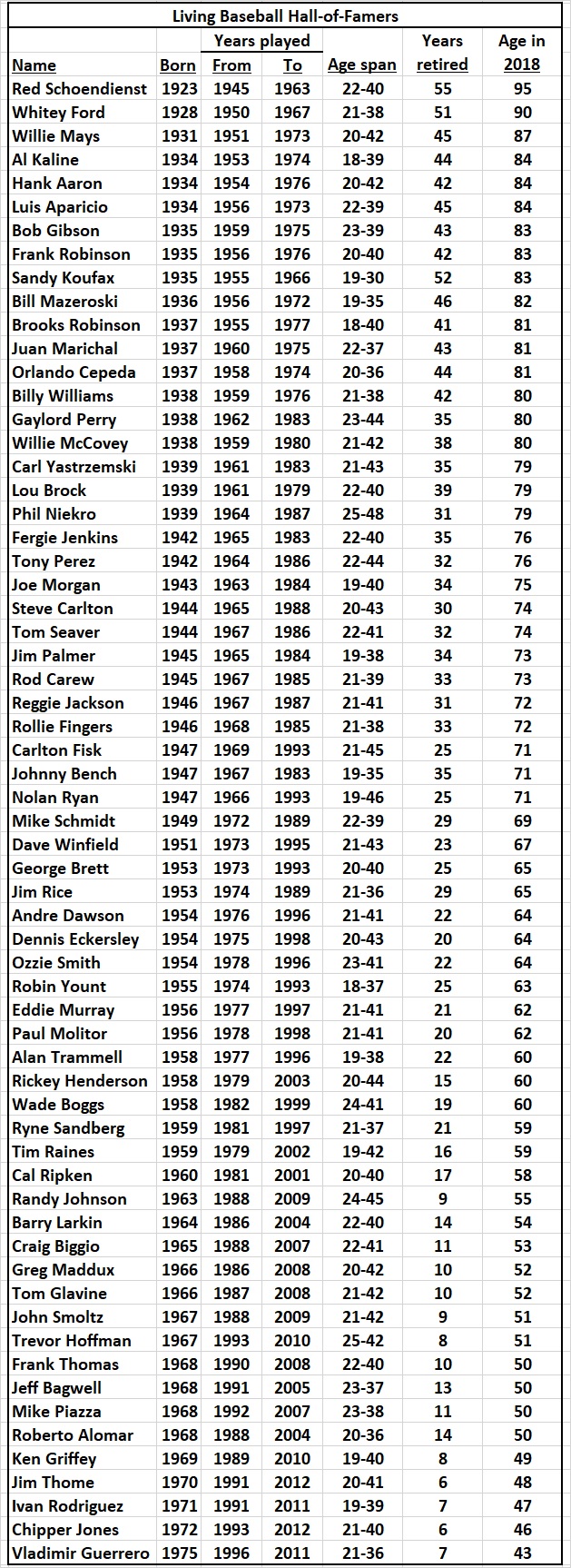
Derived from the Play Index (subscription required) at Baseball-Reference.com. Players with the same birth year may not be listed in birth order; for example, Hank Aaron was born in February 1934, and Al Kaline was born in December 1934, but Kaline is listed ahead of Aaron.
A personal note: I am older than 70 percent of the living hall-of-famers, and I have seen every one of them play in real time — mainly on TV but also at ballparks in Detroit and Baltimore.
Andrew Sullivan writes:
When elite universities shift their entire worldview away from liberal education as we have long known it toward the imperatives of an identity-based “social justice” movement, the broader culture is in danger of drifting away from liberal democracy as well. If elites believe that the core truth of our society is a system of interlocking and oppressive power structures based around immutable characteristics like race or sex or sexual orientation, then sooner rather than later, this will be reflected in our culture at large….
If voicing an “incorrect” opinion can end your career, or mark you for instant social ostracism, you tend to keep quiet. This silence on any controversial social issue is endemic on college campuses, but it’s now everywhere…. This is compounded by the idea that only a member of a minority group can speak about racism or homophobia, or that only women can discuss sexual harassment. The only reason this should be the case is if we think someone’s identity is more important than the argument they might want to make. And that campus orthodoxy is now the culture’s as a whole….
Microaggressions? How else do you explain how the glorious defenestration of horrific perpetrators of sexual abuse and harassment so quickly turned into a focus on an unwanted hug or an off-color remark?…
Privacy? Forget about it. Traditionally, liberals have wanted to see politics debated without regard for the private lives of those in the fray — because personal details can distract from the cogency of the argument. But cultural Marxists see no such distinction. In the struggle against patriarchy, a distinction between the public and private makes no sense. In fact, policing private life — the personal is political, remember — is integral to advancing social justice….
Due process? Real life is beginning to mimic college tribunals. When the perpetrator of an anonymous list accusing dozens of men of a whole range of sexual misdeeds is actually celebrated by much of mainstream media (see this fawning NYT profile), you realize that we are living in another age of the Scarlet Letter….
Treating people as individuals rather than representatives of designated groups? Almost every corporation now has affirmative action for every victim-group in hiring and promotion. Workplace codes today read like campus speech codes of a few years ago. Voice dissent from this worldview and you’ll be designated a bigot and fired (see James Damore at Google). The media is out front on this too. Just as campuses have diversity tsars, roaming through every department to make sure they are in line, we now have a “gender editor” at the New York Times, Jessica Bennett….
Objective truth? Ha! The culture is now saturated with the concept of “your own truth” — based usually on your experience of race and gender. In the culture, it is now highly controversial for individuals in one racial/gender group to write about or portray anyone outside it — because there is no art that isn’t rooted in identity….
Look: I don’t doubt the good intentions of the new identity politics — to expand the opportunities for people previously excluded. I favor a politics that never discriminates against someone for immutable characteristics — and tries to make sure that as many people as possible feel they have access to our liberal democracy. But what we have now is far more than the liberal project of integrating minorities. It comes close to an attack on the liberal project itself. Marxism with a patina of liberalism on top is still Marxism — and it’s as hostile to the idea of a free society as white nationalism is. So if you wonder why our discourse is now so freighted with fear, why so many choose silence as the path of least resistance, or why the core concepts of a liberal society — the individual’s uniqueness, the primacy of reason, the protection of due process, an objective truth — are so besieged, this is one of the reasons.
Sullivan stumbles twice in that otherwise laudable indictment of today’s virulent brand of leftism.
First, he “doesn’t doubt the good intentions of … identity politics”. I most certainly do. There’s a lot of humbug, preening, tribalism (of the wrong kind), and virtue-signaling in identity politics. Above all, the main intention of identity politics is to seize power and wield it like a club against one’s perceived enemies — those who are different. Talk about discrimination.
Which lead to Sullivan’s second stumble. There ought to be discrimination (of a kind) with respect to certain “immutable characteristics”. Intelligence and strength are immutable characteristics. Learning and practice matter, but there are at bottom wide disparities in the distribution of intelligence and strength among races and sexes.
But it has become “wrong” for the more intelligent to enjoy greater success than the less intelligent (leftists excluded, of course) because intelligence isn’t equally distributed across races and socioeconomic classes. Thus blacks and Hispanics are given university admissions, jobs, and promotions that wold belong to whites, with the result that (a) those favored are set up for failure and (b) the needs of consumers (including blacks and Hispanics) aren’t fulfilled by those best-qualified to fulfill them. Do you want to be operated on by an affirmative-action surgeon?
Another immutable characteristic is gender — which is a real thing, not something assigned at birth. There are demonstrably large differences between the sexes with respect to the distribution of strength and the aptitude for abstract thinking. But, again, it is “wrong” to admit such things and to discriminate on the basis of actual differences. There must be “fair shares” of women in STEM fields, occupations requiring analytical skills, and occupations that (traditionally) have required superior strength (e.g., soldiering, policing, and firefighting). Who suffers? The women who fail on merit — though that is increasingly barred by “political correctness” — and the consumers and taxpayers who get less value for their money.
Keith Burgess-Jackson is a self-styled conservative with whom I had a cordial online relationship about a dozen years ago. Our relationship foundered for reasons that are trivial and irrelevant to this post. I continued to visit KBJ’s eponymous blog occasionally (see first item in “related posts”, below), and learned of its disappearance when I I tried to visit it in December 2017. It had disappeared in the wake of a controversy that I will address in a future post.
In any event, KBJ has started a new blog, Just Philosophy, which I learned of and began to follow about a week ago. The posts at Just Philosophy were unexceptionable until February 5, when KBJ posted “Barry M. Goldwater (1909-1998) on the Graduated Income Tax”.
KBJ opens the post by quoting Goldwater:
The graduated [income] tax is a confiscatory tax. Its effect, and to a large extent its aim, is to bring down all men to a common level. Many of the leading proponents of the graduated tax frankly admit that their purpose is to redistribute the nation’s wealth. Their aim is an egalitarian society—an objective that does violence both to the charter of the Republic and [to] the laws of Nature. We are all equal in the eyes of God but we are equal in no other respect. Artificial devices for enforcing equality among unequal men must be rejected if we would restore that charter and honor those laws.
He then adds this “note from KBJ”:
The word “confiscate” means “take or seize (someone’s property) with authority.” Every tax, from the lowly sales tax to the gasoline tax to the cigarette tax to the estate tax to the property tax to the income tax, is by definition confiscatory in that sense, so what is Goldwater’s point in saying that the graduated (i.e., progressive) income tax is confiscatory? He must mean something stronger, namely, completely taken away. But this is absurd. We have had a progressive (“graduated”) income tax for generations, and income inequality is at an all-time high. Nobody’s income or wealth is being confiscated by the income tax, if by “confiscated” Goldwater means completely taken away. Only in the fevered minds of libertarians (such as Goldwater) is a progressive income tax designed to “bring down all men to a common level.” And what’s wrong with redistributing wealth? Every law and every public policy redistributes wealth. The question is not whether to redistribute wealth; it’s how to do so. Either we redistribute wealth honestly and intelligently or we do so with our heads in the sand. By the way, conservatives, as such, are not opposed to progressive income taxation. Conservatives want people to have good lives, and that may require progressive income taxation. Those who have more than they need (especially those who have not worked for it) are and should be required to provide for those who, through no fault of their own, have less than they need.
Yes, Goldwater obviously meant something stronger by applying “confiscatory” to the graduated income tax. But what he meant can’t be “completely taken away” because the graduated income tax is one of progressively higher marginal tax rates, none of which has ever reached 100 percent in the United States. And as KBJ acknowledges, a tax of less than 100 percent, “from the lowly sales tax to the gasoline tax to the cigarette tax to the estate tax to the property tax to the income tax, is by definition confiscatory in [the] sense” of “tak[ing] or seiz[ing] (someone’s property) with authority”. What Goldwater must have meant — despite KBJ’s obfuscation — is that the income tax is confiscatory in an especially destructive way, which Goldwater elucidates.
KBJ asks “what’s wrong with redistributing wealth?”, and justifies his evident belief that there’s nothing wrong with it by saying that “Every law and every public policy redistributes wealth.” Wow! It follows, by KBJ’s logic, that there’s nothing wrong with murder because it has been committed for millennia.
Government policy inevitably results in some redistribution of income and wealth. But that is an accident of policy in a regime of limited government, not the aim of policy. KBJ is being disingenuous (at best) when he equates an accidental outcome with the deliberate, massive redistribution of income and wealth that has been going on in the United States for more than a century. It began in earnest with the graduated income tax, became embedded in the fabric of governance with Social Security, and has been reinforced since by Medicare, Medicaid, food stamps, etc., etc., etc. Many conservatives (or “conservatives”) have been complicit in redistributive measures, but the impetus for those measures has come from the left.
KBJ then trots out this assertion: “Conservatives, as such, are not opposed to progressive income taxation.” I don’t know which conservatives KBJ has been reading or listening to (himself, perhaps, though his conservatism is now in grave doubt). In fact, the quotation in KBJ’s post is from Goldwater’s Conscience of a Conservative. For that is what Goldwater considered himself to be, not a libertarian as KBJ asserts. Goldwater was nothing like the typical libertarian who eschews the “tribalism” of patriotism. Goldwater was a patriot through-and-through.
Goldwater was a principled conservative — a consistent defender of liberty within a framework of limited government, which defends the citizenry and acts a referee of last resort. That position is the nexus of classical liberalism (sometimes called libertarianism) and conservatism, but it is conservatism nonetheless. It is a manifestation of the conservative disposition:
A conservative’s default position is to respect prevailing social norms, taking them as a guide to conduct that will yield productive social and economic collaboration. Conservatism isn’t merely a knee-jerk response to authority. It reflects an understanding, if only an intuitive one, that tradition reflects wisdom that has passed the test of time. It also reflects a preference for changing tradition — where it needs changing — from the inside out, a bit at a time, rather from the outside in. The latter kind of change is uninformed by first-hand experience and therefore likely to be counterproductive, that is, destructive of social and economic cohesion and cooperation.
The essential ingredient in conservative governance is the preservation and reinforcement of the beneficial norms that are cultivated in the voluntary institutions of civil society: family, religion, club, community (where it is close-knit), and commerce. When those institutions are allowed to flourish, much of the work of government is done without the imposition of taxes and regulations, including the enforcement of moral codes and the care of those who unable to care for themselves.
In the conservative view, government would then be limited to making and enforcing the few rules that are required to adjudicate what Oakeshott calls “collisions”. And there are always foreign and domestic predators who are beyond the effective reach of voluntary social institutions and must be dealt with by the kind of superior force wielded by government.
By thus limiting government to the roles of referee and defender of last resort, civil society is allowed to flourish, both economically and socially. Social conservatism is analogous to the market liberalism of libertarian economics. The price signals that help to organize economic production have their counterpart in the “market” for social behavior. That behavior which is seen to advance a group’s well-being is encouraged; that behavior which is seen to degrade a group’s well-being is discouraged.
Finally on this point, personal responsibility and self-reliance are core conservative values. Conservatives therefore oppose state actions that undermine those values. Progressive income taxation punishes those who take personal responsibility and strive to be self-reliant, while encouraging and rewarding those who shirk personal responsibility and prefer dependency on others.
KBJ’s next assertion is that “Conservatives want people to have good lives, and that may require progressive income taxation.” Conservatives are hardly unique in wanting people to have good lives. Though most leftists, it seems, want to control other people’s lives, there are some leftists who sincerely want people to have good lives, and who strongly believe that this does require progressive income taxation. Not only that, but they usually justify that belief in exactly the way that KBJ does:
Those who have more than they need (especially those who have not worked for it) are and should be required to provide for those who, through no fault of their own, have less than they need.
Did I miss KBJ’s announcement that he has become a “liberal”-“progressive”-pinko? It is one thing to provide for the liberty and security of the populace; it is quite another — and decidedly not conservative — to sit in judgment as to who have “more than they need” and who have “less than they need”, and whether that is “through no fault of their own”. This is the classic “liberal” formula for the arbitrary redistribution of income and wealth. There’s not a conservative thought in that formula.
KBJ seems to have rejected, out of hand (or out of ignorance), the demonstrable truth that everyone would be better off — far better off — with a lot less government involvement in economic (and social) affairs, not more of it. That is my position, as a conservative, and it is the position of the many articulate conservatives whose blogs I read regularly.
It is a position that is consistent with the values of personal responsibility and self-reliance. Conservatives embrace those values not only because they bestow dignity on those who observe them, but also because the observance fosters general as well as personal prosperity. This is another instance of the wisdom that is embedded in traditional values.
Positive law often conflicts with and undermines traditional values. That is why it is a conservative virtue to oppose, resist, and strive to overturn positive law of that kind (e.g., Roe v. Wade, Obergefell v. Hodges, Obamacare). It is a “conservative” vice to accept it just because it’s “the law of the land”.
I am left wondering if KBJ is really a conservative, or just a “conservative“.
Related reading: Yuval Levin, “The Roots of a Reforming Conservatism“, Intercollegiate Review, Spring 2015
Related posts:
Gains from Trade (A critique of KBJ’s “conservative” views on trade)
Why Conservatism Works
Liberty and Society
The Eclipse of “Old America”
Genetic Kinship and Society
Defending Liberty against (Pseudo) Libertarians
Defining Liberty
Conservatism as Right-Minarchism
The Pseudo-Libertarian Temperament
Parsing Political Philosophy (II)
My View of Libertarianism
The War on Conservatism
Another Look at Political Labels
Rescuing Conservatism
If Men Were Angels
Libertarianism, Conservatism, and Political Correctness
Disposition and Ideology
 Politics and Prosperity