Equal Protection in Principle and Practice

Here’s how it’s supposed to work: Enact a law that’s otherwise constitutional and apply that law. Thus each State has laws about the age at which a person may drink alcohol, drive a motor vehicle, and wed. Those laws (like other ones since superseded by judicial fiat) arise from the constitutional power of each State under Amendment X to legislate on matters that aren’t in the purview of the central government’s enumerated and limited powers.

Here’s how it works when liberal judges get in the act: Devise a “right” that everyone “should” have — because the judges say so — and then strike down as unconstitutional laws that don’t convey that “right” to those who seek it.

Now that the Supreme Court has decreed that States may not outlaw abortion or restrict marriage to persons of the opposite sex, despite the long-standing power of States to do such things — which was understood when Amendment X was ratified — it is incumbent on the Supreme Court to dictate that all persons in the United States may vote, drink alcohol, drive, and wed when they reach puberty. Why? Because there are undoubtedly some “activists” out there who wish it were so. And the Supreme Court can make it so by giving pubescent persons the “right” to vote, drink alcohol, drive, and wed.

The Precautionary Principle and Pascal’s Wager

Reduced to its essence, the precautionary principle (PP) is this: Avert calamity regardless of the cost of doing so.

The thinking person, as opposed the the extreme environmentalist or global-warming zealot, will immediately and carefully pose these questions about the PP: What, specifically, is the calamity to be averted? How might it be averted? With what degree of certainty? What are the opportunity and monetary costs of the options?

Take death, for example. Most persons who are in good health (and even many who are in declining health) consider death to be a calamity. So, too, do their loved ones (usually). How, then, might death be averted, with what degree of certainty, and at what cost?

Death can be averted only temporarily. That is, death often can sometimes be postponed, but never defeated. So the question is how can it be postponed, and at what cost. Let’s take an extreme case of a man dying of a virulent cancer (confirmed by extensive tests and procedures) for which there is no known treatment, other than palliative care. What good will it do that man (or his heirs) to spend his fortune in search of cure for his disease? He will almost certainly die before a possible cure is identified and can be supplied to him. But in funding the search for a cure he would have followed the PP by doing his utmost to avoid the calamity of death, without regard for the calamity thereby visited upon upon his heirs.

In sum, the PP shouldn’t be followed in cases where:

  • there is nothing that human beings can do to avert the calamity, or
  • the cost of ameliorating the calamity is itself calamitous.

Extreme environmentalists and global-warming zealots are guilty of sub-optimizing. They focus on particular calamities, not on the big picture of human flourishing. Take global warming. It has been said many times that warming has many advantages, such as a longer growing season and a lower death rate (cold is a bigger killer than heat). It has also been shown that warming hasn’t been occurring as fast as projected. The over-estimation of warming is probably due to (a) overstatement of the effects of CO2 emissions on temperatures and (b) inadequate modeling that omits key factors. But the zealots remain undeterred by such considerations.

The only thing that’s saving humanity from total impoverishment at the hands of global-warming zealots is the ridiculously high cost of (probably futile) efforts to combat global warming. Shutting down coal mines is bad enough, though tolerable given the advances that have been made in the extraction of natural gas and oil. But there is little taste (except among well-fed elites) for shutting down factories, forcing everyone to drive battery-powered cars, shifting to high-cost and unreliable sources of energy (solar, wind, and hydro), forcing people to live in densely populated cities, and so on. And if all of those things were to happen, what difference would it make? Almost none.

Moreover, there is nothing unusual about the rising temperatures of recent decades, neither in rapidity nor level. As Bob Tisdale observes, during three global warming periods — 1916-1946, 1964-1993, and 1986-2015 —

there were similar observed changes in global surface temperatures. It’s tough to claim that the recent global warming is unprecedented when surface temperatures rose at a comparable rate over a 30-year timespan that ended about 70 years ago.

Second, climate models are not simulating climate as it existed in the past or present.  The model mean of the climate models produced for the IPCC’s 5th Assessment Report simulates observed warming trends for one of the three periods shown in this post. Specifically, during the three global warming periods discussed in this post, climate models simulated three very different rates of warming (+0.050 deg C/decade for 1916-1946, +0.155 deg C/decade for 1964-1993, and +0.255 deg C/decade for 1986-2015), yet the data from GISS indicated the warming trends were very similar at +0.16 deg C/decade and +0.166 deg C/decade. If climate models can’t simulate global surface temperatures in the past or present, why should anyone have any confidence in their prognostications of future surface temperatures?

Third, the models’ failure to simulate the rate of the observed early 20th Century warming from 1916-1945 indicates that there are naturally occurring processes that can cause global surfaces to warm over multi-decadal periods above and beyond the computer-simulated warming from the forcings used to drive the climate models [emphasis added].  That of course raises the question, how much of the recent warming is also natural?

Fourth, for the most-recent 30-year period (1986-2015), climate models are overestimating the warming by a noticeable amount. This, along with their failure to simulate warming from 1916-1945, suggests climate models are too sensitive to greenhouse gases and that their projections of future global warming are too high.

Fifth, logically, the fact that the models seem to simulate the correct global-warming rate for one of the three periods discussed [1964-1993] does not mean the climate models are performing properly during the one “good” period.

Despite such reasonableness, global-warming-zealot proponents of the PP are not to be deflected. For theirs is a religion, which seems to take Pascal’s wager seriously. Here’s Robert Tracinski on the subject:

Do you freaking love science? Then you might be a big enough sucker to fall for a claim like this one: “Across the span of their lives, the average American is more than five times likelier to die during a human-extinction event than in a car crash.” Which was actually made by an environmentalist group called the Global Challenges Foundation and reported with a straight face in The Atlantic….

There is something that sounded familiar to me about this argument, and I realized that it borrows the basic form of Pascal’s Wager, an old and spectacularly unconvincing argument for belief in God. (Go here if you want to give the idea more thought than it probably deserves.) Blaise Pascal’s argument was that even if the existence of God is only a very small probability, the consequences are so spectacularly huge — eternal life if you follow the rules, eternal punishment if you don’t — that it makes even a very small probability seem overwhelmingly important. In effect, Pascal realized that you can make anything look big if you multiply it by infinity. Similarly, this new environmentalist argument assumes that you can make anything look big if you multiply it by extinction….

If Pascal’s probabilistic argument works for Christianity, then it also works for Islam, or for secular versions like Roko’s Basilisk. (And yes, an “all-seeing artificial intelligence” is included in this report as a catastrophic possibility, which gives you an idea of how seriously you should take it.) Or it works for global warming, which is exactly how it’s being used here.

Pascal was a great mathematician, but this was an awful abuse of the nascent science of probabilities. (I suspect it’s no great shakes from a religious perspective, either.) First of all, a “probability” is not just anything that you sort of think might happen. Imagination and speculation are not probability. In any mathematical or scientific sense of the word, a probability is something for which you have a real basis to measure its likelihood. Saying you are “95 percent certain” about a scientific theory, as global warming alarmists are apt to do, might make for an eye-catching turn of phrase in press headlines. But it is not an actual number that measures something.

Indeed.

Tracinski later hits a verbal home run with this:

This kind of Pascal’s-Wager-for-global-warming is part of a larger environmentalist program: a perverse attempt to take our sense of the actual risks and benefits for human life and turn it upside down.

If we’re concerned about the actual dangers to human life, we don’t have to assume a bunch of bizarre probabilities. The big dangers are known quantities: poverty, squalor, disease, famine, dictatorship, war. And the solutions are also known quantities: technology, industrialization, economic growth, freedom.

Global-warming zealots are usually leftists, and leftists claim to be upholders of science. Yet they cling to two anti-scientific dogmas: the precautionary principle and Pascal’s Wager. As Tracinski says, “global warming has become a religion with a veneer of science.”

Immigration and Intelligence

REVISED 11/18/16

I haven’t written about intelligence since April 18, 2015 (here, third item). What’s on my mind now? This:

1. Immigrants to the U.S. are overwhelmingly poor and possibly (but not necessarily) below-average in intelligence.

2. The availability of immigrants seeking employment is a boon to entrepreneurs. Investments in capital (often modest ones such as lawn mowers and chain saws) can be turned into gainful employment for immigrants and profits for entrepreneurs.

3. The employment of immigrants is also a boon to American consumers, who are able to obtain some things more cheaply and some things that they might otherwise not be able to afford (e.g., fresh fruit, maid services, yard work).

4. Consumers should be indifferent about the origin of the labor that benefits them.

5. Taxpayers should care about the origin of labor only to the extent that immigration drives up the taxes because of state support for immigrants (e.g., schooling, medical care, welfare programs where citizenship isn’t a prerequisite).

6. Each taxpayer is also a consumer, and each taxpayer is therefore in a different position with respect to the net benefits (or costs) of immigration. But every consumer-citizen is likely to benefit to some degree because of immigration, though the benefit may not offset the rise in every consumer-citizen’s taxes.

7. Low-skilled Americans who have opted for the dole have no stake in the matter of immigration. If some low-skilled Americans lose jobs that they might otherwise have held, they aren’t “losers” any more than the wagon-makers who lost their jobs when automobiles come along. Voluntary economic change doesn’t have winners and losers — it takes arbitrary government interventions (e.g., minimum-wage laws) to create them.

8. Yes, government allows immigration, but the original intervention that created winners and losers is the one that restrained immigration. If it’s all right for a piece of fruit to move from Mexico to Texas, why isn’t it all right for a worker to move from Mexico to Texas? If it’s all right for a Californian to move to Texas, it is definitely all right for a Mexican to move to Texas.

9. So the only question is whether immigration imposes net costs on some consumers who are also taxpayers. And it’s an issue only because of government programs that allow immigrants to impose costs on taxpayers.

10. The real issue, for me, isn’t immigration, it’s government interventions that may encourage immigration (at a rate higher than the “natural” one) and subsidize immigrants. As usual, government is the problem, not the solution.

What does this have to do with intelligence? This post was spurred by a recent one at West Hunter by Gregory Cochran, “Our Dumb World.” Cochran’s post, combined with another one of his to which he links, can be read as follows:

  • There’s a strong link between the average IQ of a nation and its economic success. (True.)
  • Some things have skewed the relationship (e.g., the imposition of Communism), but the link is there nonetheless.
  • Mass migration from low-IQ countries (presumably Mexico and other Central American nations) to a country with a higher average IQ (e.g., the United States) will reduce the average IQ of the receiving country and therefore harm it economically.

I don’t buy it. For one thing, immigration — even immigration by low-skilled workers with (perhaps) below-average intelligence — can be a boon to the residents of the receiving country, as discussed above. For another thing:

Low-IQ immigrants do not reduce the productivity of high-IQ natives – any more than short immigrants reduce the height of tall natives. (See here for further discussion).

To repeat myself, the real issue is whether government action causes immigrants to impose burdens on natives that wouldn’t be imposed in the absence of government action. And to be clear, government action is any action that results in a rate of immigration which is higher or lower than would occur in the absence of that action (e.g., immigration quotas, implicit or explicit promises of government aid to indigent immigrants).

What about the political and cultural effects of massive immigration from south of the border? I am at the point of declaring that it doesn’t matter. The welfare state is so firmly entrenched in America that I really don’t expect it to be uprooted, except by non-electoral means. Mass culture is already so degenerate that it’s hard to see what could make it worse. And I have no reason to believe that, in general, Hispanics are more vulgar than American Anglos. (Just look at the prime-time TV lineup.) Those of us who prefer high culture can enjoy it without mingling with the hoi polloi.

I have been for years an opponent of illegal immigration. I was on the verge of changing my mind — something of which I am capable. But I’m not ready to do that. My main reservation now has to do with the effect of mass immigration on crime, which argues strongly against immigration from south of the border.

Does Velocity Matter?

I came across some breathless prose about the rising trend in the velocity of pitches. (I’m speaking of baseball, in case you didn’t know. Now’s your chance to stop reading.) The trend, such as it is, dates to 2007, when the characteristics of large samples of pitches began to be recorded. (The statistics are available here.) What does the trend look like? The number of pitchers in the samples varies from 77 to 94 per season. I computed three trends for the velocity of fastballs: one for the top 50 pitchers in each season, one for the top 75 pitchers in each season, and one for each season’s full sample:

Pitching velocity trends

Assuming that the trend is real, what difference does it make to the outcome of play? To answer that question I looked at the determinants of runs allowed per 9 innings of play from 1901 through 2015, drawing on statistics available at Baseball-Reference.com. I winnowed the statistics to obtain three equations with explanatory variables that pass the sniff test:*

  • Equation 5 covers the post-World War II era (1946-2015). I used it for backcast estimates of runs allowed in each season from 1901 through 1945.
  • Equation 7 covers the entire span from 1901 through 2015.
  • Equation 8 covers the pre-war era (1901-1940). I used it to forecast estimates of runs allowed in each season from 1941 through 2015.

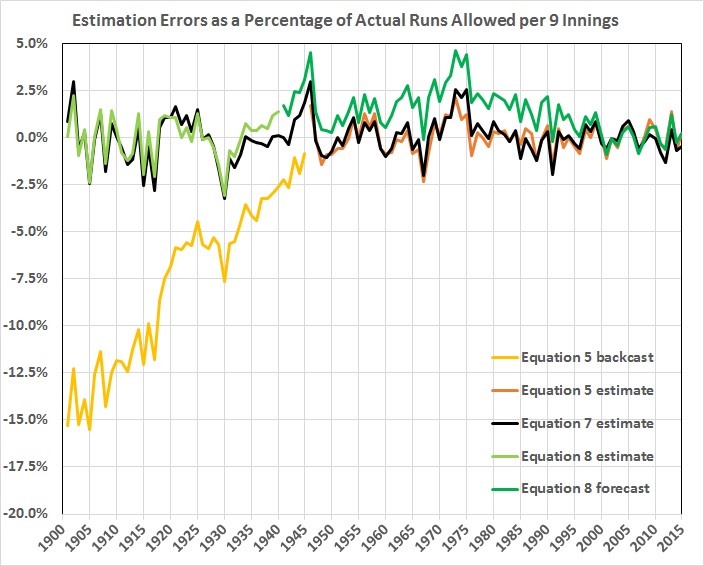
This graph shows the accuracy of each equation:

Estimation errors as perentage of runs allowed

Equation 7, even though it spans vastly different baseball eras, is as good as or better than equations 5 and 8, even though they’re tailored to their eras. Here’s equation 7:

RA9 = -5.01 + H9(0.67) + HR9(0.73) + BB9(0.32) + E9(0.60) + WP9(0.69) + HBP9(0.51) + PAge(0.03)

Where 9 stands for “per 9 innings” and
RA = runs allowed
H = hits allowed
HR = home runs allowed
BB = bases on balls allowed
E = errors committed
WP = wild pitches
HBP = batters hit by pitches
PAge = average age of pitchers

The adjusted r-squared of the equation is 0.988; the f-value is 7.95E-102 (a microscopically small probability that the equation arises from chance). See the first footnote regarding the p-values of the explanatory variables.

What does this have to do with velocity? Let’s say that velocity increased by 1 mile an hour between 2007 and 2015 (see chart above). The correlations for 2007-2015 between velocity and the six pitcher-related variables (H, HR, BB, WP, HBP, and PAge), though based on small samples, are all moderately strong to very strong (r-squared values 0.32 to 0.83). The combined effects of an increase in velocity of 1 mile an hour on those six variables yield an estimated decrease in RA9 of 0.74. The actual decrease from 2007 to 2015, 0.56, is close enough that I’m inclined to give a lot of credit to the rise in velocity.**

What about the long haul? Pitchers have been getting bigger and stronger — and probably faster — for decades. The problem is that a lot of other things have been changing for decades: the baseball, gloves, ballparks, the introduction of night games, improvements in lighting, an influx of black and Latin players, variations in the size of the talent pool relative to the number of major-league teams, the greater use of relief pitchers generally and closers in particular, the size and strength of batters, the use of performance-enhancing drugs, and so on. Though I would credit the drop in RA9 to a rise in velocity over a brief span of years — during which the use of PEDs probably declined dramatically — I won’t venture a conclusion about the long haul.
_________
* I looked for equations where explanatory variables have intuitively correct signs (e.g., runs allowed should be positively related to walks) and low p-values (i.e., low probability of inclusion by chance). The p-values for the variables in equation 5 are all below 0.01; for equation 7 the p-values all are below 0.001. In the case of equation 8, I accepted two variables with p-values greater than 0.01 but less than 0.10.

** It’s also suggestive that the relationship between velocity and the equation 7 residuals for 2007-2015 is weak and statistically insignificant. This could mean that the effects of velocity are adequately reflected in the coefficients on the pitcher-related variables.

The Yankees vs. the Rest of the American League

No one doubts that the Yankees have been the dominant team in the history of American League. Just how dominant? An obvious measure is the percentage of league championships won by the Yankees: 35 percent (40 of the 114) in the 1901-2015 seasons (no champion was declared for the 1994 season, which ended before post-season play could begin). More compellingly, the Yankees won 45 percent of the championships from their first in 1921 through their last in 2009, and 43 percent since their first in 1921.

Of course, not all championships are created equal. From 1901 through 1960 there were 8 teams in the American League, and the team with the best winning percentage in a season was the league’s champion for that season. The same arrangement prevailed during 1961-1968, when there were 10 teams in the league. After that there were two 6-team divisions (1969-1976), two 7-team divisions (1997-1993), three divisions of 5, 5, and 4 teams each (1994-2012), and three 5-team divisions (2013 to the present).

Since the creation of divisions, league champions have been determined by post-season playoffs involving division champions and, since 1994, wild-card teams (one such team in 1994-2011 and two such teams since 2012). Post-season playoffs often result in the awarding of the league championship to a team that didn’t have the best record in that season. (See this post, for example.) A division championship, on the other hand, is (by definition) awarded to the team with the division’s best record in that season.

Here’s how I’ve dealt with this mess:

The team with the league’s best record in 1901-1960 gets credit for 1 championship (pennant).

The team with the league’s best record in 1961-1968 gets credit for 1.25 pennants because the league had 1.25 (10/8) as many teams in 1961-1968 than in 1901-1960.

Similarly, the team with the best record in its division from 1969-2015 gets credit for the number of teams in its division divided by 8. Thus a division winner in the era of 6-team divisions gets credit for 0.750 (6/8) pennant; a division winner in the era of 7-team divisions gets credit for 0.875 (7/8) pennant,; and a division winner in the era of 4-team and 5-team divisions gets credit for 0.500 (4/8) pennant or 0.625 (5/8) pennant.

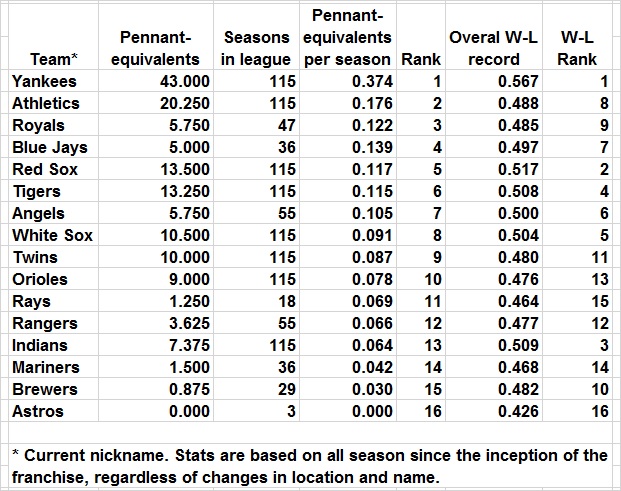
The Yankees, for example,won 25 pennants in 1901-1960, each valued at 1; 4 pennants in 1961-1968, each valued at 1.25; a division championship in 1969-1976, valued at 0.75; and 14 division championships in 1977-2015, each valued at 0.625. That adds to 43-pennant equivalents in 115 seasons (1994 counts under this method). That’s 0.374 pennant-equivalents per season of the Yankees’ existence (including 1901-1902, when the predecessor franchise was located in Baltimore and the several seasons when the team was known as the New York Highlanders).

I computed the same ratio for the other American League teams, including the Brewers — who entered in 1969 (as the Seattle Pilots) and moved to the National League after the 1997 season — and the Astros — who moved from the National League 2013. Here’s how the 16 franchises stack up:

Pennant-equivalents per season

The Red Sox, despite the second-best overall W-L record, have the fifth-best pennant-equivalents/season record; they have had the misfortune of playing in the same league and same division as the Yankees for 115 years. The Athletics, on the other hand, escaped the shadow of the Yankees in 1969 — when divisional play began — and have made the most of it.

There are many other stories behind the numbers. Ask, and I will tell them.

Xenophobic Nativism

It’s rampant on college campuses, which are dominated by liberals who scorn Brexit’s “leave” voters as xenophobic, nativist rubes. For example, liberal professors outnumber conservatives 28-to-1 in New England. That’s no accident. And it isn’t the only non-accident in academe. See this, this, and this. (All are dated, which probably means that they understate left-wing control of most campuses and disciplines.)

Oh, there is a semi-bright spot, but it still leans left.

“Fairness”

“Fairness” usually is invoked when a person or group seeks special treatment — unfairness, in other words. Here’s what’s unfair:

Making Johnny share his toys with Billy when Johnny is having a perfectly good time playing by himself.

If Billy wants to be treated fairly, he should bring his own toys and refuse to share them with Johnny. Then they can bargain about which toys to play with jointly and which toys to trade, either temporarily or permanently.

Refusing to let Abby into college because a less-qualified candidate happens to have darker skin than Abby, and there aren’t “enough” darker-skinned students.

If only there were more darker-skinned students, college authorities say, they would feel more secure and mingle with white students, thus giving the white students a broader “life experience.” How many more darker-skinned students? Well, there’s no magic number, the college must continue to prefer less-qualified darker-skinned students over white ones until mingling magically occurs. In any event, mingling is unlikely to be fostered by raising the dark-to-white ratio, though when the ratio gets large enough a certain kind of mingling will occur: Mobs of dark students will start to give the white ones some “life experience” by attacking them.

Taking money from Jack and giving it to Joe because Joe doesn’t earn “enough.”

Joe doesn’t earn much money, relative to Jack, for one or more of several reasons: Joe is dumber, lazier, less well-educated, less well-connected, or less lucky. But Jack didn’t cause Joe’s dumbness, laziness, lack of education, lack of connections, or unluckiness. Why is it “fair” to penalize Jack for things that aren’t his fault? Because everyone “deserves” a certain minimum standard of living? Who says so, a bunch of politicians who know that there are a lot of votes to be gained by spreading Jack’s money around? Jesus Christ was big on charity, but when government takes money from Jack and gives it to Joe, it’s not charity — it’s legalized theft.

Changing the definition of marriage because homosexuals want to be “married.”

For thousands of years it has been understood that marriage is a bonding of male to female. This definition seldom was so well understood and accepted that it was unnecessary to make it explicit until it came under attack. The attackers then claimed that it was “hateful” to make the definition explicit, and that persons of the same sex ought to be able to wed each other. So it’s “hateful” to defend a principle? Isn’t it therefore hateful to call someone hateful in defense of the principle that same-sex couples should be able to wed, even though the idea is relatively new and defies an understood definition of marriage that’s thousands of years old? In fact, it’s fair to call the shrill proponents of same-sex marriage hateful.

Allowing anyone who claims to “be” a female to use restrooms designated for women.

Do you know how to tell a female from a male? You don’t? Then you’d better ask your Mommy or Daddy to explain it to you — again. Do you claim to believe that a person’s sex is what that person says it is, even if the outward evidence contradicts that person’s claim? Perhaps, then, you will believe me when I say that I am God and will smite you for being such a ninny. Oh, you don’t believe me? Then why should you believe the tall, bearded fellow with a deep voice who barges into the “ladies” room and insists that he’s really a woman? Why does your judgment fail you in such cases? Because it’s only “fair” to the bearded guy to believe his story? But what if it isn’t “fair” to the real females who want privacy from prying male-like persons when they go into the “ladies” room? You’re not being fair, you’re just sticking it to “the system” because it gives you a thrill. As fads go, swallowing the transgender line makes as much sense as swallowing goldfish.

Not advising the prosecution of Hillary Clinton because “no reasonable prosecutor” would purse the case, after describing clear violations by Mrs. Clinton of an unambiguous statute.

That is unfair because, as the Director of the FBI admitted, almost anyone other than Mrs. Clinton (or another highly placed politician) would be prosecuted.

Independence Day 2016: The Way Ahead

Prudence…will dictate that Governments long established should not be changed for light and transient causes; and accordingly all experience hath shewn, that mankind are more disposed to suffer, while evils are sufferable, than to right themselves by abolishing the forms to which they are accustomed. But when a long train of abuses and usurpations…reduce them under absolute Despotism, it is their right, it is their duty, to throw off such Government, and to provide new Guards for their future security.… [A]nd such is now the necessity which constrains them to alter their former Systems of Government. The history…is a history of repeated injuries and usurpations, all having in direct object the establishment of an absolute Tyranny over these States.

Declaration of Independence
(In Congress. July 4, 1776. The unanimous Declaration
of the thirteen united States of America)

*      *      *

It is fitting, in this summer of discontent, to be faced with a choice between the spiritual descendants of P.T. Barnum and Lady Macbeth. Washington, Jefferson, and Madison are spinning in their graves, at high velocity.

The candidacies of Trump and Clinton are symptoms of the looming demise of liberty in the United States. There hasn’t been a candidate since Ronald Reagan who actually understood and believed that Americans would be freer and therefore more prosperous if the central government were contained within the four corners of the Constitution. (And even Reagan had a soft spot in his heart for Social Security.) Nevertheless, it is appalling but unsurprising that liberty’s end is in sight just 27 years after Reagan left office.

What went wrong? And how did it go wrong so quickly? Think back to 1928, when Americans were more prosperous than ever and the GOP had swept to its third consecutive lopsided victory in a presidential race. All it took to snatch disaster from the jaws of delirium was a stock-market crash in 1929 (fueled by the Fed) that turned into a recession that turned into a depression (also because of the Fed). The depression became the Great Depression, and it lasted until the eve of World War II, because of the activist policies of Herbert Hoover and Franklin Roosevelt, which suppressed recovery instead of encouraging it. There was even a recession (1937-38) within the depression, and the national unemployment rate was still 15 percent in 1940. It took the biggest war effort in the history of the United States to bring the unemployment rate back to its pre-depression level.

From that relatively brief but deeply dismal era sprang a new religion: faith in the central government to bring peace and prosperity to the land. Most Americans of the era — like most human beings of every era — did not and could not see that government is the problem, not the solution. Victory in World War II, which required central planning and a commandeered economy, helped to expunge the bitter taste of the Great Depression. And coming as it did on the heels of the Great Depression, reinforced the desperate belief — shared by too many Americans — that salvation is to be found in big government.

The beneficial workings of the invisible hand of competitive cooperation are just too subtle for most people to grasp. The promise of a quick fix by confident-sounding politicians is too alluring. FDR became a savior-figure because he talked a good game and was an inspiring war leader, though he succumbed to pro-Soviet advice.

With war’s end, the one-worlders and social engineers swooped on a people still jittery about the Great Depression and fearful of foreign totalitarianism. (The native-born variety was widely accepted because of FDR’s mythic status.) Schools and universities became training grounds for the acolytes of socialism and amoral internationalism.

Warren Henry is right when he says that

progressivism is…broadly accepted by the American public, inculcated through generations of progressive dominance of education and the media (whether that media is journalism or entertainment). Certainly Democrats embrace it. Now the political success of Donald J. Trump has opened the eyes of the Right to the fact that Republicans largely accept it….

Republicans have occasionally succeeded in slowing the rate at which America has become more progressive. President Reagan was able to cut income tax rates and increase defense spending, but accepted tax increases to kick the can on entitlements and could not convince a Democratic Congress to reduce spending generally. Subsequent administrations generally have been worse. A Republican Congress pressured Bill Clinton into keeping his promise on welfare reform after two vetoes. He did so during a period when the end of the Cold War and the revenues from the tech bubble allowed Washington to balance budgets on the Pentagon’s back. Unsurprisingly, welfare reform has eroded in the ensuing decades.

Accordingly, the big picture remains largely unchanged. Entitlements are not reformed, let alone privatized. To the contrary, Medicare was expanded during a GOP administration, if less so than it would have been under a Democratic regime…. Programs are almost never eliminated, let alone departments.

The Right also loses most cultural battles, excepting abortion and gun rights. Notably, the inroads on abortion may be due as much to the invention and deployment of the sonogram as the steadfastness of the pro-life movement. Otherwise, political and cultural progressivism has been successful in their march through the institutions, including education, religion, and the family.

Curricula increasingly conform to the progressive fashions of the moment, producing generations of precious snowflakes unequipped even to engage in the critical thinking public schools claim to prioritize over an understanding of the ages of wisdom that made us a free and prosperous people. Church membership and attendance continues their long-term decline. A country that seriously debated school prayer 30 years ago now debates whether Christians must be forced to serve same-sex weddings.

Marriage rates continue their long-term decline. Divorce rates have declined from the highs reached during the generation following the sexual revolution, but has generally increased over the course of the century during which progressivism has taken hold (despite the declining marriage rate). Those advocating reform of the nation’s various no-fault divorce laws are few and generally considered fringe.

There’s more, but disregard Henry’s reification of America when he should write “most Americans”:

Meanwhile, America has voted for decade after decade of tax-and-spend, borrow-and-spend, or some hybrid of the two. If the white working class is now discontented with the government’s failure to redress their grievances, this is in no small part due to the ingrained American expectation that government will do so, based on the observation that government typically hungers to increase government dependency (not that the white working class would use these terms).…

In sum, while it is correct to note that elites are not doing their jobs well, it is more difficult to conclude that elites have not been responding to the political demands of the American public as much as they have driven them.…

The presidential nominees our two major parties have chosen are largely viewed as awful. But Hillary Clinton and Donald Trump offer two slightly different versions of the same delusion: that progressivism works, if only the elites were not so stupid. This delusion is what most Americans currently want to believe.

Sad but disastrously true. Dependency on government has become deeply ingrained in the psyche of most Americans. As Timothy Taylor points out,

[g]overnment in the United States, especially at the federal level, has become more about transfer payments and less about provision of goods and services.…

[There has been an] overall upward rise [of transfer payments] in the last half-century from 5% of GDP back in the 1960s to about 15% of GDP in the last few years….

The political economy of such a shift is simple enough: programs that send money to lots of people tend to be popular. But I would hypothesize that this ongoing shift not only reflects voter preferences, but also affect how Americans tend to perceive the main purposes of the federal government. Many Americans have become more inclined to think of federal budget policy not in terms of goods or services or investments that it might perform, but in terms of programs that send out checks.

What lies ahead? Not everyone is addicted to government. There are millions of Americans who want less of it — a lot less — rather than more of it. Here, with some revisions and an addition, are options I spelled out three years ago:

1. Business as usual — This will lead to more and more government control of our lives and livelihoods, that is, to less and less freedom and prosperity (except for our technocratic masters, of course).

2. Rear-guard action — This option is exemplified by the refusal of some States to expand Medicaid and to establish insurance exchanges under the Affordable Care Act. This bit of foot-dragging doesn’t cure the underlying problem, which is accretion of illegitimate power by the central government. Further, it can be undone by fickle voters and fickle legislatures, as they succumb to the siren-call of “free” federal funds.

3. Geographic sorting — The tendency of “Blue” States to become “bluer” and “Red” States to become “redder” suggests that Americans are sorting themselves along ideological lines. As with rear-guard action, however, this tendency — natural and laudable as it is — doesn’t cure the underlying problem: the accretion of illegitimate power by the central government. Lives and livelihoods in every State, “Red” as well as “Blue,” are controlled by the edicts of the legislative, executive, and judicial branches of the central government. There is little room for State and local discretion. Moreover, much of the population shift toward “Red” must be understood as opportunistic (e.g., warmer climates, right-to-work laws) and not as an endorsement of “Red” politics.

4. Civil disobedience — Certainly called for, but see options 5, 6, and 7.

5. Underground society and economy — Think EPA-DOL-FBI-IRS-NSA, etc., etc., and then dismiss this as a serious option for most Americans.

6. The Benedict Option, about which Bruce Frohnen writes:

[Rod] Dreher has been writing a good deal, of late, about what he calls the Benedict Option, by which he means a tactical withdrawal by people of faith from the mainstream culture into religious communities where they will seek to nurture and strengthen the faithful for reemergence and reengagement at a later date….

The problem with this view is that it underestimates the hostility of the new, non-Christian society [e.g., this and this]….

Leaders of this [new, non-Christian] society will not leave Christians alone if we simply surrender the public square to them. And they will deny they are persecuting anyone for simply applying the law to revoke tax exemptions, force the hiring of nonbelievers, and even jail those who fail to abide by laws they consider eminently reasonable, fair, and just.

7. A negotiated partition of the country — An unlikely option (discussed in this post and in some of the posted linked to therein) because, as discussed in option 6, “Blue” will not countenance the loss of control over millions of lives and livelihoods.

8. Secession — This is legal and desirable — as long as the New Republic of free states is truly free — but (a) it is likely to be met with force and therefore (b) unlikely to attract a critical mass of States.

9. Coup — Suggested several years ago by Thomas Sowell:

When I see the worsening degeneracy in our politicians, our media, our educators, and our intelligentsia, I can’t help wondering if the day may yet come when the only thing that can save this country is a military coup.

Glenn Reynolds, who is decidedly anti-coup, writes

that the American Constitution, along with traditional American political culture in general, tends to operate against those characteristics, and to make the American polity more resistant to a coup than most. It is also notable, however, that some changes in the Constitution and in political culture may tend to reduce that resistance….

The civics-book statement of American government is that Congress passes laws that must be signed by the president (or passed over a veto), and that those laws must be upheld by thejudiciary to have effect. In practice, today’s government operates on a much more fluid basis, with administrative agencies issuing regulations that have the force of law – or, all too often, “guidance” that nominally lacks the force of law but that in practice constitutes a command – which are then enforced via agency proceedings.…

[I]t seems likely that to the extent that civilians, law enforcement, and others become used to obeying bureaucratic diktats that lack a clear basis in civics-book-style democratic process, the more likely they are to go along with other diktats emanating from related sources. This tendency to go along with instructions without challenging their pedigree would seem to make a coup more likely to succeed, just as a tendency to question possibly unlawful or unconstitutional requirements would tend to make one less likely to do so. A culture whose basis is “the law is what the bureaucrats say it is, at least unless a court says different,” is in a different place than one whose starting impulse is “it’s a free country.”…

[P]ersistent calls for a government-controlled “Internet kill switch”49 – justified, ostensibly, by the needs of cyberdefense or anti-terrorism – could undercut that advantage [of a decentralized Internet]. If whoever controlled the government could shut down the Internet, or, more insidiously, filter its content to favor the plotters’ message and squelch opposition while presenting at least a superficial appearance of normality, then things might actually be worse than they were in [Fletcher Knebel and Charles Bailey’s Seven Days in May, which imagined an attempted coup by a Curtis LeMay-like general].…

[T]he most significant barrier to a coup d’etat over American history has probably stemmed simply from the fact that such behavior is regarded as un-American. Coups are for banana republics; in America we don’t do that sort of thing. This is an enormously valuable sentiment, so long as the gap between “in America” and “banana republics” is kept sufficiently broad. But it is in this area, alas, that I fear we are in the worst shape. When it comes to ideological resistance to coups d’etat, there are two distinct groups whose opinions matter: The military, and civilians. Both are problematic….

[T]here are some troubling trends in civilian/military relations that suggest that we should be more worried about this subject in the future than we have been in the past…

Among these concerns are:

  • A “societal malaise,” with most Americans thinking that the country was on “the wrong track.”
  • A “deep pessimism about politicians and government after years of broken promises,” leading to an “environment of apathy” among voters that scholars regard as a precursor to a coup.
  • A strong belief in the effectiveness and honor of the military, as contrasted to civilian government.
  • The employment of military forces in non-military missions, from humanitarian aid to drug interdiction to teaching in schools and operating crucial infrastructure.
  • The consolidation of power within the military – with Congressional approval – into a small number of hands….
  • A reduction in the percentage of the officer corps from places outside the major service academies.…
  • A general insulation of the military from civilian life…. “Military bases, complete with schools, churches, stores, child care centers, and recreational areas, became never-to-be-left islands of tranquility removed from the chaotic crime-ridden environment outside the gates…. Thus, a physically isolated and intellectually alienated officer corps was paired with an enlisted force likewise distanced from the society it was supposed to serve [quoting from an essay by Charles J. Dunlap, “The Origins Of The American Military Coup of 2012,” Parameters, Winter, 1992-93, at 2]….

[D]istrust in the civilian government and bureaucracy is very high. A 2016 Associated Press/National Opinion Research Center poll found that more than 6 in 10 Americans have “only slight confidence – or none at all” that the federal government can successfully address the problems facing the nation. And, as the AP noted, this lack of confidence transcends partisan politics: “Perhaps most vexing for the dozen or so candidates vying to succeed President Barack Obama, the poll indicates widespread skepticism about the government’s ability to solve problems, with no significant difference in the outlook between Republicans and Democrats.”

As a troubling companion to this finding, the YouGov poll on military coups…also found a troubling disconnect between confidence in civilian government and confidence in the military: “Some 71% said military officers put the interests of the country ahead of their own interests, while just 12% thought the same about members of Congress.” While such a sharp contrast in views about civilian government and the military is not itself an indicator of a forthcoming coup, it is certainly bad news. Also troubling are polls finding that a minority of voters believes that the United States government enjoys the consent of the governed.63 This degree of disconnection and disaffection, coupled with much higher prestige on the part of the military, bodes ill.

Or well, if you believe that a coup is the only possible salvation from despotism.

Military personnel (careerists, in particular) are disciplined, have direct access to the tools of power, and many of them are trained in clandestine operations. Therefore, a cadre of properly motivated careerists might possess the wherewithal necessary to seize power. But a plot to undertake a coup is easily betrayed. (Among other things, significant numbers of high-ranking officers are shills for the regulatory-welfare state.) And a coup, if successful, might deliver us from a relatively benign despotism into a decidedly malign despotism.

But unless there is a negotiated partition of the country — perhaps in response to a serious secession movement — a coup is probably the only hope for the restoration of liberty under a government that is true to the Constitution.

The alternative is a continuation of America’s descent into despotism, which — as many Americans already know — is no longer the “soft” despotism foreseen by Tocqueville.

*      *      *

Related posts (in addition to those linked to throughout this one):
The Real Constitution and Civil Disobedience
A Declaration of Independence
A Declaration of Civil Disobedience
The States and the Constitution
And many more here

Winners and Losers

Steven Landsburg has a provocative post. His point seems to be that those who focus on the “losers” from free trade “want us to conclude either that free trade is not a good thing, or that at the very least, the winners should compensate the losers.”

Landsburg continues:

This strikes me as an extraordinarily dishonest way of arguing, because pretty much nobody ever argues this way about anything else, even though every policy change in history has created both winners and losers. In fact, every human action has both winners and losers. When Archie takes Betty instead of Veronica to the ice cream shoppe instead of the movies, both Veronica and the theater owner lose out. It does not follow that all human actions are wrong, or immoral, or should be discouraged by law, and it does not follow that all human actions should be followed by compensation to the losers.

What I object to — aside from Landsburg’s habitual use of “us,” which suggests some kind of collective consciousness at work — is his unfortunate, if inadvertent, endorsement of the idea that every human action has both winners and losers. “Winner” and “loser” are terms that properly apply to persons who are engaged in some kind of contest or bet. The rest — which includes just about everything — is just life. Stuff happens: Veronica doesn’t go the movies with Archie; American steelworkers lose jobs; dinosaurs become extinct.

Except when government is involved. Government action changes the natural course of human events, the course that they would take in a society that is bound by shared beliefs, language, and customs (or norms). A government of a relatively small or close-knit geopolitcal entity may act in accordance with and reinforce societal norms, but the governance of the United States has long since become something else: a set of interlocking dictatorial regimes (federal, State, and local) bent on enforcing rules designed on high, sometimes with the intention of favoring specific groups. Those specific groups have something that the ruling caste wants: money, influence, and votes.

Government acts legitimately only when it does things that would be done by a cohesive social group. Self-defense is one of those things. When government wages war in defense of its citizens, it has a claim to legitimacy — though the soundness of the claim depends on the necessity of the war and the skill and efficiency with which it is waged. When government executes murderers it legitimately exacts justice and deters more murders — though the soundness of the claim depends on the swiftness and fairness with which executions occur. A foreign enemy isn’t a loser, he’s an enemy. An executed murderer isn’t a loser, he’s a recipient of justice.

But beyond defense, justice, and the even-handed representation of Americans’ interests in foreign capitals, there is nothing that government can claim as a legitimate function. Government’s forays into welfare, for example, are destructive of private charity and go far beyond what a well-functioning social group would allow, in that they discourage work and saving. Social Security and Medicare, for example, don’t just mimic private charity toward the poorest and sickest of the elderly population, they benefit even the the wealthiest and healthiest of Americans. Social Security benefits and the market value of Medicare (as insurance) can easily raise a retired couple’s effective income from, say, $250,000 to $300,000 or $325,000. That’s not charity, it’s middle-class and upper-middle-class welfare. (I don’t mean to suggest that the wealthiest should be forced to subsidize everyone else; that’s a socially and economically destructive idea that I’ll not bother to discuss here.)

There’s much more to government than spending, of course, There’s also the vast web of regulations that has been spun by government at all levels. Regulations alter the course of social and economic intercourse, as they are meant to do. The justification is usually either “for your own good” or “for the good of group X.” In any event, social norms and incentives to work and save are subverted by those who believe, wrongly, that they can subvert those norms and incentives without inviting unintended consequences. The Great Recession, for example, was caused by regulation, not deregulation.

It has come to pass that many of government’s fiscal and regulatory interventions are rationalized as efforts to “level the playing” field and compensate “losers” for the “unfair” advantages enjoyed by “winners.” But such language masks a presumption that there are better social and economic arrangements and better outcomes — which, of course, are known to those who use such language. This is called the nirvana fallacy, the invalid comparison of imperfect reality to imagined perfection.

It therefore surprises me that Steven Landsburg, who is super-rational and a stickler for accuracy, would invoke “winners” and “losers.” To do so lends aid and comfort to the proponents of social and economic engineering.

It might be said, with some justice, that government interventions create winners and losers. But what those interventions really create are dependents and victims. The dependents are the tens of millions of Americans who rely on government welfare and government grants of privilege (e.g., affirmative action, regulatory protection from competition, subsidized loans). The victims are the tens of millions of Americans who pay directly for such privileges (e.g., high marginal tax rates, regulatory infringements on liberty, suppression of free speech and association, theft of property rights), and the 300-million-plus whose income is far less than it would be in the absence of fiscal and regulatory interventions, which are damaging to economic growth.

A person who earns an honest living as an investment banker, baseball player, or movie star and makes millions of dollars a year isn’t a winner, in the proper sense of the word, he’s just being rewarded according to the value placed on his efforts by those who pay for them. A person who earns a pittance because he’s an illegal immigrant who can’t speak English and has no particular skills isn’t a loser, he’s just being rewarded according to the value placed on his efforts by those who pay for them. Veronica isn’t a loser because Archie prefers Betty, she’s just another beautiful girl who can probably land someone better looking and richer than Archie. The theater owner isn’t a loser because Archie doesn’t take Veronica to the movies, he’s just another businessman who’s in the wrong business if the loss of two customers for one night is a big deal.

Let’s get real and quit calling people winners and losers when they’re not playing games or making bets. Let’s get real and start talking about those who are dependent on government and those who are its victims, which is just about everyone but the politicians and bureaucrats who feast at the public trough.

And, yes, I do mean to say that most of the dependents and enablers of big government are its victims. Such are the wages of social dissolution and economic ignorance.

“God Bless America”

Rick Moran castigates Gerth Kuntzman, a critic of “God Bless America” who objects to it because

[t]he song still embodies great things about America, but also our worst things: self-righteousness, forced piety, earnest self-reverence, foam.

Foam?

Anyway, Moran opines (correctly, in my view) that

Kuntzman’s attack on a great patriotic song embodies the left’s continuing war against normalcy and tradition.

I object to “God Bless America” and other patriotic songs because they no longer reflect America as it is: decadent and dictatorial.

*      *      *

Related post: The Eclipse of “Old America”

The Technocratic Illusion

Kevin Williamson explodes it:

Professor [Neil deGrasse] Tyson, who may be the dumbest smart person on Twitter, yesterday wrote that what the world really needs is a new kind of virtual state — he wants to call it “Rationalia” — with a one-sentence constitution: “All policy shall be based on the weight of evidence.” This schoolboy nonsense came under withering and much-deserved derision. Conservatives, who always have the French Revolution in their thoughts, reminded him that this already has been tried, and that the results are known in the history books as “the Terror.” Writing with a great deal of reserve in Popular Science, Kelsey D. Atherton notes:

Rationalia puts a burden on science that it cannot bear: to work, it must be immune to the passions of the day, promising an objective world and objective truth that will triumph over obstacles.

That’s true enough, but it shortchanges the scientific objection to Tyson’s Rationalia pipe dream, which is that it implicitly presupposes quantities and types of knowledge that are not, even in principle, available, even if the scientists in question were the dispassionate truth-seekers of Atherton’s ideal.

But will the technocrats be deterred from trying to make the world more perfect, thus making it more hellish? No, they will not be deterred. The world is full of biased know-it-alls — many of whom claim to be scientists (e.g., Neil deGrasse Tyson).

The last word goes to G. Shane Morris:

Tyson … has a philosophy, whether he realizes it or not. It’s called “scientism,” the belief that science is the only valid source of knowledge. The rule-by-self-identified-experts he envisions for the happy land of Rationalia is scientism’s logical outcome. But when you insist that facts and evidence speak for themselves, it has a funny way of silencing everyone else. As one intrepid Twitter user replied to Tyson’s initial tweet, “Convenient how the ‘evidence’ always seems to line up with Tyson’s personal beliefs.”

The real problem, of course, is that Rationalia doesn’t take into account the fallenness of human nature, or the fact that we all approach reality with a certain set of assumptions. If we’re to build a new country based on rationality, the question is simply, “Whose rationality?” I certainly don’t want it to be from someone who’s blind to his own biases, to the flaws of science, and to other people’s perspectives.

*      *      *

Related posts:

Demystifying Science
Scientism, Evolution, and the Meaning of Life
The Fallacy of Human Progress
Pinker Commits Scientism
The Limits of Science (II)
The Pretence of Knowledge
“The Science Is Settled”
The Limits of Science, Illustrated by Scientists
Rationalism, Empiricism, and Scientific Knowledge

Instant Reincarnation?

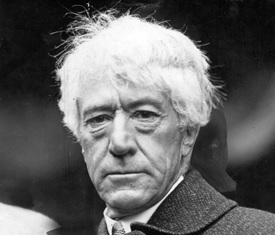
Kenesaw Mountain Landis (1866 – 1944), first commissioner of baseball:

Kenesaw Mountain Landis

Roger Scruton (1944 – ), British philosopher:

Sir Roger Scruton

Close, but no cigar. Judge Landis died on November 20, 1944. Sir Roger was born almost 9 months earlier, on February 27, 1944.

Why America Is Screwed Up

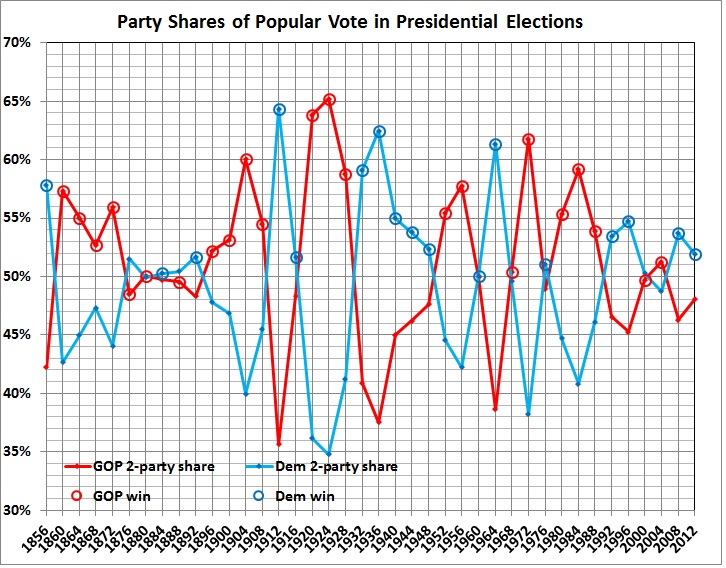
If voters were rationally committed to governing philosophies they wouldn’t have wild mood swings like this:

Party shares of popular vote in presidential elections

Big Losers and Donald Trump

Republican William Howard Taft lost his bid for re-election in 1912 to Democrat Woodrow Wilson , thanks to the candidacy of former Republican president Theodore Roosevelt, who ran on the Progressive ticket. Because of TR’s entry into the race, Taft won only 23 percent of the popular vote (he took 52 percent in the election of 1908), against Wilson’s 42 percent and TR’s 35 percent. Taft’s reverse coattails helped the GOP lose ground in the House and Senate. The GOP, which had won 41 percent of House seats in the election of 1910, dropped to 31 percent in 1912. And in the Senate the GOP went from 54 percent to 46 percent.

The next big loser was Democrat James Cox, who took only 34 of the popular vote in 1920, while Republican Warren G. Harding took 60 percent. With Harding’s big win, the GOP ran its House majority from 55 percent to 69 percent, and its Senate majority from 51 percent to 61 percent.

Democrat Franklin D. Roosevelt won re-election in 1936 with 61 percent of the popular vote. FDR’s Republican opponent, Alfred Landon, won only 37 percent. The GOP’s share of House seats dropped from 24 percent to 20 percent. In the Senate, the GOP went from 26 percent to 17 percent. Both results are low-water marks for Republican representation in Congress.

Democrat Lyndon B. Johnson duplicated FDR’s feat by winning in 1968 with 61 percent of the popular vote. Republican Barry Goldwater garnered only 38 percent. The GOP’s shares of House and Senate dropped by 8 percentage points (from 40 percent to 32 percent) and 2 percentage points (from 34 percent to 32 percent).

Republican Richard Nixon won re-election in 1972, taking 61 percent of the popular vote to Democrat George McGovern’s 38 percent. Nixon’s win led to a mild GOP resurgence in the House, from 41 percent to 44 percent. But the GOP lost ground in the Senate, dropping from 45 percent to 43 percent.

The  most recent election that resembled a landslide victory was in 1984, when Republican Ronald Reagan won re-election with 59 percent of the popular vote. Democrat Walter Mondale managed 41 percent. Reagan’s big win helped the GOP increase its share of House seats from 38 percent to 42 percent. But the Senate went the other way, with the GOP share dropping from 55 percent to 53 percent.

It seems that ticket-splitting has become more usual. And that’s a good thing if, as expected, Donald Trump loses to Hillary Clinton in November. It doesn’t seem, as of now, that Trump will be a loser on the scale of Taft, et al., but a loser nonetheless (in two meanings of loser). The only thing that will keep Trump from joining the really big losers is the identity of his opponent, who in saner times would already be in jail — with her husband.

There’s still hope that the Republican convention will yield a nominee other than Trump, but that’s a faint hope at this point.

Beyond the Far Horizon

Several years ago I began to track some celebrities who had attained the age of 90. The rather quirky list of notables now looks like this:

Luise Rainer 104, George Beverly Shea 104, Charles Lane 102Irwin Corey 101, Herman Wouk 101, George Kennan 101, Olivia de Havilland 100 (on July 1*), Gloria Stuart 100Eddie Albert 99, Michael DeBakey 99, Zsa Zsa Gabor 99, Vera Lynn 99, Mitch Miller 99, Max Schmeling 99, Risë Stevens 99, John Wooden 99Tony Martin 98, Dale Messick 98, Eli Wallach 98John Kenneth Galbraith 97, Ernest Gallo 97, Billy Graham 97, Estée Lauder 97, Art Linkletter 97, Al Lopez 97Karl Malden 97, John Mills 97, Kitty Carlisle 96Monte Irvin 96, Jack LaLanne 96, Kevin McCarthy 96, Harry Morgan 96, Fay Wray 96Jane Wyatt 96, Joseph Barbera 95, Ernest Borgnine 95, Henri Cartier-Bresson 95Herbert Lom 95, Peter Rodino, Jr 95, Sargent Shriver 95, Patty Andrews 94, Sammy Baugh 94, Constance Cummings 94, Lady Bird Johnson 94, Robert Mondavi 94, Byron Nelson 94, Les Paul 94, Ruth Hussey 93, Frankie Laine 93, Robert McNamara 93, Artie Shaw 93,  Richard Widmark 93, Oleg Cassini 92, Ralph Edwards 92Bob Feller 92, Ernie Harwell 92, Lena Horne 92Julia Child 91, Archibald Cox 91, Geraldine Fitzgerald 91, Frances Langford 91, John Profumo 91, William Westmoreland 91Jane Wyman 90.

I was reminded of this list by a name in the “Today’s Birthdays” feature of the newspaper: actress June Lockhart 91. Because only six members of my original list remain among the living, I’m adding Lockhart to the list, as well as these notables of interest to me: baseball player Bobby Doerr 98, justice John Paul Stevens 96, economist and secretary of state George Shultz 95, prince consort Philip Mountbatten 95, actress Betty White 94, secretary of defense Melvin Laird 93, baseball player Red Schoendienst 93, actress Rose Marie 92, physicist Freeman Dyson 92, president George H.W. Bush 92, and actor Hal Holbrook 91.

_________
* By my reckoning, of the dozens (or hundreds) of actors who starred in Hollywood films before World War II, only Olivia de Havilland survives. She attained star billing in 1935, at the age of 19, for her role in Captain Blood. Other pre-war films in which she starred include The Adventures of Robin Hood (1938) and Gone with the Wind (1939).

Revisiting the “Marketplace” of Ideas

In “The ‘Marketplace’ of Ideas” I observe that

[u]nlike true markets, where competition usually eliminates sellers whose products and services are found wanting, the competition of ideas often leads to the broad acceptance of superstitions, crackpot notions, and plausible but mistaken theories. These often find their way into government policy, where they are imposed on citizens and taxpayers for the psychic benefit of politicians and bureaucrats and the monetary benefit of their cronies.

The “marketplace” of ideas is replete with vendors who are crackpots, charlatans, and petty tyrants. They run rampant in the media, academia, and government.

Caveat emptor.

Theodore Dalrymple reminds us just how easily crackpot ideas gain wide acceptance:

Rather against my better judgment, and that of my wife, I allowed myself to be persuaded to take part recently in a debate, or public conversation, about prostitution….

The two women on the panel with me took different views of the matter, though both were somewhat opposed to me. The question supposedly before us was, fortunately, soon forgotten. The first of the women was a representative of a prostitutes’ organised pressure group, and herself a prostitute, and the second a sociologist….

The spokeswoman for the prostitutes of England … believed that prostitution was an evil brought about by the current economic dispensation. Women, many of them single mothers, had no choice but to prostitute themselves. They could earn much more by prostitution than in respectable jobs; increasing poverty and desperation drove them to it.

I asked her whether she was saying that all women in a certain situation were prostitutes, having no choice in the matter: in which case there would surely be millions more than there are?…

She replied that in an ideal world there would be no prostitution, but that so long as many people had to do jobs at low pay in occupations that they detested, prostitution was a reasonable choice. (The fact that prostitution in her opinion was undesirable suggested that she did not agree with the sociologist that it was a job like any other, that there was something intrinsically wrong or degrading about it.)

What she was really asking for, then, was a world in which everyone did a job, other than for reasons of pay, that he or she found agreeable and conformable to their wishes. This was a kind of Marxist Utopia, as expressed in The German Ideology [by Karl Marx and Friedrich Engels], in which

nobody has one exclusive sphere of activity but each can become accomplished in any branch he wishes, society regulates the general production and thus makes it possible for me to do one thing today and another tomorrow, to hunt in the morning, fish in the afternoon, rear cattle in the evening, criticise after dinner, just as I have a mind, without ever becoming hunter, fisherman, herdsman or critic.

I said that what the prostitute wanted, in effect, was the abolition of both the division of labour and the labour market. To my surprise, a portion of the audience, far from taking this as absurd, was extremely enthusiastic about it. They wanted (at least in theory) the abolition of the division of labour and the labour market. Furthermore, as members of the bourgeoisie themselves, in its intellectual branch, they benefited from precisely what they wanted to abolish.

This suggested to me what in fact I had long suspected, namely that victories in the field of social, economic and philosophical thought are never final, but that the battles have to be fought over and over again, no matter what experiences Mankind has gone through in the meantime.

And so it is that ideas which are not only preposterous but also anti-libertarian take root and destroy liberty. As I have said:

Liberty is lost when the law allows “freedom of speech, and of the press” to undermine the civil and state institutions that enable liberty.

Now for Texit, and More

Unless the parliament of the so-called United Kingdom double-crosses the majority of English, Welsh, Scottish, and Northern Irish voters who approved Brexit, the UK will officially withdraw from the European Union. That’s good news for those of us who oppose dictatorship by distant bureaucrats.

There’s a parallel movement known as Texit, which is dedicated to the secession of Texas from the union known as the United States. Some backers of Texit believe wrongly that the Treaty of Annexation which made Texas a State has an escape clause. It doesn’t, but secession is nevertheless legal, not only for Texas but for all States.

It is telling — and encouraging — that even Donald Trump, the non-conservative and weak prospective GOP nominee, seems likely (at this date) to win the electoral votes of 20 States. In numbers there is strength. A secession movement would have a greater chance of success if it encompassed several States.

Sign me up.

The Stock Market 15 Years from Now

I won’t bore you with a bunch of tables and graphs. I’ll just tell you that I’ve played around with inflation-adjusted stock-market indices (the Wilshire 5000 Total Return and the S&P Composite), and have discovered the following:

  • Internal relationships (future performance vs. prior performance) suggest that 15 years from now real stock prices will have risen at a compounded annual rate of +5 to +10 percent.
  • External relationships (future performance vs. current AAA corporate bond rate) suggest that 15 years from now real stock prices will have dropped at a compounded annual rate of about -5 percent.

The second result is based on a positive long-run relationship between the bond rate and stock-market performance. Why would there be such a relationship if an interest-rate hike usually causes stock prices to drop? Well, that’s a short-run phenomenon. But over the long run, higher interest rates mean more demand for money, which means that companies are making investments to generate higher profits. And over a period of sufficient length, like 15 years, those higher profits are realized and reflected in stock prices.

In sum, low interest rates signal sluggish business activity. Interest rates are at historically low levels, and have remained stubbornly low for a simple reason. It’s not just that inflation is low. It’s also that the demand for money is weak because the regulatory regime makes it more increasingly difficult and unprofitable for businesses to form and expand.

I see no hope for true regulatory reform, which would involve the beheading of almost every government bureaucrat in the United States. Therefore, my bet is on negative stock-market performance over the next 15 years — and beyond.

It can happen here if it can happen in Japan, where the Nikkei 225 index stands at 42 percent of its nominal level on December 1, 1989. Adjusted for inflation, the index probably has dropped about 75 percent in 27 years, which is a real  decline of -5 percent a year.

*     *     *

Related reading: Jon Hilsenrath, “Yellen Points to Slow Growth and Low Rates in the Long Run,” The Wall Street Journal, June 21, 2016

Related posts:
Economic Growth Since World War II (with links to many more related posts)
Bonds for the Long Run?
Why Are Interest Rates So Low?

Obama Stereotypes Muslims

Obama says that Trump’s proposal to bar immigration by Muslims would make Americans less safe. How? Because more Muslims would become radicalized and acts of terrorism would therefore become more prevalent. Why would there be more radicalized Muslims? Because the Islamic State (IS) would claim that America has declared war on Islam, and this would not only anger otherwise peaceful Muslims but draw them to IS. Therefore, there shouldn’t be any talk of barring immigration by Muslims, nor any action in that direction.

Perhaps there’s something to what Obama says. It’s too late to bar the door to Muslims because there are already enough of them in this country to commit (at least) tens of thousands of terrorist attacks, if they’re bent on doing so.

By the same token, it’s too late to clamp down on gun sales in this country because there are already enough guns to enable radicalized Muslims (and others) to commit tens of thousands of murders, if they’re bent on doing so.

Aha, leftist gun-grabbers will say, the obvious answer is to take guns away from everyone but those who “need” them — officers of the law and private bodyguards for affluent leftists, for example. There are several problems with the “obvious” answer:

  • There are so many unregistered weapons that it would impossible to confiscate enough to ensure that only the “good guys” have them.
  • A lot of registered weapons would be conveniently “lost” or “stolen” before the arrival of confiscatory agents.
  • Because gun ownership is so prevalent in this country, there’s almost no chance that Congress would enact confiscation.
  • The confiscation of guns — were it feasible — would be counterproductive; the widespread ownership of guns enables “average” citizens to thwart terrorists as well as “everyday” thieves and murderers.
  • Firearms aren’t the only weapons of use to terrorists who are bent on killing dozens to thousands of people at a time.

Gun-grabbing is just a leftist’s erotic fantasy. It’s not an actual possibility or an antidote to violence. Terrorists who are bent on terrorizing Americans can readily readily resort to home-made explosives, toxic chemicals, and sabotage.

Where does that leave us? Any attempt to ban guns will be futile, and banning guns wouldn’t prevent terrorism. But banning Muslims might well prevent a lot of terrorism, though it wouldn’t prevent terrorist acts by crypto-Muslims (e.g., white boys who join IS and similar outfits) or those who sympathize with Muslims because they’re “victims” of something or other. (Leftists love “victims.”)

What about the fear that many Muslims will be offended by the idea that (some) Americans want to protect themselves from terrorism (a Muslim-dominated enterprise) by banning immigration by Muslims, and that more Muslims will therefore commit acts of terrorism. This is nothing more than a kind of racist stereotyping. Who ever heard of large numbers of a racial or ethnic group rising up in violence because they were offended by an act of self-defense? The next thing you know, someone will say that blacks are disproportionately responsible for violent crime in the United States.

Because Obama is a semi-black leftist — and “therefore” not a racist — he can stereotype Muslims with impunity. To put it another way, Obama can speak the truth about Muslims without being accused of racism (though he’d never admit to the truth about blacks and violence).

Which brings me to the crucial question: What is Obama doing about the ever-present threat of domestic terrorism? Pandering to leftists’ gun-control fantasy and attacking Donald Trump. That’s about it as far as I can tell.

*      *      *

Related reading:

Arnold Ahlert, “Progressive Insanity Endangers America,” Patriot Post, June 16, 2016

Fred Reed, “Hussein Obama, 50; America, 0: More Adventures in Multiculturalism,” Fred on Everything, June 16, 2016

Wikipedia, “List of Islamist Terror Attacks

Related posts:

The Barbarians Within and the State of the Union
Presidential Treason
Round Up the Usual Suspects
Pacifism

The Authoritarianism of Modern Liberalism, and the Conservative Antidote

Liberalism of the modern variety is a manifestation of authoritarianism — a statement that will surprise no one but a liberal (a.k.a. progressive) and many libertarians. Libertarians? Yes, because there are many who side with modern liberals in wishing to use the power of the state to impose an agenda that suppresses freedom of speech, freedom of association, and property rights. (In the rest of this post, I use “modern liberals” and “modern liberalism” to refer to leftists and leftism, by whatever name.)

Modern liberalism attracts persons who wish to exert control over others. The stated reasons for exerting control amount to “because I know better” or “because it’s good for you (the person being controlled)” or “because ‘social justice’ demands it.” Such attitudes would seem to flout the central tenet of classical liberalism — the “harm principle” enunciated in John Stuart Mill’s On Liberty (Chapter I, paragraph 9):

That principle is, that the sole end for which mankind are warranted, individually or collectively in interfering with the liberty of action of any of their number, is self-protection. That the only purpose for which power can be rightfully exercised over any member of a civilized community, against his will, is to prevent harm to others.

Mill’s sophomoric version of liberalism gave way to modern liberalism, a fascistic creed that mocks the root meaning of liberal.

What happened to Millian (classical) liberalism? Arnold Kling quotes Kim R. Holmes’s The Closing of the Liberal Mind: How Groupthink and Intolerance Define the Left:

American progressives and classical liberals [i.e., Millians] started parting company in the late 19th century. Progressives initially clung to freedom of expression and the right to dissent from the original liberalism, but under the influence of socialism and social democracy they gradually moved leftward. Today, they largely hold classic liberalism—especially as manifested in small-government conservatism and libertarianism—in contempt. Thus, what we call a “liberal” today is not historically liberal at all but a progressive social democrat, someone who clings to the old liberal notion of individual liberty when it is convenient (as in supporting abortion or decrying the “national security” state), but who more often finds individual liberties and freedom of conscience to be barriers to building the progressive welfare state….

[A]lliances between libertarians and leftists… can be found in most policy areas, in fact, except for economics….

The postmodern left … embraces principles, attitudes, and practices that sanction the use of coercive methods, either through legal means or public shaming rituals, to deny certain people their rights and civil liberties, particularly freedom of speech and conscience, in ways that undermine American democracy and the rule of law.

[Earlier progressives] could not have imagined an unending conflict between identity tribes trying to capture the state for their own narrow group interests… [They] were still liberal enough to believe in universal justice. Multiculturalism, for example, stands completely opposed to the progressive vision of community. It promises not to build a common vision for everyone but to tear the community apart in an ethnic and racial conflict of all against all.

I agree with Holmes’s characterizations but not with his reification. There were undoubtedly some classical liberals who turned leftward in the late 19th century and early 20th century, but today’s leftists — modern liberals, progressives, and left-libertarians — were never classical liberals. They are made of authoritarian cloth. They are the intellectual heirs of Jean-Jacques Rousseau, an 18th century herald of Marxism. This is from an old version of Wikipedia‘s entry about Rousseau:

Perhaps Rousseau’s most important work is The Social Contract, which outlines the basis for a legitimate political order. Published in 1762 and condemned by the Parlement of Paris when it appeared, it became one of the most influential works of abstract political thought in the Western tradition. Building on his earlier work, such as the Discourse on Inequality, Rousseau claimed that the state of nature eventually degenerates into a brutish condition without law or morality, at which point the human race must adopt institutions of law or perish. In the degenerate phase of the state of nature, man is prone to be in frequent competition with his fellow men whilst at the same time becoming increasingly dependent on them. This double pressure threatens both his survival and his freedom. According to Rousseau, by joining together through the social contract and abandoning their claims of natural right, individuals can both preserve themselves and remain free. This is because submission to the authority of the general will of the people as a whole guarantees individuals against being subordinated to the wills of others and also ensures that they obey themselves because they are, collectively, the authors of the law. Whilst Rousseau argues that sovereignty should thus be in the hands of the people, he also makes a sharp distinction between sovereign and government. The government is charged with implementing and enforcing the general will and is composed of a smaller group of citizens, known as magistrates…Much of the subsequent controversy about Rousseau’s work has hinged on disagreements concerning his claims that citizens constrained to obey the general will are thereby rendered free….

Rousseau was one of the first modern writers to seriously attack the institution of private property, and therefore is often considered a forebearer of modern socialism and communism (see Karl Marx, though Marx rarely mentions Rousseau in his writings). Rousseau also questioned the assumption that the will of the majority is always correct. He argued that the goal of government should be to secure freedom, equality, and justice for all within the state, regardless of the will of the majority.

In other words, the magistrates decide what’s best for the people. And so it is with modern liberals. To enforce their will they (yes, even so-called libertarians) invoke the vast power of the “technocratic” state that emerged in the 20th century, and which has found its greatest champion yet in Barack Obama. The “technocrats,” under the influence of pundits and academicians, define the “general will” of the people. There is, of course, no such thing as the general will or collective consciousness or “We the People.” The technocrats are simply bent on imposing their personal preferences and those of the pundits and academicians from whom they draw inspiration — with ample support from much of the citizenry (for venal reasons, to which I will come).

Modern liberalism didn’t begin to flourish until a century after Rousseau’s death. And when it did begin to flourish, it was due in large part to the capitalist paradox, which enables the interest-group paradox.

What do I mean? I begin with a post at Imlac’s Journal (no longer available) that includes this quotation from Matt McCaffrey’s “Entrepreneurs and Investment: Past, Present, … Future?” (International Business Times, December 9, 2011]:

Schumpeter argued [that] the economic systems [which] encourage entrepreneurship and development will eventually produce enough wealth to support large classes of individuals who have no involvement in the wealth-creation process. This generates apathy or even disgust for market institutions, which leads to the gradual takeover of business by bureaucracy, and eventually to full-blown socialism.

This, of course, is the capitalist paradox. The author of Imlac’s Journal concludes with these observations:

[U]nder statist regimes, people’s choices are limited or predetermined. This may, in theory, obviate certain evils. But as McCaffrey points out, “the regime uncertainty” of onerous and ever changing regulations imposed on entrepreneurs is, ironically, much worse than the uncertainties of the normal market, to which individuals can respond more rapidly and flexibly when unhampered by unnecessary governmental intervention.

The capitalist paradox is made possible by the “comfort factor” invoked by Schumpeter. It is of a kind with the foolishness of extreme libertarians who decry defense spending and America’s “too high” rate of incarceration, when it is such things that keep them free to utter their foolishness.

The capitalist paradox also arises from the inability and unwillingness of politicians and voters to see beyond the superficial aspects of legislation and regulation. In Frédéric Bastiat’s words (“What Is Seen and What Is Not Seen“),

a law produces not only one effect, but a series of effects. Of these effects, the first alone is immediate; it appears simultaneously with its cause; it is seen. The other effects emerge only subsequently; they are not seen; we are fortunate if we foresee them.

The unseen effects — the theft of Americans’ liberty and prosperity — had been foreseen by some (e.g., Tocqueville and Hayek). But their wise words have been overwhelmed by ignorance and power-lust. The masses and their masters are willfully blind and deaf to the dire consequences of the capitalist paradox because of what I have called the interest-group paradox:

The interest-group paradox is a paradox of mass action….

Pork-barrel legislation exemplifies the interest-group paradox in action, though the paradox encompasses much more than pork-barrel legislation. There are myriad government programs that — like pork-barrel projects — are intended to favor particular classes of individuals. Here is a minute sample:

  • Social Security, Medicare, and Medicaid, for the benefit of the elderly (including the indigent elderly)
  • Tax credits and deductions, for the benefit of low-income families, charitable and other non-profit institutions, and home buyers (with mortgages)
  • Progressive income-tax rates, for the benefit of persons in the mid-to-low income brackets
  • Subsidies for various kinds of “essential” or “distressed” industries, such as agriculture and automobile manufacturing
  • Import quotas, tariffs, and other restrictions on trade, for the benefit of particular industries and/or labor unions
  • Pro-union laws (in many States), for the benefit of unions and unionized workers
  • Non-smoking ordinances, for the benefit of bar and restaurant employees and non-smoking patrons.

What do each of these examples have in common? Answer: Each comes with costs. There are direct costs (e.g., higher taxes for some persons, higher prices for imported goods), which the intended beneficiaries and their proponents hope to impose on non-beneficiaries. Just as importantly, there are indirect costs of various kinds (e.g., disincentives to work and save, disincentives to make investments that spur economic growth)….

You may believe that a particular program is worth what it costs — given that you probably have little idea of its direct costs and no idea of its indirect costs. The problem is millions of your fellow Americans believe the same thing about each of their favorite programs. Because there are thousands of government programs (federal, State, and local), each intended to help a particular class of citizens at the expense of others, the net result is that almost no one in this fair land enjoys a “free lunch.” Even the relatively few persons who might seem to have obtained a “free lunch” — homeless persons taking advantage of a government-provided shelter — often are victims of the “free lunch” syndrome. Some homeless persons may be homeless because they have lost their jobs and can’t afford to own or rent housing. But they may have lost their jobs because of pro-union laws, minimum-wage laws, or progressive tax rates (which caused “the rich” to create fewer jobs through business start-ups and expansions).

The paradox that arises from the “free lunch” syndrome is…. like the paradox of panic, in that there is a  crowd of interest groups rushing toward a goal — a “pot of gold” — and (figuratively) crushing each other in the attempt to snatch the pot of gold before another group is able to grasp it. The gold that any group happens to snatch is a kind of fool’s gold: It passes from one fool to another in a game of beggar-thy-neighbor, and as it passes much of it falls into the maw of bureaucracy.

Then there are the state-dictated programs of social engineering so beloved of modern liberals, such as affirmative action, same-sex marriage, and open borders. (The second and third of these occasion the “liberaltarian” alliance.) These and similar causes are undertaken in the name of “victims” (without regard for the rights and well-being of blameless non-victims), but are really undertaken for the sake of upending a pluralistic social order that offends the sensitivities of modern liberals.

The upshot of all this is not just the loss of essential aspects of liberty — freedom of speech, freedom of association, and property rights — but the insidious erosion of America’s prosperity through government spending and regulation. The greatest costs of government spending and regulation are unseen; beneficial economic activity is aborted before it is born. Thus most Americans have been lulled into believing in the proverbial free lunch — that big government somehow makes them richer and freer, when the opposite is true.

The alternative to modern liberalism — the only viable and truly libertarian alternative — is traditional conservatism. I turn to Michael Oakeshott’s essay “On Being Conservative (Rationalism in Politics and Other Essays, New and Expanded Edition):

To some people, ‘government’ appears as a vast reservoir of power which inspires them to dream of what use might be made of it. They have favourite projects, of various dimensions, which they sincerely believe are for the benefit of mankind, and to capture this source of power, if necessary to increase it, and to use it for imposing their favourite projects upon their fellows is what they understand as the adventure of governing men. They are, thus, disposed to recognize government as an instrument of passion; the art of politics is to inflame and direct desire. In short, governing is understood to be just like any other activity — making and selling a brand of soap, exploiting the resources of a locality, or developing a housing estate — only the power here is (for the most part) already mobilized, and the enterprise is remarkable only because it aims at monopoly and because of its promise of success once the source of power has been captured….

Now, the disposition to be conservative in respect of politics reflects a quite different view of the activity of governing. The man of this disposition understands it to be the business of a government not to inflame passion and give it new objects to feed upon, but to inject into the activities of already too passionate men an ingredient of moderation; to restrain, to deflate, to pacify and to reconcile; not to stoke the fires of desire, but to damp them down. And all this, not because passion is vice and moderation virtue, but because moderation is indispensable if passionate men are to escape being locked in an encounter of mutual frustration. A government of this sort does not need to be regarded as the agent of a benign providence, as the custodian of a moral law, or as the emblem of a divine order. What it provides is something that its subjects (if they are such people as we are) can easily recognise to be valuable; indeed, it is something that, to some extent, they do for themselves in the ordinary course of business or pleasure…. Generally speaking, they are not averse from paying the modest cost of this service; and they recognize that the appropriate attitude to a government of this sort is loyalty … , respect and some suspicion, not love or devotion or affection. Thus, governing is understood to be a secondary activity; but it is recognised also to be a specific activity, not easily to be combined with any other…. The subjects of such a government require that it shall be strong, alert, resolute, economical and neither capricious nor over-active: they have no use for a referee who does not govern the game according to the rules, who takes sides, who plays a game of his own, or who is always blowing his whistle; after all, the game’s the thing, and in playing the game we neither need to be, nor at present are disposed to be, conservative.

But there is something more to be observed in this style of governing than merely the restraint imposed by familiar and appropriate rules. Of course, it will not countenance government by suggestion or cajolery or by any other means than by law…. But the spectacle of its indifference to the beliefs and substantives activities of its subjects may itself by expected to provoke a habit of restraint. Into the heat of our engagements, into the passionate clash of beliefs, into our enthusiasm for saving the souls of our neighbours or of all mankind, a government of this sort injects an ingredient, not of reason … , but of the irony that is prepared to counteract one vice by another, of the raillery that deflates extravagance without itself pretending to wisdom: indeed, it might be said that we keep a government of this sort to do for us the scepticism we have neither the time nor the inclination to do for ourselves. It is like the cool touch of the mountain that one feels in the plain even on the hottest summer day. Or, to leave metaphor behind, it is like the ‘governor’ which, by controlling the speed at which its marts move, keeps an engine from racketing itself to pieces.

It is not, then, mere stupid prejudice disposes a conservative to take this view of the activity of governing; nor are any highfalutin metaphysical beliefs necessary to provoke it or make it intelligible. It is connected merely with the observation that where activity is bent upon enterprise the indispensable counterpart is another order of activity, bent upon restraint, which is unavoidably corrupted (indeed, altogether abrogated) when the power assigned to it is used for advancing favourite projects. An ‘umpire’ what at the same time is one of the players is no umpire; ‘rules’ about which we are not disposed to be conservative are not rules but incitements to disorder; the conjunction of dreaming and ruling generates tyranny.

Political conservatism is, then, not at all unintelligible in a people disposed to be adventurous and enterprising, a people in love with change and apt to rationalise their affections in terms of ‘progress’. And one does not need to think that the belief in ‘progress’ is the most cruel and unprofitable of all beliefs, arousing cupidity without satisfying it, in order to think it inappropriate for a government to be conspicuously ‘progressive’. Indeed, a disposition to be conservative in respect of government would seem to be pre-eminently appropriate to men who have something to do and something to think about on their own account, who have a skill to practise or an intellectual fortune to make, to people whose passions do not need to be inflamed, whose desires do not need to be provoked and whose dreams of a better world need no prompting. Such people know the value of a rule which imposes orderliness without irecting enterprise, a rule which concentrates duty so that room is left for delight.

Contrast the conservative disposition to the attitude of left-wing intellectuals, do-gooders, and politicians to whom government “appears as a vast reservoir of power which inspires them to dream of what use might be made of it.” It may be true, as Oakeshott charitably asserts, that some of them “sincerely believe [that their favorite projects] are for the benefit of mankind.” But, in my observation, the left is largely animated by power-lust.

*     *     *

Related reading:

John J. Ray, “Authoritarianism Is Leftist, Not Rightist” (the complete version of an article later published in truncated form as “Explaining the Left/Right Divide,” Society, Vol. 41, no. 4, pp. 70-78)

John N. Gray, “Mill on the Priority of Liberty as Autonomy: Laissez-faire, Private Property, and Socialism,” Literature of Liberty. Vol. ii, no. 2, pp. 7-37. Arlington, VA: Institute for Humane Studies (as reproduced at the Library of Economics and Liberty)

Ed Fuelner, “Liberal in Name Only,” The Washington Times, May 9, 2016

Arnold Kling, “Liberalism and Its Enemies,” Library of Economics and Liberty, June 6, 2016

Steven Hayward, “Epic Correction of the Decade,” PowerLine, June 8, 2016

*     *     *

Related posts (listed in chronological order):

Conservatism, Libertarianism, and the Authoritarian Personality
The F Scale Revisited
Intellectuals and Capitalism
Liberal Fascism
On Liberty
The Interest-Group Paradox
Inventing “Liberalism”
The Indivisibility of Social and Economic Liberty
Evolution, Culture, and “Diversity”
Illegal Immigration: A Note to Libertarian Purists
Enough of “Social Welfare”
The Illusion of Prosperity and Stability
Intellectuals and Society: A Review
The Left’s Agenda
Bootleggers, Baptists, and Pornography
Luck-Egalitarianism and Moral Luck
Understanding Hayek
The Left and Its Delusions
Facets of Liberty
Burkean Libertarianism
What Is Libertarianism?
True Libertarianism, One More Time
Human Nature, Liberty, and Rationalism
The Myth that Same-Sex “Marriage” Causes No Harm
The Spoiled Children of Capitalism
Politics, Sophistry, and the Academy
Subsidizing the Enemies of Liberty
Lay My (Regulatory) Burden Down
Why (Libertarian) Conservatism Works
Race and Reason: The Victims of Affirmative Action
Race and Reason: The Achievement Gap — Causes and Implications
The Capitalist Paradox Meets the Interest-Group Paradox
Defending Liberty against (Pseudo) Libertarians
“We the People” and Big Government
The Social Animal and the “Social Contract”
Politics & Prosperity, “target=”_blank”>The Pseudo-Libertarian Temperament
Parsing Political Philosophy (II)
Romanticizing the State
Libertarianism and the State
“Liberalism” and Personal Responsibility
Bleeding Heart Libertarians = Left-Statists (Redux)
Ruminations on the Left in America
The Harmful Myth of Inherent Equality
My View of Libertarianism
The Rahn Curve Revisited
A Cop-Free World?
Nature, Nurture, and Inequality
Tolerance
How to Protect Property Rights and Freedom of Association and Expression
Democracy, Human Nature, and America’s Future
Rationalism, Empiricism, and Scientific Knowledge
The Gaystapo at Work
The Gaystapo and Islam
The Perpetual Nudger
Academic Ignorance
Privilege, Power, and Hypocrisy
The Beginning of the End of Liberty in America
More About Social Norms and Liberty
The Euphemism Conquers All
Pop Logic
How Democracy Works
Superiority
The “Marketplace” of Ideas
Thinkers vs. Doers
The War on Conservatism
Whiners
From Each According to His Ability…
America’s Political Profile
A Dose of Reality
“Cheerful” Thoughts
Assuming a Pretzel-Like Shape
How Government Subverts Social Norms
Immigration and Crime
Turning Points
There’s More to It Than Religious Liberty