Oh, the Horror!

I constructed the following graph with the aid of Advance Title Search at IMDb.

Horror, musical, and comedy films as percentage of total

How would you explain the shifting popularity of the three genres? Here are my thoughts:

The rising popularity of comedies in the 1930s and 1940s can be attributed to the tensions of the Great Depression and World War II. The renewed and rising popularity of comedies in the 1960s to 2010s can be attributed to the rising social tensions of those decades. The relative unpopularity of comedy in the 1950s attests to the “normalcy” of that decade.

There were a few silent “musicals,” but real musicals didn’t arrive on the scene until the late 1920s, so the rise in popularity in the 1930s is unsurprising. The further rise in the 1940s is probably the due to the impetus of World War II, and the need for “light” escape. The decline in the relative popularity of musicals since the 1940s reflects the growing “sophistication” of the populace. Musicals defy belief in ways that comedies and horror films do not. People often crack jokes; horror simply exaggerated the brutal reality of twisted bodies, twisted minds, and the destructiveness of man and nature. But people don’t begin a sentence and then break into song, with the backing of a full orchestra and the accompaniment of choruses and dancers.

What about horror films, the taste for which seems to have risen through the 1980s, dropped in the 1990s, and since resumed its climb? Viewing a horror film is a way of fighting fire with fire: immersing oneself in the phony frights of the screen in order to make the traumas of everyday life seem milder by comparison. The Great Depression was followed in turn by World War II and the Cold War that ended in 1991 (and during which nuclear annihilation seemed a possibility). The Cold War was studded with lesser but controversial wars (Korea, Vietnam), assassinations, social unrest, and oil shortages, to name some of the lowlights of the post-World War II era through 1991. Then came the “peace dividend” of the 1990s: a decade of 1950-ish “normalcy” (compared with what had preceded it). That brief era ended shockingly on September 11, 2001, and it has been followed by wars, seemingly unextinguishable terror, and economic stagnation (punctuated by the worst recession since the Great Depression). So moviegoers resumed their antidotal intake of horror.

Your turn.

Laugh of the Day

Facebook, for me, is a mildly amusing diversion. I have only 39 Facebook “friends,” and I follow only about a third of them. The rest are obligatory friends whose doings don’t interest me.

I strive to make Facebook as unintrusive as possible. To that end, I have long used the F.B. Purity extension for Firefox, which eliminates a lot of clutter and unwanted features. I also use Adblock Plus, though Facebook has found a way to work around it and plops an ad or two in my newsfeed every day.

I’ve just learned that Facebook categorizes the politics of its users. I was amused to find that I’m a Liberal. I guess it’s because of the postings of some of my friends — postings that I usually hide to avoid irritation.  It’s easy to delete the political preference setting, so I did.

And I’ve just come to understand the meaning of the popular abbreviation for Facebook: FB = For the Birds.

Film Fiasco: Mon Oncle Antoine

WARNING! WARNING! WARNING! SPOILERS AHEAD — THOUGH I RECOMMEND THAT YOU AVOID THE FILM REVIEWED HERE.

This is a review of Mon oncle Antoine, a 1971 French-Canadian film. The film is set at Christmastime in a remote village in Quebec, the main adornment of which is the mountainous pile of dirt leavings (or whatever they’re called) at an asbestos mine.

The story starts with Jos Poulin working at the mine. Jos doesn’t like the job, so he quits and goes to work at a logging camp. Jos doesn’t like that job either, so he wanders home.

In the meantime there’s Benoit, a 15 year old who lives with his Uncle Antoine and Aunt Cecile. Antoine and Cecile own the general store, and Antoine is also the local undertaker. Antoine and Cecile employ a clerk named Fernand, who is also the undertaker’s assistant. They also employ a girl of about 15 named Carmen, who lives with them. Her father drops by on payday to collect Carmen’s pay. Carmen seem to be an unhappy person. She and Benoit lust after each other, but nothing comes of it.

Benoit is an altar boy. He drinks from the bottle of communion wine, then he watches the priest do the same thing, so that’s okay.

On Christmas Eve, Jos’s oldest son, Marcel, dies. Jos doesn’t know this because he’s still slogging home from the logging camp. Antoine goes to fetch the body, but he takes Benoit instead of Fernand with him for no discernible reason other than to allow Cecile to play Cougar to Fernand. So she does. And they do.

Antoine and Benoit set out by horse-drawn sleigh to collect Marcel’s body. Although it’s the late 1940s (or the late 1960s, judging by the shortness of Carmen’s dress), Antoine doesn’t seem to have an automobile. But if he had one the main event of the film wouldn’t have happened, and the film would be more pointless than it is.

The main event is this: After arriving at the Poulin house with the pine box for Marcel’s body, Marcel’s mother offers Antoine and Benoit a meal, of which Antoine partakes in a rather crude fashion — grunting and belching all the while. Oh, he’s also drinking from the 1.5 litre bottle of grappa (or something more lethal) that he brought along for the trip. Antoine and Benoit get Marcel’s body into the pine box and onto the back of the sleigh. And off they go, as Antoine continues to chug the bottle of grappa. When Antoine falls asleep (or into a semi-comatose state), Benoit decides to liven things up by stirring the horse into action. Now the thing that I expected to happen does happen. The pine box containing Marcel’s body slides off the back of the sleigh.

Benoit brings the sleigh to a halt about 100 feet from the box. After pounding on Antoine to bring him to half-awakeness, they trudge to the box, which Antoine is unable to budge because his muscles have turned to mush after so many oral doses of grappa. He cries about his wasted life.

Antoine and Benoit return to the store — which, cozily, is also where Antoine, Cecile, Benoit, Carmen, and Fernand live. Benoit, of course, opens the door to Cecile’s boudoir to find Fernand there. Some muttering (but no violence) ensues before Fernand and Benoit set off to retrieve the box. Benoit, amazingly and despite the remarkable event that has just befallen him, can’t remember which of two possible routes to follow back to the box.

Well, it doesn’t matter. Because they eventually arrive back at the Poulin house, sans box, which has somehow transported itself into the Poulin’s parlor. There, the wandering Jos and his family are kneeling around the open box, staring at the dead Marcel. And wondering, no doubt, why the hell they agreed to act in such a pointless film.

But maybe they knew that it would someday be voted the best Canadian film of all time. I’d hate to see the second-best one.

Three Now-Obscure Actors

The 1950s were as dull as they’re made out to be. (Oh, to have them back!) Among the landmarks of that dull decade were three actors who, between them, seemed to appear almost every night on one TV drama or another: Henry Jones (1912-1999), John Newland (1917-2000), and Harry Townes (1914-2001). All three had long acting careers, and Newland was also a producer and director. But you probably can’t put faces with the names. Here they are:

Henry Jones
Henry Jones


John Newland
John Newland


Harry Townes
Harry Townes

An Addendum to Asymmetrical (Ideological) Warfare

I published “Asymmetrical (Ideological) Warfare” almost six years ago. I must say that it holds up well. In fact, I wouldn’t change a word of it. It’s fairly long, and I won’t try to summarize or excerpt it, except to repeat the opening sentence:

This post could be subtitled: “Or, why the left — Democrats and so-called liberals and progressives — enjoy a rhetorical advantage over libertarians and fiscal conservatives.”

In a few words: Leftists have the advantage of saying the kinds of things that people like to hear, especially when it comes to promising “free” stuff and visions of social perfection. There’s a lot more to it than that. Please read the whole thing.

What I didn’t say then, but will say now is that leftists have another advantage: they’re ruthless. Unlike true conservatives (not Trumpsters) and most libertarians, leftists can be ruthless, unto vicious. They pull no punches; they call people names; they skirt the law — and violate it — to get what they want (e.g., Obama’s various “executive actions”); they use the law and the media to go after their ideological opponents; and on and on.

Why the difference between leftists and true conservatives? Leftists want to rearrange the world to fit their idea of perfection. They have it all figured out, and dissent from the master plan will not be tolerated. (This is very Hitleresque and Stalinesque.) Conservatives and libertarians want people to figure out for themselves how to arrange the world within the roomy confines of simple morality (don’t cheat, don’t steal, don’t murder, etc.).

If Trump wins in November — a very big “if” — it should be an object lesson to true conservatives and libertarians. Take the gloves off and don brass knuckles. This isn’t a contest for hockey’s Lady Byng Trophy. To change the sports metaphor, we’re in the late rounds of a brutal fight, and well behind on points. It’s time to go for the knockout.

Non-Judgmentalism as Leftist Condescension

Theodore Dalrymple (Anthony Daniels), drawing on his experience as a psychiatrist who worked with prisoners, writes  about “The Gift of Language” in Not With a Bang but a Whimper: The Politics & Culture of Decline:

With a very limited vocabulary, it is impossible to make, or at least to express, important distinctions and to examine any question with conceptual care. My patients often had no words to describe what they were feeling, except in the crudest possible way, with expostulations, exclamations and physical displays of emotion.… Complex narrative and most abstractions were closed to them.

In their dealings with authority, they were at a huge disadvantage – a disaster, since so many of them depended upon various public bureaucracies for so many of their needs, from their housing and health care to their income and the education of their children.…

All this, it seems to me, directly contradicts our era’s ruling orthodoxy about language. According to that orthodoxy, every child, save the severely brain-damaged and those with very rare genetic defects, learns his or her native language with perfect facility, adequate to his needs. He does so because the faculty of language is part of human nature, inscribed in man’s physical being, as it were, and almost independent of environment.…

It follows that no language or dialect is superior to any other and that modes of verbal communication cannot be ranked according to complexity, expressiveness or any other virtue. Thus, attempts to foist alleged grammatical ‘correctness’ on native speakers of an ‘incorrect’ dialect are nothing but the unacknowledged and oppressive exercise of social control – the means by which the elites deprive whole social classes and peoples of self-esteem and keep them in permanent subordination.…

The locus classicus of this way of thinking, at least for laymen such as myself, is Steven Pinker’s book The Language Instinct.…

Pinker nails his colours to the mast at once. His book, he says, ‘will not chide you about proper usage’ because, after all, ‘[l] anguage is a complex, specialised skill which… is qualitatively the same in every individual… Language is no more a cultural invention than is upright posture,’ and men are as naturally equal in their ability to express themselves as in their ability to stand on two legs. ‘Once you begin to look at language… as a biological adaptation to communicate information,’ Pinker continues, ‘it is no longer as tempting to see language as an insidious shaper of thought.’ Every individual has an equal linguistic capacity to formulate the most complex and refined thoughts. We all have, so to speak, the same tools for thinking. ‘When it comes to linguistic form,’ Pinker says, quoting the anthropologist Edward Sapir, ‘Plato walks with the Macedonian swineherd, Confucius with the head-hunting savage of Assam.’ To put it another way, ‘linguistic genius is involved every time a child learns his or her mother tongue’.…

Children will learn their native language adequately whatever anyone does, and the attempt to teach them language is fraught with psychological perils. For example, to ‘correct’ the way a child speaks is potentially to give him what used to be called an inferiority complex. Moreover, when schools undertake such correction they risk dividing the child from his parents and social milieu, for he will speak in one way and live in another, creating hostility and possibly rejection all around him. But happily, since every child is a linguistic genius, there is no need to do any such thing. Every child will have the linguistic equipment he needs, merely by virtue of growing older.

I need hardly point out that Pinker doesn’t really believe anything of what he writes, at least if example is stronger evidence of belief than precept. Though artfully sown here and there with a demotic expression to prove that he is himself of the people, his own book is written, not surprisingly, in the kind of English that would please schoolmarms. I doubt very much whether it would have reached its 25th printing had he chosen to write it in the dialect of the slums of Newcastle-upon-Tyne, for example, or of rural Louisiana. Even had he chosen to do so, he might have found the writing rather difficult. I should like to see him try to translate a sentence from his book that I have taken at random – ‘The point that the argument misses is that, although natural selection involves incremental steps that enhance functioning, the enhancements do not have to be an existing module’ – into the language of the back streets of Glasgow or Detroit.…

Over and over again, Pinker stresses that children do not learn language by imitation; rather, they learn it because they are biologically predestined to do so.…

It is utterly implausible to suggest that imitation of parents (or other social contacts) has nothing whatever to do with the acquisition of language. I hesitate to mention so obvious a consideration, but Chinese parents tend to have Chinese-speaking children, and Portuguese parents Portuguese-speaking ones. I find it difficult to believe that this is entirely a coincidence and that imitation has nothing to do with it. Moreover, it is a sociological truism that children tend to speak not merely the language but the dialect of their parents.…

The contrast between a felt and lived reality – in this case, Pinker’s need to speak and write standard English because of its superior ability to express complex ideas – and the denial of it, perhaps in order to assert something original and striking, is characteristic of an intellectual climate in which the destruction of moral and social distinctions is proof of the very best intentions.

Pinker’s grammatical latitudinarianism…has the practical effect of encouraging those born in the lower reaches of society to remain there, to enclose them in the mental world of their particular milieu. This is perfectly all right if you also believe that all stations in life are equally good and desirable and that there is nothing to be said for articulate reflection upon human existence. In other words, grammatical latitudinarianism is the natural ideological ally of moral and cultural relativism….

…Everyone, save the handicapped, learns to run without being taught; but no-one runs 100 metres in ten seconds, or even fifteen seconds, without training. It is fatuous to expect that the most complex of human faculties, language, requires no special training to develop it to its highest possible power.

Pinker, whose fatuousness extends to a risible belief that human nature is changing for the better, has contradicted his thesis in “Why Academics Stink at Writing–and How to Fix It,” which is available here in exchange for your name, your job title, the name of your organization, and your e-mail address. How can a person who claims that ‘linguistic genius is involved every time a child learns his or her mother tongue’ turn around and criticize his academic peers for their general lack of linguistic genius? Pinker the linguistic theorist is wrong; Pinker the critic of bloated, impenetrable prose is right,

As Dalrymple suggests, Pinker’s linguistic latitudinarianism gives aid and comfort to the moral and cultural relativists of the left. Almost nothing, it seems, is beneath a leftist’s condescension; if it’s inferior it’s praiseworthy.

This pattern fits my version of Arnold Klng’s three-axis model, in which I characterize the leftist (“progressive”) axis: privileged-underprivileged. As I say in “Another Look at Political Labels,”

Privilege, for Ps [“progressives”], implies that the possessors of certain positive attributes (high intelligence, good looks, high income, access to political power) have come by those things undeservedly, and even at the expense of those who lack them: the underprivileged. Ps believe implicitly in a state of nature wherein everyone would have equal endowments of intelligence, looks, etc., if only it weren’t for “bad luck.” Ps believe it necessary to use the power of government to alleviate (if not eliminate) unequal endowments and to elevate the “victims” of inequality.

The left’s mantra should be “If it’s bad it’s good.”When a leftist praises or defends something, it’s a good sign that it’s substandard in morality or quality.

Quotation of the Day

Political correctness is communist propaganda writ small. In my study of communist societies, I came to the conclusion that the purpose of communist propaganda was not to persuade or convince, nor to inform, but to humiliate; and therefore, the less it corresponded to reality the better. When people are forced to remain silent when they are being told the most obvious lies, or even worse when they are forced to repeat the lies themselves, they lose once and for all their sense of probity. To assent to obvious lies is to co-operate with evil, and in some small way to become evil oneself. One’s standing to resist anything is thus eroded, and even destroyed. A society of emasculated liars is easy to control. I think if you examine political correctness, it has the same effect and is intended to.

Theodore Dalrymple (Anthony Daniels), interview August 31, 2005

“God Bless America”

Rick Moran castigates Gerth Kuntzman, a critic of “God Bless America” who objects to it because

[t]he song still embodies great things about America, but also our worst things: self-righteousness, forced piety, earnest self-reverence, foam.

Foam?

Anyway, Moran opines (correctly, in my view) that

Kuntzman’s attack on a great patriotic song embodies the left’s continuing war against normalcy and tradition.

I object to “God Bless America” and other patriotic songs because they no longer reflect America as it is: decadent and dictatorial.

*      *      *

Related post: The Eclipse of “Old America”

Unwatchable Movies on the Rise

Incorporated in this page.

PC-ness in Austin

If Austin had a larger black population, the decision about renaming one of the city’s elementary schools probably would cause rioting. The upshot will be a lot of verbal fireworks from patronizing white “liberals” — the kind who oppose  the nickname “Redskins” even though most of the real ones don’t give a war whoop about it.

The decision about the school’s name, which has been months in the making, transforms Robert E. Lee Elementary to Russell Lee Elementary. It’s not only a late entry in the anti-Confederacy hysteria that swept campuses and Statehouses last year, but it’s a rather timid one. (Not that I care.) Here’s the story:

The Austin school board on Monday night voted to rename Robert E. Lee Elementary, the first time the district has changed the name of a school because of its ties to the Confederacy.

In an 8 to 1 vote, trustees chose Russell Lee Elementary, the name favored among the school’s parents and teachers….

Some community members voiced support for the name because the school already is referred to as just Lee. Two weeks ago, it appeared that a majority of trustees wanted to stick with the school community’s wishes.

Russell Lee was a critically acclaimed Depression-era photographer and the founding professor of the University of Texas photography department. He also lived in the neighborhood. A major collection of his work is archived at the University of Texas’ Briscoe Center for American History, and some of his work hangs in the hallways of the school.

Trustee Amber Elenz said hundreds of hours among the school’s community went into the decision and she felt the board should honor their choice.

“This name change is really only happening because the school asked us to make it happen,” Elenz said. “The decision of name choices came to us solely through the hard work, long hours and collaborative efforts of the school’s leadership within the campus’ advisory council. The recommendation to name the school Russell Lee Elementary is the result of a clearly defined, open, transparent and purposeful process that was developed by and for the Lee Elementary school community.”…

More than 240 suggestions were submitted as possibilities to replace the school name, including several sassy retorts probably from those opposed to making any kind of name change — such as Hypothetical Perfect Person Memorial Elementary School. In late April, the campus advisory council announced it had narrowed the list to eight.

The issue of whether to change the name of the campus was debated for months. In the wake of last year’s church shootings in Charleston, S.C. — which killed nine African-Americans and prompted a national conversation about whether flags and other Confederate symbols belong in public spaces and buildings — Austin community members called on the district to change the name of the school. Ultimately, more than 500 residents signed a petition calling for a new name for Lee, which was named after the Confederate general in 1939. Lee has been Austin’s only campus to request a name change.

Anyway, the thing that probably will cause the never-satisfied white “liberals” of Austin to rise up (verbally, of course) is the ironic fact that Russell Lee was white:

Russell Lee

I would have voted for Hypothetical Perfect Person Memorial Elementary School.

Bubbling Along

There’s been a spate of commentary about the (supposedly) growing class divide in America. It all builds on Charles Murray’s four-year-old book, Coming Apart: The State of White America, 1960-2010. Murray continues to write about it. His latest entry is a blog post at AEI.org, “Why Should I Have All the Fun? More from the Bubble Quiz.”

The Bubble Quiz, which Murray introduced in Chapter 4 of his book, is meant to measure a person’s distance from working-norms; the lower one’s score, the more one is immersed in an upper-class “bubble,” that is, unattuned to working-class cultural and social norms.

Others have recently joined Murray’s lamentation about the supposedly growing class divide in America. Mark Pulliam, writing at the Library of Law and Liberty (“Horatio Alger Matters“), comments on a new book by George Mason University law school professor Frank Buckley, The Way Back: Restoring the Promise of America:

American society, Buckley argues, is trending toward a caste system, in which one’s future economic prospects are largely dictated by the status of one’s parents…. Buckley—who in his Acknowledgments section makes clear his grounding on the political Right— advocates an agenda to restore upward mobility with sensible free-market reforms, which he drolly calls “socialist ends through capitalist means.”

Buckley believes the current sclerosis is largely caused by government policies, not technological change. Specifically, he sees a de facto aristocracy having struck an unholy bargain with the lumpenproletariat to conspire against the middle class…. Buckley posits that America’s wealthy (and mostly liberal) elites support “policies that preserve their privileges and those of their children at the expense of a rising middle class.”…

As surely as contract law spelled the end of feudal serfdom, the rule of law is indispensable to upward mobility. But the rule of law has been hobbled by an overly-complicated legal system that empowers unscrupulous prosecutors, enriches elite lawyers, and reduces the certainty and predictability of everyday commerce.

…The New Class cynically “buys” the acquiescence of the “peasants” (and their leaders) with generous welfare benefits, plentiful government jobs, affirmative action, and Progressive policies that wreak havoc on the middle class, but which largely spare the New Class, ensconced in its gated enclaves, cloistered communities, and private schools.  In Buckley’s telling, stagnant mobility in the United States relative to the rest of the developed countries has produced a “Legacy Nation, a society of inherited privilege and frozen classes.”

The thesis explains many things, including why Goldman Sachs and other Wall Street financiers so lavishly support Hillary Clinton’s candidacy, and why the political leadership of both parties is so indifferent to the interests of middle class Americans. (Opinion polls show, for example, that the public overwhelmingly favors significant reductions—if not outright cessation—of immigration levels, yet Congress refuses to act.) The solutions Buckley offers—reforming education (mainly by adopting school choice), paring back government regulation, simplifying the tax code, adopting a Canadian model of immigration (focusing primarily on the skills of the immigrant and the needs of the host country), tort reform, and so forth—are sensible whether or not they would solve the problem of inequality and immobility.

Thomas Edsall of The New York Times comes at the issue from the left in “How the Other Fifth Lives,” citing research that seems to have been inspired by Murray’s work, though Edsall never mentions Murray, who is libetarianish. Edsall is nevertheless in sync with Murray and Buckley:

[Bernie] Sanders’s extraordinary performance to date … points to the vulnerability of a liberal alliance in which the economic interests of those on the top — often empowered to make policy — diverge ever more sharply from those in the middle and on the bottom.

As the influence of affluent Democratic voters and donors grows, the leverage of the poor declines. This was evident in the days leading up to the New York primary when, as Ginia Bellafante of The Times reported, both Clinton and Sanders, under strong pressure from local activists, agreed to tour local housing projects. Bellafante noted that their reluctance reflects how “liberal candidates on the national stage view public housing as a malady from which it is safest to maintain a distance.”

The lack of leverage of those on the bottom rungs can be seen in a recent Pew survey in which dealing with the problems of the poor and needy ranked 10th on a list of public priorities, well behind terrorism, education, Social Security and the deficit. This 10th place ranking is likely to drop further as the gap widens between the bottom and the top fifth of voters in the country.

It turns out that the United States has a double-edged problem — the parallel isolation of the top and bottom fifths of its population. For the top, the separation from the middle and lower classes means less understanding and sympathy for the majority of the electorate, combined with the comfort of living in a cocoon.

For those at the bottom, especially the families who are concentrated in extremely high poverty neighborhoods, isolation means bad schools, high crime, high unemployment and high government dependency.

The trends at the top and the bottom are undermining cohesive politics, but more important they are undermining social interconnection as they fracture the United States more and more into a class and race hierarchy

Before I tell you what I think of these quasi-apocalyptic mutterings, I must quote from a four-year-old post of mine, in which I reported my bubble score:

I am proud to say that I do not live in the upper-middle-class bubble, even though my career, income history, and tastes qualify me as a resident of the bubble. My upbringing (outlined here) inoculated me from elitism. The effects of that inoculation are reflected in my score of 51 on the quiz that Murray presents in Chapter 4 of his book…. Murray gives the following interpretation of scores:

  • A lifelong resident of a working-class neighborhood with average television and moviegoing habits. Range: 48–99. Typical: 77.
  • A first- generation middle-class person with working-class parents and  average television and moviegoing habits. Range: 42–100. Typical: 66.
  • A first- generation upper-middle- class person with middle-class parents. Range: 11–80. Typical: 33.
  • A second- generation (or more) upper-middle-class person who has made a point of getting out a lot. Range: 0–43. Typical: 9.
  • A second- generation (or more) upper-middle-class person with the television and moviegoing habits of the upper middle class. Range: 0–20.Typical: 2.The scoring of the archetypes reflects a few realities about socioeconomic background and the bubble

I defy Murray’s categorization, for I am a first-generation upper-middle-class person with working-class parents and the television and moviegoing habits of the upper middle class. But no matter. My quiz score indicates my comprehension of the “real world” and the “real people” who inhabit it. They are not faceless game pieces to be shunted about in the name of “society” for the sake of my ego or power cravings. That is why I am neither a “liberal” nor a pseudo-libertarian like this fellow and this bunch.

Having said that, I don’t put much stock in the bubble score or in the scare-mongering of Murray, Buckley, Edsall, and others. First, there’s a lot of mobility between income groups — persons who are in the bottom-fifth aren’t doomed to stay there, just as persons who are in the top-fifth (and higher) often fail to stay there. See, for example, my post “Mass (Economic) Hysteria: Income Inequality and Related Themes,” which gives many links to supporting material.

Second, the illusion of a greater gap between “rich” and “poor” is fostered, in part, by what some call the disappearance of the middle class. Well, the middle class is shrinking, if one measures the middle class by the fraction of persons or households with incomes in a certain income range. But the reason for that shrinkage is simple: a general upward migration toward the upper-income classes. Mark Perry neatly summarizes the state of affairs in “Yes, America’s Middle Class Has Been Disappearing…into Higher Income Groups.” (There’s more here: “Sorry, Everyone: The American Middle Class Is Winning.”)

Third, there just aren’t the kind of sharp class divisions that Murray et al. like to moan about. Murray himself (unwittingly) offers evidence to support my point. It’s found in a spreadsheet that that gives SES percentiles and bubble scores by ZIP (https://www.aei.org/wp-content/uploads/2016/04/Public-Use-Zip-Code-File.xlsx), to which Murray links in the AEI.org piece mentioned in the first paragraph of this post. I derived the following graph from Murray’s spreadsheet:

Bubble score vs. SES percentile
SES percentile refers to a measure of socioeconomic status that takes into account a person’s income, education, and occupation.

Where’s the dividing line — the “knee of the curve” in pseudo-scientific parlance? There’s isn’t one: As a brilliant former colleague put it, curves don’t have knees. In fact, there’s a lot of overlap in bubble scores across the full range of SES values. That overlap is consistent with the r-squared of the polynomial fit, which means that SES explains only 40 percent of the bubble score.

The real problem with American “society” is a kind of moral decay, brought on in great part by dependency on government. Working-class people of my father’s generation didn’t look to government for betterment; they just went out and worked, and usually bettered themselves.

Moreover, working-class people and upper-class “liberals” weren’t inundated by a lot of envy-inducing media blather about “crony capitalism” and “assortive mating.” (See the articles by Buckley and Edsall.) Crony capitalists (a relative handful among 320 million Americans) are the kind of people who would do well under any system — even including Soviet-style communism, which rewards ambition and intelligence, just in different ways than capitalism.

The whining about assortive mating is pointless and hypocritical. Those who engage in such whining would be appalled if government required mating across income levels — a kind of social engineering on a par with China’s one-baby policy. I doubt that affluent left-wing graduates of prestigious universities would countenance such a policy. And if they wouldn’t, what are they whining about?

And what about the obvious fact that high-income persons live in areas that poor people can’t afford. That’s hardly a new thing. But thanks to (relatively) free markets that reward the combination of intelligence-education-effort, there are proportionally more people who are in a position to live in areas that poor people can’t afford. Isn’t that exactly what most striving poor and middle-income persons want? What’s the problem?

I can understand Edsall’s preoccupation with social distancing; he’s a left-leaner who probably wants government to “do something” about it. Murray’s motivation is harder to understand given his libertarianish politics. But it’s evident that he’s been playing into the hands of do-something leftists, albeit unintentionally.

What will happen if government tries to “do something,” that is, more than it has already done (in vain) about supposed social distancing? The “something” is unlikely to be deregulation, tax-code reform, or anything that reduces government’s economic role. The “something” is more likely to be more preferences and handouts that reinforce and expand the cycle of dependency, thus lessening the urge to strive. The spreading rot will bring calls for yet more government action, which will further spread the rot, and so on into America’s dark, dystopian, “European” future.

*      *      *

Related posts:

In Defense of the 1%

Race and Reason: The Achievement Gap — Causes and Implications

IQ, Political Correctness, and America’s Present Condition

Alienation

Income Inequality and Economic Growth

A Case for Redistribution, Not Made

Greed, Conscience, and Big Government

The Rahn Curve Revisited

The Slow-Motion Collapse of the Economy

Nature, Nurture, and Inequality

How to Eradicate the Welfare State, and How Not to Do It

Diminishing Marginal Utility and the Redistributive Urge

Tolerance

Privilege, Power, and Hypocrisy

Capitalism, Competition, Prosperity, and Happiness

Untimely Deaths

The late Prince Rogers Nelson (a.k.a. Prince), a late-20th and early-21st century “musician,” seems to have died of the usual causes. Some will call his death untimely because of the relatively early age at which he succumbed. I can easily think of many real musicians who died before or at the age of 57. The following eclectic list of names (with biographical links), gives the age at which each musician died and a link to a representative recording of his or her work:

Russ Columbo, 26, “Goodnight Sweetheart” (1931)

Bix Beiderbecke, 28, “Somebody Stole My Gal” (1928)

Jimmie Rodgers, 35, “Blue Yodel Number 1 (T for Texas)” (ca. 1930)

Fritz Wunderlich, 35, “Dein ist mein ganzes Herz“* (ca. 1965)

Joseph Schmidt, 38, “Dein ist mein ganzes Herz“* (1930s)

Glenn Miller, 40, “Chattanooga Choo Choo,” (1941)

Kathleen Ferrier, 41, “Ombra mai fù“** (1949)

Helen Morgan, 41, “Body and Soul” (1930)

Al Bowlly, 43, “Did You Ever See a Dream Walking?” (1933)

Django Reinhardt, 43, “Ain’t Misbehavin’” (with the Quintette of the Hot Club of France, 1937)

Bessie Smith, 43, “St. Louis Blues” (1925)

Mildred Bailey, 44, “Georgia on My Mind” (1931)

Franklyn Baur, 47, “When My Dreams Come True” (1929)

Enrico Caruso, 48, “Questo o quella” (1908)

Leonard Warren, 48, “Largo al factotum” (1940s or 1950s)

Jussi Björling, 49, “Duet” (from Bizet’s The Pearl Fishers, 1940s or 1950s, with Robert Merrill)

Tommy Dorsey, 51, “Daddy Change Your Mind” (1929)

Jimmy Dorsey, 53, “Oodles of Noodles” (1932)

Ma Rainey, 53, “Farewell Daddy Blues” (1924)

Richard Tauber, 56, “Dein ist mein ganzes Herz“* (1920s or 1930s)

James Melton, 57, “Make Believe” (1932)

__________
* I chose the same song for Wunderlich, Schmidt, and Tauber just for the fun of it. “Dein ist mein ganzes Herz” is from Franz Lehár‘s The Land of Smiles (1929). The song, like many of Lehár’s, was written for Tauber, who had the perfect voice for Lehár’s lushly romantic melodies.

** If Ferrier’s rendition doesn’t send a chill up your spine and cause you to choke up, you had better check yourself for a pulse.

Identity and Crime

“transgender” people aren’t: they’re just crazy.

Gregory Cochran, physicist and anthropological geneticist,
writing at West Hunter

*     *     *

The current craze for self-definition suggests a cure for crime: Deny its existence.

If a biological male (female) can claim to be a female (male), and his (her) claim can be upheld by a court and given credence by major corporations,* it follows that a criminal can simply deny that he is a criminal.

End of crime problem. Police forces and courts can be disbanded, and the savings passed on to taxpayers.

Oh wait, that won’t happen. The savings will be used to subsidize the purchase of gender-appropriate clothing, sex-change operations, hormone treatments, voice coaching, and other trappings of terminal gender confusion.

_________
* Recent examples are Target’s decision to allow self-declared transsexuals to enter the fitting rooms and restrooms of their choice, and ESPN’s firing of Curt Shilling for openly stating his opposition to such lunacy.

Defending the Offensive

An image of the Battle Flag of the Army of Northern Virginia is displayed prominently in the sidebar of this blog. I do not display the flag to defend it, as one reader suggested. As it says under the image of the flag, I display it to symbolize my hope for deliverance from an oppressive national government (the present one) and to signify my opposition to political correctness (of the kind that can’t tolerate the display of the flag for any purpose).

I certainly do not display the flag to defend the Confederacy’s central cause: the preservation of slavery. (For an alternative view, see this.) But I do defend the legality of secession, as a constitutional right of States. Nor does the display signify racism on my part, because I am not racist. Clicking on the flag takes the reader to my “moral profile,” where the last entry strongly supports my claim of race neutrality.

In any event, as I told my reader,

Perhaps there are some visitors to my blog who are turned off by the flag, and who leave without reading my explanation or despite reading my explanation. Frankly, I’m too old to give a damn.

I refuse to cater to the ignorant and easily offended. The ranks of the latter seem to be growing daily. Karen Swallow Prior writes:

[I]t seems political correctness is being replaced by a new trend—one that might be called “empathetic correctness.”

While political correctness seeks to cultivate sensitivity outwardly on behalf of those historically marginalized and oppressed groups, empathetic correctness focuses inwardly toward the protection of individual sensitivities. Now, instead of challenging the status quo by demanding texts that question the comfort of the Western canon, students are demanding the status quo by refusing to read texts that challenge their own personal comfort….

The most jaw-dropping display of empathetic correctness came in a recent New York Times article reporting on the number of campuses proposing that so-called “trigger warnings” be placed on syllabi in courses using texts or films containing material that might “trigger” discomfort for students. Themes seen as needing such warnings range from suicide, abuse, and rape to anti-Semitism, “misogynistic violence,” and “controlling relationships.”…

The purpose of these trigger warnings, according to one Rutgers student calling for them, is to permit students to either plan ahead for “tackling triggering massages” [sic] or to arrange “an alternate reading schedule with their professor.” The student, a sophomore and, surprisingly, an English major (once upon a time, English majors clamored for provocative books) advocates professors warning students as to which passages contain “triggering material” and which are “safer” so that students can read only portions of the book with which “they are fully comfortable.” [“‘Empathetically Correct’ Is the New Politically Correct,” The Atlantic, May 23, 2014]

The empathetically correct mindset is beyond parody. (For more in the same vein, see “The Euphemism Conquers All.”)

A lot of people just want to be offended, and they look for ways of achieving their aim. Take the controversies about the use of “niggardly.” They became controversies for two reasons: (a) some persons who knew the meaning of the word chose to take offense just because it bears a resemblance to a racial slur; (b) some ignoramuses didn’t know the meaning of the word and chose to remain offended even when it was explained to them. (For a recounting of my experience as a user of “niggardly,” go to “On Writing” and scroll down to “Verboten Words” in Part IV.B.4.)

Symbols of the Confederacy are the new “niggardly,” but on a grander scale. As suddenly and pervasively as the hula-hoop craze of the 1950s — and mainly because of a single act of violence in Charleston — it has become de rigeur to condemn persons, places, and things associated with the Confederacy. This is nothing but hysterical nonsense.

Cue Jim Goad:

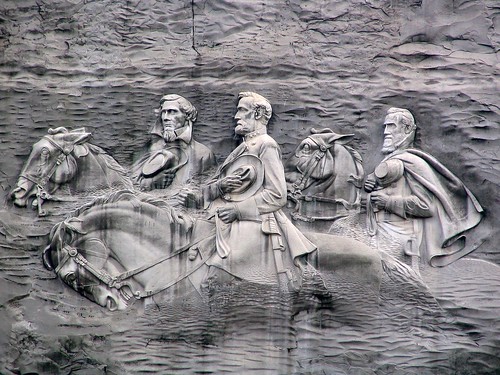
Stone Mountain is a 1,700-foot-tall grey dome rock located about a half-hour due east of downtown Atlanta. On its northern face is the largest bas-relief carving in the world—bigger even than the carving at Mount Rushmore. It depicts Confederate heroes Robert E. Lee, Stonewall Jackson, and Jefferson Davis. The mountain also features a Confederate battle flag at the base of its hiking trail.

Stone Mountain is also where the Ku Klux Klan reinvented itself in 1915 under the direction of William J. Simmons. As legend has it, the Klan would conduct nighttime cross burnings from atop that massive rock to frighten the Atlanta area’s entire black population in one big theatrical stroke of political terror.

Fast-forward a hundred years, and the Klan has clearly lost. The surrounding town of Stone Mountain is now over 75% black and about 18% white. And Atlanta hasn’t had a white mayor since the early 1970s.

Mid-June’s Charleston church shooting—involving a killer who had sullenly posed for selfies hoisting a small Rebel flag—was used as an excuse to launch a full-on cultural purge of all Confederate symbols by those who hate what they insist those symbols represent. And they insist those symbols represent HATE. And they hate that. Those symbols represent intolerance. And they will not tolerate that….

Recently a spokesman for Atlanta’s NAACP demanded that the Confederate carving “be sand-blasted off” Stone Mountain’s side. He also urged authorities to remove the Rebel flag from the mountain’s base.

This raised the hackles and chafed the sunburned necks of Confederate sympathizers across Georgia. Insisting that the flag represented “heritage, not hate,” they arranged for a pro-Confederate rally last Saturday morning at Stone Mountain Park….

[A] young black male was pleading with attendees about how he felt the flag was a provocation, and the attendees kept insisting it had nothing to do with him, especially not with hating him. But he told them that it did. And they kept insisting that it didn’t.

Smirking at an argument that kept going in circles, one peckerwood quipped to me, “That’s one of those deals where ain’t nobody going to get ahead.”

And that pithy quote encapsulated the entire event. It was an argument over what symbols represent—an argument that no one could ever win, because there is no objective answer. In the end, symbols represent whatever someone wants them to represent. One person’s heritage is another person’s hate. And the twain shall never agree. [“Of Heritage and Hate,” Taki’s Magazine, August 3, 2015]

What should and shouldn’t be considered offensive? More to the point, where should the boundaries of state action be drawn? I offer some guidelines in “The Principles of Actionable Harm“:

5. With those exceptions [e.g., defamation, treason, divulging classified information, perjury, incitement to violence, fraud and deception], a mere statement of fact, belief, opinion, or attitude cannot be an actionable harm. Otherwise, those persons who do not care for the facts, beliefs, opinions, or attitudes expressed by other persons would be able to stifle speech they find offensive merely by claiming to be harmed by it. And those persons who claim to be offended by the superior income or wealth of other persons would be entitled to recompense from those other persons….

6. …Nor can it be an actionable harm to commit a private, voluntary act which does nothing more than arouse resentment, envy, or anger in others….

9. Except in the case of punishment for an actionable harm, it is an actionable harm to bar a competent adult from

a. expressing his views, as long as they are not defamatory or meant to incite harm….

10. The proper role of the state is to enforce the preceding principles. In particular,

a. to remain neutral with respect to evolved social norms, except where those norms deny voice or exit, as with the systematic disenfranchisement or enslavement of particular classes of persons; and….

c. to ensure free expression of thought, except where such expression is tantamount to an actionable harm (as in a conspiracy to commit murder or mount a campaign of harassment)….

It would be nice if these principles were observed by politicians, the media, the punditocracy, and various interest groups (both left and right). But it won’t happen for two reasons:

  • People are tribal and love to take stances that identify the particular tribes to which they belong. Arnold Kling puts it this way: “You can take man out of tribal society, but you cannot take tribal society out of man.”
  • Elites and aspiring elites are especially enamored of tribal signaling. As a  commenter at Kling’s blog says: “The main goal of the ascendant educated left-wing white people is to differentiate themselves socially from middle-class white people.” For completeness, I would add lower-class white people, evangelicals and other defenders of traditional morality, the petite bourgeoisie, and anyone who might be suspected of voting Republican.

Clearly, the culture war has entered a new and dangerous phase, reminiscent of China’s Cultural Revolution under Mao. As Boyd Cathey writes,

in the United States today we live in a country characterized by what historian Thomas Fleming has written afflicted this nation in 1860–“a disease in the public mind,” that is, a collective madness, lacking in both reflection and prudential understanding of our history. Too many authors advance willy-nilly down the slippery slope–thus, if we ban the Battle Flag, why not destroy all those monuments to Lee and Jackson. And why stop there? Washington and Jefferson were slave holders, were they not? Obliterate and erase those names from our lexicon, tear down their monuments! Fort Hood, Fort Bragg, Fort Gordon? Change those names, for they remind us of Confederate generals! Nathan Bedford Forest is buried in Memphis? Let’s dig up him up! Amazon sells “Gone with Wind?” Well, to quote a writer at the supposedly “conservative,” Rupert Murdoch-owned New York Post, ban it, too!

It is a slippery slope, but an incline that in fact represents a not-so-hidden agenda, a cultural Marxism, that seeks to take advantage of the genuine horror at what happened in Charleston to advance its own designs which are nothing less than the remaking completely of what remains of the American nation. And, since it is the South that has been most resistant to such impositions and radicalization, it is the South, the historic South, which enters the cross hairs as the most tempting target. And it is the Battle Flag–true, it has been misused on occasion–which is not just the symbol of Southern pride, but becomes the target of a broad, vicious, and zealous attack on Western Christian tradition, itself. Those attacks, then, are only the opening salvo in this renewed cleansing effort, and those who collaborate with them, good intentions or not, collaborate with the destruction of our historic civilization. For that they deserve our scorn and our most vigorous and steadfast opposition. [“‘A Sickness in the Public Mind’: The Battle Flag and the Attack on Western Culture,” Abbeville Institute: The Abbeville Blog, August 4, 2015]

I stand with Dr. Cathey in offering scorn and most vigorous and steadfast opposition.

  *     *     *

Related reading:

*     *     *

Related posts:

The Culture War
Ruminations on the Left in America<
Privilege, Power, and Hypocrisy
Tolerance
Good Riddance
The Gaystapo at Work
The Gaystapo and Islam
The Beginning of the End of Liberty in America
The Tenor of the Times
Social Norms and Liberty
More About Social Norms and Liberty
The Madness Continues
The Euphemism Conquers All

Signature

The Euphemism Conquers All

A euphemism is

a generally innocuous word or expression used in place of one that may be found offensive or suggest something unpleasant….

The market in euphemisms has been cornered by politically correct leftists, who can’t confront reality and wish to erect a fantasy in its place. A case in point is a “bias-free language guide” that was posted on the website of the University of New Hampshire in 2013 and stayed there until today. The guide disappeared after Mark Huddleston, the university’s president, issued this statement:

While individuals on our campus have every right to express themselves, I want to make it absolutely clear that the views expressed in this guide are NOT the policy of the University of New Hampshire. I am troubled by many things in the language guide, especially the suggestion that the use of the term ‘American’ is misplaced or offensive. The only UNH policy on speech is that it is free and unfettered on our campuses. It is ironic that what was probably a well-meaning effort to be ‘sensitive’ proves offensive to many people, myself included. [as quoted in “University President Offended by Bias-Free Language Guide,” an Associated Press story published in USA Today, July 30, 2015]

The same story adds some detail about the contents of the guide:

One section warns against the terms “older people, elders, seniors, senior citizens.” It suggests “people of advanced age” as preferable, though it notes that some have “reclaimed” the term “old people.” Other preferred terms include “person of material wealth” instead of rich, “person who lacks advantages that others have” instead of poor and “people of size” to replace the word overweight.

There’s more from another source:

Saying “American” to reference Americans is also problematic. The guide encourages the use of the more inclusive substitutes “U.S. citizen” or “Resident of the U.S.”

The guide notes that “American” is problematic because it “assumes the U.S. is the only country inside [the continents of North and South America].” (The guide doesn’t address whether or not the terms “Canadians” and “Mexicans” should be abandoned in favor of “Residents of Canada” and “Residents of Mexico,” respectively.)

The guide clarifies that saying “illegal alien” is also problematic. While “undocumented immigrant” is acceptable, the guide recommends saying “person seeking asylum,” or “refugee,” instead. Even saying “foreigners” is problematic; the preferred term is “international people.”

Using the word “Caucasian” is considered problematic as well, and should be discontinued in favor of “European-American individuals.” The guide also states that the notion of race is “a social construct…that was designed to maintain slavery.”

The guide also discourages the use of “mothering” or “fathering,” so as to “avoid gendering a non-gendered activity.”

Even saying the word “healthy” is problematic, the university says. The “preferred term for people without disabilities,” the university says, is “non-disabled.” Similarly, saying “handicapped” or “physically-challenged” is also problematic. Instead, the university wants people to use the more inclusive “wheelchair user,” or “person who is wheelchair mobile.”

Using the words “rich” or “poor” is also frowned upon. Instead of saying “rich,” the university encourages people to say “person of material wealth.” Rather than saying a person is “poor,” the university encourages its members to substitute “person who lacks advantages that others have” or “low economic status related to a person’s education, occupation and income.”

Terms also considered problematic include: “elders,” “senior citizen,” “overweight” (which the guide says is “arbitrary”), “speech impediment,” “dumb,” “sexual preference,” “manpower,” “freshmen,” “mailman,” and “chairman,” in addition to many others. [Peter Hasson, “Bias-Free Language Guide Claims the Word ‘American’ Is ‘Problematic’,” Campus Reform, July 28, 2015]

And more, from yet another source:

Problematic: Opposite sex. Preferred: Other sex.

Problematic: Homosexual. Preferred: Gay, Lesbian, Same Gender Loving

Problematic: Normal … healthy or whole. Preferred: Non-disabled.

Problematic/Outdated: Mothering, fathering. Preferred: Parenting, nurturing. [Jennifer Kabbany, “University’s ‘Bias-Free Language Guide’ Criticizing Word ‘American’ Prompts Shock, Anger,” The College Fix, July 30, 2015

The UNH students who concocted the guide — and the thousands (millions?) at other campuses who think similarly — must find it hard to express themselves clearly. Every word must be weighed before it is written or spoken, for fear of giving offense to a favored group or implying support of an idea, cause, institution, or group of which the left disapproves. (But it’s always open season on “fascist, capitalist pigs.”)

Gee, it must be nice to live in a fantasy world, where reality can be obscured or changed just by saying the right words. Here’s a thought for the fantasists of the left: You don’t need to tax, spend, and regulate Americans until they’re completely impoverished and subjugated. Just say that it’s so — and leave the rest of us alone.

*     *     *

Related posts:

Intellectuals and Society: A Review
“Intelligence” As a Dirty Word
Ruminations on the Left in America
On Writing

Signature

The Tenor of the Times

Below are some links that I’ve collected about the culture war, political correctness, political hypocrisy, and other disturbing features of the contemporary scene. I don’t agree with everything said by the writers, but I believe that they are broadly right about the madness into which America seems to be rapidly descending.

Each link is followed by an excerpt of the piece that is linked. The excerpt — usually but not always the lede — is meant to entice you to follow the link. I urge you to do so.

*     *     *

Adam Marcus and Ivan Oransky, “Author Retracts Study of Changing Minds on Same-Sex Marriage after Colleague Admits Data Were Faked,” Retraction Watch, May 20, 2015 (et seq.):

In what can only be described as a remarkable and swift series of events, one of the authors of a much-ballyhooed Science paper claiming that short conversations could change people’s minds on same-sex marriage is retracting it following revelations that the data were faked by his co-author. [Leftists love to fake data to make political points (e.g., economics and climate studies). — TEA]

Jason Morgan, “Dissolving America,” American Thinker, June 29, 2015

The instant media consensus is in: the Confederate flag atop the South Carolina statehouse has got to go.  The battle flag of the Army of Northern Virginia, we are told, just doesn’t represent who we are as a nation anymore.

But if we are going to take the Confederate flag down because it no longer represents us, then there is no reason why we shouldn’t take the American flag down, too.  Not just from the government buildings in South Carolina, but from every home, ship, office, and church throughout the entire American territory.  Because neither flag has anything to do with who we are anymore.  Old Glory is now just as much a meaningless relic as the republic that created it — as obsolete as the Stars and Bars became in April of 1865.

Bill Vallicella, “SCOTUS and Benedict,” Maverick Philosopher, June 30, 2015:

[Quoting Rod Dreher]:

It is time for what I call the Benedict Option. In his 1982 book After Virtue, the eminent philosopher Alasdair MacIntyre likened the current age to the fall of ancient Rome. He pointed to Benedict of Nursia, a pious young Christian who left the chaos of Rome to go to the woods to pray, as an example for us. We who want to live by the traditional virtues, MacIntyre said, have to pioneer new ways of doing so in community. We await, he said “a new — and doubtless very different — St. Benedict.”

So now you are out in the desert or the forest or in some isolated place free of the toxic influences of a society in collapse.  The problem is that you are now a very easy target for the fascists.  You and yours are all in one place, far away from the rest of society and its infrastructure.  All the fascists have to do is trump up some charges, of child-abuse, of gun violations, whatever.  The rest of society considers you kooks and benighted bigots and won’t be bothered if you are wiped off the face of the earth.  You might go the way of the Branch Davidians.

Heather Mac Donald, “The Shameful Liberal Exploitation of the Charleston Massacre,” National Review, July 1, 2015:

In fact, white violence against blacks is dwarfed by black on white violence. In 2012, blacks committed 560,600 acts of violence against whites (excluding homicide), and whites committed 99,403 acts of violence (excluding homicide) against blacks, according to data from the National Crime Victimization Survey provided to the author. Blacks, in other words, committed 85 percent of the non-homicide interracial crimes of violence between blacks and whites, even though they are less than 13 percent of the population. Both the absolute number of incidents and the rate of black-on-white violence are therefore magnitudes higher than white-on-black violence. There is no white race war going on.

Steve McCann, “America’s Destiny in the Balance,” American Thinker, July 1, 2015:

Beginning in the 1930’s, under the aegis of Franklin Roosevelt, the nation began a drift to the left as a reaction to the Great Depression.  However, those truly committed to socialist/Marxist philosophy and tactics remained in the shadows until the 1960’s.  The Viet Nam war protests unleashed far more than just a demand for an end to the war.  Those that blamed America for all manner of alleged sins in the past and determined to transform the United States into a socialist/Marxist nirvana were able to step out from behind the shadows and enter the mainstream of national legitimacy.  This swarm of locusts soon enveloped the higher levels of academia spawning countless clones to further infiltrate all strata of society — most notably the mainstream media, the entertainment complex and the ultimate target: the Democratic Party.  These vital segments of the culture are now instruments of indoctrination, propaganda and political power.

Victoria Razzi, “Asian American Studies Professors Stay Silent on Asian vs. Black Integration,” The College Fix, July 1, 2015:

An 80-year-old Duke University professor recently argued that Asian Americans have integrated into America better than African Americans, a controversial and contentious assertion that caused uproar and prompted the scholar to be labeled a racist.

Eugene Slavin, “The White Privilege Lie,” American Thinker, July 1, 2015:

Of all the invectives launched against the United States by the resurgent American Left, the charge that in America, White Privilege reigns supreme is the most insidious and culturally ruinous.

Its intent is unambiguous: leftists perpetuate the White Privilege lie to smear America and its institutions as inherently racist, and therefore unworthy of adulation and in need of fundamental socioeconomic transformation.

David Limbaugh, “I Told You Things Are Getting Crazier,” CNSNews.com, July 7, 2015:

The world is upside down, inside out, sideways, crazy, nutso. Bad is good; up is down. Left is right; right is wrong. Evil is good; insanity is sanity. Abnormal is normal. Circles are squares. Hot is cold. Luke warm is red hot — among Republicans, anyway. Common sense is uncommon. The world is otherworldly. Dissent is “hate.” Diversity means conformity. The good guys are the bad guys; virtue is vice; sophistry is intellectualism; jerks are celebrated; debauchery is glorified; the holy is debauched. Let me share some of these headlines, which speak for themselves — loudly and depressingly.

Robert Joyner, “The Hypocrisy of #Black Lives Matter, July 4th EditionTheden, July 9, 2015:

As Theden has argued before, the Black Lives Matter movement is one that very clearly does not care about its own stated goals. The name implies that the movement exists to protect and enrich the lives of blacks, but it spends its time protesting often spurious cases of police brutality and, more recently, the flying of “offensive” flags. It is conspicuously silent on the number one threat to black lives in America, which is other blacks. The movement routinely hectors whites, but frankly the preponderance of evidence shows that whites already value black lives more than blacks do themselves.

Fred Reed, “‘Payback’s a Bitch’: Rural Wisdom and the Gathering Storm,” Fred on Everything, July 9, 2015:

The furor over the Confederate flag, think I, has little to do with the Confederate flag, which is a pretext, an uninvolved bystander. Rather it is about a seething anger in the United States that we must not mention. It is the anger of people who see everything they are and believe under attack by people they aren’t and do not want to be—their heritage, their religion, their values and way of life all mocked and even made criminal.

Bill Vallicella, “Is Reason a White Male Euro-Christian Construct?,” Maverick Philosopher, July 10, 2015:

[Quoting John D. Caputo]:

White is not “neutral.” “Pure” reason is lily white, as if white is not a color or is closest to the purity of the sun, and everything else is “colored.” Purification is a name for terror and deportation, and “white” is a thick, dense, potent cultural signifier that is closely linked to rationalism and colonialism. What is not white is not rational. So white is philosophically relevant and needs to be philosophically critiqued — it affects what we mean by “reason” — and “we” white philosophers cannot ignore it.

This is truly depressing stuff.  It illustrates the rarefied, pseudo-intellectual stupidity to which leftist intellectuals routinely succumb, and the level to which humanities departments in our universities have sunk.

It’s all depressing. Have a nice day.

Signature

Capitalism, Competition, Prosperity, and Happiness

Capitalism is a misnomer for the system of free markets that could deliver abundant prosperity and happiness, were markets left free. Free does not mean unfettered; competition for the favor of consumers exerts strong discipline on markets. And laws against theft, deception, and fraud would serve amply to keep markets honest, the worrying classes to the contrary notwithstanding.

Capitalism is but one pillar of free markets — an essential pillar, to be sure. But it is competition that drives capitalists, entrepreneurs, managers, and workers alike to excel in the satisfaction of consumers’ wants and to make the best use of resources as they satisfy those wants.

I argue that it is the curtailment of competition, due to the enlargement of government, that has caused the economies of the West to yield much less prosperity than they could, and much less psychic satisfaction than workers, managers, and entrepreneurs (if not to capitalists) would otherwise enjoy.

One reason for the ease with which competition has been stifled is the word’s negative connotation, which seems to hold sway even among millions of Americans who compete gladly for more business, better jobs, and higher incomes. The negative view of competition may date from 1845, when Friedrich Engels wrote these words:

Competition is the completest expression of the battle of all against all which rules modern civil society. [The Condition of the Working-Class in England in 1844, 1892 edition, p. 75]

Thanks to Engels and his ilk, most notably Karl Marx, competition became and remains a dirty word, with respect to economic activity if not with respect to games, sports, and idiotic TV shows. Economic competition is too much thought of as a brutal contest in which there are relatively few winners and myriad losers.

In fact, economic competition has myriad winners, consumers prominent among them. Adam Smith explained it in 1776:

When the quantity [of a commodity] brought to market exceeds the effectual demand, it cannot be all sold to those who are willing to pay the whole value of the rent, wages, and profit, which must be paid in order to bring it thither. Some part must be sold to those who are willing to pay less, and the low price which they give for it must reduce the price of the whole. [An Inquiry into the Nature and Causes of the Wealth of Nations, Chapter 7]

Consumers benefit not only from competition among the sellers of a particular good or service, but also from competition among the sellers of a variety of goods and services. In the first instance, consumers benefit from lower prices or higher quality when there’s more than one seller of a particular item (or items that are close substitutes, such as compact cars). In the second instance, the availability of a variety of items requires sellers of all of those items to compete for the consumer’s patronage, either on the basis of price or quality (or both). In either case, sellers often compete by offering new and improved goods and services, thus further benefiting consumers.

The owners of a particular business might wish that they had no competition. But even if the wish is seemingly granted (e.g., by crony-friendly regulations that prevent the formation of similar businesses), that business still has to compete with other kinds of businesses for the favor of consumers.

Most consumers are also sellers of their labor. And as sellers, they compete for jobs. Unless government steps in to designate winners (as in the case of affirmative action), labor competition enables employers to hire and promote workers who have seem to have skills and experience best suited to the work at hand. This is a boon to consumers because competition among workers enables the producers of goods and services to get the most “bang” from their labor budgets.

Labor competition is also a boon to workers. Rarely are workers in a situation where they have only one prospective employer. Employers must usually compete against one another for the services of workers. Competitive labor markets — markets that are free of arbitrary government rules and union-imposed restrictions on about hiring and promotion — help workers to find employment for which they are best suited, and help them maximize their income, given their skills and experience.

Again, absent government- and union-imposed restrictions, workers must use their skills and experience productively. If they don’t, they will be fired or at least not promoted beyond the level at which they are worth their pay. If employers are prevented from firing or demoting unproductive workers, better workers are denied opportunities to earn more. And consumers are harmed because they are forced by widely applicable government- and union-imposed restrictions to subsidize the products of inferior labor. The only escape from federal mandates is the substitution of capital for labor, which is why government-imposed minimum wages (among many things) harm the very groups that they are meant to help.

Engels, Marx, and their purportedly empathic successors want to do away with competition because they don’t understand how it helps consumers and workers. The “ideal” alternative to competition is communism (with a small “c”). But communism, like anarchism, is a system that works only for relatively small numbers of like-minded or genetically bonded persons, and then not for long. The only lasting substitute for communism has been state socialism (also known in its more draconian manifestations as Communism with a capital “c”).

State socialism — even in its relatively mild but still heavy-handed American form — decrees the variety of goods and services that may be produced, and restricts their production. This differs in degree but not in kind from Communism, which produced disastrous consequences for the material and psychic well-being of the hundred of millions of persons who labored and still labor under it. (Party leaders, officials, and favorites were and are given special treatment, of course. Elites never disappear, they just assume different titles.)

The false premise of central planners and those who believe in central planning is that a group of persons — even armed with massive computing power — can anticipate and satisfy the vastly varied and ever-changing skills, wants, tastes, and preferences of a diverse populace. All that the central planners can do, at best, is impose their own preferences on others and make some groups (mainly themselves and their favorites) better off at the expense of others.

A bureaucracy which is set on producing X when people want Y will go on producing X for many years after businesses would have shifted to the production of Y. A bureaucracy that stifles innovation (as bureaucracies do) is unlikely to take a chance on introducing Z, which some consumers might prefer to X or Y, but the introduction of Z is what businesses do every day. Nor are stodgy bureaucracies likely to improve their methods of producing X, Y, Z, or anything else, and so they will use labor and other resources in wasteful ways. All for the sake of avoiding what shallow thinkers like to call “wasteful competition.”

It’s ironic that competition (in contexts other than sports, games, and idiotic TV shows) became a dirty word. Most people compete daily without giving it a second thought. It’s simply a matter of doing the best that one can do — or that one is willing to do — and accepting the consequences, or doing better if one is dissatisfied with the consequences. It is gratifying — not demeaning — to meet life’s challenges, and to meet them successfully (or as successfully as one is able).

Engels and Marx’s pseudo-intellectual successors in politics, the academy, and the punditocracy would recognize the truth of this if they were capable of candid introspection. Assuming that they are (sometimes) capable of it, they must believe themselves to be different from (and superior to) the great mass of people, who must be “rescued” from competition. This belief is a compound of psychological projection and condescending hogwash.

Yes, it’s true that most people are willing and eager to get something for nothing. But until the advent of state socialism (also known euphemistically as democratic socialism) most people were unable to get something for nothing. Yes, there have always been those with access to power — like today’s so-called crony capitalists (whose reliance on cronyism disqualifies them as capitalists) — but they were the major exception. Today’s cronies, “capitalist” and other, run the gamut from CEOs of major corporations to physically and mentally able dole collectors to retirees whose productive investments in economic growth have been stunted by the lure (and cost of) “free” Social Security and Medicare benefits.

It needn’t have been thus. The Framers of the Constitution meant to limit the central government’s powers to those sixteen (enumerated in Article I, Section 8) that would “provide for the common Defence and general Welfare.” And the powers of the central government remained within the Framers’ limits for well over a century. But once the government’s powers began to spread beyond their constitutional boundaries, there was no turning back — or so it seems.

The growth of dependency on the state, which in the United States began in earnest with the New Deal, is a cancer that has eaten away the competitive spirit that once animated Americans’ economic striving. The cancer needn’t have taken hold and spread, but it did, thanks to ambitious politicians and know-it-all academicians and pundits, whose siren song of “something for nothing” has lured too many Americans into the arms of the nanny state. And those who have resisted the siren song are nevertheless forced to pay for the “something” that others get for nothing.

Competition is a good word, not a dirty one. It should be praised and emulated, not derided and denigrated. It is at the heart of psychically satisfying and materially enriching economic activity.

*     *     *

Related reading:

*     *     *

Related posts:

Fear of the Free Market — Part I
Fear of the Free Market — Part II
Fear of the Free Market — Part III
The Cost of Affirmative Action
Socialist Calculation and the Turing Test
Monopoly and the General Welfare
Slopes, Ratchets, and the Death Spiral of Liberty
Academic Bias
Intellectuals and Capitalism
Greed, Cosmic Justice, and Social Welfare
Positive Rights and Cosmic Justice
Fascism with a “Friendly” Face
The Interest-Group Paradox
Parsing Political Philosophy
Monopoly: Private Is Better Than Public
Gains from Trade
Trade
The Near-Victory of Communism
Tocqueville’s Prescience
The Real Burden of Government
The Left
The Constitution: Original Meaning, Corruption, and Restoration
The Illusion of Prosperity and Stability
The Deficit Commission’s Deficit of Understanding
Our Enemy, the State
“Intellectuals and Society”: A Review
Competition Shouldn’t Be a Dirty Word
The Stagnation Thesis
Social Justice
The Left’s Agenda
More Social Justice
Luck-Egalitarianism and Moral Luck
Empathy Is Overrated
Union-Busting
In Defense of Wal-Mart
Taxing the Rich
More about Taxing the Rich
The Evil That Is Done with Good Intentions
Understanding Hayek
The Left and Its Delusions
Creative Destruction, Reification, and Social Welfare
The Arrogance of (Some) Economists
The “Jobs Speech” That Obama Should Have Given
Regime Uncertainty and the Great Recession
Regulation as Wishful Thinking
The Spoiled Children of Capitalism
Politics, Sophistry, and the Academy
Subsidizing the Enemies of Liberty
In Defense of the 1%
Are You in the Bubble?
Lay My (Regulatory) Burden Down
The Burden of Government
Economic Growth Since World War II
The Eclipse of “Old America”
Genetic Kinship and Society
Government in Macroeconomic Perspective
How High Should Taxes Be?
The Value of Experience
Economics: A Survey (also here)
Why Are Interest Rates So Low?
Vulgar Keynesianism and Capitalism
America’s Financial Crisis Is Now
“We the People” and Big Government
The Keynesian Multiplier: Phony Math
The True Multiplier
Parsing Political Philosophy (II)
Some Inconvenient Facts about Income Inequality
Modern Liberalism as Wishful Thinking
Mass (Economic) Hysteria: Income Inequality and Related Themes
The Pretence of Knowledge
Alienation
Income Inequality and Economic Growth
A Case for Redistribution, Not Made
Ruminations on the Left in America
McCloskey on Piketty
The Rahn Curve Revisited
The Slow-Motion Collapse of the Economy
Nature, Nurture, and Inequality
How to Eradicate the Welfare State, and How Not to Do It
The Real Burden of Government (II)
Diminishing Marginal Utility and the Redistributive Urge
Obamanomics in Action
Academic Ignorance
Judicial Supremacy: Judicial Tyranny
Does the Power to Tax Give Congress Unlimited Power? (II)
The Beginning of the End of Liberty in America

And guest-blogger L. P.‘s posts about the downside of empathy: here, here, here, here, here, and here.

Signature

“Than I” or “Than Me”?

Which of these sentences do you prefer?

“John is older than I.”

“John is older than me.”

The first sentence is favored by pedants; the second, by “average people,” or so it seems to me. Unusually, I’m on the side of “average people,” not because there are more of them (democracy is the bane of liberty) but because the second sentence is grammatically correct.

Some pedants try to justify the first sentence (and similar ones) by asserting that it means “John is older than I am,” where “am” is an understood word. That is a strained explanation for a simple comparison of the attributes of two entities. It leaves “am” dangling. Some pedants try to avert the “dangle” by asserting that “John is older than I” means “John is older than I am old.” But “I am old” is nonsensical in this context: “I” is not necessarily old, just younger than John.

Alternatively, pedants assert that “than” is functioning as a conjunction, a word that “connects words, phrases, clauses, or sentences.” (A definition that affords no distinction.) However, if you follow the first link in the preceding sentence, you will learn that a conjunction may overlap with other parts of speech. In the case of “than” it often does just that; that is, it also serves as a preposition: a word “that is used to show the relation of a noun or noun-equivalent (the object of the preposition) to some other word in the sentence” (Harbrace College Handbook, 6th editiion, p. 457). That is precisely the function of “than” in “John is older than me.”

Generalizing from the case of John and me, I must respectfully disagree with Garner’s Modern American Usage. It is an excellent guide that I have been using for several months in place of Follett’s Modern American Usage, which had been my guide for more than forty years. On page 805 of Garner’s, the author (Bryan A. Garner) gives examples of what he considers wrong usages; his corrections are in parentheses (his sources are omitted, for brevity):

  • “Too many of our students seem to struggle…. Are we really that much smarter than them [read they]?”
  • “What makes the story even juicier is that Pamela, 74, has allegedly been feuding for years with her two former stepdaughters, both of them slightly older than her [read she] — and one of them may face financial difficulties.”
  • “Scrambling to improve his chances, Donald Skelton, a safe-deposit manager at Chase plans to go to night school this summer at age 46. He had a rude awakening after 23 years at the bank when he learned that his daughter, fresh out of college, earned more than him [read he].”
  • The sun on the runway illuminated their hair, which was bobbed to shoulder length and styled to the same tint — all in their thirties (he was fifty-eight at the time), twenty years younger than him [read he?], and of the same height.”

Garner’s uncertainty in the fourth example suggests a lack of confidence in his assertion that “than” is (in such cases) a conjunction rather than a preposition.

I am confident that “than” is a preposition in cases of the kind adduced by Garner; that is, it expresses a relationship between two entities.

My bottom line: In a comparative statement where “than” intervenes between a noun and a noun-substitute, the word that follows “than” should take the objective case: me, him, them, and so on. It not only sounds more natural (to most people), but it’s also grammatically correct.

*     *     *

Related posts:

Remedial Vocabulary Training
One Small Step for Literacy
Punctuation
Data Are
“Hopefully” Arrives
Hopefully, This Post Will Be Widely Read
Why Prescriptivism?
Unsplit Infinitives
Lincoln, the Poet President
On Writing
Tolerance

Signature

Privilege, Power, and Hypocrisy

The Almighty is not a liberal… The Almighty is the driving force for the entire universe and the universe is not a very liberal place. That is what the modern world seems not to understand….

Simon Mawer, The Gospel of Judas

*     *     *

Complaints about privilege are really complaints about power. How did privilege and power come to be conflated? Let’s begin with an authoritative definition* of privilege:

A right, advantage, or immunity granted to or enjoyed by a person, or a body or class of persons, beyond the common advantages of others; an exemption in a certain case from certain burdens or liabilities.

Are all privileges unjust? Do privileges necessarily confer power or arise from it?

Good Privilege and Days of Yore

There was a time when most privileges were neither unjust nor a sign of power: when younger men ceded their seats on buses to older persons and pregnant women, when a man could hold open a door for a woman and be thanked for it instead of being repaid with a stony glare or silence; when a fit person would cede a seat to a crippled one; and so on.

Was there anything wrong with such behaviors? Only a revisionist who views the world through contemporary mores (of a politically correct hue)  would think so. Such behaviors were in fact widely practiced and accepted as fitting and proper. They were not condescending or demeaning. They did not confer power or arise from it, except to the extent that persons who had the power to grant them did so voluntarily and out of pity or respect for those who received them. But the grantors’ power was only situational, not general. A better word for it would be opportunity, as in the opportunity to do a good deed for a fellow human being.

The Decline of Civility and the Rise of Big Government

Such behaviors have gone out of style, or nearly so, not because they were considered improper but because manners have coarsened. Manners have coarsened because people — not all people but too many of them — have become self-centered and inconsiderate of others. My view is that the rise of the “me” generation in the 1960s curtailed instances of public kindness, thus producing fewer instances of good manners that might be copied and repeated, thus leading to the further recession of good manners, etc.

The “me” generation didn’t arise spontaneously. Its rise was an integral part of the breakdown of the social fabric that big government has abetted and encouraged. What breakdown? Anthony Esolen describes it all too well:

[W]hen we ask, “Why are the churches empty?” we might also ask, “Why are our public buildings so ugly? Why do we no longer have any folk art to speak of? Why do neighbors not know one another? Why are there no dances for everyone of all ages to enjoy? Why is the sight of a young lad and lass holding hands as rare now as public indecency used to be? Why is no one getting married? Why have family trees turned into family sticks, or family briars?

“Why are there so many feral young men and women, tattooed and slovenly, loitering about shopping malls or slouching towards the internet for their porn? Why are there so many old neighborhoods, roads, and bridges crumbling, while millions of young men are unemployed or, worse, unemployable? Why do so many teachers believe it their duty to tear down the glories of their own civilization, calling it ‘critical thinking,’ without a passing thought as to what will remain in their place? Who are what used to be called the ‘leading men’ of an ordinary town? Are there any? Who are what used to be called ‘city fathers’? Are there any?

“Where are the songs of yesteryear? Where are the poems? Where are the holidays? What happened to the parades and the marching bands?

“What virtue do we honor, other than what we call tolerance, which turns out not to be tolerance at all but the ‘virtue’ of demanding that there should be no honor granted to virtue?” [“What Is a Healthy Culture?,” The Imaginative Conservative, June 16, 2015]

Walter Williams puts it this way:

A civilized society’s first line of defense is not the law, police and courts but customs, traditions, rules of etiquette and moral values. These behavioral norms — mostly transmitted by example, word of mouth and religious teachings — represent a body of wisdom distilled over the ages through experience and trial and error. They include important thou-shalt-nots, such as thou shalt not murder, thou shalt not steal and thou shalt not cheat. They also include all those courtesies that have traditionally been associated with ladylike and gentlemanly conduct.

The failure to fully transmit these values and traditions to subsequent generations represents one of the failings of what journalist Tom Brokaw called “The Greatest Generation.” People in this so-called great generation, who lived during the trauma of the Great Depression and fought World War II, not only failed to transmit the moral values of their parents but also are responsible for government programs that will deliver economic chaos….

For nearly three-quarters of a century, the nation’s liberals have waged war on traditional values, customs and morality. Our youths have been counseled that there are no moral absolutes. Instead, what’s moral or immoral is a matter of personal opinion. During the 1960s, the education establishment began to challenge and undermine lessons children learned from their parents and Sunday school with fads such as “values clarification.” So-called sex education classes are simply indoctrination that undermines family and church strictures against premarital sex. Lessons of abstinence were considered passe and replaced with lessons about condoms, birth control pills and abortions. Further undermining of parental authority came with legal and extralegal measures to assist teenage abortions with neither parental knowledge nor parental consent….

If it were only the economic decline threatening our future, there might be hope. It’s the moral decline that spells our doom. [“Culture and Social Pathology,” creators.com, June 16, 2015]

Williams hints at the role of government in the sundering of the social fabric. Let’s spell it out. As government has become all-powerful and crushingly intrusive (with respect to Americans, if not with respect to their enemies) personal responsibility and the civilizing bonds of society have been replaced by dependency on the state and the use of its power to advance the interest of some at the expense of all. (See “The Interest-Group Paradox” for more about this phenomenon and its folly.)

The privileges that are accorded out of kindness, of which I wrote earlier, arise from civil society, and they are dying with it. People seem less willing than they were in the past to accord such privileges to others.

Privilege as a Dirty Word

With the withering away of civil society, privilege is now thought of mainly as something that someone demands or takes because of his rank, socioeconomic status, gender, or race. Privilege-taking was widely scorned until the arrival of the age of identity politics. Consider the phrase “rank has its privileges” (RHIP), which is a term of derogation that applies where persons of high status (judges, elected officials, corporate executives, military “brass”) enjoy perquisites or escape punishments because of their status.

Then there’s the case of the “privileged brat” — a young person who acts haughtily toward others. This is usually someone whose parents are affluent and on whom the parents have lavished money (or the things that it can buy) — someone, in other words, who has come to think of himself as “special” and whose wishes are to be taken as commands by others. I could add examples, but they would be of the same type: the privilege-taker who exploits his status to demand things of others.

Who are today’s dominant privilege-takers?

Unjust Stereotyping

Is a white person — better yet, a straight, white male of European descent (preferably non-Mediterranean) — necessarily privileged in either sense discussed here: a beneficiary of privileges voluntarily accorded by others or a privilege-taker who demands and receives favors based on his race, gender, and ethnicity?

If you select either answer you’re making the grievously wrong generalization that all heterosexual, white males of non-Mediterranean European descent (hetwhims for short) are not alike. Further, many hetwhims who seem to be “privileged” owe their privilege to causes other than gender, race, and ethnicity: Intelligence, other innate traits, and hard work should come to mind. (If you say, factually, that whites of European descent are generally smarter than, say, persons of African descent, you are unlikely to be a person who pigeonholes all hetwhims as “privileged.”)

Let’s make it real by asking if the following types of hetwhim are privileged:

  • a redneck hetwhim of below-average intelligence who comes from a poor Appalachian family
  • any hetwhim of average or below average intelligence who comes from a family with below-average income
  • a hetwhim who has been denied a job or promotion for which he was, objectively, the best candidate because he was competing with non-hetwhims, especially blacks, women, or — nowadays — homosexuals
  • a hetwhim who has a mental or physical condition that makes it impossible for him to enjoy what passes for a normal life
  • a hetwhim who is actively discriminated against in a university setting — as a student, professor, or prospective professor — because of his gender, color, and sexual orientation and not because of his actual beliefs or qualifications
  • one of the tens of millions of hetwhims in the United States who simply does the best he can with his mental and physical endowment, and whose achievements are due to those endowments and his efforts, plain and simple.

Blaming any of them for what befalls others — usually because of their own faults and failings — is nothing less than blaming the blameless. (See my post, “Luck-Egalitarianism and Moral Luck.”)

The Hypocrisy of the Truly Privileged

The stereotyping of hetwims as privileged is laughable when it is done by affluent hetwims in the media and academia. It is especially laughable when it is done by privileged members of the so-called victim groups: the president and his wife, many cabinet members and other high officials, many members of Congress, their counterparts at the State and local levels, a disproportionately high percentage of functionaries at all levels of government, and on and on throughout the ranks of business, the media, and academia. Beginning with the president, these privileged masses include more than a fair share of mediocrities who would not be where they are if they had to rely on their natural endowments, and if they could not exploit the misplaced guilt that underlies political correctness, affirmative action, and other modes of injustice.

“Injustice” is an apt word:

The obsession of seeing everything in race-coloured terms is itself racist. Anti-racism pursed by zealots transforms itself into the very vice it deplores. This is the cost of identity politics, and its close bedmate, victimology enterprises — the desire to judge, define, represent and indict the individual by the group he or she belongs to. Every human being’s experience in its infinite particularities and potentials transcends category. [Rex Murphy, “‘White Privilege’ on the March,” The National Post, May 15, 2015]

Another apt word is “payback.” The non-victims of non-privilege — with the considerable aid of their privileged allies on the left — are in the process of paying back tens of millions of hetwhims for their imagined sins. Payback may be cathartically pleasurable, but it isn’t justice — social, racial, or other. It’s just plain vindictiveness.

What about “fairness,” which is a favorite word of the racism-sexism-social-justice warriors? “Fairness” is the first refuge of the envious and their morally corrupt allies on the left. Whenever I hear “It just isn’t fair to [insert name of “victimized” group],” I think of a petulant child who lost a game because of his own lack of skill.

*     *     *

Related posts:

Refuting Rousseau and His Progeny
Liberty and “Fairness”
The Adolescent Rebellion Syndrome
Academic Bias
The F-Scale Revisited
Intellectuals and Capitalism
Greed, Cosmic Justice, and Social Welfare
Positive Rights and Cosmic Justice
The Interest-Group Paradox
The State of the Union 2010
The Shape of Things to Come
Sexist Nonsense
Inside-Outside
Asymmetrical (Ideological) Warfare
“Intellectuals and Society”: A Review
Government vs. Community
Social Justice
The Left’s Agenda
More Social Justice
The Evil That Is Done with Good Intentions
Luck-Egalitarianism and Moral Luck
The Left and Its Delusions
The Destruction of Society in the Name of “Society”
An Economist’s Special Pleading: Affirmative Action for the Ugly
Nature is Unfair
The Spoiled Children of Capitalism
Politics, Sophistry, and the Academy
Subsidizing the Enemies of Liberty
Our Perfect, Perfect Constitution
Constitutional Confusion
Race and Reason: The Achievement Gap — Causes and Implications
Liberty and Society
The Eclipse of “Old America”
The Capitalist Paradox Meets the Interest-Group Paradox
Genetic Kinship and Society
America: Past, Present, and Future
Defending Liberty against (Pseudo) Libertarians
Left-Libertarians, Obama, and the Zimmerman Case
“Conversing” about Race
The Fallacy of Human Progress
Political Correctness vs. Civility
IQ, Political Correctness, and America’s Present Condition
Defining Liberty
“We the People” and Big Government
Evolution and Race
The Culture War
The Fall and Rise of American Empire
Some Inconvenient Facts about Income Inequality
Modern Liberalism as Wishful Thinking
Mass (Economic) Hysteria: Income Inequality and Related Themes
Getting Liberty Wrong
Romanticizing the State
“Wading” into Race, Culture, and IQ
“Liberalism” and Personal Responsibility
Income Inequality and Economic Growth
Round Up the Usual Suspects
Poverty, Crime, and Big Government
Evolution, Culture, and “Diversity”
A Case for Redistribution, Not Made
Greed, Conscience, and Big Government
Ruminations on the Left in America
The Harmful Myth of Inherent Equality
My View of Libertarianism
Crime Revisited
Getting “Equal Protection” Right
A Cop-Free World?
Nature, Nurture, and Inequality
Tolerance
The Real Burden of Government
No Wonder Liberty Is Disappearing
Diminishing Marginal Utility and the Redistributive Urge
How to Protect Property Rights and Freedom of Association and Expression
Democracy, Human Nature, and the Future of America
The Gaystapo at Work
The Gaystapo and Islam
1963: The Year Zero

__________
* The Compact Edition of the Oxford English Dictionary (New York: The Oxford University Press, Sixth Printing in the United States, September 1973), Volume 2, p. 2307, at 3.

Signature

1963: The Year Zero

[A] long habit of not thinking a thing WRONG, gives it a superficial appearance of being RIGHT…. Time makes more converts than reason.

Thomas Paine, Common Sense

If ignorance and passion are the foes of popular morality, it must be confessed that moral indifference is the malady of the cultivated classes. The modern separation of enlightenment and virtue, of thought and conscience, of the intellectual aristocracy from the honest and common crowd is the greatest danger that can threaten liberty.

Henri Frédéric Amiel, Journal

The Summer of Love ignited the loose, Dionysian culture that is inescapable today. The raunch and debauchery, radical individualism, stylized non-conformity, the blitzkrieg on age-old authorities, eventually impaired society’s ability to function.

Gilbert T. Sewall, “Summer of Love, Winter of Decline

*     *     *

If, like me, you were an adult when John F. Kennedy was assassinated, you may think of his death as a watershed moment in American history. I say this not because I’m an admirer of Kennedy the man (I am not), but because American history seemed to turn a corner when Kennedy was murdered. To take the metaphor further, the corner marked the juncture of a sunny, tree-lined street (America from the end of World War II to November 22, 1963) and a dingy, littered street (America since November 22, 1963).

Changing the metaphor, I acknowledge that the first 18 years after V-J Day were by no means halcyon, but they were the spring that followed the long, harsh winter of the Great Depression and World War II. Yes, there was the Korean War, but that failure of political resolve was only a rehearsal for later debacles. McCarthyism, a political war waged (however clumsily) on America’s actual enemies, was benign compared with the war on civil society that began in the 1960s and continues to this day. The threat of nuclear annihilation, which those of you who were schoolchildren of the 1950s will remember well, had begun to subside with the advent of JFK’s military policy of flexible response, and seemed to evaporate with JFK’s resolution of the Cuban Missile Crisis (however poorly he managed it). And for all of his personal faults, JFK was a paragon of grace, wit, and charm — a movie-star president — compared with his many successors, with the possible exception of Ronald Reagan, who had been a real movie star.

What follows is an impression of America since November 22, 1963, when spring became a long, hot summer, followed by a dismal autumn and another long, harsh winter — not of deprivation, and perhaps not of war, but of rancor and repression.

This petite histoire begins with the Vietnam War and its disastrous mishandling by LBJ, its betrayal by the media, and its spawning of the politics of noise. “Protests” in public spaces and on campuses are a main feature of the politics of noise. In the new age of instant and sympathetic media attention to “protests,” civil and university authorities often refuse to enforce order. The media portray obstructive and destructive disorder as “free speech.” Thus do “protestors” learn that they can, with impunity, inconvenience and cow the masses who simply want to get on with their lives and work.

Whether “protestors” learned from rioters, or vice versa, they learned the same lesson. Authorities, in the age of Dr. Spock, lack the guts to use force, as necessary, to restore civil order. (LBJ’s decision to escalate gradually in Vietnam — “signaling” to Hanoi — instead of waging all-out war was of a piece with the “understanding” treatment of demonstrators and rioters.) Rioters learned another lesson — if a riot follows the arrest, beating, or death of a black person, it’s a “protest” against something (usually white-racist oppression, regardless of the facts), not wanton mayhem. After a lull of 21 years, urban riots resumed in 1964, and continue to this day.

LBJ’s “Great Society” marked the resurgence of FDR’s New Deal — with a vengeance — and the beginning of a long decline of America’s economic vitality. The combination of the Great Society (and its later extensions, such as Medicare Part D and Obamacare) with the rampant growth of regulatory activity has cut the rate of economic growth from 5 percent to 2 percent.  The entrepreneurial spirit has been crushed; dependency has been encouraged and rewarded; pension giveaways have bankrupted public treasuries across the land. America since 1963 has been visited by a perfect storm of economic destruction that seems to have been designed by America’s enemies.

The Civil Rights Act of 1964 unnecessarily crushed property rights, along with freedom of association, to what end? So that a violent, dependent, Democrat-voting underclass could arise from the Great Society? So that future generations of privilege-seekers could cry “discrimination” if anyone dares to denigrate their “lifestyles”? There was a time when immigrants and other persons who seemed “different” had the good sense to strive for success and acceptance as good neighbors, employees, and merchants. But the Civil Rights Act of 1964 and its various offspring — State and local as well as federal — are meant to short-circuit that striving and to force acceptance, whether or not a person has earned it. The vast, silent majority is caught between empowered privilege-seekers and powerful privilege-granters. The privilege-seekers and privilege-granters are abetted by dupes who have, as usual, succumbed to the people’s romance — the belief that government represents society.

Presidents, above all, like to think that they represent society. What they represent, of course, are their own biases and the interests to which they are beholden. Truman, Ike, and JFK were imperfect presidential specimens, but they are shining idols by contrast with most of their successors. The downhill slide from the Vietnam and the Great Society to Obamacare and lawlessness on immigration has been punctuated by many shameful episodes; for example:

  • LBJ — the botched war in Vietnam, repudiation of property rights and freedom of association (the Civil Rights Act)
  • Nixon — price controls, Watergate
  • Carter — dispiriting leadership and fecklessness in the Iran hostage crisis
  • Reagan — bugout from Lebanon, rescue of Social Security
  • Bush I — failure to oust Saddam when it could have been done easily, the broken promise about taxes
  • Clinton — bugout from Somalia, push for an early version of Obamacare, budget-balancing at the cost of defense, and perjury
  • Bush II — No Child Left Behind Act, Medicare Part D, the initial mishandling of Iraq, and Wall Street bailouts
  • Obama — stimulus spending, Obamacare, reversal of Bush II’s eventual success in Iraq, naive backing for the “Arab spring,”  acquiescence to Iran’s nuclear ambitions, unwillingness to acknowledge or do anything about the expansionist aims of Russia and China, neglect or repudiation of traditional allies (especially Israel), and refusal to take care that the immigration laws are executed faithfully.

Only Reagan’s defense buildup and its result — victory in the Cold War — stands out as a great accomplishment. But the victory was squandered: The “peace dividend” should have been peace through continued strength, not unpreparedness for the post 9/11 wars and the resurgence of Russia and China.

The war on defense has been accompanied by a war on science. The party that proclaims itself the party of science is anything but that. It is the party of superstitious, Luddite anti-science. Witness the embrace of extreme environmentalism, the arrogance of proclamations that AGW is “settled science,” unjustified fear of genetically modified foodstuffs, the implausible doctrine that race is nothing but a social construct, and on and on.

With respect to the nation’s moral well-being, the most destructive war of all has been the culture war, which assuredly began in the 1960s. Almost overnight, it seems, the nation was catapulted from the land of Ozzie and Harriet, Father Knows Best, and Leave It to Beaver to the land of the free- filthy-speech movement, Altamont, Woodstock, Hair, and the unspeakably loud, vulgar, and violent offerings that are now plastered all over the air waves, the internet, theater screens, and “entertainment” venues.

Adherents of the ascendant culture esteem protest for its own sake, and have stock explanations for all perceived wrongs (whether or not they are wrongs): racism, sexism, homophobia, Islamophobia, hate, white privilege, inequality (of any kind), Wall  Street, climate change, Zionism, and so on.

Then there is the campaign to curtail freedom of speech. This purported beneficiaries of the campaign are the gender-confused and the easily offended (thus “microagressions” and “trigger warnings”). The true beneficiaries are leftists. Free speech is all right if it’s acceptable to the left. Otherwise, it’s “hate speech,” and must be stamped out. This is McCarthyism on steroids. McCarthy, at least, was pursuing actual enemies of liberty; today’s leftists are the enemies of liberty.

There’s a lot more, unfortunately. The organs of the state have been enlisted in an unrelenting campaign against civilizing social norms. As I say here,

we now have not just easy divorce, subsidized illegitimacy, and legions of non-mothering mothers, but also abortion, concerted (and deluded) efforts to defeminize females and to neuter or feminize males, forced association (with accompanying destruction of property and employment rights), suppression of religion, absolution of pornography, and the encouragement of “alternative lifestyles” that feature disease, promiscuity, and familial instability. The state, of course, doesn’t act of its own volition. It acts at the behest of special interests — interests with a “cultural” agenda….  They are bent on the eradication of civil society — nothing less — in favor of a state-directed Rousseauvian dystopia from which morality and liberty will have vanished, except in Orwellian doublespeak.

If there are unifying themes in this petite histoire, they are the death of common sense and the rising tide of moral vacuity — thus the epigrams at the top of the post. The history of the United States since 1963 supports the proposition that the nation is indeed going to hell in a handbasket.

Read on.

*     *     *

Related reading:

*     *     *

Related posts:

Refuting Rousseau and His Progeny
Killing Free Speech in Order to Save It
The Adolescent Rebellion Syndrome
The Ruinous Despotism of Democracy
Academic Bias
The F-Scale Revisited
The Modern Presidency: A Tour of American History
The People’s Romance
Intellectuals and Capitalism
On Liberty
Greed, Cosmic Justice, and Social Welfare
Positive Rights and Cosmic Justice
Liberalism and Sovereignty
The Interest-Group Paradox
Getting It Wrong and Right about Iran
The Real Constitution and Civil Disobedience
The State of the Union 2010
The Shape of Things to Come
Sexist Nonsense
The Constitution: Original Meaning, Corruption, and Restoration
Delusions of Preparedness
Inside-Outside
Asymmetrical (Ideological) Warfare
A Grand Strategy for the United States
The Folly of Pacifism
The Unconstitutionality of the Individual Mandate
“Intellectuals and Society”: A Review
Does the Power to Tax Give Congress Unlimited Power?
Does Congress Have the Power to Regulate Inactivity?
Is the Anger Gone?
Government vs. Community
Social Justice
The Left’s Agenda
More Social Justice
Why We Should (and Should Not) Fight
Rating America’s Wars
The Public-School Swindle
The Evil That Is Done with Good Intentions
Transnationalism and National Defense
Luck-Egalitarianism and Moral Luck
The Left and Its Delusions
In Defense of Wal-Mart
The Destruction of Society in the Name of “Society”
The Folly of Pacifism, Again
An Economist’s Special Pleading: Affirmative Action for the Ugly
September 20, 2001: Hillary Clinton Signals the End of “Unity”
The War on Terror, As It Should Have Been Fought
Obamacare: Neither Necessary nor Proper
The Spoiled Children of Capitalism
Politics, Sophistry, and the Academy
Subsidizing the Enemies of Liberty
Defense as an Investment in Liberty and Prosperity
Our Perfect, Perfect Constitution
Free Will, Crime, and Punishment
Constitutional Confusion
Obamacare, Slopes, Ratchets, and the Death-Spiral of Liberty
Obamacare and Zones of Liberty
Race and Reason: The Achievement Gap — Causes and Implications
Obama’s Big Lie
Liberty and Society
The Eclipse of “Old America”
The Capitalist Paradox Meets the Interest-Group Paradox
Genetic Kinship and Society
America: Past, Present, and Future
Defending Liberty against (Pseudo) Libertarians
Left-Libertarians, Obama, and the Zimmerman Case
“Conversing” about Race
The Fallacy of Human Progress
Fighting Modernity
Political Correctness vs. Civility
IQ, Political Correctness, and America’s Present Condition
AGW: The Death Knell
The Barbarians Within and the State of the Union
Defining Liberty
The World Turned Upside Down
“We the People” and Big Government
Evolution and Race
The Culture War
Defense Spending: One More Time
The Fall and Rise of American Empire
Some Inconvenient Facts about Income Inequality
Modern Liberalism as Wishful Thinking
Mass (Economic) Hysteria: Income Inequality and Related Themes
Presidential Treason
Getting Liberty Wrong
Romanticizing the State
The Limits of Science (II)
The Pretence of Knowledge
“The Science Is Settled”
“Wading” into Race, Culture, and IQ
“Liberalism” and Personal Responsibility
Income Inequality and Economic Growth
Round Up the Usual Suspects
Walking the Tightrope Reluctantly
Poverty, Crime, and Big Government
Evolution, Culture, and “Diversity”
A Case for Redistribution, Not Made
Greed, Conscience, and Big Government
Ruminations on the Left in America
The Harmful Myth of Inherent Equality
My View of Libertarianism
Crime Revisited
Getting “Equal Protection” Right
McCloskey on Piketty
The Rahn Curve Revisited
The Slow-Motion Collapse of the Economy
A Cop-Free World?
Nature, Nurture, and Inequality
Tolerance
How to Eradicate the Welfare State, and How Not to Do It
Does Obama Love America?
The Real Burden of Government
No Wonder Liberty Is Disappearing
Diminishing Marginal Utility and the Redistributive Urge
How to Protect Property Rights and Freedom of Association and Expression
Obamanomics in Action
Democracy, Human Nature, and the Future of America
Rationalism, Empiricism, and Scientific Knowledge
The Gaystapo at Work
The Gaystapo and Islam
AGW in Austin?

Signature