Democracy in Austin

Proposition 1 was on the ballot in a special election held yesterday in Austin. The adoption of Prop 1 would have left background checks for Uber and Lyft drivers in the hands of the companies. But it was hard to tell what Prop 1 meant because of the contorted language concocted by the anti-Uber/Lyft majority of Austin’s city council. The contorted language made it necessary for Uber and Lyft to help finance a media campaign to explain Prop 1. (Austin’s “news” outlets — in their typically pro-government style — had a lot of negative things to say about the cost of the campaign, from which they profited.)

In the end, only 17 percent of Austin’s registered voters turned out to defeat Proposition 1 by 56 percent to 44 percent. The defeat of Prop 1 means that the background checks on prospective Uber and Lyft drivers will be conducted by the city, instead of by the companies. That’s just the seed from which bureaucratic control would inevitably grow to envelope Uber and Lyft, their drivers, and their customers. With the handwriting on the wall, Uber and Lyft probably will withdraw from Austin.

According to one report of the outcome,

Opposition to Prop 1 was concentrated in East, North and South Austin, with many downtown and West Austin voting precincts seeing a majority of their voters supporting the measure.

The election, in other words, pitted the “working class” sections of Austin against the “white collar” sections of Austin. The outcome reflects resentment toward Uber and Lyft (characterized as “big business” by some opponents of Prop 1) and their generally more affluent riders, who prefer Uber and Lyft’s less-plebian, higher-tech, surge-priced services.

What does this have to do with democracy in Austin? Here are two snippets from the source quoted above:

“The people have spoken tonight loud and clear,” said Austin Mayor Steve Adler in an emailed statement. “

Councilmember Ann Kitchen…. “The voters have spoken and they want these requirements and I know that we can do that…”

This is from another source:

Former Austin City Council member Laura Morrison has been a staunch opponent of Proposition 1, speaking on behalf of Our City, Our Safety, Our Choice, a group opposed to the ordinance. She said Saturday’s election results were Austin’s way of saying, “that’s not how we do democracy in this city.”

How is it “democratic” for the city’s government to allow voters (and a relatively small number of them, at that) to override the voluntary choices of Uber and Lyft users? Adler, Kitchen, and Morrison are the kind of people (i.e., big-D Democrats) who would defend voluntary choice when it comes to abortion (i.e., killing a living human being). But it’s not all right (with them) if a person chooses to take the overstated risk of using Uber or Lyft instead of a taxi.

The intrusion of Austin’s government into the ride-sharing business (with the ardent support of local taxi companies), is yet another instance of “liberal” madness.

*     *     *

Related reading: John Daniel Davidson, “How Austin Drove Out Uber and Lyft,” The Federalist, May 10, 2016

Bubbling Along

There’s been a spate of commentary about the (supposedly) growing class divide in America. It all builds on Charles Murray’s four-year-old book, Coming Apart: The State of White America, 1960-2010. Murray continues to write about it. His latest entry is a blog post at AEI.org, “Why Should I Have All the Fun? More from the Bubble Quiz.”

The Bubble Quiz, which Murray introduced in Chapter 4 of his book, is meant to measure a person’s distance from working-norms; the lower one’s score, the more one is immersed in an upper-class “bubble,” that is, unattuned to working-class cultural and social norms.

Others have recently joined Murray’s lamentation about the supposedly growing class divide in America. Mark Pulliam, writing at the Library of Law and Liberty (“Horatio Alger Matters“), comments on a new book by George Mason University law school professor Frank Buckley, The Way Back: Restoring the Promise of America:

American society, Buckley argues, is trending toward a caste system, in which one’s future economic prospects are largely dictated by the status of one’s parents…. Buckley—who in his Acknowledgments section makes clear his grounding on the political Right— advocates an agenda to restore upward mobility with sensible free-market reforms, which he drolly calls “socialist ends through capitalist means.”

Buckley believes the current sclerosis is largely caused by government policies, not technological change. Specifically, he sees a de facto aristocracy having struck an unholy bargain with the lumpenproletariat to conspire against the middle class…. Buckley posits that America’s wealthy (and mostly liberal) elites support “policies that preserve their privileges and those of their children at the expense of a rising middle class.”…

As surely as contract law spelled the end of feudal serfdom, the rule of law is indispensable to upward mobility. But the rule of law has been hobbled by an overly-complicated legal system that empowers unscrupulous prosecutors, enriches elite lawyers, and reduces the certainty and predictability of everyday commerce.

…The New Class cynically “buys” the acquiescence of the “peasants” (and their leaders) with generous welfare benefits, plentiful government jobs, affirmative action, and Progressive policies that wreak havoc on the middle class, but which largely spare the New Class, ensconced in its gated enclaves, cloistered communities, and private schools.  In Buckley’s telling, stagnant mobility in the United States relative to the rest of the developed countries has produced a “Legacy Nation, a society of inherited privilege and frozen classes.”

The thesis explains many things, including why Goldman Sachs and other Wall Street financiers so lavishly support Hillary Clinton’s candidacy, and why the political leadership of both parties is so indifferent to the interests of middle class Americans. (Opinion polls show, for example, that the public overwhelmingly favors significant reductions—if not outright cessation—of immigration levels, yet Congress refuses to act.) The solutions Buckley offers—reforming education (mainly by adopting school choice), paring back government regulation, simplifying the tax code, adopting a Canadian model of immigration (focusing primarily on the skills of the immigrant and the needs of the host country), tort reform, and so forth—are sensible whether or not they would solve the problem of inequality and immobility.

Thomas Edsall of The New York Times comes at the issue from the left in “How the Other Fifth Lives,” citing research that seems to have been inspired by Murray’s work, though Edsall never mentions Murray, who is libetarianish. Edsall is nevertheless in sync with Murray and Buckley:

[Bernie] Sanders’s extraordinary performance to date … points to the vulnerability of a liberal alliance in which the economic interests of those on the top — often empowered to make policy — diverge ever more sharply from those in the middle and on the bottom.

As the influence of affluent Democratic voters and donors grows, the leverage of the poor declines. This was evident in the days leading up to the New York primary when, as Ginia Bellafante of The Times reported, both Clinton and Sanders, under strong pressure from local activists, agreed to tour local housing projects. Bellafante noted that their reluctance reflects how “liberal candidates on the national stage view public housing as a malady from which it is safest to maintain a distance.”

The lack of leverage of those on the bottom rungs can be seen in a recent Pew survey in which dealing with the problems of the poor and needy ranked 10th on a list of public priorities, well behind terrorism, education, Social Security and the deficit. This 10th place ranking is likely to drop further as the gap widens between the bottom and the top fifth of voters in the country.

It turns out that the United States has a double-edged problem — the parallel isolation of the top and bottom fifths of its population. For the top, the separation from the middle and lower classes means less understanding and sympathy for the majority of the electorate, combined with the comfort of living in a cocoon.

For those at the bottom, especially the families who are concentrated in extremely high poverty neighborhoods, isolation means bad schools, high crime, high unemployment and high government dependency.

The trends at the top and the bottom are undermining cohesive politics, but more important they are undermining social interconnection as they fracture the United States more and more into a class and race hierarchy

Before I tell you what I think of these quasi-apocalyptic mutterings, I must quote from a four-year-old post of mine, in which I reported my bubble score:

I am proud to say that I do not live in the upper-middle-class bubble, even though my career, income history, and tastes qualify me as a resident of the bubble. My upbringing (outlined here) inoculated me from elitism. The effects of that inoculation are reflected in my score of 51 on the quiz that Murray presents in Chapter 4 of his book…. Murray gives the following interpretation of scores:

  • A lifelong resident of a working-class neighborhood with average television and moviegoing habits. Range: 48–99. Typical: 77.
  • A first- generation middle-class person with working-class parents and  average television and moviegoing habits. Range: 42–100. Typical: 66.
  • A first- generation upper-middle- class person with middle-class parents. Range: 11–80. Typical: 33.
  • A second- generation (or more) upper-middle-class person who has made a point of getting out a lot. Range: 0–43. Typical: 9.
  • A second- generation (or more) upper-middle-class person with the television and moviegoing habits of the upper middle class. Range: 0–20.Typical: 2.The scoring of the archetypes reflects a few realities about socioeconomic background and the bubble

I defy Murray’s categorization, for I am a first-generation upper-middle-class person with working-class parents and the television and moviegoing habits of the upper middle class. But no matter. My quiz score indicates my comprehension of the “real world” and the “real people” who inhabit it. They are not faceless game pieces to be shunted about in the name of “society” for the sake of my ego or power cravings. That is why I am neither a “liberal” nor a pseudo-libertarian like this fellow and this bunch.

Having said that, I don’t put much stock in the bubble score or in the scare-mongering of Murray, Buckley, Edsall, and others. First, there’s a lot of mobility between income groups — persons who are in the bottom-fifth aren’t doomed to stay there, just as persons who are in the top-fifth (and higher) often fail to stay there. See, for example, my post “Mass (Economic) Hysteria: Income Inequality and Related Themes,” which gives many links to supporting material.

Second, the illusion of a greater gap between “rich” and “poor” is fostered, in part, by what some call the disappearance of the middle class. Well, the middle class is shrinking, if one measures the middle class by the fraction of persons or households with incomes in a certain income range. But the reason for that shrinkage is simple: a general upward migration toward the upper-income classes. Mark Perry neatly summarizes the state of affairs in “Yes, America’s Middle Class Has Been Disappearing…into Higher Income Groups.” (There’s more here: “Sorry, Everyone: The American Middle Class Is Winning.”)

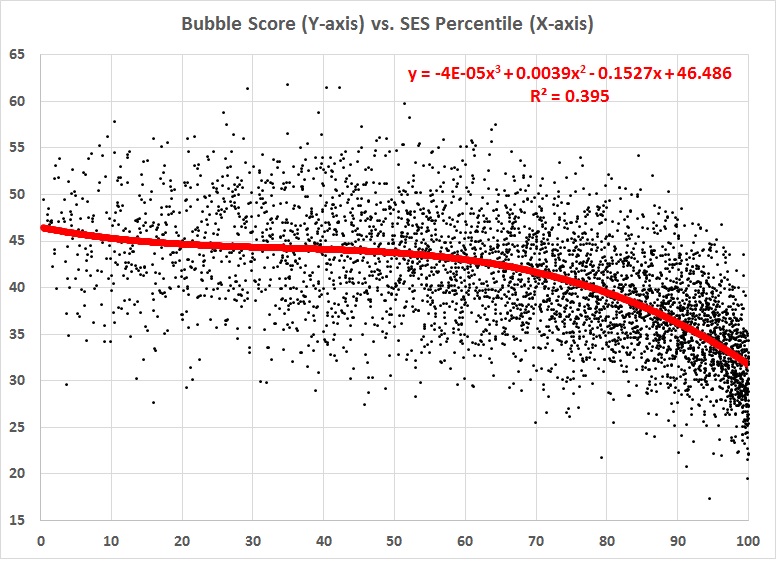
Third, there just aren’t the kind of sharp class divisions that Murray et al. like to moan about. Murray himself (unwittingly) offers evidence to support my point. It’s found in a spreadsheet that that gives SES percentiles and bubble scores by ZIP (https://www.aei.org/wp-content/uploads/2016/04/Public-Use-Zip-Code-File.xlsx), to which Murray links in the AEI.org piece mentioned in the first paragraph of this post. I derived the following graph from Murray’s spreadsheet:

Bubble score vs. SES percentile
SES percentile refers to a measure of socioeconomic status that takes into account a person’s income, education, and occupation.

Where’s the dividing line — the “knee of the curve” in pseudo-scientific parlance? There’s isn’t one: As a brilliant former colleague put it, curves don’t have knees. In fact, there’s a lot of overlap in bubble scores across the full range of SES values. That overlap is consistent with the r-squared of the polynomial fit, which means that SES explains only 40 percent of the bubble score.

The real problem with American “society” is a kind of moral decay, brought on in great part by dependency on government. Working-class people of my father’s generation didn’t look to government for betterment; they just went out and worked, and usually bettered themselves.

Moreover, working-class people and upper-class “liberals” weren’t inundated by a lot of envy-inducing media blather about “crony capitalism” and “assortive mating.” (See the articles by Buckley and Edsall.) Crony capitalists (a relative handful among 320 million Americans) are the kind of people who would do well under any system — even including Soviet-style communism, which rewards ambition and intelligence, just in different ways than capitalism.

The whining about assortive mating is pointless and hypocritical. Those who engage in such whining would be appalled if government required mating across income levels — a kind of social engineering on a par with China’s one-baby policy. I doubt that affluent left-wing graduates of prestigious universities would countenance such a policy. And if they wouldn’t, what are they whining about?

And what about the obvious fact that high-income persons live in areas that poor people can’t afford. That’s hardly a new thing. But thanks to (relatively) free markets that reward the combination of intelligence-education-effort, there are proportionally more people who are in a position to live in areas that poor people can’t afford. Isn’t that exactly what most striving poor and middle-income persons want? What’s the problem?

I can understand Edsall’s preoccupation with social distancing; he’s a left-leaner who probably wants government to “do something” about it. Murray’s motivation is harder to understand given his libertarianish politics. But it’s evident that he’s been playing into the hands of do-something leftists, albeit unintentionally.

What will happen if government tries to “do something,” that is, more than it has already done (in vain) about supposed social distancing? The “something” is unlikely to be deregulation, tax-code reform, or anything that reduces government’s economic role. The “something” is more likely to be more preferences and handouts that reinforce and expand the cycle of dependency, thus lessening the urge to strive. The spreading rot will bring calls for yet more government action, which will further spread the rot, and so on into America’s dark, dystopian, “European” future.

*      *      *

Related posts:

In Defense of the 1%

Race and Reason: The Achievement Gap — Causes and Implications

IQ, Political Correctness, and America’s Present Condition

Alienation

Income Inequality and Economic Growth

A Case for Redistribution, Not Made

Greed, Conscience, and Big Government

The Rahn Curve Revisited

The Slow-Motion Collapse of the Economy

Nature, Nurture, and Inequality

How to Eradicate the Welfare State, and How Not to Do It

Diminishing Marginal Utility and the Redistributive Urge

Tolerance

Privilege, Power, and Hypocrisy

Capitalism, Competition, Prosperity, and Happiness

Cutting the Cord

If you haven’t already cut the cord (i.e., rid yourself of cable or satellite TV service), you’ve probably dreamed of doing it. I just cut the cord, and it makes me feel good all over.

Cable companies had it good for a long time — armed as they were with government-granted monopolies on access to channels that can’t be captured by an antenna. Enter satellite TV providers, whose offerings helped to keep cable companies in check, but who maximized profits by adopting the same bundling strategy as cable companies.

Then along came internet-based alternatives, centered on smart TVs, streaming devices like Roku, and streaming services like Netflix and Amazon Video. A lot of consumers — like me — can watch just about anything they want to watch, and at a much lower cost, by switching to streaming devices and services. The missing ingredient is usually access to local TV broadcasts of news and weather.

That’s where the antenna comes in, in particular, an indoor antenna that doesn’t require roof-climbing and still delivers a sharp signal. Specifically, this antenna: ClearStream Eclipse Indoor HDTV Antenna with Sure Grip Technology – 25 Mile Range, for which I paid $39.99. (There are also amplified versions if you live more than 25 miles from a transmission tower or your line of sight is obstructed by terrain or tall buildings.) The high ratings at Amazon.com pushed me toward the ClearStream; this review at The WireCutter convinced me.

And I wasn’t disappointed — quite the opposite, in fact. Within 15 minutes after opening the package, I had crystal-clear reception of 32 channels (only four of which are of use to me). Most of the time was taken up by programming my TV for local channels, which as a long-time cable/satellite TV customer victim, I hadn’t done before. Installation might have taken longer if I’d had to move the antenna around to get better reception, but I didn’t have to do that. I placed it where I thought it would get a strong signal, and it did.

I enjoyed my new freedom from satellite TV for a few days — watching local news and weather via my antenna and watching House of Cards on Netflix streaming video. Then I called DirecTV this morning to cancel my satellite TV service. Bwa-ha-ha-ha!

The writing is on the wall for cable and satellite TV providers. And they’ve begun to move in the direction of customized service. AT&T U-verse, for example, has a local-channels-only option — but if you can get what you need with an easy-to-install $40 antenna, why pay a $199 installation fee and about $30 for monthly service? Cable companies have similar “basic” options, but the one offered in my area by Time-Warner cost almost $40 a month the last time I looked at it.

Yes, cable and satellite TV companies are beginning to offer consumers greater flexibility in choosing from among the thousands of channels on offer. And that will help the companies stay in business for a while. There are a lot of consumers who just don’t want to spend the time and effort it takes to save hundreds or thousands of dollars a year. They’d rather keep on doing what they’re doing.  So cable and satellite TV companies will survive for another decade or two on sucker business. Then they’ll go the way of the CRT television set — into the dustbin of history.

And I have done my little bit to help make it happen.

Why Liberty of Contract Matters

UPDATED 10/19/15

I wrote this four years ago “In Defense of Wal-Mart“:

There are no goon squads dragging unwilling people in from the streets to work in Wal-Mart stores. There are no Wal-Mart employees caged in their work areas. There are secret prisons in Arkansas where they send Wal-Mart employees who elect to move on to more highly compensated jobs at other companies.

People work at Wal-Mart because it offers them the best combination of pay, benefits, and working conditions available to them. In other words, employment at Wal-Mart usually is a step up, not a step down.

The attention of the worrying classes turned recently to Amazon, as John O. McGinnis notes:

The New York Times has recently portrayed Amazon as a workplace somewhere between the first circle of hell and a bad section of purgatory, with harsh supervisors and backbiting colleagues that are the inevitable consequence of the company’s management practices. I did not need Jeff Bezos’s demurral to doubt the accuracy of portrait. In a company this large, there will always be bad supervisors, intriguing colleagues and disgruntled employees that can support a lot of wild anecdotes. And the New York Times, a newspaper that even a former ombudsman has admitted is on the left, has an agenda of attacking business the better to justify an intrusive state. [“The Liberty to Work Under Tough Bosses,” Library of Law and Liberty, August 19, 2015]

McGinnis continues:

But let us suppose for moment that the Times portrait is more accurate than Bezos’s denial that overall these anecdotes capture the reality of the company.  Is it really any cause for concern? The employees chose to work there and can leave at any time: it is not a case of indentured servitude. The white collar jobs portrayed here pay good wages. And most important of all, we have a competitive labor market that serves the needs of employees and consumers alike. Even the Times’ description shows that many employees find the culture empowering and thrilling. Some employees stay for a long period. Others use the skills they learn to start their own businesses. It may well make perfect sense for some people to endure upfront unpleasantness—even of the kind that leads to occasional tears—to gain discipline and knowledge that will later stand them in good stead.

I couldn’t have said it better.

UPDATE:

The Atlantic reports on Amazon’s response to the Times story.  I gagged when I read this:

The company, in its post Monday, also did not challenge the other claim made in the Times story: that Amazon can be a challenging place for its female employees. One female employee, Molly Jay, who had received high ratings for years, found herself being called “a problem” after she began traveling to care for her father, who was stricken with cancer. Another, Michelle Williamson, a 41-year-old mother of three children, was told, in the words of the newspaper, “that raising children would most likely prevent her from success at a higher level because of the long hours required.” A third, Julia Cheiffetz, wrote in Medium, about being sidelined after having a child and being diagnosed with cancer. [Krishnadev Calamur, “A Blistering Response from Amazon,” October 19, 2015]

Life is full of choices. If you choose family over work, don’t expect your employers’ customers to pay you (or your employer) for time you spend away from work.

*     *     *

Related posts:

A Short Course in Economics
Law and Liberty
Creative Destruction, Reification, and Social Welfare
“Buy Local”
Substantive Due Process, Liberty of Contract, and States’ “Police Power”

The Madness Continues

I just learned about this while watching the news on TV:

Uber and Lyft are being sued in several jurisdictions for allegedly denying service to passengers with wheelchairs and guide dogs. Not only that, but the U.S. Justice Department recently intervened in a case brought by blind plaintiffs, urging that the discrimination accusations be taken seriously. And not only that, but Uber told The Daily Beast that drivers accused of discrimination are usually suspended or fired. Lyft has a similar policy.

Why in the hell are handicapped persons — egged on by wheelchair-chasing lawyers, DOJ, and the usual whining meddlers — complaining about Uber and Lyft? And why are Uber and Lyft apologizing?

Uber and Lyft are providing services that weren’t previously available. They’re not denying the handicapped services to which the handicapped previously had access. They’re certainly not denying services that they have a contractual or moral responsibility to provide.

If anything, the availability of Uber and Lyft means that the handicapped have greater access to the sources of transportation on which they previously relied because many non-handicapped persons have switched to Uber and Lyft. Handicapped persons should be thankful to Uber and Lyft instead of whining about them.

Further, as the article notes, Uber and Lyft are technology companies — they match drivers and passengers — they’re not public carriers. It’s not their responsibility to provide transportation for the handicapped. Nor should it be the responsibility of Uber and Lyft drivers to do so. They may choose to do so, but that should be their call; they shouldn’t be compelled by yet another regulatory, statutory, or judicial mandate.

This is what happens when leftists, lawyers, and government agencies are free to meddle in the marketplace: They screw things up, just because they can.

Signature

Not-So-Random Thoughts (XVI)


Links to the other posts in this occasional series may be found at “Favorite Posts,” just below the list of topics. This is an especially long entry in the series, so I’ve labeled each item. You can navigate directly to items by clicking on any of the following links:

“Libertarian” Paternalism

Drug Prohibition

Unconstitutionality of Social Security and Medicare

Où est Charlie Hebdo?

Speaking of Censorship

Censorship-Plus

The Disparate Impact of Government

Putting the Civil War in Perspective

*     *     *


“Libertarian” Paternalism

Timothy Taylor asks “Who Will Nudge the Nudgers?” in a post about a paper by W. Kip Viscusi and Ted Gayer:

Viscusi and Gayer point out a number of reasons why less-than-rational behavioral responses may be more prevalent among government decision-makers than for economic actors in the private economy. Here are some examples: 1) Private actors (like consumers and firms) need to bear the immediate costs of their decisions in a direct way, while elected officials and regulators do not. 2) Public policies are often influenced by the loud voice of concentrated special interests, who can overwhelm the quieter and more diffuse voices for the general interest. 3) Market actions evolve from an interaction of many buyers and sellers, and the checks and balances that such a process provides, but government actions can evolve from a much smaller number of potentially overconfident technocrats, who have a personal and career interest in pushing their own agendas. [The Conversible Economist, July 21, 2015]

There’s much more. Read it, then see my post, “The Perpetual Nudger.” I point out that “nudgers” (e.g., Richard Thaler) are really wannabe dictators:

What seems to bother Thaler is that most people aren’t Econs [hyper-rational calculators]; their tastes and preferences seem irrational to him, and it’s his (self-appointed) role in life to force them to make “correct” decisions (i.e., the decisions he would make).

There’s much more in the many posts to which I link at the end of “The Perpetual Nudger.”

Return to the top of this post.

*     *     *


Drug Prohibition

The estimable Theodore Dalrymple strikes again:

[I]t is not true that problems with drugs arise only when or because they are prohibited.

The relationship between crime and drug prohibition is also much more complex than the legalizers would have us believe. It is certainly true that gangs quickly form that try to control drug distribution in certain areas, and that conflict between the aspirant gangs leads to violence…. But here I would point out two things: first that the violence of such criminal gangs was largely confined to the subculture from which they emerged, so that other people were not much endangered by it; and second that, in my dealings with such people, I did not form the impression that, were it not for the illegality of drugs, they would otherwise be pursuing perfectly respectable careers. If my impression is correct, then the illegality of drugs might protect the rest of society from their criminality: the illegal drug trade being the occasion, but not the cause, of their violence.

What about Prohibition, is the natural reply? It is true that the homicide rate in the United States fell dramatically in the wake of repeal. By the 1960s, however, when alcohol was not banned, it had climbed higher than during Prohibition…. Moreover, what is less often appreciated, the homicide rate in the United States rose faster in the thirteen years before than in the thirteen years during Prohibition. (In other respects, Prohibition was not as much of a failure as is often suggested: alcohol-related problems such as liver disease declined during it considerably. But no consequences by themselves can justify a policy, otherwise the amputation of thieves’ hands would be universal.) Al Capone was not a fine upstanding citizen before Prohibition turned him into a gangster. [“Ditching Drug Prohibition: A Dissent,” Library of Law and Liberty, July 23, 2015, and the second in a series; see also “The Simple Truth about J.S. Mill’s Simple Truth,” op. cit., July 20, 2015; “Myths and Realities of Drug Addiction, Consumption, and Crime,” op. cit., July 31, 2015; and “Closing Argument on the Drug Issue,” op. cit., August 4, 2015]

This reminds me of my post, “Prohibition, Abortion, and ‘Progressivism’,” in which I wrote about the Ken Burns series, Prohibition. Here’s some of it:

Although eugenics is not mentioned in Prohibition, it looms in the background. For eugenics — like prohibition of alcohol and, later, the near-prohibition of smoking — is symptomatic of the “progressive” mentality. That mentality is paternalistic, through and through. And “progressive” paternalism finds its way into the daily lives of Americans through the regulation of products and services — for our own good, of course. If you can think of a product or service that you use (or would like to use) that is not shaped by paternalistic regulation or taxes levied with regulatory intent, you must live in a cave.

However, the passing acknowledgement of “progressivism” as a force for the prohibition of alcohol is outweighed by the attention given to the role of “evangelicals” in the enactment of prohibition. I take this as a subtle swipe at anti-abortion stance of fundamentalist Protestants and adherents of the “traditional” strands of Catholicism and Judaism. Here is the “logic” of this implied attack on pro-lifers: Governmental interference in a personal choice is wrong with respect to the consumption of alcohol and similarly wrong with respect to abortion.

By that “logic,” it is wrong for government to interfere in or prosecute robbery, assault, rape, murder and other overtly harmful acts, which — after all — are merely the consequences of personal choices made by their perpetrators. Not even a “progressive” would claim that robbery, assault, etc., should go unpunished, though he would quail at effective punishment.

“Progressives” just don’t know where to draw lines. (Witness the many phantom red lines that Obama has drawn for Syria and  Iran.) It’s centuries too late to prohibit the consumption of alcohol (not that I’d wish it had happened); it’s still not too late to prohibit the consumption of hard, death-dealing drugs. If those drugs are legalized, it won’t be long before taxpayers are forced to pay for the drug habits of a growing population of drug abusers. That’s the “progressive” way.

Return to the top of this post.

*     *     *


Unconstitutionality of Social Security and Medicare

Mike Rappaport makes the case, and concludes with this:

Now that we have had Social Security and Medicare for generations and people have relied upon them, I don’t think that the original meaning can be enforced to hold them unconstitutional.  Precedent should allow them to continue.  But it is worth remembering that these programs would have never taken their pernicious form if the Constitution’s original meaning had been followed in the first place. [“The Unconstitutionality of Social Security and Medicare,” Library of Law and Liberty, July 23, 2015]

This comes as no surprise to me. Here’s a bit from a recent post, “Does the Power to Tax Give Congress Unlimited Power? (II),” which refers to a much older one:

[T]he power to tax is not unlimited. Taxes levied by the central government must be levied for the purpose of executing powers specifically enumerated in Article I, Section 8 of the Constitution. Nevertheless, the majority NFIB v. Sebelius chose not only to distort the individual mandate — which is clearly a penalty, not a tax — but also to willfully disregard the Constitution’s expressed limitations on the powers of Congress. Even if the individual mandate were a tax, Congress cannot constitutionally levy such a tax because the Affordable Care Act isn’t contemplated in its enumerated powers. (ACA derives its supposedly constitutional status from the Court’s decision in 1935 to declare the Social Security Act constitutional, even though it isn’t. See my post of October 31, 2004, “Social Security Is Unconstitutional.”)

Return to the top of this post.

*     *     *


Où est Charlie Hebdo?

As dead (in spirit) as the 12 who were murdered in January. Mark Steyn writes:

I mentioned a few days ago the announcement by Charlie Hebdo that they are no longer in the business of Mohammed cartoons:

So another non-senseless act has paid off bigtime for the Islamic enforcers. I regret the decision, although I understand it.

Which I do. Almost everyone who mattered at Charlie Hebdo is dead. What did they die for? A hashtag and a candlelight vigil? None of those who seized eagerly on #JeSuisCharlie as the cause du jour, from Angela Merkel and François Hollande to George Clooney and Helen Mirren to thousands in the streets of Paris and millions across the Internet, were willing to do the one thing that would have mattered, and show the reason why they died. Which is why such sterling champions of free speech as PLO leader Mahmoud Abbas and Sultan Erdogan’s vizier Ahmet Davutoglu were happy to march in the big post-slaughter parade. Do you think they’d have been there if any of the dead’s multitudes of new “friends” were waving Charlie magazine covers?…

And so, after a similar but fortunately less bloody attack in Texas [link added], virtually the entire American media decided to blame the victim and took it as read that Islam now has an opt-out from the First Amendment. You can’t fence off Islam and contain the damage to freedom of speech: the decision to surrender it incrementally leads inevitably to its total loss. On the day of his murder, I quoted the words of Stéphane “Charb” Charbonnier, Laurent Sourisseau’s predecessor as Charlie editor, from two years earlier:

It may seem pompous, but I’d rather die standing than live on my knees.

It’s not pompous, but it is lonely. And the slippery, weaselly nature of the post-bloodbath support told Charlie Hebdo it was only going to get lonelier. It’s hard standing on your feet when everyone else with the #JeSuisCharlie buttons is on their knees, bottoms in the air, prostrate before the fanatics. And so Charb’s successor has opted to live on his knees. [“The Knees Have It,” SteynOnline, July 22, 2015]

Color me unsurprised. In the aftermath of the slaughter in January, I wrote “Sober Reflections on ‘Charlie Hebdo’.” Here’s some of it:

[Charlie Hebdo is] a stridently left-wing rag that mocks religion (of all kinds), and anything else deemed too “respectable” for the adolescent tastes of its staff.

What’s most striking about the “Je suis Charlie” movement is its pure hypocrisy….

Yes, the left gets up in arms when some of its members are slaughtered by Muslim pigs (I love that phrase). But this is the same, hypocritical left that condones and promotes censorship….

The slaughter at Charlie Hebdo is not a reason for solidarity with the left, but a reason to oppose the left and its clients — especially (but not exclusively) the murderous adherents of Islam.

Return to the top of this post.

*     *     *


Speaking of Censorship

Erick Erickson writes about

an organized movement within the gay rights community that is sometimess referred to as the “gay mafia.” They want to harass those who disagree with their agenda and silence any dissent from their agenda. They have worked overtime in the past twenty-four hours because an AP poll shows that the number of Americans who now support gay marriage has declined since the Supreme Court’s ruling and a majority believe Christian businesses should not be compelled to provide goods and services to gay weddings.

They cannot have that. They also cannot have books and data that dispute their claims. One such book is by my friend Ryan Anderson. The book is called Truth Overruled: The Future of Marriage and Religious Freedom. A subgroup of the gay mafia who call themselves “Flying Monkeys” are flinging poo in the direction of Ryan’s book.

In particular, they have organized a campaign to down vote Ryan’s book on Amazon.com. The Daily Signal has screenshots of the gay mafia’s online conversations encouraging people to go “review” Ryan’s book and give it one star reviews.

The people have not read the book. But they want you to think the book is a terrible read. They are attacking Ryan personally and attacking arguments they have not even read. Anyone who knows Ryan knows he takes a very scholarly approach to the marriage arguments and has provided a great deal of foresight into the movement again marriage.

You can order Ryan’s book on the Kindle now or get a print edition next month via Amazon. I highly recommend it. [“The Gay Mafia Wants to Stop You from Doing This,” RedState, July 21, 2015]

I have ordered it.

We in the U.S. have thus far been spared the excesses of censorship that plague Canada. One such excess is the subject of my post, “Free Speech Ends at the Northern Border.” That an overstatement, of course, because censorship is rife in America, especially on college campuses. Just check out the website of The Foundation for Individual Rights in Education.

See also my posts “The Gaystapo at Work,” “The Gaystapo and Islam.” “The Beginning of the End of Liberty in America,” and “The Tenor of the Times.”

Return to the top of this post.

*     *     *


Censorship-Plus

In a closely related development, there’s a portentous recent ruling by the Equal Employment Opportunity Commission:

Last week, the Equal Employment Opportunity Commission dropped an astounding ruling: By a 3-2 vote, it concluded that “sexual orientation is inherently a ‘sex-based consideration,’ and an allegation of discrimination based on sexual orientation is necessarily an allegation of sex discrimination under Title VII.”

This is a big deal: The Commission’s recommendations shape rulings on federal employees’ workplace-discrimination claims, and its field offices deal with claims made by employees at private organizations, as well. But the ruling is also a reminder of how complicated—and unresolved—the post-Obergefell legal landscape is. The Supreme Court’s ruling in favor of same-sex marriage at the end of June has set the country up for two new waves of discrimination claims: those made by same-sex couples and LGBT workers, and those made by religious Americans who oppose same-sex marriage. The two may seem distinct or even opposed, but they’re actually intertwined: In certain cases, extending new rights to LBGT workers will necessarily lead to religious-freedom objections, and vice versa.

Right now, it’s impossible to know how these claims will fall out. It’s been less than a month since the ruling, and much of the legal theory on these issues is just that: theory. In Congress, there’s at least some effort to reconcile the two sides. As my colleague Russell Berman wrote on Friday, Democrats are pushing for legislation which would include prohibitions on discrimination in education, housing, and public accommodation, and Republicans may well sign on—if that legislation allows for religious exemptions. No matter what passes, the issues will remain tangled. These will be some of the questions courts and legislatures have to untangle in the wake of Obergefell. [Emma Green, “Gay Rights May Come at the Cost of Religious Freedom,” The Atlantic, July 27, 2015]

It’s not just religious liberty that’s under attack, it’s liberty — period. It’s clear that the federal government is gearing up to tell Americans what they may say about others and who they must associate with, like it or not:

Most citizens will, of course, attempt to exercise their freedom of speech, and many business owners will, of course, attempt to exercise their freedom of association. But for every person who insists on exercising his rights, there will be at least as many (and probably more) who will be cowed, shamed, and forced by the state into silence and compliance with the new dispensation. And the more who are cowed, shamed, and forced into silence and compliance, the fewer who will assert their rights. Thus will the vestiges of liberty vanish.

That’s from my post, “The Beginning of the End of Liberty in America,” which I published on the day of the Obergefell diktat.

Return to the top of this post.

*     *     *


The Disparate Impact of Government

Speaking of impending atrocities, Michael Barone takes on “HUD’s ‘Disparate Impact’ War on Suburban America“:

Disparate impact. It’s a legal doctrine that may be coming soon to your suburb (if you’re part of the national majority living in suburbs).

Bringing it there will be the Obama Department of Housing and Urban Development’s Affirmatively Furthering Fair Housing program. It has been given a green light to impose the rule from Justice Anthony Kennedy’s majority opinion in the Supreme Court’s 5-4 decision [link added] in Texas Department of Housing and Community Affairs v. Inclusive Communities Project. [Kennedy must have been warming up for his Obergefell diktat, which came on the following day. — TEA]

The decision purports to interpret the Fair Housing Act of 1968 as authorizing lawsuits if municipal policies have a “disparate impact” as measured by the racial percentages of those affected — this despite the fact that the words of the Fair Housing Act prohibit only intentional racial discrimination….

In every large metropolitan area with a significant black population, you won’t find a single census tract with 0 black residents. Blacks sometimes encounter resistance when trying to buy or rent a house that they can afford, which is unjust and infuriating, and a problem for which the Fair Housing Act provides remedies.

But, of course, that has not created an America in which every community has the same percentage as the national average of blacks and whites, Hispanics and Asians, marrieds and singles, gays and straights, Protestants and Catholics and Jews and Muslims.

Free choice never shakes out that way. Throughout history, Americans and immigrants have tended to choose to cluster with likeminded people….

How did disparate impact come into the law? In a 1971 Supreme Court case, Griggs v. Duke Power Co., the Court, acting when memory was still fresh of Southern resistance to desegregation, ruled that the company’s aptitude test amounted to discrimination because whites passed at higher rates than blacks. But that’s true of most aptitude tests — which as a result aren’t used much in hiring any more. [creators.com, July 21, 2015]

Don’t tell it to the “social justice” police in D.C. They don’t want to hear it.

The 1971 “disparate impact” ruling by the Supreme Court ranks among the 16 cases that I list as examples of “the judicial betrayal of the constitutional scheme of limited government, and of order and traditional morality,” in “The Fall and Rise of American Empire.” (I would now add the Kennedy Court’s decisions about “disparate impact,” same-sex “marriage,” and Obamacare subsidies.)

“Disparate impact” isn’t just about where people live and work. Malcolm Pollack is on the case:

Here is an item that’s been going around over the past couple of days: an essay by Paul Sperry describing the Obama administration’s latest race-leveling operation.

The idea is to fish for “disparate impact” violations, wherever they can be found — in housing, lending, school discipline, academic performance, enrollment in gifted-student programs, etc. — and to use the coercive power of the State to flatten outcomes.

The Left has a secret weapon here, and in the current cultural climate, it’s a beaut. Here’s how it works:

1) If you go looking for disparate outcomes by racial groups (or by sex), you’ll certainly find them. They are real, and persistent. (See, for example, just how persistent they can be, here.)

2) When such disparate outcomes occur, there are only two possible causes: either they are due to an external obstacle, or something intrinsic to the group itself.

3) If all racial groups are assumed, as by current social convention they must be, to have exactly identical distributions of every cognitive and behavioral trait, then any variation in outcome that disparately affects a particular racial group must be evidence of some external obstacle. This can only be due to racism and injustice, and therefore it is just and proper for the State to detect and remove it, by whatever means necessary.

4) If however, you suggest that disparities under neutral policies may be due, even in part, to innate differences in the distribution of cognitive and behavioral characteristics in different racial groups, then you are a racist. (If you present actual evidence of such differences, you’re a “scientific” racist.) Moreover, the fact that you are even thinking such things is evidence of the persistence and prevalence of racism in general, which in turns confirms the assumption that disparate outcomes are the result of pervasive and intractable racism, and not innate differences. This is what justifies redoubled efforts on the part of the State to bring every aspect of our lives under racial scrutiny, and impose corrective measures wherever disparate outcomes are found.

So: notwithstanding that race, as we are told, is a “social construct” with no basis in reality, the government will spare no effort to group people by race, and to scour vast collections of intrusively gathered data to find inequalities in social and economic outcomes — not on any individual basis, but by race. But despite race being real enough, apparently, to justify making such racial categorizations, race can have no deeper reality as regards any shared characteristics that might contribute to such inequalities. Race is, in other words, real, but only real enough to serve, somehow, as a marker for defining groups, and thereby to serve as the basis of racism, without having any other actual properties. Moreover (and this is what makes the whole thing work so beautifully): if you disagree with any of this, you are yourself a racist — and you have thereby just demonstrated that persistent racism is indeed the problem.

Thanks to this secret weapon, we have moved beyond — far beyond — the idea that particular differences in outcomes may be due to specific and remediable instances of conscious and intentional racism. As we go Forward, we have a new paradigm: differences in outcomes simply ARE racism, now and forever.

That’s some catch!

[“A Respectful Whistle,” waka waka waka, July 21, 2015]

(I couldn’t resist reproducing Pollack’s brilliant post in its entirety. If you don’t already follow his blog, you should do so.)

Return to the top of this post.

*     *     *


Putting the Civil War in Perspective

Walter Williams does it brilliantly:

Was President Abraham Lincoln really for outlawing slavery? Let’s look at his words. In an 1858 letter, Lincoln said, “I have declared a thousand times, and now repeat that, in my opinion neither the General Government, nor any other power outside of the slave states, can constitutionally or rightfully interfere with slaves or slavery where it already exists.” … Debating Sen. Stephen Douglas, Lincoln said, “I am not, nor ever have been, in favor of making voters or jurors of Negroes nor of qualifying them to hold office nor to intermarry with white people; and I will say in addition to this that there is a physical difference between the white and black races, which I believe will forever forbid the two races living together on terms of social and political equality.”

What about Lincoln’s Emancipation Proclamation? Here are his words: “I view the matter (of slaves’ emancipation) as a practical war measure, to be decided upon according to the advantages or disadvantages it may offer to the suppression of the rebellion.” …

Lincoln did articulate a view of secession that would have been heartily endorsed by the Confederacy: “Any people anywhere, being inclined and having the power, have the right to rise up and shake off the existing government and form a new one that suits them better. … Nor is this right confined to cases in which the whole people of an existing government may choose to exercise it. Any portion of such people that can may revolutionize and make their own of so much of the territory as they inhabit.” Lincoln expressed that view in an 1848 speech in the U.S. House of Representatives, supporting the secession of Texas from Mexico.

Why didn’t Lincoln share the same feelings about Southern secession? Following the money might help with an answer. Throughout most of our nation’s history, the only sources of federal revenue were excise taxes and tariffs. During the 1850s, tariffs amounted to 90 percent of federal revenue. Southern ports paid 75 percent of tariffs in 1859. What “responsible” politician would let that much revenue go? [“Historical Ignorance II,” creators.com, July 22, 2015]

(There’s more in William Sullivan’s “Lincoln vs. Lee: How History Is Distorted to Preserve Legends,” American Thinker, August 1, 2015.)

Yes, it can be asserted (with some degree of accuracy) that slavery was the proximate cause of the Civil War, because it was the issue of slavery that brought to a head the longstanding tension between North and South. But the leaders of the South also had a righteous cause, in principle: the cause of constitutional government. This is from my post, “The Southern Secession Reconsidered“:

What tends to be forgotten is the South’s pre-Civil War stance with respect to the central government. Southern resistance to the centralization of political power, and to the central government’s unconstitutional exercises of power, long pre-dated the Southern secession and was founded on a valid interpretation of the Constitution.

The Civil War, as a forcible act of reunification, is defensible only insofar as a main result was the end of slavery in the United States. On constitutional grounds, however, the Southern secession was valid and should not have been contested. [Chapter and verse follow.]

My current view of the Constitution — “How Libertarians Ought to Think About the Constitution” — is more cynical and sweeping:

What does all of this mean for secession? Here it is, from the beginning and by the numbers:

1. The Constitution was a contract, but not a contract between “the people.” It was a contract drawn by a small fraction of the populace of twelve States, and put into effect by a small fraction of the populace of nine States….

2. Despite their status as “representatives of the people,” the various fractions of the populace that drafted and ratified the Constitution had no moral authority to bind all of their peers, and certainly no moral authority to bind future generations….

3. The Constitution was and is binding only in the way that a debt to a gangster who demands “protection money” is binding. It was and is binding because state actors have the power to enforce it, as they see fit to interpret it….

4. The Constitution contains provisions that can be and sometimes have been applied to advance liberty. But such applications have depended on the aims and whims of those then in positions of power.

5. It is convenient to appeal to the Constitution in the cause of liberty … but that doesn’t change the fact that the Constitution was not and never will be a law enacted by “the people” of the United States or any State thereof.

6. Any person and any government in the United States may therefore, in principle, reject the statutes, executive orders, and judicial holdings of the United States government (or any government) as non-binding.

7. Secession is one legitimate form of rejection….

8. An  act of secession may be put down — through legal process or force of arms — but that doesn’t alter the (limited) legitimacy of the act.

9. Given the preceding, any act of secession is no less legitimate than was the adoption of the Constitution.

10. The legitimacy of an act of secession isn’t colored by its proximate cause, whether that cause is a desire to preserve slavery, or to escape oppressive taxation and regulation by the central government, or to live in a civil society that is governed by the Golden Rule. The proximate cause must be evaluated on its own merits, or lack thereof.

If the feds continue their assault on liberty, secession will become an increasingly attractive option. There are other options, including de facto secession.

Return to the top of this post.

Signature

Will Texas Pay My Taxes?

Ryan H. Murphy offers a tantalizing idea:

In Texas, taxes on income are against the state constitution. However, Texans still pay the federal income tax.

In principle, the state could effectively end the federal income tax by using two surprisingly simple and straightforward legislative maneuvers—neither of which involves secession. Texas could choose to send its federal taxpayers a check in the form of a state tax credit equal to their federal income tax liability. It could then pay for the credit by increasing the state sales tax in a revenue neutral way. effectively, t hat would mean the end of all income taxes in the state while significantly raising sales taxes. This isn’t about cutting taxes per se; rather, this is the tax swap to end all tax swaps….

This would constitute a drastic policy shift, but why not do it? The superiority of consumption taxes to income taxes has long been argued by many neoclassical economists. The real difference between a consumption tax and an income tax is that a consumption tax encourages saving and thrift. We have good reason to believe  that (relatively speaking) discouraging saving—and therefore investment—has significant negative effects on growth….

[Jens] Arnold’s work indicates that consumption taxes and property taxes are distinctly superior to income taxes, especially to an income tax with high progressivity. William McBride of the Tax Foundation summarizes this in a 2012 study, “What Is the Evidence on Taxes and Growth?” What is clear is that a U.S. state that is willing to move its tax environment strongly in this direction would attract investment, entrepreneurs, and workers from the other 49 states. [“How States Can Effectively End the Federal Income Tax — and Why They Should,” Regulation, Summer 2015]

Murphy doesn’t try to assess the legality of the maneuvers, nor will I. I’m interested in the arithmetic of Murphy’s proposal.

I dismiss Murphy’s emphasis on the supposed advantages to a particular State: attracting “investment, entrepreneurs, and workers from the other 49 states.” That just a kind of mercantilism. What’s critical is that sales taxes encourage saving and investment, while income taxes discourage them. (That’s a relative statement for a given level of tax revenue. In fact, saving and investment would be maximized when the sum of all tax receipts is just sufficient to maintain public order and national defense, and when those receipts come from sales and use taxes.)

As a resident of Texas — one of seven States that doesn’t levy an income tax — I’m keenly interested in Murphy’s scheme. But is it feasible for Texas to pay the federal income taxes of its residents, then collect the same amount through sales taxes? I think not.

In fiscal year 2008, for example, the residents of Texas owed $89 billion in federal income taxes. In the same fiscal year the State’s sale tax receipts were $22 billion. (The State’s sales-tax rate is 6.25 percent on taxable items. Cities, counties, and other jurisdictions are allowed to collect up to an additional 2 percent on taxable items, but there’s no need to include those taxes in this analysis, as you’ll see.)

Assuming that ratio of federal income taxes to State sales taxes hasn’t changed much since 2008, Texas would have to quintuple its sale-tax rate from 6.25 percent to more than 31 percent in order to pay the federal income taxes of Texas residents while netting its usual sales-tax income. How likely is that?

The nationwide picture looks much the same. All U.S. taxpayers owed the feds $1.1 trillion in fiscal year 2008. Sales tax receipts across the country came to $443 billion in the same period. (This amount includes receipts of local jurisdictions as well as States.) Sales-tax rates would have to be multipled by 3.5 if all States were to finance federal income-tax bills while they (and local governments) net their usual sales-tax income. How likely is that?

Partial subsidies might be feasible, though politically difficult. There’s always great resistance to increases in sales-tax rates because sales taxes are said to be regressive.

Murphy’s idea sounds good, but it’s not a practical one. Also, if adopted widely it would lighten the federal income-tax burden on high-income individuals. That’s a good thing and a bad thing. On the bad side, it would make high-income individuals less mindful of the need to fight for lower tax rates and the spending cuts that should go with lower tax rates. The proper objective — if you favor liberty and economic growth — isn’t to disguise the burden of federal spending, as Murphy’s scheme would do, but to reduce that burden, by a whole lot.

*     *     *

Related posts:

Income Inequality and Economic Growth
A Case for Redistribution, Not Made
McCloskey on Piketty
The Rahn Curve Revisited
The Slow-Motion Collapse of the Economy
How to Eradicate the Welfare State, and How Not to Do It
The Real Burden of Government
Diminishing Marginal Utility and the Redistributive Urge
Obamanomics in Action
Capitalism, Competition, Prosperity, and Happiness

Signature

Further Thoughts about the Keynesian Multiplier

Now an addendum to this page.

Capitalism, Competition, Prosperity, and Happiness

Capitalism is a misnomer for the system of free markets that could deliver abundant prosperity and happiness, were markets left free. Free does not mean unfettered; competition for the favor of consumers exerts strong discipline on markets. And laws against theft, deception, and fraud would serve amply to keep markets honest, the worrying classes to the contrary notwithstanding.

Capitalism is but one pillar of free markets — an essential pillar, to be sure. But it is competition that drives capitalists, entrepreneurs, managers, and workers alike to excel in the satisfaction of consumers’ wants and to make the best use of resources as they satisfy those wants.

I argue that it is the curtailment of competition, due to the enlargement of government, that has caused the economies of the West to yield much less prosperity than they could, and much less psychic satisfaction than workers, managers, and entrepreneurs (if not to capitalists) would otherwise enjoy.

One reason for the ease with which competition has been stifled is the word’s negative connotation, which seems to hold sway even among millions of Americans who compete gladly for more business, better jobs, and higher incomes. The negative view of competition may date from 1845, when Friedrich Engels wrote these words:

Competition is the completest expression of the battle of all against all which rules modern civil society. [The Condition of the Working-Class in England in 1844, 1892 edition, p. 75]

Thanks to Engels and his ilk, most notably Karl Marx, competition became and remains a dirty word, with respect to economic activity if not with respect to games, sports, and idiotic TV shows. Economic competition is too much thought of as a brutal contest in which there are relatively few winners and myriad losers.

In fact, economic competition has myriad winners, consumers prominent among them. Adam Smith explained it in 1776:

When the quantity [of a commodity] brought to market exceeds the effectual demand, it cannot be all sold to those who are willing to pay the whole value of the rent, wages, and profit, which must be paid in order to bring it thither. Some part must be sold to those who are willing to pay less, and the low price which they give for it must reduce the price of the whole. [An Inquiry into the Nature and Causes of the Wealth of Nations, Chapter 7]

Consumers benefit not only from competition among the sellers of a particular good or service, but also from competition among the sellers of a variety of goods and services. In the first instance, consumers benefit from lower prices or higher quality when there’s more than one seller of a particular item (or items that are close substitutes, such as compact cars). In the second instance, the availability of a variety of items requires sellers of all of those items to compete for the consumer’s patronage, either on the basis of price or quality (or both). In either case, sellers often compete by offering new and improved goods and services, thus further benefiting consumers.

The owners of a particular business might wish that they had no competition. But even if the wish is seemingly granted (e.g., by crony-friendly regulations that prevent the formation of similar businesses), that business still has to compete with other kinds of businesses for the favor of consumers.

Most consumers are also sellers of their labor. And as sellers, they compete for jobs. Unless government steps in to designate winners (as in the case of affirmative action), labor competition enables employers to hire and promote workers who have seem to have skills and experience best suited to the work at hand. This is a boon to consumers because competition among workers enables the producers of goods and services to get the most “bang” from their labor budgets.

Labor competition is also a boon to workers. Rarely are workers in a situation where they have only one prospective employer. Employers must usually compete against one another for the services of workers. Competitive labor markets — markets that are free of arbitrary government rules and union-imposed restrictions on about hiring and promotion — help workers to find employment for which they are best suited, and help them maximize their income, given their skills and experience.

Again, absent government- and union-imposed restrictions, workers must use their skills and experience productively. If they don’t, they will be fired or at least not promoted beyond the level at which they are worth their pay. If employers are prevented from firing or demoting unproductive workers, better workers are denied opportunities to earn more. And consumers are harmed because they are forced by widely applicable government- and union-imposed restrictions to subsidize the products of inferior labor. The only escape from federal mandates is the substitution of capital for labor, which is why government-imposed minimum wages (among many things) harm the very groups that they are meant to help.

Engels, Marx, and their purportedly empathic successors want to do away with competition because they don’t understand how it helps consumers and workers. The “ideal” alternative to competition is communism (with a small “c”). But communism, like anarchism, is a system that works only for relatively small numbers of like-minded or genetically bonded persons, and then not for long. The only lasting substitute for communism has been state socialism (also known in its more draconian manifestations as Communism with a capital “c”).

State socialism — even in its relatively mild but still heavy-handed American form — decrees the variety of goods and services that may be produced, and restricts their production. This differs in degree but not in kind from Communism, which produced disastrous consequences for the material and psychic well-being of the hundred of millions of persons who labored and still labor under it. (Party leaders, officials, and favorites were and are given special treatment, of course. Elites never disappear, they just assume different titles.)

The false premise of central planners and those who believe in central planning is that a group of persons — even armed with massive computing power — can anticipate and satisfy the vastly varied and ever-changing skills, wants, tastes, and preferences of a diverse populace. All that the central planners can do, at best, is impose their own preferences on others and make some groups (mainly themselves and their favorites) better off at the expense of others.

A bureaucracy which is set on producing X when people want Y will go on producing X for many years after businesses would have shifted to the production of Y. A bureaucracy that stifles innovation (as bureaucracies do) is unlikely to take a chance on introducing Z, which some consumers might prefer to X or Y, but the introduction of Z is what businesses do every day. Nor are stodgy bureaucracies likely to improve their methods of producing X, Y, Z, or anything else, and so they will use labor and other resources in wasteful ways. All for the sake of avoiding what shallow thinkers like to call “wasteful competition.”

It’s ironic that competition (in contexts other than sports, games, and idiotic TV shows) became a dirty word. Most people compete daily without giving it a second thought. It’s simply a matter of doing the best that one can do — or that one is willing to do — and accepting the consequences, or doing better if one is dissatisfied with the consequences. It is gratifying — not demeaning — to meet life’s challenges, and to meet them successfully (or as successfully as one is able).

Engels and Marx’s pseudo-intellectual successors in politics, the academy, and the punditocracy would recognize the truth of this if they were capable of candid introspection. Assuming that they are (sometimes) capable of it, they must believe themselves to be different from (and superior to) the great mass of people, who must be “rescued” from competition. This belief is a compound of psychological projection and condescending hogwash.

Yes, it’s true that most people are willing and eager to get something for nothing. But until the advent of state socialism (also known euphemistically as democratic socialism) most people were unable to get something for nothing. Yes, there have always been those with access to power — like today’s so-called crony capitalists (whose reliance on cronyism disqualifies them as capitalists) — but they were the major exception. Today’s cronies, “capitalist” and other, run the gamut from CEOs of major corporations to physically and mentally able dole collectors to retirees whose productive investments in economic growth have been stunted by the lure (and cost of) “free” Social Security and Medicare benefits.

It needn’t have been thus. The Framers of the Constitution meant to limit the central government’s powers to those sixteen (enumerated in Article I, Section 8) that would “provide for the common Defence and general Welfare.” And the powers of the central government remained within the Framers’ limits for well over a century. But once the government’s powers began to spread beyond their constitutional boundaries, there was no turning back — or so it seems.

The growth of dependency on the state, which in the United States began in earnest with the New Deal, is a cancer that has eaten away the competitive spirit that once animated Americans’ economic striving. The cancer needn’t have taken hold and spread, but it did, thanks to ambitious politicians and know-it-all academicians and pundits, whose siren song of “something for nothing” has lured too many Americans into the arms of the nanny state. And those who have resisted the siren song are nevertheless forced to pay for the “something” that others get for nothing.

Competition is a good word, not a dirty one. It should be praised and emulated, not derided and denigrated. It is at the heart of psychically satisfying and materially enriching economic activity.

*     *     *

Related reading:

*     *     *

Related posts:

Fear of the Free Market — Part I
Fear of the Free Market — Part II
Fear of the Free Market — Part III
The Cost of Affirmative Action
Socialist Calculation and the Turing Test
Monopoly and the General Welfare
Slopes, Ratchets, and the Death Spiral of Liberty
Academic Bias
Intellectuals and Capitalism
Greed, Cosmic Justice, and Social Welfare
Positive Rights and Cosmic Justice
Fascism with a “Friendly” Face
The Interest-Group Paradox
Parsing Political Philosophy
Monopoly: Private Is Better Than Public
Gains from Trade
Trade
The Near-Victory of Communism
Tocqueville’s Prescience
The Real Burden of Government
The Left
The Constitution: Original Meaning, Corruption, and Restoration
The Illusion of Prosperity and Stability
The Deficit Commission’s Deficit of Understanding
Our Enemy, the State
“Intellectuals and Society”: A Review
Competition Shouldn’t Be a Dirty Word
The Stagnation Thesis
Social Justice
The Left’s Agenda
More Social Justice
Luck-Egalitarianism and Moral Luck
Empathy Is Overrated
Union-Busting
In Defense of Wal-Mart
Taxing the Rich
More about Taxing the Rich
The Evil That Is Done with Good Intentions
Understanding Hayek
The Left and Its Delusions
Creative Destruction, Reification, and Social Welfare
The Arrogance of (Some) Economists
The “Jobs Speech” That Obama Should Have Given
Regime Uncertainty and the Great Recession
Regulation as Wishful Thinking
The Spoiled Children of Capitalism
Politics, Sophistry, and the Academy
Subsidizing the Enemies of Liberty
In Defense of the 1%
Are You in the Bubble?
Lay My (Regulatory) Burden Down
The Burden of Government
Economic Growth Since World War II
The Eclipse of “Old America”
Genetic Kinship and Society
Government in Macroeconomic Perspective
How High Should Taxes Be?
The Value of Experience
Economics: A Survey (also here)
Why Are Interest Rates So Low?
Vulgar Keynesianism and Capitalism
America’s Financial Crisis Is Now
“We the People” and Big Government
The Keynesian Multiplier: Phony Math
The True Multiplier
Parsing Political Philosophy (II)
Some Inconvenient Facts about Income Inequality
Modern Liberalism as Wishful Thinking
Mass (Economic) Hysteria: Income Inequality and Related Themes
The Pretence of Knowledge
Alienation
Income Inequality and Economic Growth
A Case for Redistribution, Not Made
Ruminations on the Left in America
McCloskey on Piketty
The Rahn Curve Revisited
The Slow-Motion Collapse of the Economy
Nature, Nurture, and Inequality
How to Eradicate the Welfare State, and How Not to Do It
The Real Burden of Government (II)
Diminishing Marginal Utility and the Redistributive Urge
Obamanomics in Action
Academic Ignorance
Judicial Supremacy: Judicial Tyranny
Does the Power to Tax Give Congress Unlimited Power? (II)
The Beginning of the End of Liberty in America

And guest-blogger L. P.‘s posts about the downside of empathy: here, here, here, here, here, and here.

Signature

The Unemployment Rate Isn’t 5.3 Percent, and It Didn’t Drop in June

For the latest, see this post.

The official unemployment rate dropped from 5.5 to 5.3 percent between May and June, while the real unemployment rate rose from 11.7 to 11.9 percent.

How can I say that the real unemployment rate is almost 12 percent, even though the official rate is only 5.3 percent? Easily. Just follow this trail of definitions, provided by the official purveyor of unemployment statistics, the Bureau of Labor Statistics:

Unemployed persons (Current Population Survey)
Persons aged 16 years and older who had no employment during the reference week, were available for work, except for temporary illness, and had made specific efforts to find employment sometime during the 4-week period ending with the reference week. Persons who were waiting to be recalled to a job from which they had been laid off need not have been looking for work to be classified as unemployed.

Unemployment rate
The unemployment rate represents the number unemployed as a percent of the labor force.

Labor force (Current Population Survey)
The labor force includes all persons classified as employed or unemployed in accordance with the definitions contained in this glossary.

Labor force participation rate
The labor force as a percent of the civilian noninstitutional population.

Civilian noninstitutional population (Current Population Survey)
Included are persons 16 years of age and older residing in the 50 States and the District of Columbia who are not inmates of institutions (for example, penal and mental facilities, homes for the aged), and who are not on active duty in the Armed Forces.

In short, if you are 16 years of age and older, not confined to an institution or on active duty in the armed forces, but have not recently made specific efforts to find employment, you are not (officially) a member of the labor force. And if you are not (officially) a member of the labor force because you have given up looking for work, you are not (officially) unemployed — according to the BLS. Of course, you are really unemployed, but your unemployment is well disguised by the BLS’s contorted definition of unemployment.

What has happened is this: Since the first four months of 2000, when the labor-force participation rate peaked at 67.3 percent, it has declined to 62.6 percent:

Labor force participation rate
Source: See next graph.

Why the decline, which had came to a halt during G.W. Bush’s second term but resumed in late 2008? The slowdown of 2000 (coincident with the bursting of the dot-com bubble) and the shock of 9/11 can account for the decline from 2000 to 2004, as workers chose to withdraw from the labor force when faced with dimmer employment prospects. But what about the sharper decline that began near the end of Bush’s second term?

There we see not only the demoralizing effects of the Great Recession but also the lure of incentives to refrain from work, namely, extended unemployment benefits, the relaxation of welfare rules, the aggressive distribution of food stamps, and “free” healthcare” for an expanded Medicaid enrollment base and 20-somethings who live in their parents’ basements.* Need I add that both the prolongation of the Great Recession and the enticements to refrain from work are Obama’s doing? (That’s on the supply side. On the demand side, of course, there are the phony and even negative effects of “stimulus” spending, the chilling effects of regime uncertainty, which has persisted beyond the official end of the Great Recession, and the expansion of government spending.)

If the labor-force participation rate had remained at its peak of 67.3 percent, so that the disguised unemployed was no longer disguised, the official unemployment rate would have reached 13.1 percent in October 2009, as against the nominal peak of 10 percent. Further, instead of declining to the phony rate of 5.3 percent in June 2015, the official unemployment rate would have stayed hovered between 11.7 percent and 13.6 percent.

In sum, the real unemployment rate was 3.1 points above the nominal rate in October 2009; the real rate is now 6.6 points above the nominal rate. The growing disparity between the real and nominal unemployment rates is evident in this graph:

Actual vs nominal unemployment rate
Derived from SeriesLNS12000000, Seasonally Adjusted Employment Level; SeriesLNS11000000, Seasonally Adjusted Civilian Labor Force Level; and Series LNS11300000, Seasonally Adjusted Civilian labor force participation rate. All are available at BLS, Labor Force Statistics from the Current Population Survey.

_________

* Contrary to some speculation, the labor-force participation rate is not declining because older workers are retiring earlier. The participation rate among workers 55 and older rose between 2002 and 2012. The decline is concentrated among workers under the age of 55, and especially workers in the 16-24 age bracket. (See this table at BLS.gov.) Why? My conjecture: The Great Recession caused a shakeout of marginal (low-skill) workers, many of whom simply dropped out of the labor market. And it became easier for them to drop out because, under Obamacare, many of them became eligible for Medicaid and many others enjoy prolonged coverage (until age 26) under their parents’ health plans.

*     *     *

Related posts:

Are We Mortgaging Our Children’s Future?
In the Long Run We Are All Poorer
Mr. Greenspan Doth Protest Too Much
Rationing and Health Care
The Fed and Business Cycles
The Commandeered Economy
The Perils of Nannyism: The Case of Obamacare
The Real Burden of Government
Toward a Risk-Free Economy
The Illusion of Prosperity and Stability
More about the Perils of Obamacare
Health Care “Reform”: The Short of It
The Mega-Depression
I Want My Country Back
The “Forthcoming Financial Collapse”
The Deficit Commission’s Deficit of Understanding
The Bowles-Simpson Report
The Bowles-Simpson Band-Aid
The Stagnation Thesis
Taxing the Rich
More about Taxing the Rich
Understanding Hayek
Money, Credit, and Economic Fluctuations
A Keynesian Fantasy Land
The Keynesian Fallacy and Regime Uncertainty
Why the “Stimulus” Failed to Stimulate
The “Jobs Speech” That Obama Should Have Given
Say’s Law, Government, and Unemployment
Regime Uncertainty and the Great Recession
Regulation as Wishful Thinking
Don’t Just Stand There, “Do Something”
The Commandeered Economy
The Burden of Government
Progressive Taxation Is Alive and Well in the U.S. of A.
Government in Macroeconomic Perspective
Keynesianism: Upside-Down Economics in the Collectivist Cause
The Economic Outlook in Brief
Is Taxation Slavery? (yes)
Taxes Matter
Economic Horror Stories: The Great “Demancipation” and Economic Stagnation
Economics: A Survey (also here)
Why Are Interest Rates So Low?
Vulgar Keynesianism and Capitalism
America’s Financial Crisis Is Now
The Keynesian Multiplier: Phony Math
The True Multiplier
Some Inconvenient Facts about Income Inequality
Mass (Economic) Hysteria: Income Inequality and Related Themes
Income Inequality and Economic Growth
A Case for Redistribution, Not Made
McCloskey on Piketty
The Rahn Curve Revisited
The Slow-Motion Collapse of the Economy
How to Eradicate the Welfare State, and How Not to Do It
The Real Burden of Government
Diminishing Marginal Utility and the Redistributive Urge
Obamanomics in Action (the first three graphs and related discussion)

Signature

Privilege, Power, and Hypocrisy

The Almighty is not a liberal… The Almighty is the driving force for the entire universe and the universe is not a very liberal place. That is what the modern world seems not to understand….

Simon Mawer, The Gospel of Judas

*     *     *

Complaints about privilege are really complaints about power. How did privilege and power come to be conflated? Let’s begin with an authoritative definition* of privilege:

A right, advantage, or immunity granted to or enjoyed by a person, or a body or class of persons, beyond the common advantages of others; an exemption in a certain case from certain burdens or liabilities.

Are all privileges unjust? Do privileges necessarily confer power or arise from it?

Good Privilege and Days of Yore

There was a time when most privileges were neither unjust nor a sign of power: when younger men ceded their seats on buses to older persons and pregnant women, when a man could hold open a door for a woman and be thanked for it instead of being repaid with a stony glare or silence; when a fit person would cede a seat to a crippled one; and so on.

Was there anything wrong with such behaviors? Only a revisionist who views the world through contemporary mores (of a politically correct hue)  would think so. Such behaviors were in fact widely practiced and accepted as fitting and proper. They were not condescending or demeaning. They did not confer power or arise from it, except to the extent that persons who had the power to grant them did so voluntarily and out of pity or respect for those who received them. But the grantors’ power was only situational, not general. A better word for it would be opportunity, as in the opportunity to do a good deed for a fellow human being.

The Decline of Civility and the Rise of Big Government

Such behaviors have gone out of style, or nearly so, not because they were considered improper but because manners have coarsened. Manners have coarsened because people — not all people but too many of them — have become self-centered and inconsiderate of others. My view is that the rise of the “me” generation in the 1960s curtailed instances of public kindness, thus producing fewer instances of good manners that might be copied and repeated, thus leading to the further recession of good manners, etc.

The “me” generation didn’t arise spontaneously. Its rise was an integral part of the breakdown of the social fabric that big government has abetted and encouraged. What breakdown? Anthony Esolen describes it all too well:

[W]hen we ask, “Why are the churches empty?” we might also ask, “Why are our public buildings so ugly? Why do we no longer have any folk art to speak of? Why do neighbors not know one another? Why are there no dances for everyone of all ages to enjoy? Why is the sight of a young lad and lass holding hands as rare now as public indecency used to be? Why is no one getting married? Why have family trees turned into family sticks, or family briars?

“Why are there so many feral young men and women, tattooed and slovenly, loitering about shopping malls or slouching towards the internet for their porn? Why are there so many old neighborhoods, roads, and bridges crumbling, while millions of young men are unemployed or, worse, unemployable? Why do so many teachers believe it their duty to tear down the glories of their own civilization, calling it ‘critical thinking,’ without a passing thought as to what will remain in their place? Who are what used to be called the ‘leading men’ of an ordinary town? Are there any? Who are what used to be called ‘city fathers’? Are there any?

“Where are the songs of yesteryear? Where are the poems? Where are the holidays? What happened to the parades and the marching bands?

“What virtue do we honor, other than what we call tolerance, which turns out not to be tolerance at all but the ‘virtue’ of demanding that there should be no honor granted to virtue?” [“What Is a Healthy Culture?,” The Imaginative Conservative, June 16, 2015]

Walter Williams puts it this way:

A civilized society’s first line of defense is not the law, police and courts but customs, traditions, rules of etiquette and moral values. These behavioral norms — mostly transmitted by example, word of mouth and religious teachings — represent a body of wisdom distilled over the ages through experience and trial and error. They include important thou-shalt-nots, such as thou shalt not murder, thou shalt not steal and thou shalt not cheat. They also include all those courtesies that have traditionally been associated with ladylike and gentlemanly conduct.

The failure to fully transmit these values and traditions to subsequent generations represents one of the failings of what journalist Tom Brokaw called “The Greatest Generation.” People in this so-called great generation, who lived during the trauma of the Great Depression and fought World War II, not only failed to transmit the moral values of their parents but also are responsible for government programs that will deliver economic chaos….

For nearly three-quarters of a century, the nation’s liberals have waged war on traditional values, customs and morality. Our youths have been counseled that there are no moral absolutes. Instead, what’s moral or immoral is a matter of personal opinion. During the 1960s, the education establishment began to challenge and undermine lessons children learned from their parents and Sunday school with fads such as “values clarification.” So-called sex education classes are simply indoctrination that undermines family and church strictures against premarital sex. Lessons of abstinence were considered passe and replaced with lessons about condoms, birth control pills and abortions. Further undermining of parental authority came with legal and extralegal measures to assist teenage abortions with neither parental knowledge nor parental consent….

If it were only the economic decline threatening our future, there might be hope. It’s the moral decline that spells our doom. [“Culture and Social Pathology,” creators.com, June 16, 2015]

Williams hints at the role of government in the sundering of the social fabric. Let’s spell it out. As government has become all-powerful and crushingly intrusive (with respect to Americans, if not with respect to their enemies) personal responsibility and the civilizing bonds of society have been replaced by dependency on the state and the use of its power to advance the interest of some at the expense of all. (See “The Interest-Group Paradox” for more about this phenomenon and its folly.)

The privileges that are accorded out of kindness, of which I wrote earlier, arise from civil society, and they are dying with it. People seem less willing than they were in the past to accord such privileges to others.

Privilege as a Dirty Word

With the withering away of civil society, privilege is now thought of mainly as something that someone demands or takes because of his rank, socioeconomic status, gender, or race. Privilege-taking was widely scorned until the arrival of the age of identity politics. Consider the phrase “rank has its privileges” (RHIP), which is a term of derogation that applies where persons of high status (judges, elected officials, corporate executives, military “brass”) enjoy perquisites or escape punishments because of their status.

Then there’s the case of the “privileged brat” — a young person who acts haughtily toward others. This is usually someone whose parents are affluent and on whom the parents have lavished money (or the things that it can buy) — someone, in other words, who has come to think of himself as “special” and whose wishes are to be taken as commands by others. I could add examples, but they would be of the same type: the privilege-taker who exploits his status to demand things of others.

Who are today’s dominant privilege-takers?

Unjust Stereotyping

Is a white person — better yet, a straight, white male of European descent (preferably non-Mediterranean) — necessarily privileged in either sense discussed here: a beneficiary of privileges voluntarily accorded by others or a privilege-taker who demands and receives favors based on his race, gender, and ethnicity?

If you select either answer you’re making the grievously wrong generalization that all heterosexual, white males of non-Mediterranean European descent (hetwhims for short) are not alike. Further, many hetwhims who seem to be “privileged” owe their privilege to causes other than gender, race, and ethnicity: Intelligence, other innate traits, and hard work should come to mind. (If you say, factually, that whites of European descent are generally smarter than, say, persons of African descent, you are unlikely to be a person who pigeonholes all hetwhims as “privileged.”)

Let’s make it real by asking if the following types of hetwhim are privileged:

  • a redneck hetwhim of below-average intelligence who comes from a poor Appalachian family
  • any hetwhim of average or below average intelligence who comes from a family with below-average income
  • a hetwhim who has been denied a job or promotion for which he was, objectively, the best candidate because he was competing with non-hetwhims, especially blacks, women, or — nowadays — homosexuals
  • a hetwhim who has a mental or physical condition that makes it impossible for him to enjoy what passes for a normal life
  • a hetwhim who is actively discriminated against in a university setting — as a student, professor, or prospective professor — because of his gender, color, and sexual orientation and not because of his actual beliefs or qualifications
  • one of the tens of millions of hetwhims in the United States who simply does the best he can with his mental and physical endowment, and whose achievements are due to those endowments and his efforts, plain and simple.

Blaming any of them for what befalls others — usually because of their own faults and failings — is nothing less than blaming the blameless. (See my post, “Luck-Egalitarianism and Moral Luck.”)

The Hypocrisy of the Truly Privileged

The stereotyping of hetwims as privileged is laughable when it is done by affluent hetwims in the media and academia. It is especially laughable when it is done by privileged members of the so-called victim groups: the president and his wife, many cabinet members and other high officials, many members of Congress, their counterparts at the State and local levels, a disproportionately high percentage of functionaries at all levels of government, and on and on throughout the ranks of business, the media, and academia. Beginning with the president, these privileged masses include more than a fair share of mediocrities who would not be where they are if they had to rely on their natural endowments, and if they could not exploit the misplaced guilt that underlies political correctness, affirmative action, and other modes of injustice.

“Injustice” is an apt word:

The obsession of seeing everything in race-coloured terms is itself racist. Anti-racism pursed by zealots transforms itself into the very vice it deplores. This is the cost of identity politics, and its close bedmate, victimology enterprises — the desire to judge, define, represent and indict the individual by the group he or she belongs to. Every human being’s experience in its infinite particularities and potentials transcends category. [Rex Murphy, “‘White Privilege’ on the March,” The National Post, May 15, 2015]

Another apt word is “payback.” The non-victims of non-privilege — with the considerable aid of their privileged allies on the left — are in the process of paying back tens of millions of hetwhims for their imagined sins. Payback may be cathartically pleasurable, but it isn’t justice — social, racial, or other. It’s just plain vindictiveness.

What about “fairness,” which is a favorite word of the racism-sexism-social-justice warriors? “Fairness” is the first refuge of the envious and their morally corrupt allies on the left. Whenever I hear “It just isn’t fair to [insert name of “victimized” group],” I think of a petulant child who lost a game because of his own lack of skill.

*     *     *

Related posts:

Refuting Rousseau and His Progeny
Liberty and “Fairness”
The Adolescent Rebellion Syndrome
Academic Bias
The F-Scale Revisited
Intellectuals and Capitalism
Greed, Cosmic Justice, and Social Welfare
Positive Rights and Cosmic Justice
The Interest-Group Paradox
The State of the Union 2010
The Shape of Things to Come
Sexist Nonsense
Inside-Outside
Asymmetrical (Ideological) Warfare
“Intellectuals and Society”: A Review
Government vs. Community
Social Justice
The Left’s Agenda
More Social Justice
The Evil That Is Done with Good Intentions
Luck-Egalitarianism and Moral Luck
The Left and Its Delusions
The Destruction of Society in the Name of “Society”
An Economist’s Special Pleading: Affirmative Action for the Ugly
Nature is Unfair
The Spoiled Children of Capitalism
Politics, Sophistry, and the Academy
Subsidizing the Enemies of Liberty
Our Perfect, Perfect Constitution
Constitutional Confusion
Race and Reason: The Achievement Gap — Causes and Implications
Liberty and Society
The Eclipse of “Old America”
The Capitalist Paradox Meets the Interest-Group Paradox
Genetic Kinship and Society
America: Past, Present, and Future
Defending Liberty against (Pseudo) Libertarians
Left-Libertarians, Obama, and the Zimmerman Case
“Conversing” about Race
The Fallacy of Human Progress
Political Correctness vs. Civility
IQ, Political Correctness, and America’s Present Condition
Defining Liberty
“We the People” and Big Government
Evolution and Race
The Culture War
The Fall and Rise of American Empire
Some Inconvenient Facts about Income Inequality
Modern Liberalism as Wishful Thinking
Mass (Economic) Hysteria: Income Inequality and Related Themes
Getting Liberty Wrong
Romanticizing the State
“Wading” into Race, Culture, and IQ
“Liberalism” and Personal Responsibility
Income Inequality and Economic Growth
Round Up the Usual Suspects
Poverty, Crime, and Big Government
Evolution, Culture, and “Diversity”
A Case for Redistribution, Not Made
Greed, Conscience, and Big Government
Ruminations on the Left in America
The Harmful Myth of Inherent Equality
My View of Libertarianism
Crime Revisited
Getting “Equal Protection” Right
A Cop-Free World?
Nature, Nurture, and Inequality
Tolerance
The Real Burden of Government
No Wonder Liberty Is Disappearing
Diminishing Marginal Utility and the Redistributive Urge
How to Protect Property Rights and Freedom of Association and Expression
Democracy, Human Nature, and the Future of America
The Gaystapo at Work
The Gaystapo and Islam
1963: The Year Zero

__________
* The Compact Edition of the Oxford English Dictionary (New York: The Oxford University Press, Sixth Printing in the United States, September 1973), Volume 2, p. 2307, at 3.

Signature

Not-So-Random Thoughts (XV)

Links to the other posts in this occasional series may be found at “Favorite Posts,” just below the list of topics.

*     *     *

Victor Davis Hanson writes:

This descent into the Dark Ages will not end well. It never has in the past. [“Building the New Dark-Age Mind,” Works and Days, June 8, 2015]

Hamson’s chronicle of political correctness and doublespeak echoes one theme of my post, “1963: The Year Zero.”

*     *     *

Timothy Taylor does the two-handed economist act:

It may be that the question of “does inequality slow down economic growth” is too broad and diffuse to be useful. Instead, those of us who care about both the rise in inequality and the slowdown in economic growth should be looking for policies to address both goals, without presuming that substantial overlap will always occur between them. [“Does Inequality Reduce Economic Growth: A Skeptical View,” The Conversible Economist, May 29, 2015]

The short answer to the question “Does inequality reduce growth?” is no. See my post “Income Inequality and Economic Growth.” Further, even if inequality does reduce growth, the idea of reducing inequality (through income redistribution, say) to foster growth is utilitarian and therefore morally egregious. (See “Utilitarianism vs. Liberty.”)

*     *     *

In “Diminishing Marginal Utility and the Redistributive Urge” I write:

[L]eftists who deign to offer an economic justification for redistribution usually fall back on the assumption of the diminishing marginal utility (DMU) of income and wealth. In doing so, they commit (at least) four errors.

The first error is the fallacy of misplaced concreteness which is found in the notion of utility. Have you ever been able to measure your own state of happiness? I mean measure it, not just say that you’re feeling happier today than you were when your pet dog died. It’s an impossible task, isn’t it? If you can’t measure your own happiness, how can you (or anyone) presume to measure and aggregate the happiness of millions or billions of individual human beings? It can’t be done.

Which brings me to the second error, which is an error of arrogance. Given the impossibility of measuring one person’s happiness, and the consequent impossibility of measuring and comparing the happiness of many persons, it is pure arrogance to insist that “society” would be better off if X amount of income or wealth were transferred from Group A to Group B….

The third error lies in the implicit assumption embedded in the idea of DMU. The assumption is that as one’s income or wealth rises one continues to consume the same goods and services, but more of them….

All of that notwithstanding, the committed believer in DMU will shrug and say that at some point DMU must set in. Which leads me to the fourth error, which is an error of introspection….  [If over the years] your real income has risen by a factor of two or three or more — and if you haven’t messed up your personal life (which is another matter) — you’re probably incalculably happier than when you were just able to pay your bills. And you’re especially happy if you put aside a good chunk of money for your retirement, the anticipation and enjoyment of which adds a degree of utility (such a prosaic word) that was probably beyond imagining when you were in your twenties, thirties, and forties.

Robert Murphy agrees:

[T]he problem comes in when people sometimes try to use the concept of DMU to justify government income redistribution. Specifically, the argument is that (say) the billionth dollar to Bill Gates has hardly any marginal utility, while the 10th dollar to a homeless man carries enormous marginal utility. So clearly–the argument goes–taking a dollar from Bill Gates and giving it to a homeless man raises “total social utility.”

There are several serious problems with this type of claim. Most obvious, even if we thought it made sense to attribute units of utility to individuals, there is no reason to suppose we could compare them across individuals. For example, even if we thought a rich man had units of utility–akin to the units of his body temperature–and that the units declined with more money, and likewise for a poor person, nonetheless we have no way of placing the two types of units on the same scale….

In any event, this is all a moot point regarding the original question of interpersonal utility comparisons. Even if we thought individuals had cardinal utilities, it wouldn’t follow that redistribution would raise total social utility.

Even if we retreat to the everyday usage of terms, it still doesn’t follow as a general rule that rich people get less happiness from a marginal dollar than a poor person. There are many people, especially in the financial sector, whose self-esteem is directly tied to their earnings. And as the photo indicates, Scrooge McDuck really seems to enjoy money. Taking gold coins from Scrooge and giving them to a poor monk would not necessarily increase happiness, even in the everyday psychological sense. [“Can We Compare People’s Utilities?,” Mises Canada, May 22, 2015]

See also David Henderson’s “Murphy on Interpersonal Utility Comparisons” (EconLog, May 22, 2015) and Henderson’s earlier posts on the subject, to which he links. Finally, see my comment on an earlier post by Henderson, in which he touches on the related issue of cost-benefit analysis.

*     *     *

Here’s a slice of what Robert Tracinski has to say about “reform conservatism”:

The key premise of this non-reforming “reform conservatism” is the idea that it’s impossible to really touch the welfare state. We might be able to alter its incentives and improve its clanking machinery, but only if we loudly assure everyone that we love it and want to keep it forever.

And there’s the problem. Not only is this defeatist at its core, abandoning the cause of small government at the outset, but it fails to address the most important problem facing the country.

“Reform conservatism” is an answer to the question: how can we promote the goal of freedom and small government—without posing any outright challenge to the welfare state? The answer: you can’t. All you can do is tinker around the edges of Leviathan. And ultimately, it won’t make much difference, because it will all be overwelmed in the coming disaster. [“Reform Conservatism Is an Answer to the Wrong Question,” The Federalist, May 22, 2015]

Further, as I observe in “How to Eradicate the Welfare State, and How Not to Do It,” the offerings of “reform conservatives”

may seem like reasonable compromises with the left’s radical positions. But they are reasonable compromises only if you believe that the left wouldn’t strive vigorously to undo them and continue the nation’s march toward full-blown state socialism. That’s the way leftists work. They take what they’re given and then come back for more, lying and worse all the way.

See also Arnold Kling’s “Reason Roundtable on Reform Conservatism” (askblog, May 22, 2015) and follow the links therein.

*     *     *

I’ll end this installment with a look at science and the anti-scientific belief in catastrophic anthropogenic global warming.

Here’s Philip Ball in “The Trouble With Scientists“:

It’s likely that some researchers are consciously cherry-picking data to get their work published. And some of the problems surely lie with journal publication policies. But the problems of false findings often begin with researchers unwittingly fooling themselves: they fall prey to cognitive biases, common modes of thinking that lure us toward wrong but convenient or attractive conclusions. “Seeing the reproducibility rates in psychology and other empirical science, we can safely say that something is not working out the way it should,” says Susann Fiedler, a behavioral economist at the Max Planck Institute for Research on Collective Goods in Bonn, Germany. “Cognitive biases might be one reason for that.”

Psychologist Brian Nosek of the University of Virginia says that the most common and problematic bias in science is “motivated reasoning”: We interpret observations to fit a particular idea. Psychologists have shown that “most of our reasoning is in fact rationalization,” he says. In other words, we have already made the decision about what to do or to think, and our “explanation” of our reasoning is really a justification for doing what we wanted to do—or to believe—anyway. Science is of course meant to be more objective and skeptical than everyday thought—but how much is it, really?

Whereas the falsification model of the scientific method championed by philosopher Karl Popper posits that the scientist looks for ways to test and falsify her theories—to ask “How am I wrong?”—Nosek says that scientists usually ask instead “How am I right?” (or equally, to ask “How are you wrong?”). When facts come up that suggest we might, in fact, not be right after all, we are inclined to dismiss them as irrelevant, if not indeed mistaken….

Given that science has uncovered a dizzying variety of cognitive biases, the relative neglect of their consequences within science itself is peculiar. “I was aware of biases in humans at large,” says [Chris] Hartgerink [of Tilburg University in the Netherlands], “but when I first ‘learned’ that they also apply to scientists, I was somewhat amazed, even though it is so obvious.”…

One of the reasons the science literature gets skewed is that journals are much more likely to publish positive than negative results: It’s easier to say something is true than to say it’s wrong. Journal referees might be inclined to reject negative results as too boring, and researchers currently get little credit or status, from funders or departments, from such findings. “If you do 20 experiments, one of them is likely to have a publishable result,” [Ivan] Oransky and [Adam] Marcus [who run the service Retraction Watch] write. “But only publishing that result doesn’t make your findings valid. In fact it’s quite the opposite.”9 [Nautilus, May 14, 2015]

Zoom to AGW. Robert Tracinski assesses the most recent bit of confirmation bias:

A lot of us having been pointing out one of the big problems with the global warming theory: a long plateau in global temperatures since about 1998. Most significantly, this leveling off was not predicted by the theory, and observed temperatures have been below the lowest end of the range predicted by all of the computerized climate models….

Why, change the data, of course!

Hence a blockbuster new report: a new analysis of temperature data since 1998 “adjusts” the numbers and magically finds that there was no plateau after all. The warming just continued….

How convenient.

It’s so convenient that they’re signaling for everyone else to get on board….

This is going to be the new party line. “Hiatus”? What hiatus? Who are you going to believe, our adjustments or your lying thermometers?…

The new adjustments are suspiciously convenient, of course. Anyone who is touting a theory that isn’t being borne out by the evidence and suddenly tells you he’s analyzed the data and by golly, what do you know, suddenly it does support his theory—well, he should be met with more than a little skepticism.

If we look, we find some big problems. The most important data adjustments by far are in ocean temperature measurements. But anyone who has been following this debate will notice something about the time period for which the adjustments were made. This is a time in which the measurement of ocean temperatures has vastly improved in coverage and accuracy as a whole new set of scientific buoys has come online. So why would this data need such drastic “correcting”?

As climatologist Judith Curry puts it:

The greatest changes in the new NOAA surface temperature analysis is to the ocean temperatures since 1998. This seems rather ironic, since this is the period where there is the greatest coverage of data with the highest quality of measurements–ARGO buoys and satellites don’t show a warming trend. Nevertheless, the NOAA team finds a substantial increase in the ocean surface temperature anomaly trend since 1998.

….

I realize the warmists are desperate, but they might not have thought through the overall effect of this new “adjustment” push. We’ve been told to take very, very seriously the objective data showing global warming is real and is happening—and then they announce that the data has been totally changed post hoc. This is meant to shore up the theory, but it actually calls the data into question….

All of this fits into a wider pattern: the global warming theory has been awful at making predictions about the data ahead of time. But it has been great at going backward, retroactively reinterpreting the data and retrofitting the theory to mesh with it. A line I saw from one commenter, I can’t remember where, has been rattling around in my head: “once again, the theory that predicts nothing explains everything.” [“Global Warming: The Theory That Predicts Nothing and Explains Everything,” The Federalist, June 8, 2015]

Howard Hyde also weighs in with “Climate Change: Where Is the Science?” (American Thinker, June 11, 2015).

Bill Nye, the so-called Science Guy, seems to epitomize the influence of ideology on “scientific knowledge.”  I defer to John Derbyshire:

Bill Nye the Science Guy gave a commencement speech at Rutgers on Sunday. Reading the speech left me thinking that if this is America’s designated Science Guy, I can be the nation’s designated swimsuit model….

What did the Science Guy have to say to the Rutgers graduates? Well, he warned them of the horrors of climate change, which he linked to global inequality.

We’re going to find a means to enable poor people to advance in their societies in countries around the world. Otherwise, the imbalance of wealth will lead to conflict and inefficiency in energy production, which will lead to more carbon pollution and a no-way-out overheated globe.

Uh, given that advanced countries use far more energy per capita than backward ones—the U.S.A. figure is thirty-four times Bangladesh’s—wouldn’t a better strategy be to keep poor countries poor? We could, for example, encourage all their smartest and most entrepreneurial people to emigrate to the First World … Oh, wait: we already do that.

The whole climate change business is now a zone of hysteria, generating far more noise—mostly of a shrieking kind—than its importance justifies. Opinions about climate change are, as Greg Cochran said, “a mark of tribal membership.” It is also the case, as Greg also said, that “the world is never going to do much about in any event, regardless of the facts.”…

When Ma Nature means business, stuff happens on a stupendously colossal scale.  And Bill Nye the Science Guy wants Rutgers graduates to worry about a 0.4ºC warming over thirty years? Feugh.

The Science Guy then passed on from the dubiously alarmist to the batshit barmy.

There really is no such thing as race. We are one species … We all come from Africa.

Where does one start with that? Perhaps by asserting that: “There is no such thing as states. We are one country.”

The climatological equivalent of saying there is no such thing as race would be saying that there is no such thing as weather. Of course there is such a thing as race. We can perceive race with at least three of our five senses, and read it off from the genome. We tick boxes for it on government forms: I ticked such a box for the ATF just this morning when buying a gun.

This is the Science Guy? The foundational text of modern biology bears the title On the Origin of Species by Means of Natural Selection, or the Preservation of Favored Races in the Struggle for Life. Is biology not a science?

Darwin said that populations of a species long separated from each other will diverge in their biological characteristics, forming races. If the separation goes on long enough, any surviving races will diverge all the way to separate species. Was Ol’ Chuck wrong about that, Mr. Science Guy?

“We are one species”? Rottweilers and toy poodles are races within one species, a species much newer than ours; yet they differ mightily, not only in appearance but also—gasp!—in behavior, intelligence, and personality. [“Nye Lied, I Sighed,” Taki’s Magazine, May 21, 2015]

This has gone on long enough. Instead of quoting myself, I merely refer you to several related posts:

Demystifying Science
AGW: The Death Knell
Evolution and Race
The Limits of Science (II)
The Pretence of Knowledge
“The Science Is Settled”
The Limits of Science, Illustrated by Scientists
Rationalism, Empiricism, and Scientific Knowledge
AGW in Austin?

Signature

1963: The Year Zero

[A] long habit of not thinking a thing WRONG, gives it a superficial appearance of being RIGHT…. Time makes more converts than reason.

Thomas Paine, Common Sense

If ignorance and passion are the foes of popular morality, it must be confessed that moral indifference is the malady of the cultivated classes. The modern separation of enlightenment and virtue, of thought and conscience, of the intellectual aristocracy from the honest and common crowd is the greatest danger that can threaten liberty.

Henri Frédéric Amiel, Journal

The Summer of Love ignited the loose, Dionysian culture that is inescapable today. The raunch and debauchery, radical individualism, stylized non-conformity, the blitzkrieg on age-old authorities, eventually impaired society’s ability to function.

Gilbert T. Sewall, “Summer of Love, Winter of Decline

*     *     *

If, like me, you were an adult when John F. Kennedy was assassinated, you may think of his death as a watershed moment in American history. I say this not because I’m an admirer of Kennedy the man (I am not), but because American history seemed to turn a corner when Kennedy was murdered. To take the metaphor further, the corner marked the juncture of a sunny, tree-lined street (America from the end of World War II to November 22, 1963) and a dingy, littered street (America since November 22, 1963).

Changing the metaphor, I acknowledge that the first 18 years after V-J Day were by no means halcyon, but they were the spring that followed the long, harsh winter of the Great Depression and World War II. Yes, there was the Korean War, but that failure of political resolve was only a rehearsal for later debacles. McCarthyism, a political war waged (however clumsily) on America’s actual enemies, was benign compared with the war on civil society that began in the 1960s and continues to this day. The threat of nuclear annihilation, which those of you who were schoolchildren of the 1950s will remember well, had begun to subside with the advent of JFK’s military policy of flexible response, and seemed to evaporate with JFK’s resolution of the Cuban Missile Crisis (however poorly he managed it). And for all of his personal faults, JFK was a paragon of grace, wit, and charm — a movie-star president — compared with his many successors, with the possible exception of Ronald Reagan, who had been a real movie star.

What follows is an impression of America since November 22, 1963, when spring became a long, hot summer, followed by a dismal autumn and another long, harsh winter — not of deprivation, and perhaps not of war, but of rancor and repression.

This petite histoire begins with the Vietnam War and its disastrous mishandling by LBJ, its betrayal by the media, and its spawning of the politics of noise. “Protests” in public spaces and on campuses are a main feature of the politics of noise. In the new age of instant and sympathetic media attention to “protests,” civil and university authorities often refuse to enforce order. The media portray obstructive and destructive disorder as “free speech.” Thus do “protestors” learn that they can, with impunity, inconvenience and cow the masses who simply want to get on with their lives and work.

Whether “protestors” learned from rioters, or vice versa, they learned the same lesson. Authorities, in the age of Dr. Spock, lack the guts to use force, as necessary, to restore civil order. (LBJ’s decision to escalate gradually in Vietnam — “signaling” to Hanoi — instead of waging all-out war was of a piece with the “understanding” treatment of demonstrators and rioters.) Rioters learned another lesson — if a riot follows the arrest, beating, or death of a black person, it’s a “protest” against something (usually white-racist oppression, regardless of the facts), not wanton mayhem. After a lull of 21 years, urban riots resumed in 1964, and continue to this day.

LBJ’s “Great Society” marked the resurgence of FDR’s New Deal — with a vengeance — and the beginning of a long decline of America’s economic vitality. The combination of the Great Society (and its later extensions, such as Medicare Part D and Obamacare) with the rampant growth of regulatory activity has cut the rate of economic growth from 5 percent to 2 percent.  The entrepreneurial spirit has been crushed; dependency has been encouraged and rewarded; pension giveaways have bankrupted public treasuries across the land. America since 1963 has been visited by a perfect storm of economic destruction that seems to have been designed by America’s enemies.

The Civil Rights Act of 1964 unnecessarily crushed property rights, along with freedom of association, to what end? So that a violent, dependent, Democrat-voting underclass could arise from the Great Society? So that future generations of privilege-seekers could cry “discrimination” if anyone dares to denigrate their “lifestyles”? There was a time when immigrants and other persons who seemed “different” had the good sense to strive for success and acceptance as good neighbors, employees, and merchants. But the Civil Rights Act of 1964 and its various offspring — State and local as well as federal — are meant to short-circuit that striving and to force acceptance, whether or not a person has earned it. The vast, silent majority is caught between empowered privilege-seekers and powerful privilege-granters. The privilege-seekers and privilege-granters are abetted by dupes who have, as usual, succumbed to the people’s romance — the belief that government represents society.

Presidents, above all, like to think that they represent society. What they represent, of course, are their own biases and the interests to which they are beholden. Truman, Ike, and JFK were imperfect presidential specimens, but they are shining idols by contrast with most of their successors. The downhill slide from the Vietnam and the Great Society to Obamacare and lawlessness on immigration has been punctuated by many shameful episodes; for example:

  • LBJ — the botched war in Vietnam, repudiation of property rights and freedom of association (the Civil Rights Act)
  • Nixon — price controls, Watergate
  • Carter — dispiriting leadership and fecklessness in the Iran hostage crisis
  • Reagan — bugout from Lebanon, rescue of Social Security
  • Bush I — failure to oust Saddam when it could have been done easily, the broken promise about taxes
  • Clinton — bugout from Somalia, push for an early version of Obamacare, budget-balancing at the cost of defense, and perjury
  • Bush II — No Child Left Behind Act, Medicare Part D, the initial mishandling of Iraq, and Wall Street bailouts
  • Obama — stimulus spending, Obamacare, reversal of Bush II’s eventual success in Iraq, naive backing for the “Arab spring,”  acquiescence to Iran’s nuclear ambitions, unwillingness to acknowledge or do anything about the expansionist aims of Russia and China, neglect or repudiation of traditional allies (especially Israel), and refusal to take care that the immigration laws are executed faithfully.

Only Reagan’s defense buildup and its result — victory in the Cold War — stands out as a great accomplishment. But the victory was squandered: The “peace dividend” should have been peace through continued strength, not unpreparedness for the post 9/11 wars and the resurgence of Russia and China.

The war on defense has been accompanied by a war on science. The party that proclaims itself the party of science is anything but that. It is the party of superstitious, Luddite anti-science. Witness the embrace of extreme environmentalism, the arrogance of proclamations that AGW is “settled science,” unjustified fear of genetically modified foodstuffs, the implausible doctrine that race is nothing but a social construct, and on and on.

With respect to the nation’s moral well-being, the most destructive war of all has been the culture war, which assuredly began in the 1960s. Almost overnight, it seems, the nation was catapulted from the land of Ozzie and Harriet, Father Knows Best, and Leave It to Beaver to the land of the free- filthy-speech movement, Altamont, Woodstock, Hair, and the unspeakably loud, vulgar, and violent offerings that are now plastered all over the air waves, the internet, theater screens, and “entertainment” venues.

Adherents of the ascendant culture esteem protest for its own sake, and have stock explanations for all perceived wrongs (whether or not they are wrongs): racism, sexism, homophobia, Islamophobia, hate, white privilege, inequality (of any kind), Wall  Street, climate change, Zionism, and so on.

Then there is the campaign to curtail freedom of speech. This purported beneficiaries of the campaign are the gender-confused and the easily offended (thus “microagressions” and “trigger warnings”). The true beneficiaries are leftists. Free speech is all right if it’s acceptable to the left. Otherwise, it’s “hate speech,” and must be stamped out. This is McCarthyism on steroids. McCarthy, at least, was pursuing actual enemies of liberty; today’s leftists are the enemies of liberty.

There’s a lot more, unfortunately. The organs of the state have been enlisted in an unrelenting campaign against civilizing social norms. As I say here,

we now have not just easy divorce, subsidized illegitimacy, and legions of non-mothering mothers, but also abortion, concerted (and deluded) efforts to defeminize females and to neuter or feminize males, forced association (with accompanying destruction of property and employment rights), suppression of religion, absolution of pornography, and the encouragement of “alternative lifestyles” that feature disease, promiscuity, and familial instability. The state, of course, doesn’t act of its own volition. It acts at the behest of special interests — interests with a “cultural” agenda….  They are bent on the eradication of civil society — nothing less — in favor of a state-directed Rousseauvian dystopia from which morality and liberty will have vanished, except in Orwellian doublespeak.

If there are unifying themes in this petite histoire, they are the death of common sense and the rising tide of moral vacuity — thus the epigrams at the top of the post. The history of the United States since 1963 supports the proposition that the nation is indeed going to hell in a handbasket.

Read on.

*     *     *

Related reading:

*     *     *

Related posts:

Refuting Rousseau and His Progeny
Killing Free Speech in Order to Save It
The Adolescent Rebellion Syndrome
The Ruinous Despotism of Democracy
Academic Bias
The F-Scale Revisited
The Modern Presidency: A Tour of American History
The People’s Romance
Intellectuals and Capitalism
On Liberty
Greed, Cosmic Justice, and Social Welfare
Positive Rights and Cosmic Justice
Liberalism and Sovereignty
The Interest-Group Paradox
Getting It Wrong and Right about Iran
The Real Constitution and Civil Disobedience
The State of the Union 2010
The Shape of Things to Come
Sexist Nonsense
The Constitution: Original Meaning, Corruption, and Restoration
Delusions of Preparedness
Inside-Outside
Asymmetrical (Ideological) Warfare
A Grand Strategy for the United States
The Folly of Pacifism
The Unconstitutionality of the Individual Mandate
“Intellectuals and Society”: A Review
Does the Power to Tax Give Congress Unlimited Power?
Does Congress Have the Power to Regulate Inactivity?
Is the Anger Gone?
Government vs. Community
Social Justice
The Left’s Agenda
More Social Justice
Why We Should (and Should Not) Fight
Rating America’s Wars
The Public-School Swindle
The Evil That Is Done with Good Intentions
Transnationalism and National Defense
Luck-Egalitarianism and Moral Luck
The Left and Its Delusions
In Defense of Wal-Mart
The Destruction of Society in the Name of “Society”
The Folly of Pacifism, Again
An Economist’s Special Pleading: Affirmative Action for the Ugly
September 20, 2001: Hillary Clinton Signals the End of “Unity”
The War on Terror, As It Should Have Been Fought
Obamacare: Neither Necessary nor Proper
The Spoiled Children of Capitalism
Politics, Sophistry, and the Academy
Subsidizing the Enemies of Liberty
Defense as an Investment in Liberty and Prosperity
Our Perfect, Perfect Constitution
Free Will, Crime, and Punishment
Constitutional Confusion
Obamacare, Slopes, Ratchets, and the Death-Spiral of Liberty
Obamacare and Zones of Liberty
Race and Reason: The Achievement Gap — Causes and Implications
Obama’s Big Lie
Liberty and Society
The Eclipse of “Old America”
The Capitalist Paradox Meets the Interest-Group Paradox
Genetic Kinship and Society
America: Past, Present, and Future
Defending Liberty against (Pseudo) Libertarians
Left-Libertarians, Obama, and the Zimmerman Case
“Conversing” about Race
The Fallacy of Human Progress
Fighting Modernity
Political Correctness vs. Civility
IQ, Political Correctness, and America’s Present Condition
AGW: The Death Knell
The Barbarians Within and the State of the Union
Defining Liberty
The World Turned Upside Down
“We the People” and Big Government
Evolution and Race
The Culture War
Defense Spending: One More Time
The Fall and Rise of American Empire
Some Inconvenient Facts about Income Inequality
Modern Liberalism as Wishful Thinking
Mass (Economic) Hysteria: Income Inequality and Related Themes
Presidential Treason
Getting Liberty Wrong
Romanticizing the State
The Limits of Science (II)
The Pretence of Knowledge
“The Science Is Settled”
“Wading” into Race, Culture, and IQ
“Liberalism” and Personal Responsibility
Income Inequality and Economic Growth
Round Up the Usual Suspects
Walking the Tightrope Reluctantly
Poverty, Crime, and Big Government
Evolution, Culture, and “Diversity”
A Case for Redistribution, Not Made
Greed, Conscience, and Big Government
Ruminations on the Left in America
The Harmful Myth of Inherent Equality
My View of Libertarianism
Crime Revisited
Getting “Equal Protection” Right
McCloskey on Piketty
The Rahn Curve Revisited
The Slow-Motion Collapse of the Economy
A Cop-Free World?
Nature, Nurture, and Inequality
Tolerance
How to Eradicate the Welfare State, and How Not to Do It
Does Obama Love America?
The Real Burden of Government
No Wonder Liberty Is Disappearing
Diminishing Marginal Utility and the Redistributive Urge
How to Protect Property Rights and Freedom of Association and Expression
Obamanomics in Action
Democracy, Human Nature, and the Future of America
Rationalism, Empiricism, and Scientific Knowledge
The Gaystapo at Work
The Gaystapo and Islam
AGW in Austin?

Signature

The Perpetual Nudger

Richard Thaler, about whose “libertarian” paternalism I’ve written many times, is at it again. Thaler, in case you don’t know of him, is co-author (with Cass Sunstein) of Nudge: Improving Decisions About Health, Wealth, and Happiness. Thaler’s partnership with Sunstein should be enough to tell you that “libertarian” paternalism is about paternalism, not liberty. (My many essays about Thaler, Sunstein, and their works and minds are among the “related posts” at the bottom of this one.)

What’s Thaler up to now? It seems that he’s written a new book, Misbehaving: The Making of Behavioral Economics, from which he has drawn “Unless You Are Spock, Irrelevant Things Matter in Economic Behavior” (The New York Times, May 8, 2015). The article displays three of Thaler’s pet tricks:

  • He misrepresents classical microeconomics.
  • He assumes (implicitly) that everyone should make economic decisions from an omniscient, end-of-life perspective.
  • He substitutes his economic desiderata for the free choices of millions of persons.

Regarding Thaler’s misrepresentation of classical microeconomics, consider these passages from his article:

Economists [who adhere to traditional microeconomic theory] discount any factors that would not influence the thinking of a rational person. These things are supposedly irrelevant. But unfortunately for the theory, many supposedly irrelevant factors do matter.

Economists create this problem with their insistence on studying mythical creatures often known as Homo economicus. I prefer to call them “Econs”— highly intelligent beings that are capable of making the most complex of calculations but are totally lacking in emotions. Think of Mr. Spock in “Star Trek.” In a world of Econs, many things would in fact be irrelevant.

No Econ would buy a larger portion of whatever will be served for dinner on Tuesday because he happens to be hungry when shopping on Sunday. Your hunger on Sunday should be irrelevant in choosing the size of your meal for Tuesday. An Econ would not finish that huge meal on Tuesday, even though he is no longer hungry, just because he had paid for it. To an Econ, the price paid for an item in the past is not relevant in making the decision about how much of it to eat now.

An Econ would not expect a gift on the day of the year in which she happened to get married, or be born. What difference do these arbitrary dates make?…

Of course, most economists know that the people with whom they interact do not resemble Econs. In fact, in private moments, economists are often happy to admit that most of the people they know are clueless about economic matters. But for decades, this realization did not affect the way most economists did their work. They had a justification: markets. To defenders of economics orthodoxy, markets are thought to have magic powers.

This reads more like the confession of an Econ than an accurate description of the principles of microeconomics. Even in those benighted days when I learned the principles of “micro” — just a few years ahead of Thaler — it was understood that the assumption of rationality was an approximation of the tendency of individuals to try to make themselves better off by making choices that would do so, given their tastes and preferences and the information that they possess at the time or could obtain at a cost commensurate with the value of the decision at hand.

Yes, there are Econs, but they’re usually economists who also know full well that the mass of people don’t behave like Econs (as Thaler admits), and for whom the postulate of utter rationality is, as I’ve suggested, shorthand for an imprecise tendency. The fact that most human beings aren’t Econs doesn’t vitiate the essential truth of the traditional theory of choice. What seems to bother Thaler is that most people aren’t Econs; their tastes and preferences seem irrational to him, and it’s his (self-appointed) role in life to force them to make “correct” decisions (i.e., the decisions he would make).

I’ll say more about that. But I can’t let Thaler’s views about markets pass without comment. He continues:

There is a version of this magic market argument that I call the invisible hand wave…. Words and phrases such as high stakes, learning and arbitrage are thrown around to suggest some of the ways that markets can do their magic, but it is my claim that no one has ever finished making the argument with both hands remaining still.

Hand waving is required because there is nothing in the workings of markets that turns otherwise normal human beings into Econs. For example, if you choose the wrong career, select the wrong mortgage or fail to save for retirement, markets do not correct those failings. In fact, quite the opposite often happens. It is much easier to make money by catering to consumers’ biases than by trying to correct them.

This is a perverted description of the role of markets. And it betrays the peculiar vantage point from which Thaler views economic decision-making. Markets provide information, much of which reflects decisions already made by others. Markets, in other words, enable persons who are contemplating decisions to learn from the decisions of others — whether those others view their decisions as bad, good, or indifferent. But it’s up to persons who are contemplating decisions to take advantage of the information provide by markets. I’ve never known anyone to suggest that markets are antidote of sorts for choices already made.

Moreover, markets don’t merely “cater to consumers’ biases.” Markets enable businesses to shape consumers’ tastes and preferences by presenting them with information about the availability and advantages of new and improved products and services. Markets transmit information in two directions, not just from consumers to producers.

What about people who make “bad” choices, such as choosing the “wrong” career, selecting the “wrong” mortgage, or failing to save for retirement? That’s Thaler the Nudge talking. He wants to save people from such fates. While he’s at it, perhaps he can also save them from choosing the wrong spouse or the wrong number of children.

I say that because when Thaler writes about “wrong” choices in such matters, he writes as if people can and should make their minute-by-minute, hour-by-hour, day-by-day, week-by-week, and year-by-year decisions by reckoning (like an Econ) how those decisions will affect their “score” when they reach the finish line of life, or some other arbitrary point in time. What about all those points in between, don’t they count, too? And who knows when the finish line will arrive? Given such quandaries and uncertainties, how are the irrational masses supposed to cope? Well, they don’t — or so Thaler would like to believe. So it follows that Thaler must cope for them, but only when it comes to his pet projects (e.g., automatic enrollment in 401(k) plans). He’s silent about the myriad other decisions that real people face.

Why should Thaler care if X chooses the “wrong” career, takes a mortgage he can’t afford, doesn’t save “enough” for retirement, chooses the “wrong” spouse, or has “too many” children? It’s paternalistic thinking like Thaler’s that leads politicians to concoct programs that transfer the cost of bad choices from those who make them to those who are just trying to live their lives without making them. I expect that Thaler would respond by saying that government is already in the business of making such transfers, so the best thing is to reduce the need for them. No, the best thing is to make individuals responsible for the consequences of their choices, and let them — and others — learn from the consequences. The best thing is to dismantle the dependency-creating, handout-giving functions of government. And a behavioral economist like Thaler is just the kind of person who could mount a strong economic case against those functions — if he were of a mind to do so.

Thaler doesn’t seem to be of a mind to do so because what he really wants is for people to make the “right” decisions, by his lights. Why? Because he knows what’s best for all of us; for example:

Consider defined-contribution retirement plans like 401(k)’s. Econs would have no trouble figuring out how much to save for retirement and how to invest the money, but mere humans can find it quite tough. So knowledgeable employers have incorporated three [features] in their plan design: they automatically enroll employees (who can opt out), they automatically increase the saving rate every year, and they offer a sensible default investment choice like a target date fund. These features significantly improve the outcomes of plan participants…. [TEA: This assumes that everyone should care more about retirement income than about anything else, at the margin.]

These retirement plans also have a supposedly relevant factor: Contributions and capital appreciation are tax-sheltered until retirement. This tax break was created to induce people to save more….

[The authors of a recent study] conclude: “…Automatic enrollment or default policies that nudge individuals to save more could have larger impacts on national saving at lower social cost.”

Get it? One of the objectives of nudging people to participate in 401(k) plans is to raise the national saving rate. Anyone who’s passingly familiar with this blog knows that I often decry government policies that discourage saving, especially by imposing more taxes on high-earners, because such policies reduce saving and therefore reduce investment and economic growth. But saving should be a voluntary thing, and the national saving rate should emerge from voluntary decisions. It shouldn’t be dictated by those, like Thaler, who view a higher national saving rate as a holy grail, to be advanced by policies that effectively dictate the “choices” that people make. But that’s Thaler for you: Imposing his economic desiderata on others.

I learned one thing from Thaler’s article: He’s a quintessential Econ. Pot. Kettle. Black.

*     *     *

Related reading: John Cochrane, “Homo Economicus or Homo Paleas?,” The Grumpy Economist, May 22, 2015 (In which Professor Cochrane reinforces some of my points and makes some others — all telling.)

*     *     *

Related posts:

The Rationality Fallacy
Libertarian Paternalism
A Libertarian Paternalist’s Dream World
The Short Answer to Libertarian Paternalism
Second-Guessing, Paternalism, Parentalism, and Choice
Another Thought about Libertarian Paternalism
Back-Door Paternalism
Another Voice Against the New Paternalism
Slippery Paternalists
The Feds and “Libertarian Paternalism”
A Further Note about “Libertarian” Paternalism
Apropos Paternalism
Irrationality, Suboptimality, and Voting
Beware of Libertarian Paternalists
More about Paternalism
Columnist, Heal Thyself
Discounting and Libertarian Paternalism
The Mind of a Paternalist
The Mind of a Paternalist, Revisited
Pseudo-Libertarian Sophistry vs. True Libertarianism
Irrational Rationality
Not-So-Random Thoughts (III) (third item)
The Sunstein Effect Is Alive and Well in the White House (see “related posts” for many more about Sunstein)
Not-So-Random Thoughts (XII) (eighth item)

Signature

Not-So-Random Thoughts (XIV)

UPDATED 04/19/15 WITH THE ADDITION OF TWO ENTRIES

Links to the other posts in this occasional series may be found at “Favorite Posts,” just below the list of topics.

*     *     *

Paul Mirengoff explores the similarities between Neville Chamberlain and Barack Obama; for example:

We see with Chamberlain the same curious dynamic present in the Obama presidency. At home, a tough-as-nails administration/political machine that takes no prisoners and rarely compromises; abroad, a feckless operation with a pattern of caving to belligerent adversaries. [Neville Chamberlain and Barack Obama: The Similarities Run Deep,” Powerline Blog, April 15, 2014]

See also John Hinderaker’s Powerline post, “Daniel Pipes: The Obama Doctrine Serves Up One Disaster After Another” (April 6, 2015), and a piece by Eileen F. Toplansky,”Obama’s Three Premises” (American Thinker, April 20, 2015).

What is Obama up to? For my take, see “Does Obama Love America?

*     *     *

If it were possible to convince a climate alarmist that he is wrong, Christopher Monckton of Brenchley is the man for the job:

What Evidence,” asks Ronald Bailey’s headline (www.reason.com, April 3, 2015), “Would Convince You That Man-Made Climate Change Is Real?

The answer: a rational, scientific case rooted in established theory and data would convince me that manmade climate change is a problem. That it is real is not in doubt, for every creature that breathes out emits CO2 and thus affects the climate.

The true scientific question, then, is not the fatuous question whether “Man-Made Climate Change Is Real” but how much global warming our sins of emission may cause, and whether that warming might be more a bad thing than a good thing.

However, Mr Bailey advances no rational case. What, then, are the elements of a rational, scientific case that our influence on the climate will prove dangerous unless the West completes its current self-shutdown?… [How to Convince a Climate Skeptic He’s Wrong,” Watts Up With That, April 9, 2015]

There follows a step-by-step dismantling of Mr. Bailey’s case for alarmism. Lord Monckton ends with this:

[I]f Mr Bailey does me the courtesy of reading the above, he will realize that temperatures are not rising by much, glacial ice-melt (if occurring) is on too small a scale to raise sea level by much, global sea ice extent shows little change in two generations, ditto northern-hemisphere snow cover, there has been little increase in rainfall and (according to the IPCC) little evidence for “stronger rainstorms”, and the ocean warming is so small that it falls within the considerable measurement error.

The evidence he adduces is questionable at best on every count. The Temple of Thermageddon will have to do better than that if it wants to convince us in the teeth of the evidence….

…[N]o rational scientific or economic case can be made for taking any action whatsoever today in a probably futile and certainly cost-ineffective attempt to make global warming that is not happening as predicted today go away the day after tomorrow.

The correct policy to address what is likely to prove a non-problem – and what, even if it were every bit as much of a problem as the tax-gobblers would wish, could not by even their most creative quantitative easing be cost-effectively solved by any attempt at mitigation – is to have the courage to do nothing now and adapt later if necessary.

The question is why, in the teeth of the scientific and economic evidence, nearly all of the global governing class were so easily taken in or bought out or both by the strange coalescence of powerful vested interests who have, until now, profited so monstrously by the biggest fraud in history at such crippling expense in lives and treasure to the rest of us, and at such mortal threat to the integrity and trustworthiness of science itself. [Ibid.]

My own modest effort to quell climate alarmism is summarized in “AGW: The Death Knell.”

*     *     *

Steve Sailer has some fun with the latest bit of experimental hocus-pocus by the intelligence-isn’t-heritable crowd, as interpreted by a reporter for The Washington Post:

In the last few years, there appears to have been a decision to blame racial differences in intelligence on differences in income level, although, of course, that’s not very plausible. That’s what people said way back in 1965, but then the federal Coleman Report of 1966 showed that affluent black students weren’t setting the world on fire academically on average, and vast amounts of data have accumulated validating the Coleman Report ever since.

But a half century later we’re back to asserting the same untested theories as in 1965….

Allow me to point out that a national newspaper has asked a couple of guys who know what they are talking about to punch holes in the latest bit of goodthink and, as of press time, the American public hasn’t dug up Hitler’s DNA and elected it President. So maybe we’re actually mature enough to discuss reality rather than lie all the time?…

Six decades from now, the Education Secretary of the hereditary Bush-Clinton Administration will be declaring the key periods for federal intervention are the eight months and 29 days before birth … but not a day sooner! [Charles Murray and James Thompson Asked Their Opinions in ‘Post’ Article on Brain Size; World Hasn’t Ended, Yet,” The Unz Review, April 15, 2015]

Along the way, Sailer links to Dr. James Thompson’s post about the article in question. There’s a followup post by Thompson, and this one is good, too. See also this post by Sailer.

Gregory Cochran has a related post (“Scanners Live in Vain,” West Hunter, March 31, 2015), where he says this about the paper and the reporting about it:

There is a new paper out in Nature Neuroscience,  mainly by Kimberly Noble, on socioeconomic variables and and brain structure:  Family income, parental education and brain structure in children and adolescents. They found that cortex area went up with income, although more slowly at high incomes.  Judging from their comments to the press, the authors think that being poor shrinks your brain.

Of course, since intelligence is highly heritable, and since people in higher social classes, or with high income, have higher average IQs (although not nearly as high as I would like), you would expect their kids to be, on average, smarter than kids from low-income groups (and have larger brains, since brain size is correlated with IQ) for genetic reasons.  But I guess the authors of this paper have never heard of  any of that – which raises the question, did they scan the brains of the authors?  Because that would have been interesting.  You can actually do microscopic MRI.

Even better, in talking to Nature, another researcher, Martha Farah,  mentions unpublished work that shows that the brain-size correlation with SES  is already there (in African-American kids) by age one month!

Of course, finding that the pattern already exists at the age of one month seriously weakens any idea that being poor shrinks the brain: most of the environmental effects you would consider haven’t even come into play in the first four weeks, when babies drink milk, sleep, and poop. Genetics affecting both parents and their children would make more sense, if the pattern shows up so early (and I’ll bet money that, if real,  it shows up well before one month);  but Martha Farah, and the reporter from Nature, Sara Reardon, ARE TOO FUCKING DUMB to realize this.

And John Ray points to this:

Quick thinkers are born not made, claim scientists.

They have discovered a link between our genes and the ability to remain mentally on the ball in later life.

It is the first time a genetic link has been shown to explain why some people have quick thinking skills.

Researchers identified a common genetic variant – changes in a person’s genetic code – related to how quickly a person is able to process new information. [Jenny Hope, “Quick Thinkers Are Born Not Made: The Speed at Which We Process New Information Is Written in Our Genes,” DailyMail.com, April 16, 2015]

Dr. Ray links to the underlying studies, here.

I’ve probably said more than I should say about the heritability of intelligence in “Race and Reason: The Achievement Gap — Causes and Implications,” “Evolution and Race,” “‘Wading’ into Race, Culture, and IQ,” and “The Harmful Myth of Inherent Equality.”

*     *     *

Speaking of equality, or the lack thereof, Daniel Bier explains “How Piketty Manufactured Rising [Wealth] Inequality in 6 Steps” (Foundation for Economic Education, April 9, 2015):

Piketty’s chart on US wealth inequality displayed a trend that none of its original sources showed. Worst of all, he didn’t tell his readers that he had done any of this, much less explained his reasoning.

But now Magness has deconstructed the chart and shown, step by step, how Piketty tortured his sources into giving him the result he wanted to see….

If your methods can produce opposite results using the same sources, depending entirely on your subjective judgment, you’re not doing science — you’re doing a Choose Your Own Adventure story where you start from the conclusion and work backwards.

Now that you’ve seen how it’s done, you too can “piketty” your data and massage your narrative into selling 1.5 million books — that almost no one will actually read, but will be widely cited as justification for higher taxes nonetheless.

Committed leftists will ignore Piketty’s step back from extreme redistributionism, which I discussed in “Not-So-Random Thoughts (XIII).”

*     *     *

Committed leftists will lament the predicate of “Has Obamacare Turned Voters Against Sharing the Wealth?” (The New York Times, April 15, 2015). The author of the piece, Thomas B. Edsall (formerly of The Washington Post), clearly laments the possibility. (I do not, of course.) Edsall’s article is full of good news (for me); for example:

In 2006, by a margin of more than two to one, 69-28, those surveyed by Gallup said that the federal government should guarantee health care coverage for all citizens of the United States. By late 2014, however, Gallup found that this percentage had fallen 24 points to 45 percent, while the percentage of respondents who said health care is not a federal responsibility nearly doubled to 52 percent.

Edsall’s main worry seems to be how such a mood shift will help Republicans. Evidently, he doesn’t care about taxpayers, people who earn their income, or economic growth, which is inhibited by redistribution from “rich” to “poor.” But what else is new? Edsall is just another representative of the elite punditariat — a member of the “top” part of the left’s “top and bottom” coalition.

Edsall and his ilk should be worried. See, for example, “The Obamacare Effect: Greater Distrust of Government” (the title tells the tale) and “‘Blue Wall’ Hype” which debunks the idea that Democrats have a lock on the presidency.

*     *     *

The question of nature vs. nurture, which I touched on three entries earlier, is closely related to the question of innate ability vs. effort as the key to success in a field of endeavor. “Scott Alexander” of Slate Star Codex has written at length about innate ability vs. effort in two recent posts: “No Clarity Around Growth Mindset…Yet” and “I Will Never Have the Ability to Clearly Explain My Beliefs about Growth Mindset.” (That should be “to explain clearly.”)

This is from the first-linked post:

If you’re not familiar with it, growth mindset is the belief that people who believe ability doesn’t matter and only effort determines success are more resilient, skillful, hard-working, perseverant in the face of failure, and better-in-a-bunch-of-other-ways than people who emphasize the importance of ability. Therefore, we can make everyone better off by telling them ability doesn’t matter and only hard work does.

This is all twaddle, as “Alexander” shows, more or less, in his two very long posts. My essay on the subject is a lot shorter and easier to grasp: “The Harmful Myth of Inherent Equality.”

*     *     *

ENTRIES ADDED 04/19/15:

Obamacare, not unsurprisingly to me, has led to the rationing of health care, according to Bob Unruh’s “Obamacare Blocks Patients Paying for Treatment” (WND, March 6, 2014). And Aleyne Singer delivers “More Proof Obamacare Is Increasing Coverage but Not Access to Health Care” (The Daily Signal, December 9, 2014).

None of this should surprise anyone who thought about the economics of Obamacare, as I did in “Rationing and Health Care,” “The Perils of Nannyism: The Case of Obamacare,” “More about the Perils of Obamacare,” and “Health-Care Reform: The Short of It.”

*     *     *

Ben Bernanke asks “Why Are Interest Rates So Low?” (Ben Bernanke’s Blog, March 30, 2015). His answer? In so many words, business is bad, which means that the demand for capital financing is relatively weak. But in a followup post, “Why Are Interest Rates So Low, Part 2: Secular Stagnation” (Ben Bernanke’s Blog, March 31, 2015), Bernanke argues that the problem isn’t secular stagnation.

I agree that interest rates are low because the economy remains weak, despite some recovery from the nadir of the Great Recession. But, unlike Bernanke, I don’t expect the economy to make a full recovery — and I’m talking about real growth, not phony unemployment-rate recovery. Why Not? See “Obamanomics in Action” and “The Rahn Curve Revisited.” The economy will never grow to its potential as long as the dead hand of government continues to press down on it.

Signature

Obamanomics in Action

See this post.

Diminishing Marginal Utility and the Redistributive Urge

It is a staple of economic thought that the additions to utility (enjoyment, satisfaction, happiness, pleasure) gained from additional income or wealth diminish as income or wealth increases. From this assumption flows a theoretical justification for the redistribution of income or wealth from persons of high income or wealth to persons of lower income or wealth.*

It follows — if you accept the assumption of diminishing marginal utility and ignore the negative effect of redistribution on economic growth — that overall utility (a.k.a. the social welfare function) will be raised if income is redistributed from high-earners to low-earners, and if wealth is redistributed from the wealthier to the less wealthy. But in order to know when to stop redistributing income or wealth, you must be able to measure the utility of individuals with some precision, and you must be able to sum those individual views of utility across the entire nation. Nay, across the entire world, if you truly want to maximize social welfare.

Most leftists (and not a few economists) don’t rely on the assumption of diminishing marginal utility as a basis for redistributing income and wealth. To them, it’s just a matter of “fairness” or “social justice.” After all, “you didn’t build that,” according to America’s Glorious Leader. It’s odd, though, that affluent leftists seem unable to support redistributive schemes that would reduce their income and wealth to, say, the global median for each measure. “Fairness” and “social justice” are all right in their place — in lecture halls and op-ed columns — but keep them at a comfortable distance from an affluent leftist’s comfortable abode.

In any event, those leftists who deign to offer an economic justification for redistribution usually fall back on the assumption of the diminishing marginal utility (DMU) of income and wealth. In doing so, they commit (at least) four errors.

The first error is the fallacy of misplaced concreteness which is found in the notion of utility. Have you ever been able to measure your own state of happiness? I mean measure it, not just say that you’re feeling happier today than you were when your pet dog died. It’s an impossible task, isn’t it? If you can’t measure your own happiness, how can you (or anyone) presume to measure and aggregate the happiness of millions or billions of individual human beings? It can’t be done.

Which brings me to the second error, which is an error of arrogance. Given the impossibility of measuring one person’s happiness, and the consequent impossibility of measuring and comparing the happiness of many persons, it is pure arrogance to insist that “society” would be better off if X amount of income or wealth were transferred from Group A to Group B.

Think of it this way: A tax levied on Group A for the benefit of Group B doesn’t make Group A better off. It may make some smug members of Group A feel superior to other members of Group A, but it doesn’t make all members of Group A better off. In fact, most members of Group A are likely to feel worse off. It takes an arrogant so-and-so to insist that “society” is somehow better off even though a lot of persons (i.e., members of “society”) have been made worse off.

Would the arrogant so-and-so agree that “society” had been made better off if I were to gain a great deal of satisfaction by punching him in the nose? I don’t think so, but that’s the import of his redistributive arrogance. He could claim that my increase in happiness doesn’t cancel his decrease in happiness, and he would be right. But that’s as far as he could go; he couldn’t claim to measure and compare my gain and his loss.

The third error lies in the implicit assumption embedded in the idea of DMU. The assumption is that as one’s income or wealth rises one continues to consume the same goods and services, but more of them. Thus the example of chocolate cake: The first slice is enjoyed heartily, the second slice is enjoyed but less heartily, the third slice is consumed reluctantly, and the fourth  slice is rejected.

But that’s a bad example. The fact is that having more income or wealth enables a person to consume goods and services of greater variety and higher quality. Given that, it is possible to increase one’s utility by shifting from a “third helping” of a cheap product to a “first helping” of an expensive one, and to keep on doing so as one’s income rises. Perhaps without limit, given the profusion of goods and services available to consumers.

And if should you run out of new and different things to buy (an unlikely event), you can make yourself happier by acquiring more income to amass more wealth, and (if it makes you happy) by giving away some of your wealth. How much happier? Well, if you’re a “scorekeeper” (as very wealthy persons seem to be), your happiness rises immeasurably when your wealth rises from, say, $10 million to $100 million to $1 billion — and if your wealth-based income rises proportionally. How much happier is “immeasurably happier”? Who knows? That’s why I say “immeasurably” — there’s no way of telling. Which is why it’s arrogant to say that a wealthy person doesn’t “need” his next $1 million or $10 million, or that they don’t give him as much happiness as the preceding $1 million or $10 million.

All of that notwithstanding, the committed believer in DMU will shrug and say that at some point DMU must set in. Which leads me to the fourth error, which is an error of introspection. If you’re like most mere mortals (as I am), your income during your early working years barely covered your bills. If you’re more than a few years into your working career, subsequent pay raises probably made you feel better about your financial state — not just a bit better but a whole lot better. Those raises enabled you to enjoy newer, better things (as discussed above). And if your real income has risen by a factor of two or three or more — and if you haven’t messed up your personal life (which is another matter) — you’re probably incalculably happier than when you were just able to pay your bills. And you’re especially happy if you put aside a good chunk of money for your retirement, the anticipation and enjoyment of which adds a degree of utility (such a prosaic word) that was probably beyond imagining when you were in your twenties, thirties, and forties.

In sum, the idea that one’s marginal utility (an unmeasurable abstraction) diminishes with one’s income or wealth is nothing more than an assumption that simply doesn’t square with my experience. And I’m sure that my experience is far from unique, though I’m not arrogant enough to believe that it’s universal.

Thus endeth today’s lesson in economics and humility.

__________
* It is a misconception that demand curves slope downward and to the right because of DMU. They do not, as explained by Bruce R. Beattie and Jeffrey T. LaFrance in “The Law of Demand versus Diminishing Marginal Utility,” which is available here as a PowerPoint presentation.

*     *     *

Related posts:
The Social Welfare Function
Inventing “Liberalism”
Accountants of the Soul
Enough of “Social Welfare”

Signature

The Real Burden of Government (II)

The proprietor of Political Calculations, harkening back to Irving Fisher, makes a case for personal consumption as the proper measure of national output. Robert Higgs argues that personal consumption is the proper benchmark against which to measure the burden of government spending:

How big is government in the United States? The answer depends on the concept used to define its size. Although many such concepts are available, and several are used from time to time, by far the most common measure, especially in studies by economists, is total government spending (G) as a percentage of the gross domestic product (GDP)….

On reflection, however, one might well wonder why G has been “normalized” so often by measuring it relative to GDP. One reason this practice is questionable is that GDP includes a large part—equal in recent years to about 10 percent of the total—known as the capital consumption allowance. This is an estimate of the amount of spending that was required simply to maintain the value of the nation’s capital stock as it depreciated because of wear and tear and obsolescence. Given that GDP is defined to include only “final” goods and services, it is questionable that expenditures made solely to maintain the capital stock should be included at all, rather than excluded as “intermediate goods,” as a large volume of the economy’s total output is already excluded (e.g., steel sold the manufacturers of machinery, wheat sold to flour mills).

One way around this difficulty is to measure G not relative to GDP, but relative to net national product, which, except for a statistical discrepancy, is the same as the accounting concept known as national income (NI). Using NI as the denominator, for the same period 2010-14, we find that size of government in the United States was 41.4 percent. This figure, however, may still give a misleading impression of the relative size of government because NI includes elements that are more or less remote from the economic affairs of individual households.

After some adjustments to NI, including several deductions (e.g., for contributions to government social insurance) and several additions (e.g., for personal income receipts on assets), we arrive at the accounting concept designated personal income (PI), which, because the foregoing deductions and additions have been almost offsetting, has been approximately the same as NI in recent years. From the total PI, individuals pay taxes, spend a portion (designated personal consumption, C), and save the rest. PI is the income concept that accords most closely with ordinary people’s notion of their income.

Personal consumption outlays, which currently amount to about 95 percent of disposable (that is, after-tax) personal income, are an arguably superior denominator for the measurement of the relative size of government. If we use it as such, we find, for the same period 2010-14, a figure of 52.2 percent. Thus, by a more meaningful measure, total government spending is equivalent not to a little more than a third of the economy (G/GDP) nor to a little more than four-tenths of it (G/NI), but rather to a little more than half of the part of the economy that affords immediate satisfaction to consumers (C/PI).

I would argue that something like PI, rather than C, is the proper benchmark for measuring the burden of government spending. As Higgs says, “PI is the income concept that accords most closely with ordinary people’s notion of their income.”

But I would go a step further and say that the relevant measure of personal income is that part of it which derives from private economic activity: private personal income (PPI). I would therefore exclude from PPI any income derived directly from government employment and government transfer payments (Social Security, etc.).

PPI is a measure of “real” economic activity, in that it reflects the aggregate value of voluntary, mutually beneficial exchanges of goods and services. Government, on the other hand, crowds out and hinders real economic activity, in three ways: spending on government programs, redistributive spending, and regulatory activity. In other words, there is more to government spending than G, the formal definition of which excludes transfer payments. I therefore compare PPI to $Ga, which

represents the observable cost of [governmental activities], including [actual transfer payments and de facto transfer payments disguised as compensation of government employees and contractors], even though they flow into private-sector consumption and investment…. $Ga does not include indirect costs, such as those that are imposed by the regulatory burden….

Without further ado, here’s a graphical comparison of PPI and $Ga*:

PPI vs $Ga

That’s not the end of the story. Regulations impose a huge burden on the U.S. economy. Higgs cites the work of Wayne Crews, “who makes an annual estimate of the cost of compliance with federal regulations alone.” According to Crews, “Costs for Americans to comply with federal regulations reached $1.863 trillion in 2013.” (That’s remarkably close to an estimate for 2008 obtained by a different study, which I’ve cited elsewhere.)

Let’s focus on 2013. In then-year dollars, PPI was $11.4 trillion, $Ga was $6.3 trillion, and the regulatory burden imposed by federal regulations was $1.9 trillion. The sum of these three (mutually exclusive) quantities is $19.6 trillion. PPI accounts for only 58 percent of the sum. And it is safe to say that if State and local regulations were taken into account, PPI would account for no more than one-half of the dollar value of the nation’s potential economic output.

That is a reasonable estimate of the real (economic) burden of government — at the moment. But the cumulative burden is greater than that; decades of government spending and regulatory activity have cut the rate of economic growth almost in half since the end of World War II:

Real GDP by post-WW2 business cycle

__________
* I estimated PPI from Bureau of Economic Analysis, National Income and Product Accounts Tables, Table 2.1, Personal Income and Its Disposition, by adding line 4 (wages and salaries paid by private industries); the portion of line 6 (supplements to wages and salaries) attributable to private employment (line 4 divided by line 3 — total salaries and wages, including government — times line 6); line 9 (proprietors’ income); line 12 (rental income); and line 13 (interest and dividend income).

I estimated $Ga from Table 3.1, Government Current Receipts and Expenditures, by adding lines 35-38: current expenditures, gross government investment, capital transfer payments, and net purchases on non-produced assets.

In both cases, I estimated per capita values by applying the population figures given at MeasuringWorth. I converted all estimates to 2014 dollars by applying CPI-U values obtained from BLS.gov.

 *     *     *

Related posts:
Lay My (Regulatory) Burden Down
Government in Macroeconomic Perspective
The Rahn Curve Revisited
The Slow-Motion Collapse of the Economy

Signature

Not-So-Random Thoughts (XIII)

Links to the other posts in this occasional series may be found at “Favorite Posts,” just below the list of topics.

*     *     *

Jeremy Egerer says this “In Defense of a Beautiful Boss” (American Thinker, February 8, 2015):

Leftists have been waging a war against nearly every personal advantage for years: if they aren’t upset because your parents are rich, they’ll insult you because your parents are white, or maybe because you have a penis.  In their most unreasonable moments, they might even be upset that you deserve your own job.  It seems only reasonable to expect that sooner or later, they would be complaining about whether or not our bosses keep themselves in shape.

This is because at the heart of all leftism lies an unreasonable envy of all advantage (disguised as an advocacy of the disadvantaged) and an unhealthy hatred of actual diversity (disguised as an appreciation of difference).  They call life a meritocracy when your successful parents raise you to win, which is a lot like complaining that your parents raised you at all.  It’s almost enough to make you wonder whether they loathe the laws of cause and effect.  In the fight against all odds – not his, but everyone’s – the leftist hasn’t only forgotten that different people breed different people; he’s forgotten that different people are diversity itself, and that diversity, the thing he claims to be championing, means that someone is going to have natural advantages.

Spot on. I have addressed the left’s war on “lookism” in “How to Combat Beauty-ism” and “An Economist’s Special Pleading: Affirmative Action for the Ugly.”

*     *     *

John Ray tackles “Conservative and Liberal Brains Again” (A Western Heart, February 14, 2015):

Most such reports [Current Biology 21, 677–680, April 26, 2011 ª2011. DOI 10.1016/j.cub.2011.03.017] are … parsimoniously interpreted as conservatives being more cautious, which is hardly a discovery. And if there is something wrong with caution then there is everything wrong with a lot of things.  Science, for instance, is a sustained exercise in caution. So conservatives are born more cautious and Leftist brains miss most of that out.  So [a commentary that conservatives are] “sensitive to fear” … could be equally well restated as “cautious”.  And the finding that liberals “have a higher capacity to tolerate uncertainty and conflicts” is pure guesswork [on the part of the commentators].  As the report authors note, that is just “one of the functions of the anterior cingulate cortex”.

Despite the apparent even-handedness of the authors of the study cited by Dr. Ray, the field of psychology has long had a pro-left tilt. See, for example, my posts “Conservatism, Libertarianism, and the ‘Authoritarian Personality’,” “The F Scale, Revisited,” and “The Psychologist Who Played God.”

*     *     *

Income inequality is another item in the long list of subjects about which leftists obsess, despite the facts of the matter. Mark J. Perry, as usual, deals in facts: “US Middle Class Has Disappeared into Higher-Income Groups; Recent Stagnation Explained by Changing Household Demographics?” (AEI.org, February 4, 2015) and “Evidence Shows That Affluence in the US Is Much More Fluid and Widespread Than The Rigid Class Structure Narrative Suggests” (AEI.org, February 25, 2015). The only problem with these two posts is Perry’s unnecessary inclusion of a question mark in the title of the first one. For more on the subject, plus long lists of related posts and readings, see my post, “Mass (Economic) Hysteria: Income Inequality and Related Themes.”

*     *     *

Speaking of leftists who obsess about income inequality — and get it wrong — there’s Thomas Piketty, author of the much-rebutted Capital in the Twenty-First Century. I have much to say about Deidre McCloskey’s take-down of Piketty in “McCloskey on Piketty.” David Henderson, whose review of Capital is among the several related readings listed in my post, has more to say; for example:

McCloskey’s review is a masterpiece. She beautifully weaves together economic history, simple price theory, basic moral philosophy, and history of economic thought. Whereas I had mentally put aside an hour to read and think, it took only about 20 minutes. I highly recommend it. (“McCloskey on Piketty,” EconLog, February 25, 2015)

Henderson continues by sampling some of Piketty’s many errors of fact, logic, and economic theory that McCloskey exposes.

*     *     *

Although it won’t matter to committed leftists, Piketty seems to have taken some of this critics to heart. James Pethokoukis writes:

[I]n a new paper, Piketty takes a step or two backward. He now denies that he views his simple economic formula “as the only or even the primary tool for considering changes in income and wealth in the 20th century, or for forecasting the path of income and wealth inequality in the 21st century.” Seems his fundamental law isn’t so fundamental after all once you factor in things like how some of that wealth is (a) spent on super-yachts and bad investments; (b) divided among children through the generations; and (c) already taxed fairly heavily. In particular, the rise in income inequality, as opposed to wealth inequality, has “little to do” with “r > g,” he says….

Piketty’s modest retreat isn’t all that surprising, given the withering academic assault on his research. In a survey of top economists late last year, 81 percent disagreed with his thesis. And several used fairly rough language — at least for scholars — such as “weak” and not “particularly useful,” with one accusing Piketty of “poor theory” and “negligible empirics.”

This is all rather bad news for what I have termed the Unified Economic Theory of Modern Liberalism: Not only are the rich getting richer — and will continue to do so because, you know, capitalism — but this growing gap is hurting economic growth. Redistribution must commence, tout de suite!

But Piketty’s clarification isn’t this politically convenient theory’s only problem. The part about inequality and growth has also suffered a setback. The link between the two is a key part of the “secular stagnation” theory of superstar Democratic economist Lawrence Summers. Since the rich save more than the middle class, growing income inequality is sapping the economy of consumer demand. So government must tax more and spend more. But Summers recently offered an updated view, saying that while boosting consumer demand is necessary, it is not sufficient for strong economic growth. Washington must also do the sort of “supply-side” stuff that Republicans kvetch about, such as business tax reform.

…[C]oncern about the income gap shouldn’t be used an excuse to ignore America’s real top problem, a possible permanent downshift in the growth potential of the U.S. economy. At least Piketty got half his equation right. [“The Politically Convenient but Largely Bogus Unified Economic Theory of Modern Liberalism,” The Week, March 11, 2015]

About that bogus inequality-hurts-growth meme, see my post, “Income Inequality and Economic Growth.”

*     *     *

Harvard’s Robert Putnam is another class warrior, whose propagandistic effusion “E Pluribus Unum: Diversity and Community in the Twenty-first Century“ I skewer in “Society and the State” and “Genetic Kinship and Society.” I was therefore gratified to read in Henry Harpending’s post, “Charles Murray and Robert Putnam on Class” (West Hunter, March 20, 2015) some things said by John Derbyshire about Putnam’s paper:

That paper has a very curious structure. After a brief introduction (two pages), there are three main sections, headed as follows:

The Prospects and Benefits of Immigration and Ethnic Diversity (three pages)
Immigration and Diversity Foster Social Isolation (nineteen pages)
Becoming Comfortable with Diversity (seven pages)

I’ve had some mild amusement here at my desk trying to think up imaginary research papers similarly structured. One for publication in a health journal, perhaps, with three sections titled:

Health benefits of drinking green tea
Green tea causes intestinal cancer
Making the switch to green tea

Social science research in our universities cries out for a modern Jonathan Swift to lampoon its absurdities.

Amen.

*     *     *

Putnam is a big booster of “diversity,” which — in the left’s interpretation — doesn’t mean diversity of political, social, and economic views. What it means is the forced association of persons of irreconcilably opposed social norms. I say some things about that in “Society and the State” and “Genetic Kinship and Society.” Fred Reed has much more to say in a recent column:

In Ferguson blacks are shooting policemen as others cheer. It does a curmudgeon’s soul good: Everything gets worse, the collapse continues, and unreasoning stupidity goes thundering into the future.

We will hear I suppose that it wasn’t racial, that teens did it, that discrimination  caused it, white privilege, racism, institutional racism, slavery, colonialism, bigots, Southerners, rednecks—everything but the hatred of blacks for whites.

And thus we will avoid the unavoidable, that racial relations are a disaster, will remain a disaster, will get worse, are getting worse, and will lead to some awful denouement no matter how much we lie, preen, vituperate, chatter like Barbary apes, or admire ourselves.

It isn’t working. There is no sign that it ever will. What now?

The only solution, if there is a solution, would seem to be an amicable separation. This methinks would be greatly better than the slow-motion, intensifying racial war we now see, and pretend not to see. When the races mix, there is trouble. So, don’t mix them….

The racial hostility of blacks for whites can be seen elsewhere, for example in targeting of crime, most starkly in interracial rates of rape…. The numbers on rape, almost entirely black on white, also check out as cold fact… This has been analyzed to death, and ignored to death, but perhaps the most readable account is Jim Goad’s For Whom the Cat Calls (the numbers of note come below the ads).

Even without the (inevitable) racial hostility, togetherheid would not work well. The races have little or nothing in common. They do not want the same things. Whites come from a literate European tradition dating at least from the Iliad in 800 BC, a tradition characterized by literature, mathematics, architecture, philosophy, and the sciences. Africa, having a very different social traditions, was barely touched by this, and today blacks still show little interest. Even in the degenerate America of today, whites put far more emphasis on education than do blacks.

The media paint the problems of blacks as consequent to discrimination, but they clearly are not. If blacks in white schools wanted to do the work, or could, whites would applaud. If in black schools they demanded thicker textbooks with bigger words and smaller pictures, no white would refuse. The illiteracy, the very high rates of illegitimacy, the crime in general, the constant killing of young black men by young black men in particular—whites do not do these. They are either genetic, and irremediable, or cultural, and remediable, if at all, only in the very long run. We live in the short run.

Would it then not be reasonable to encourage a voluntary segregation? Having only black policemen in black regions would slow the burning of cities. If we let people live among their own, let them study what they chose to study, let them police themselves and order their schools as they chose, considerable calm would fall over the country.

If the races had the choice of running their own lives apart, they would. If this is not true, why do we have to spend such effort trying to force them together?

It is a great fallacy to think that because we ought to love one another, we will; or that because bloodshed among groups makes no sense, it won’t happen. The disparate seldom get along, whether Tamils and Sinhalese or Hindus and Moslems or Protestants and Catholics or Jews and Palestinians. The greater the cultural and genetic difference, the greater the likelihood and intensity of conflict. Blacks and whites are very, very different….

Separation does not imply disadvantage. The assertion that “separate is inherently unequal” is a catchiphrastic embodiment of the Supreme Court’s characteristic blowing in the political wind. A college for girls is not inherently inferior to a college for boys, nor a yeshiva for Jews inherently inferior to a parish school for Catholics. And maybe it is the business of girls and boys, Catholics and Jews, to decide what and where they want to study—not the government’s business….

Anger hangs over the country. Not everyone white is a professor or collegiate sophomore or network anchor. Not every white—not by a long shot—in Congress or the federal bureaucracy is a Mother Jones liberal, not in private conversation. They say aloud what they have to say. But in the Great Plains and small-town South, in corner bars in Chicago and Denver, in the black enclaves of the cities, a lot of people are ready to rumble. Read the comments section of the St. Louis papers after the riots. We can call the commenters whatever names we choose but when we finish, they will still be there. The shooting of policemen for racial reasons–at least four to date–is not a good sign. We will do nothing about it but chatter. [“The Symptoms Worsen,” Fred on Everything, March 15, 2015]

See also Reed’s column “Diversity: Koom. Bah. Humbug” (January 13, 2015) and my posts, “Race and Reason: The Achievement Gap — Causes and Implications,” “The Hidden Tragedy of the Assassination of Lincoln.”, “‘Conversing’ about Race,” “‘Wading’ into Race, Culture, and IQ,” “Round Up the Usual Suspects,”and “Evolution, Culture, and ‘Diversity’.”

*     *     *

In “The Fallacy of Human Progress” I address at length the thesis of Steven Pinker’s ludicrous The Better Angels of Our Nature: Why Violence Has Declined. In rebuttal to Pinker, I cite John Gray, author of The Silence of Animals: On Progress and Other Modern Myths:

Gray’s book — published  18 months after Better Angels — could be read as a refutation of Pinker’s book, though Gray doesn’t mention Pinker or his book.

Well, Gray recently published a refutation of Pinker’s book, which I can’t resist quoting at length:

The Better Angels of Our Nature: a history of violence and humanity (2011) has not only been an international bestseller – more than a thousand pages long and containing a formidable array of graphs and statistics, the book has established something akin to a contemporary orthodoxy. It is now not uncommon to find it stated, as though it were a matter of fact, that human beings are becoming less violent and more altruistic. Ranging freely from human pre-history to the present day, Pinker presents his case with voluminous erudition. Part of his argument consists in showing that the past was more violent than we tend to imagine…. This “civilising process” – a term Pinker borrows from the sociologist Norbert Elias – has come about largely as a result of the increasing power of the state, which in the most advanced countries has secured a near-monopoly of force. Other causes of the decline in violence include the invention of printing, the empowerment of women, enhanced powers of reasoning and expanding capacities for empathy in modern populations, and the growing influence of Enlightenment ideals….

Another proponent of the Long Peace is the well-known utilitarian philosopher Peter Singer, who has praised The Better Angels of Our Nature as “a supremely important book … a masterly achievement. Pinker convincingly demonstrates that there has been a dramatic decline in violence, and he is persuasive about the causes of that decline.” In a forthcoming book, The Most Good You Can Do, Singer describes altruism as “an emerging movement” with the potential to fundamentally alter the way humans live….

Among the causes of the outbreak of altruism, Pinker and Singer attach particular importance to the ascendancy of Enlightenment thinking….

…Pinker’s response when confronted with [contrary] evidence is to define the dark side of the Enlightenment out of existence. How could a philosophy of reason and toleration be implicated in mass murder? The cause can only be the sinister influence of counter-Enlightenment ideas….

The picture of declining violence presented by this new orthodoxy is not all it seems to be. As some critics, notably John Arquilla, have pointed out, it’s a mistake to focus too heavily on declining fatalities on the battlefield….

If great powers have avoided direct armed conflict, they have fought one another in many proxy wars. Neocolonial warfare in south-east Asia, the Korean war and the Chinese invasion of Tibet, British counter-insurgency warfare in Malaya and Kenya, the abortive Franco-British invasion of Suez, the Angolan civil war, the Soviet invasions of Hungary, Czechoslovakia and Afghanistan, the Vietnam war, the Iran-Iraq war, the first Gulf war, covert intervention in the Balkans and the Caucasus, the invasion of Iraq, the use of airpower in Libya, military aid to insurgents in Syria, Russian cyber-attacks in the Baltic states and the proxy war between the US and Russia that is being waged in Ukraine – these are only some of the contexts in which great powers have been involved in continuous warfare against each other while avoiding direct military conflict.

While it is true that war has changed, it has not become less destructive. Rather than a contest between well-organised states that can at some point negotiate peace, it is now more often a many-sided conflict in fractured or collapsed states that no one has the power to end….

It may be true that the modern state’s monopoly of force has led, in some contexts, to declining rates of violent death. But it is also true that the power of the modern state has been used for purposes of mass killing, and one should not pass too quickly over victims of state terror…. Pinker goes so far as to suggest that the 20th-century Hemoclysm might have been a gigantic statistical fluke, and cautions that any history of the last century that represents it as having been especially violent may be “apt to exaggerate the narrative coherence of this history” (the italics are Pinker’s). However, there is an equal or greater risk in abandoning a coherent and truthful narrative of the violence of the last century for the sake of a spurious quantitative precision….

While the seeming exactitude of statistics may be compelling, much of the human cost of war is incalculable…. [T]he statistics presented by those who celebrate the arrival of the Long Peace are morally dubious if not meaningless.

The radically contingent nature of the figures is another reason for not taking them too seriously. (For a critique of Pinker’s statistical methods, see Nassim Nicholas Taleb’s essay on the Long Peace.)…

Certainly the figures used by Pinker and others are murky, leaving a vast range of casualties of violence unaccounted for. But the value of these numbers for such thinkers comes from their very opacity. Like the obsidian mirrors made by the Aztecs for purposes of divination, these rows of graphs and numbers contain nebulous images of the future – visions that by their very indistinctness can give comfort to believers in human improvement….

Unable to tolerate the prospect that the cycles of conflict will continue, many are anxious to find continuing improvement in the human lot. Who can fail to sympathise with them? Lacking any deeper faith and incapable of living with doubt, it is only natural that believers in reason should turn to the sorcery of numbers. How else can they find meaning in their lives? [“John Gray: Steven Pinker Is Wrong about Violence and War,” The Guardian, March 13, 2015]

 *     *     *

I close this super-sized installment of “Thoughts” by returning to the subject of so-called net neutrality, which I addressed almost nine years ago in “Why ‘Net Neutrality’ Is a Bad Idea.” Now it’s a bad idea that the FCC has imposed on ISPs and their customers — until, one hopes, it’s rejected by the Supreme Court as yet another case of Obamanomic overreach.

As Robert Tracinski notes,

[b]illionaire investor Mark Cuban recently commented, about a push for new regulations on the Internet, that “In my adult life I have never seen a situation that paralleled what I read in Ayn Rand’s books until now with Net Neutrality.” He continued, “If Ayn Rand were an up-and-coming author today, she wouldn’t write about steel or railroads, it would be Net Neutrality.”

She certainly would, but if he thinks this is the first time real life has imitated Ayn Rand’s fiction, he needs to be paying a little more attention. Atlas has been shrugging for a long, long time. [“Net Neutrality: Yes, Mark Cuban, Atlas Is Shrugging,” The Federalist, March 18, 2015]

The rest of the story is outlined by the headings in Tracinski’s article:

The Relationship Between Net Neutrality and Atlas Shrugged

Internet Execs Are Already Uncomfortable with the Net Neutrality They Demanded

The Parallels Extend Into Fracking

Government Shuts Down Any Runaway Success

Atlas Shrugged Is Coming True Before Our Eyes

As I did in my post, Julian Adorney focuses on the economics of net neutrality:

After a number of false starts and under pressure from the White House, the FCC gave in and voted to regulate the Internet as a public utility in order to ban such practices, thus saving the Internet from a variety of boogeymen.

This is a tempting narrative. It has conflict, villains, heroes, and even a happy ending. There’s only one problem: it’s a fairy tale. Such mischief has been legal for decades, and ISPs have almost never behaved this way. Any ISP that created “slow lanes” or blocked content to consumers would be hurting its own bottom line. ISPs make money by seeking to satisfy consumers, not by antagonizing them.

There are two reasons that ISPs have to work to satisfy their customers. First, every company needs repeat business….

For Internet service providers, getting new business is expensive…. Satisfying customers so that they continue subscribing is cheaper, easier, and more profitable than continually replacing them. ISPs’ self-interest pushes them to add value to their customers just to keep them from jumping ship to their competitors.

In fact, this is what we’ve seen. ISPs have invested heavily in new infrastructure, and Internet speeds have increased by leaps and bounds…. These faster speeds have not been limited to big corporate customers: ISPs have routinely improved their services to regular consumers. They didn’t do so because the FCC forced them. For the past twenty years, “slow lanes” have been perfectly legal and almost as perfectly imaginary….

…ISPs shy away from creating slow lanes not because they have to but because they have a vested interest in offering fast service to all customers.

Contrary to the myth about ISPs being localized monopolies, 80 percent of Americans live in markets with access to multiple high-speed ISPs. While expensive regulations can discourage new players from entering the market, competition in most cities is increasingly robust….

ISPs still have to compete with each other for customers. If one ISP sticks them in the slow lane or blocks access to certain sites — or even just refuses to upgrade its service — consumers can simply switch to a competitor.

The second reason that ISPs seek to satisfy customers is that every business wants positive word of mouth. Consumers who receive excellent service talk up the service to their friends, generating new sign-ups. Consumers who receive mediocre service not only leave but badmouth the company to everyone they know.

In fact, this happened in one of the few cases where an ISP chose to discriminate against content. When Verizon blocked text messages from a pro-choice activist group in 2007, claiming the right to block “controversial or unsavory” messages, the backlash was fierce. Consumer Affairs notes that, “after a flurry of criticism, Verizon reversed its policy” on the pro-choice texts. The decision may have been ideological, but more likely Verizon reversed a policy that was driving away consumers, generating bad press, and hurting its bottom line.

In 2010, an FCC order made such “unreasonable discrimination” illegal (until the rule was struck down in 2014), but even without this rule, consumers proved more than capable of standing up to big corporations and handling such discrimination themselves.

In competitive markets, the consumer’s demand for quality prevents companies from cutting corners. Before the FCC imposed public utility regulations on the Internet, ISPs were improving service and abandoning discriminatory practices in order to satisfy their users. Net Neutrality advocates have spent years demanding a government solution to a problem that  markets had already solved. [“Net Nonsense,” The Freeman, March 18, 2015]

Amen, again.

Understanding Investment Bubbles

In the classic definition of gross domestic product (GDP), saving (income not spent) is always equal to investment (output allocated to capital rather than current consumption). Thus, in the simple case of an economy without government or foreign trade:

GDP = C + I = C + S

∴ I = S

Whether I represents an addition to productive capital is another matter.

Consider a self-sufficient baker who bakes 8 loaves of bread a week. He usually consumes 7 of the loaves and saves 1 in case he gets sick and isn’t able to bake enough to cover his consumption. The extra loaf is just an investment in inventory, not an investment in productive capital. To be an investment in productive capital, the baker would have to increase his rate of consumption for the purpose of fortifying himself for an expansion of his baking operation.

If the baker doesn’t get sick and his inventory of uneaten loaves continues to grow, some of the loaves will become inedible. In other words, the baker’s inventory will depreciate, and he will have wasted time and materials because he overestimated his own demand for bread.

In the extreme, if the baker never gets sick and effectively wastes a loaf of bread a week, his apparent output (GDP) is higher than his actual income — his consumption (C) — by 1 loaf a week. The baker has created an inventory “bubble” that he’s unlikely to sustain when the facts of his situation hit home. Until then, his real GDP will have been overstated because of the inventory buildup that was unwarranted by his own demand for bread.

Alternatively, the baker consumes the 8th loaf of bread every week and expends the resulting boost in energy by building another oven, which can produce another 8 loaves a week. He has invested in productive capacity, yes? Only if there is demand for the additional output. But there isn’t. After he has built the new oven, the baker reverts to his previous consumption rate — 7 loaves of bread a week — so his new oven stands idle. Superficially, the baker has invested in additional productive capacity. But in reality, he has created an investment “bubble” — the additional oven that doesn’t produce anything because there’s no demand for its output.

The inflated inventory and the unused productive capacity seem, on the surface, to represent investment. But both are bubbles: the wasted expenditure of resources (the baker’s efforts and materials). The bigger the bubble, the more waste there is.

Bubbles are inevitable in a complex economy, where there’s imperfect information about the demand for various goods and services. But markets quickly put an end to bubbles because they promptly fill information gaps.

Government interventions stifle the transmission of information, with the result that such interventions cause resources to be wasted in profusion. When government steps in to mandate low-income mortgages, for example, demand for housing is overstated to the extent that home-buyers are encouraged to buy houses which they can’t afford. Absent the mandate, fewer home-buyers would be tempted to borrow beyond their means. And fewer builders would hire workers and buy materials to construct houses that are foreclosed and stand empty for months and years.

The self-sufficient baker harms only himself when he bakes too much bread. Government harms millions of people when it pushes resources toward unsupportable uses.

*     *     *

Related posts:
Mr. Greenspan Doth Protest Too Much
Monopoly: Private Is Better than Public
The Fed and Business Cycles
Government Failure: An Example
Money, Credit, and Economic Fluctuations
Lay My (Regulatory) Burden Down
“Big SIS”: A Review
How Not to Cope with Government Failure
Government in Macroeconomic Perspective
Greed, Conscience, and Big Government

Signature