Defending the Offensive

An image of the Battle Flag of the Army of Northern Virginia is displayed prominently in the sidebar of this blog. I do not display the flag to defend it, as one reader suggested. As it says under the image of the flag, I display it to symbolize my hope for deliverance from an oppressive national government (the present one) and to signify my opposition to political correctness (of the kind that can’t tolerate the display of the flag for any purpose).

I certainly do not display the flag to defend the Confederacy’s central cause: the preservation of slavery. (For an alternative view, see this.) But I do defend the legality of secession, as a constitutional right of States. Nor does the display signify racism on my part, because I am not racist. Clicking on the flag takes the reader to my “moral profile,” where the last entry strongly supports my claim of race neutrality.

In any event, as I told my reader,

Perhaps there are some visitors to my blog who are turned off by the flag, and who leave without reading my explanation or despite reading my explanation. Frankly, I’m too old to give a damn.

I refuse to cater to the ignorant and easily offended. The ranks of the latter seem to be growing daily. Karen Swallow Prior writes:

[I]t seems political correctness is being replaced by a new trend—one that might be called “empathetic correctness.”

While political correctness seeks to cultivate sensitivity outwardly on behalf of those historically marginalized and oppressed groups, empathetic correctness focuses inwardly toward the protection of individual sensitivities. Now, instead of challenging the status quo by demanding texts that question the comfort of the Western canon, students are demanding the status quo by refusing to read texts that challenge their own personal comfort….

The most jaw-dropping display of empathetic correctness came in a recent New York Times article reporting on the number of campuses proposing that so-called “trigger warnings” be placed on syllabi in courses using texts or films containing material that might “trigger” discomfort for students. Themes seen as needing such warnings range from suicide, abuse, and rape to anti-Semitism, “misogynistic violence,” and “controlling relationships.”…

The purpose of these trigger warnings, according to one Rutgers student calling for them, is to permit students to either plan ahead for “tackling triggering massages” [sic] or to arrange “an alternate reading schedule with their professor.” The student, a sophomore and, surprisingly, an English major (once upon a time, English majors clamored for provocative books) advocates professors warning students as to which passages contain “triggering material” and which are “safer” so that students can read only portions of the book with which “they are fully comfortable.” [“‘Empathetically Correct’ Is the New Politically Correct,” The Atlantic, May 23, 2014]

The empathetically correct mindset is beyond parody. (For more in the same vein, see “The Euphemism Conquers All.”)

A lot of people just want to be offended, and they look for ways of achieving their aim. Take the controversies about the use of “niggardly.” They became controversies for two reasons: (a) some persons who knew the meaning of the word chose to take offense just because it bears a resemblance to a racial slur; (b) some ignoramuses didn’t know the meaning of the word and chose to remain offended even when it was explained to them. (For a recounting of my experience as a user of “niggardly,” go to “On Writing” and scroll down to “Verboten Words” in Part IV.B.4.)

Symbols of the Confederacy are the new “niggardly,” but on a grander scale. As suddenly and pervasively as the hula-hoop craze of the 1950s — and mainly because of a single act of violence in Charleston — it has become de rigeur to condemn persons, places, and things associated with the Confederacy. This is nothing but hysterical nonsense.

Cue Jim Goad:

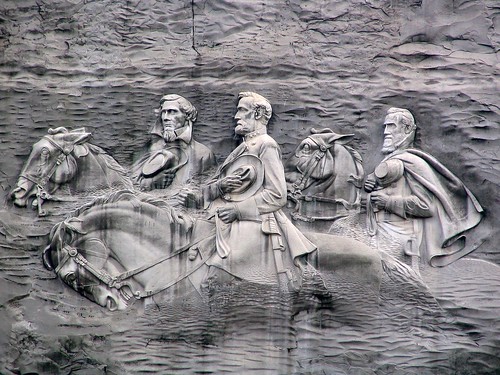
Stone Mountain is a 1,700-foot-tall grey dome rock located about a half-hour due east of downtown Atlanta. On its northern face is the largest bas-relief carving in the world—bigger even than the carving at Mount Rushmore. It depicts Confederate heroes Robert E. Lee, Stonewall Jackson, and Jefferson Davis. The mountain also features a Confederate battle flag at the base of its hiking trail.

Stone Mountain is also where the Ku Klux Klan reinvented itself in 1915 under the direction of William J. Simmons. As legend has it, the Klan would conduct nighttime cross burnings from atop that massive rock to frighten the Atlanta area’s entire black population in one big theatrical stroke of political terror.

Fast-forward a hundred years, and the Klan has clearly lost. The surrounding town of Stone Mountain is now over 75% black and about 18% white. And Atlanta hasn’t had a white mayor since the early 1970s.

Mid-June’s Charleston church shooting—involving a killer who had sullenly posed for selfies hoisting a small Rebel flag—was used as an excuse to launch a full-on cultural purge of all Confederate symbols by those who hate what they insist those symbols represent. And they insist those symbols represent HATE. And they hate that. Those symbols represent intolerance. And they will not tolerate that….

Recently a spokesman for Atlanta’s NAACP demanded that the Confederate carving “be sand-blasted off” Stone Mountain’s side. He also urged authorities to remove the Rebel flag from the mountain’s base.

This raised the hackles and chafed the sunburned necks of Confederate sympathizers across Georgia. Insisting that the flag represented “heritage, not hate,” they arranged for a pro-Confederate rally last Saturday morning at Stone Mountain Park….

[A] young black male was pleading with attendees about how he felt the flag was a provocation, and the attendees kept insisting it had nothing to do with him, especially not with hating him. But he told them that it did. And they kept insisting that it didn’t.

Smirking at an argument that kept going in circles, one peckerwood quipped to me, “That’s one of those deals where ain’t nobody going to get ahead.”

And that pithy quote encapsulated the entire event. It was an argument over what symbols represent—an argument that no one could ever win, because there is no objective answer. In the end, symbols represent whatever someone wants them to represent. One person’s heritage is another person’s hate. And the twain shall never agree. [“Of Heritage and Hate,” Taki’s Magazine, August 3, 2015]

What should and shouldn’t be considered offensive? More to the point, where should the boundaries of state action be drawn? I offer some guidelines in “The Principles of Actionable Harm“:

5. With those exceptions [e.g., defamation, treason, divulging classified information, perjury, incitement to violence, fraud and deception], a mere statement of fact, belief, opinion, or attitude cannot be an actionable harm. Otherwise, those persons who do not care for the facts, beliefs, opinions, or attitudes expressed by other persons would be able to stifle speech they find offensive merely by claiming to be harmed by it. And those persons who claim to be offended by the superior income or wealth of other persons would be entitled to recompense from those other persons….

6. …Nor can it be an actionable harm to commit a private, voluntary act which does nothing more than arouse resentment, envy, or anger in others….

9. Except in the case of punishment for an actionable harm, it is an actionable harm to bar a competent adult from

a. expressing his views, as long as they are not defamatory or meant to incite harm….

10. The proper role of the state is to enforce the preceding principles. In particular,

a. to remain neutral with respect to evolved social norms, except where those norms deny voice or exit, as with the systematic disenfranchisement or enslavement of particular classes of persons; and….

c. to ensure free expression of thought, except where such expression is tantamount to an actionable harm (as in a conspiracy to commit murder or mount a campaign of harassment)….

It would be nice if these principles were observed by politicians, the media, the punditocracy, and various interest groups (both left and right). But it won’t happen for two reasons:

  • People are tribal and love to take stances that identify the particular tribes to which they belong. Arnold Kling puts it this way: “You can take man out of tribal society, but you cannot take tribal society out of man.”
  • Elites and aspiring elites are especially enamored of tribal signaling. As a  commenter at Kling’s blog says: “The main goal of the ascendant educated left-wing white people is to differentiate themselves socially from middle-class white people.” For completeness, I would add lower-class white people, evangelicals and other defenders of traditional morality, the petite bourgeoisie, and anyone who might be suspected of voting Republican.

Clearly, the culture war has entered a new and dangerous phase, reminiscent of China’s Cultural Revolution under Mao. As Boyd Cathey writes,

in the United States today we live in a country characterized by what historian Thomas Fleming has written afflicted this nation in 1860–“a disease in the public mind,” that is, a collective madness, lacking in both reflection and prudential understanding of our history. Too many authors advance willy-nilly down the slippery slope–thus, if we ban the Battle Flag, why not destroy all those monuments to Lee and Jackson. And why stop there? Washington and Jefferson were slave holders, were they not? Obliterate and erase those names from our lexicon, tear down their monuments! Fort Hood, Fort Bragg, Fort Gordon? Change those names, for they remind us of Confederate generals! Nathan Bedford Forest is buried in Memphis? Let’s dig up him up! Amazon sells “Gone with Wind?” Well, to quote a writer at the supposedly “conservative,” Rupert Murdoch-owned New York Post, ban it, too!

It is a slippery slope, but an incline that in fact represents a not-so-hidden agenda, a cultural Marxism, that seeks to take advantage of the genuine horror at what happened in Charleston to advance its own designs which are nothing less than the remaking completely of what remains of the American nation. And, since it is the South that has been most resistant to such impositions and radicalization, it is the South, the historic South, which enters the cross hairs as the most tempting target. And it is the Battle Flag–true, it has been misused on occasion–which is not just the symbol of Southern pride, but becomes the target of a broad, vicious, and zealous attack on Western Christian tradition, itself. Those attacks, then, are only the opening salvo in this renewed cleansing effort, and those who collaborate with them, good intentions or not, collaborate with the destruction of our historic civilization. For that they deserve our scorn and our most vigorous and steadfast opposition. [“‘A Sickness in the Public Mind’: The Battle Flag and the Attack on Western Culture,” Abbeville Institute: The Abbeville Blog, August 4, 2015]

I stand with Dr. Cathey in offering scorn and most vigorous and steadfast opposition.

  *     *     *

Related reading:

*     *     *

Related posts:

The Culture War
Ruminations on the Left in America<
Privilege, Power, and Hypocrisy
Tolerance
Good Riddance
The Gaystapo at Work
The Gaystapo and Islam
The Beginning of the End of Liberty in America
The Tenor of the Times
Social Norms and Liberty
More About Social Norms and Liberty
The Madness Continues
The Euphemism Conquers All

Signature

Not-So-Random Thoughts (XVI)


Links to the other posts in this occasional series may be found at “Favorite Posts,” just below the list of topics. This is an especially long entry in the series, so I’ve labeled each item. You can navigate directly to items by clicking on any of the following links:

“Libertarian” Paternalism

Drug Prohibition

Unconstitutionality of Social Security and Medicare

Où est Charlie Hebdo?

Speaking of Censorship

Censorship-Plus

The Disparate Impact of Government

Putting the Civil War in Perspective

*     *     *


“Libertarian” Paternalism

Timothy Taylor asks “Who Will Nudge the Nudgers?” in a post about a paper by W. Kip Viscusi and Ted Gayer:

Viscusi and Gayer point out a number of reasons why less-than-rational behavioral responses may be more prevalent among government decision-makers than for economic actors in the private economy. Here are some examples: 1) Private actors (like consumers and firms) need to bear the immediate costs of their decisions in a direct way, while elected officials and regulators do not. 2) Public policies are often influenced by the loud voice of concentrated special interests, who can overwhelm the quieter and more diffuse voices for the general interest. 3) Market actions evolve from an interaction of many buyers and sellers, and the checks and balances that such a process provides, but government actions can evolve from a much smaller number of potentially overconfident technocrats, who have a personal and career interest in pushing their own agendas. [The Conversible Economist, July 21, 2015]

There’s much more. Read it, then see my post, “The Perpetual Nudger.” I point out that “nudgers” (e.g., Richard Thaler) are really wannabe dictators:

What seems to bother Thaler is that most people aren’t Econs [hyper-rational calculators]; their tastes and preferences seem irrational to him, and it’s his (self-appointed) role in life to force them to make “correct” decisions (i.e., the decisions he would make).

There’s much more in the many posts to which I link at the end of “The Perpetual Nudger.”

Return to the top of this post.

*     *     *


Drug Prohibition

The estimable Theodore Dalrymple strikes again:

[I]t is not true that problems with drugs arise only when or because they are prohibited.

The relationship between crime and drug prohibition is also much more complex than the legalizers would have us believe. It is certainly true that gangs quickly form that try to control drug distribution in certain areas, and that conflict between the aspirant gangs leads to violence…. But here I would point out two things: first that the violence of such criminal gangs was largely confined to the subculture from which they emerged, so that other people were not much endangered by it; and second that, in my dealings with such people, I did not form the impression that, were it not for the illegality of drugs, they would otherwise be pursuing perfectly respectable careers. If my impression is correct, then the illegality of drugs might protect the rest of society from their criminality: the illegal drug trade being the occasion, but not the cause, of their violence.

What about Prohibition, is the natural reply? It is true that the homicide rate in the United States fell dramatically in the wake of repeal. By the 1960s, however, when alcohol was not banned, it had climbed higher than during Prohibition…. Moreover, what is less often appreciated, the homicide rate in the United States rose faster in the thirteen years before than in the thirteen years during Prohibition. (In other respects, Prohibition was not as much of a failure as is often suggested: alcohol-related problems such as liver disease declined during it considerably. But no consequences by themselves can justify a policy, otherwise the amputation of thieves’ hands would be universal.) Al Capone was not a fine upstanding citizen before Prohibition turned him into a gangster. [“Ditching Drug Prohibition: A Dissent,” Library of Law and Liberty, July 23, 2015, and the second in a series; see also “The Simple Truth about J.S. Mill’s Simple Truth,” op. cit., July 20, 2015; “Myths and Realities of Drug Addiction, Consumption, and Crime,” op. cit., July 31, 2015; and “Closing Argument on the Drug Issue,” op. cit., August 4, 2015]

This reminds me of my post, “Prohibition, Abortion, and ‘Progressivism’,” in which I wrote about the Ken Burns series, Prohibition. Here’s some of it:

Although eugenics is not mentioned in Prohibition, it looms in the background. For eugenics — like prohibition of alcohol and, later, the near-prohibition of smoking — is symptomatic of the “progressive” mentality. That mentality is paternalistic, through and through. And “progressive” paternalism finds its way into the daily lives of Americans through the regulation of products and services — for our own good, of course. If you can think of a product or service that you use (or would like to use) that is not shaped by paternalistic regulation or taxes levied with regulatory intent, you must live in a cave.

However, the passing acknowledgement of “progressivism” as a force for the prohibition of alcohol is outweighed by the attention given to the role of “evangelicals” in the enactment of prohibition. I take this as a subtle swipe at anti-abortion stance of fundamentalist Protestants and adherents of the “traditional” strands of Catholicism and Judaism. Here is the “logic” of this implied attack on pro-lifers: Governmental interference in a personal choice is wrong with respect to the consumption of alcohol and similarly wrong with respect to abortion.

By that “logic,” it is wrong for government to interfere in or prosecute robbery, assault, rape, murder and other overtly harmful acts, which — after all — are merely the consequences of personal choices made by their perpetrators. Not even a “progressive” would claim that robbery, assault, etc., should go unpunished, though he would quail at effective punishment.

“Progressives” just don’t know where to draw lines. (Witness the many phantom red lines that Obama has drawn for Syria and  Iran.) It’s centuries too late to prohibit the consumption of alcohol (not that I’d wish it had happened); it’s still not too late to prohibit the consumption of hard, death-dealing drugs. If those drugs are legalized, it won’t be long before taxpayers are forced to pay for the drug habits of a growing population of drug abusers. That’s the “progressive” way.

Return to the top of this post.

*     *     *


Unconstitutionality of Social Security and Medicare

Mike Rappaport makes the case, and concludes with this:

Now that we have had Social Security and Medicare for generations and people have relied upon them, I don’t think that the original meaning can be enforced to hold them unconstitutional.  Precedent should allow them to continue.  But it is worth remembering that these programs would have never taken their pernicious form if the Constitution’s original meaning had been followed in the first place. [“The Unconstitutionality of Social Security and Medicare,” Library of Law and Liberty, July 23, 2015]

This comes as no surprise to me. Here’s a bit from a recent post, “Does the Power to Tax Give Congress Unlimited Power? (II),” which refers to a much older one:

[T]he power to tax is not unlimited. Taxes levied by the central government must be levied for the purpose of executing powers specifically enumerated in Article I, Section 8 of the Constitution. Nevertheless, the majority NFIB v. Sebelius chose not only to distort the individual mandate — which is clearly a penalty, not a tax — but also to willfully disregard the Constitution’s expressed limitations on the powers of Congress. Even if the individual mandate were a tax, Congress cannot constitutionally levy such a tax because the Affordable Care Act isn’t contemplated in its enumerated powers. (ACA derives its supposedly constitutional status from the Court’s decision in 1935 to declare the Social Security Act constitutional, even though it isn’t. See my post of October 31, 2004, “Social Security Is Unconstitutional.”)

Return to the top of this post.

*     *     *


Où est Charlie Hebdo?

As dead (in spirit) as the 12 who were murdered in January. Mark Steyn writes:

I mentioned a few days ago the announcement by Charlie Hebdo that they are no longer in the business of Mohammed cartoons:

So another non-senseless act has paid off bigtime for the Islamic enforcers. I regret the decision, although I understand it.

Which I do. Almost everyone who mattered at Charlie Hebdo is dead. What did they die for? A hashtag and a candlelight vigil? None of those who seized eagerly on #JeSuisCharlie as the cause du jour, from Angela Merkel and François Hollande to George Clooney and Helen Mirren to thousands in the streets of Paris and millions across the Internet, were willing to do the one thing that would have mattered, and show the reason why they died. Which is why such sterling champions of free speech as PLO leader Mahmoud Abbas and Sultan Erdogan’s vizier Ahmet Davutoglu were happy to march in the big post-slaughter parade. Do you think they’d have been there if any of the dead’s multitudes of new “friends” were waving Charlie magazine covers?…

And so, after a similar but fortunately less bloody attack in Texas [link added], virtually the entire American media decided to blame the victim and took it as read that Islam now has an opt-out from the First Amendment. You can’t fence off Islam and contain the damage to freedom of speech: the decision to surrender it incrementally leads inevitably to its total loss. On the day of his murder, I quoted the words of Stéphane “Charb” Charbonnier, Laurent Sourisseau’s predecessor as Charlie editor, from two years earlier:

It may seem pompous, but I’d rather die standing than live on my knees.

It’s not pompous, but it is lonely. And the slippery, weaselly nature of the post-bloodbath support told Charlie Hebdo it was only going to get lonelier. It’s hard standing on your feet when everyone else with the #JeSuisCharlie buttons is on their knees, bottoms in the air, prostrate before the fanatics. And so Charb’s successor has opted to live on his knees. [“The Knees Have It,” SteynOnline, July 22, 2015]

Color me unsurprised. In the aftermath of the slaughter in January, I wrote “Sober Reflections on ‘Charlie Hebdo’.” Here’s some of it:

[Charlie Hebdo is] a stridently left-wing rag that mocks religion (of all kinds), and anything else deemed too “respectable” for the adolescent tastes of its staff.

What’s most striking about the “Je suis Charlie” movement is its pure hypocrisy….

Yes, the left gets up in arms when some of its members are slaughtered by Muslim pigs (I love that phrase). But this is the same, hypocritical left that condones and promotes censorship….

The slaughter at Charlie Hebdo is not a reason for solidarity with the left, but a reason to oppose the left and its clients — especially (but not exclusively) the murderous adherents of Islam.

Return to the top of this post.

*     *     *


Speaking of Censorship

Erick Erickson writes about

an organized movement within the gay rights community that is sometimess referred to as the “gay mafia.” They want to harass those who disagree with their agenda and silence any dissent from their agenda. They have worked overtime in the past twenty-four hours because an AP poll shows that the number of Americans who now support gay marriage has declined since the Supreme Court’s ruling and a majority believe Christian businesses should not be compelled to provide goods and services to gay weddings.

They cannot have that. They also cannot have books and data that dispute their claims. One such book is by my friend Ryan Anderson. The book is called Truth Overruled: The Future of Marriage and Religious Freedom. A subgroup of the gay mafia who call themselves “Flying Monkeys” are flinging poo in the direction of Ryan’s book.

In particular, they have organized a campaign to down vote Ryan’s book on Amazon.com. The Daily Signal has screenshots of the gay mafia’s online conversations encouraging people to go “review” Ryan’s book and give it one star reviews.

The people have not read the book. But they want you to think the book is a terrible read. They are attacking Ryan personally and attacking arguments they have not even read. Anyone who knows Ryan knows he takes a very scholarly approach to the marriage arguments and has provided a great deal of foresight into the movement again marriage.

You can order Ryan’s book on the Kindle now or get a print edition next month via Amazon. I highly recommend it. [“The Gay Mafia Wants to Stop You from Doing This,” RedState, July 21, 2015]

I have ordered it.

We in the U.S. have thus far been spared the excesses of censorship that plague Canada. One such excess is the subject of my post, “Free Speech Ends at the Northern Border.” That an overstatement, of course, because censorship is rife in America, especially on college campuses. Just check out the website of The Foundation for Individual Rights in Education.

See also my posts “The Gaystapo at Work,” “The Gaystapo and Islam.” “The Beginning of the End of Liberty in America,” and “The Tenor of the Times.”

Return to the top of this post.

*     *     *


Censorship-Plus

In a closely related development, there’s a portentous recent ruling by the Equal Employment Opportunity Commission:

Last week, the Equal Employment Opportunity Commission dropped an astounding ruling: By a 3-2 vote, it concluded that “sexual orientation is inherently a ‘sex-based consideration,’ and an allegation of discrimination based on sexual orientation is necessarily an allegation of sex discrimination under Title VII.”

This is a big deal: The Commission’s recommendations shape rulings on federal employees’ workplace-discrimination claims, and its field offices deal with claims made by employees at private organizations, as well. But the ruling is also a reminder of how complicated—and unresolved—the post-Obergefell legal landscape is. The Supreme Court’s ruling in favor of same-sex marriage at the end of June has set the country up for two new waves of discrimination claims: those made by same-sex couples and LGBT workers, and those made by religious Americans who oppose same-sex marriage. The two may seem distinct or even opposed, but they’re actually intertwined: In certain cases, extending new rights to LBGT workers will necessarily lead to religious-freedom objections, and vice versa.

Right now, it’s impossible to know how these claims will fall out. It’s been less than a month since the ruling, and much of the legal theory on these issues is just that: theory. In Congress, there’s at least some effort to reconcile the two sides. As my colleague Russell Berman wrote on Friday, Democrats are pushing for legislation which would include prohibitions on discrimination in education, housing, and public accommodation, and Republicans may well sign on—if that legislation allows for religious exemptions. No matter what passes, the issues will remain tangled. These will be some of the questions courts and legislatures have to untangle in the wake of Obergefell. [Emma Green, “Gay Rights May Come at the Cost of Religious Freedom,” The Atlantic, July 27, 2015]

It’s not just religious liberty that’s under attack, it’s liberty — period. It’s clear that the federal government is gearing up to tell Americans what they may say about others and who they must associate with, like it or not:

Most citizens will, of course, attempt to exercise their freedom of speech, and many business owners will, of course, attempt to exercise their freedom of association. But for every person who insists on exercising his rights, there will be at least as many (and probably more) who will be cowed, shamed, and forced by the state into silence and compliance with the new dispensation. And the more who are cowed, shamed, and forced into silence and compliance, the fewer who will assert their rights. Thus will the vestiges of liberty vanish.

That’s from my post, “The Beginning of the End of Liberty in America,” which I published on the day of the Obergefell diktat.

Return to the top of this post.

*     *     *


The Disparate Impact of Government

Speaking of impending atrocities, Michael Barone takes on “HUD’s ‘Disparate Impact’ War on Suburban America“:

Disparate impact. It’s a legal doctrine that may be coming soon to your suburb (if you’re part of the national majority living in suburbs).

Bringing it there will be the Obama Department of Housing and Urban Development’s Affirmatively Furthering Fair Housing program. It has been given a green light to impose the rule from Justice Anthony Kennedy’s majority opinion in the Supreme Court’s 5-4 decision [link added] in Texas Department of Housing and Community Affairs v. Inclusive Communities Project. [Kennedy must have been warming up for his Obergefell diktat, which came on the following day. — TEA]

The decision purports to interpret the Fair Housing Act of 1968 as authorizing lawsuits if municipal policies have a “disparate impact” as measured by the racial percentages of those affected — this despite the fact that the words of the Fair Housing Act prohibit only intentional racial discrimination….

In every large metropolitan area with a significant black population, you won’t find a single census tract with 0 black residents. Blacks sometimes encounter resistance when trying to buy or rent a house that they can afford, which is unjust and infuriating, and a problem for which the Fair Housing Act provides remedies.

But, of course, that has not created an America in which every community has the same percentage as the national average of blacks and whites, Hispanics and Asians, marrieds and singles, gays and straights, Protestants and Catholics and Jews and Muslims.

Free choice never shakes out that way. Throughout history, Americans and immigrants have tended to choose to cluster with likeminded people….

How did disparate impact come into the law? In a 1971 Supreme Court case, Griggs v. Duke Power Co., the Court, acting when memory was still fresh of Southern resistance to desegregation, ruled that the company’s aptitude test amounted to discrimination because whites passed at higher rates than blacks. But that’s true of most aptitude tests — which as a result aren’t used much in hiring any more. [creators.com, July 21, 2015]

Don’t tell it to the “social justice” police in D.C. They don’t want to hear it.

The 1971 “disparate impact” ruling by the Supreme Court ranks among the 16 cases that I list as examples of “the judicial betrayal of the constitutional scheme of limited government, and of order and traditional morality,” in “The Fall and Rise of American Empire.” (I would now add the Kennedy Court’s decisions about “disparate impact,” same-sex “marriage,” and Obamacare subsidies.)

“Disparate impact” isn’t just about where people live and work. Malcolm Pollack is on the case:

Here is an item that’s been going around over the past couple of days: an essay by Paul Sperry describing the Obama administration’s latest race-leveling operation.

The idea is to fish for “disparate impact” violations, wherever they can be found — in housing, lending, school discipline, academic performance, enrollment in gifted-student programs, etc. — and to use the coercive power of the State to flatten outcomes.

The Left has a secret weapon here, and in the current cultural climate, it’s a beaut. Here’s how it works:

1) If you go looking for disparate outcomes by racial groups (or by sex), you’ll certainly find them. They are real, and persistent. (See, for example, just how persistent they can be, here.)

2) When such disparate outcomes occur, there are only two possible causes: either they are due to an external obstacle, or something intrinsic to the group itself.

3) If all racial groups are assumed, as by current social convention they must be, to have exactly identical distributions of every cognitive and behavioral trait, then any variation in outcome that disparately affects a particular racial group must be evidence of some external obstacle. This can only be due to racism and injustice, and therefore it is just and proper for the State to detect and remove it, by whatever means necessary.

4) If however, you suggest that disparities under neutral policies may be due, even in part, to innate differences in the distribution of cognitive and behavioral characteristics in different racial groups, then you are a racist. (If you present actual evidence of such differences, you’re a “scientific” racist.) Moreover, the fact that you are even thinking such things is evidence of the persistence and prevalence of racism in general, which in turns confirms the assumption that disparate outcomes are the result of pervasive and intractable racism, and not innate differences. This is what justifies redoubled efforts on the part of the State to bring every aspect of our lives under racial scrutiny, and impose corrective measures wherever disparate outcomes are found.

So: notwithstanding that race, as we are told, is a “social construct” with no basis in reality, the government will spare no effort to group people by race, and to scour vast collections of intrusively gathered data to find inequalities in social and economic outcomes — not on any individual basis, but by race. But despite race being real enough, apparently, to justify making such racial categorizations, race can have no deeper reality as regards any shared characteristics that might contribute to such inequalities. Race is, in other words, real, but only real enough to serve, somehow, as a marker for defining groups, and thereby to serve as the basis of racism, without having any other actual properties. Moreover (and this is what makes the whole thing work so beautifully): if you disagree with any of this, you are yourself a racist — and you have thereby just demonstrated that persistent racism is indeed the problem.

Thanks to this secret weapon, we have moved beyond — far beyond — the idea that particular differences in outcomes may be due to specific and remediable instances of conscious and intentional racism. As we go Forward, we have a new paradigm: differences in outcomes simply ARE racism, now and forever.

That’s some catch!

[“A Respectful Whistle,” waka waka waka, July 21, 2015]

(I couldn’t resist reproducing Pollack’s brilliant post in its entirety. If you don’t already follow his blog, you should do so.)

Return to the top of this post.

*     *     *


Putting the Civil War in Perspective

Walter Williams does it brilliantly:

Was President Abraham Lincoln really for outlawing slavery? Let’s look at his words. In an 1858 letter, Lincoln said, “I have declared a thousand times, and now repeat that, in my opinion neither the General Government, nor any other power outside of the slave states, can constitutionally or rightfully interfere with slaves or slavery where it already exists.” … Debating Sen. Stephen Douglas, Lincoln said, “I am not, nor ever have been, in favor of making voters or jurors of Negroes nor of qualifying them to hold office nor to intermarry with white people; and I will say in addition to this that there is a physical difference between the white and black races, which I believe will forever forbid the two races living together on terms of social and political equality.”

What about Lincoln’s Emancipation Proclamation? Here are his words: “I view the matter (of slaves’ emancipation) as a practical war measure, to be decided upon according to the advantages or disadvantages it may offer to the suppression of the rebellion.” …

Lincoln did articulate a view of secession that would have been heartily endorsed by the Confederacy: “Any people anywhere, being inclined and having the power, have the right to rise up and shake off the existing government and form a new one that suits them better. … Nor is this right confined to cases in which the whole people of an existing government may choose to exercise it. Any portion of such people that can may revolutionize and make their own of so much of the territory as they inhabit.” Lincoln expressed that view in an 1848 speech in the U.S. House of Representatives, supporting the secession of Texas from Mexico.

Why didn’t Lincoln share the same feelings about Southern secession? Following the money might help with an answer. Throughout most of our nation’s history, the only sources of federal revenue were excise taxes and tariffs. During the 1850s, tariffs amounted to 90 percent of federal revenue. Southern ports paid 75 percent of tariffs in 1859. What “responsible” politician would let that much revenue go? [“Historical Ignorance II,” creators.com, July 22, 2015]

(There’s more in William Sullivan’s “Lincoln vs. Lee: How History Is Distorted to Preserve Legends,” American Thinker, August 1, 2015.)

Yes, it can be asserted (with some degree of accuracy) that slavery was the proximate cause of the Civil War, because it was the issue of slavery that brought to a head the longstanding tension between North and South. But the leaders of the South also had a righteous cause, in principle: the cause of constitutional government. This is from my post, “The Southern Secession Reconsidered“:

What tends to be forgotten is the South’s pre-Civil War stance with respect to the central government. Southern resistance to the centralization of political power, and to the central government’s unconstitutional exercises of power, long pre-dated the Southern secession and was founded on a valid interpretation of the Constitution.

The Civil War, as a forcible act of reunification, is defensible only insofar as a main result was the end of slavery in the United States. On constitutional grounds, however, the Southern secession was valid and should not have been contested. [Chapter and verse follow.]

My current view of the Constitution — “How Libertarians Ought to Think About the Constitution” — is more cynical and sweeping:

What does all of this mean for secession? Here it is, from the beginning and by the numbers:

1. The Constitution was a contract, but not a contract between “the people.” It was a contract drawn by a small fraction of the populace of twelve States, and put into effect by a small fraction of the populace of nine States….

2. Despite their status as “representatives of the people,” the various fractions of the populace that drafted and ratified the Constitution had no moral authority to bind all of their peers, and certainly no moral authority to bind future generations….

3. The Constitution was and is binding only in the way that a debt to a gangster who demands “protection money” is binding. It was and is binding because state actors have the power to enforce it, as they see fit to interpret it….

4. The Constitution contains provisions that can be and sometimes have been applied to advance liberty. But such applications have depended on the aims and whims of those then in positions of power.

5. It is convenient to appeal to the Constitution in the cause of liberty … but that doesn’t change the fact that the Constitution was not and never will be a law enacted by “the people” of the United States or any State thereof.

6. Any person and any government in the United States may therefore, in principle, reject the statutes, executive orders, and judicial holdings of the United States government (or any government) as non-binding.

7. Secession is one legitimate form of rejection….

8. An  act of secession may be put down — through legal process or force of arms — but that doesn’t alter the (limited) legitimacy of the act.

9. Given the preceding, any act of secession is no less legitimate than was the adoption of the Constitution.

10. The legitimacy of an act of secession isn’t colored by its proximate cause, whether that cause is a desire to preserve slavery, or to escape oppressive taxation and regulation by the central government, or to live in a civil society that is governed by the Golden Rule. The proximate cause must be evaluated on its own merits, or lack thereof.

If the feds continue their assault on liberty, secession will become an increasingly attractive option. There are other options, including de facto secession.

Return to the top of this post.

Signature

Substantive Due Process, Liberty of Contract, and States’ “Police Power”

I published this post at Liberty Corner almost ten years ago. I was prompted to re-publish it (with minor changes) upon reading George Will’s column about Chief Justice Roberts’s egregious treatment of Lochner v. New York and substantive due process in the Chief’s otherwise commendable dissent from the majority in Obergefell v. Hodges.

*     *     *

Judge Raymond Randolph, in a speech to the Federalist Society’s National Lawyer’s Convention on November 11, 2005, discussed Judge Henry Friendly’s draft opinion in a suit challenging New York’s abortion prohibition in 1970. According to Juan Non-Volokh (Jonathan Adler) of The Volokh Conspiracy, Judge Friendly’s opinion

was never published because New York amended its law before the case was decided. Had it been issued, it would have been the first federal court opinion on the constitutionality of a state abortion law. Judge Randolph was one of Friendly’s clerks at the time, and kept a copy of the never-issued draft.

According to the draft, Judge Friendly would have upheld the law, not because he was anti-abortion, but because the law was a constitutional exercise of state power — and that many of the inherently arbitrary policy judgments about abortion should or should not be permissible are better made by elected legislatures than a panel of federal judges. As described by Randolph, the decision anticipated many of the subsequent questions about the legitimacy of non-prohibitory abortion regulations that would follow in the wake of Roe.

Aside from that, Randolph had much to say about substantive due process, privacy, and a Court that has lost sight of the Constitution in its zeal to attain certain results:

. . . Substantive due process is the idea that the Due Process Clause of the 14th Amendment protects rights even if they are not set out specifically in the Constitution.

The Due Process Clause states simply that ““nor shall any State deprive any person of life, liberty, or property, without due process of law.”” Given the theme of this conference, one must ask about the original meaning of these words. The 14th Amendment due process clause is identical to the due process clause in the Fifth Amendment, applicable to the federal government. Two current Justices — you may guess who they are –– think the phrase ““substantive due process”” is an oxymoron. Process means procedure, not substance –– and that is what it meant historically. That the due process clause ever came to apply to legislation, as it did for the first time in the infamous Dred Scott case, is strange enough. What is the process due from a legislature? A quorum? An accurate vote count? There is something else I find quite odd about this concept. In many of the substantive due process cases the Court has stated that ““fundamental liberties”” are protected. Roe v. Wade is an example. Freedom of religion is, by all accounts, a fundamental liberty. Are we to suppose that freedom of religion is a right the state can take away so long as it does so with due process? That would be protecting a civil right in one amendment, the First, only to allow it to be taken away through another.

The Framers were smart people; they could not have intended such an absurdity. And they did not. History shows that the meaning of ““liberty”” as used in the 5th and 14th Amendments is simply freedom from restraint — that is, imprisonment. This explains why the Framers placed the due process clause in the Fifth Amendment, which deals almost entirely with criminal proceedings. Learned Hand, found the historical evidence supporting this interpretation clear beyond — in his words –– any ““reasonable doubt.” Yet the chances of the Supreme Court going back to the original understanding are, I think, slim to none.

But . . . the Fifth Amendment does not deal exclusively with criminal proceedings, the Fourteenth Amendment has nothing to do with criminal proceedings, and both do explicitly prohibit the taking of life, liberty, or property without due process of law. Given the Due Process Clauses of the Fifth and Fourteenth Amendments, I do not see how a legislature can enact any law that simply amounts to a “taking” of liberty or property for no valid constitutional purpose.

The Framers were smart people, as Randolph says. That’s why the Constitution, in Article I, Section 9, says explicitly that “No Bill of Attainder or ex post facto Law shall be passed” by Congress. That’s why the Constitution in Article I, Section 10, says explicitly that “No State shall . . . pass any Bill of Attainder, ex post facto Law, or Law impairing the Obligation of Contracts. . . .”

The Framers understood very well that obligation of contracts (or liberty or freedom of contract) is both a matter of liberty and a matter of property. To interfere legislatively with liberty of contract amounts to a deprivation of due process because such interference prevents willing parties from employing their labor or property in the pursuit of otherwise lawful ends. That is, the legislature finds them “guilty” of otherwise lawful actions by forbidding and penalizing those actions.

The concept of substantive due process is in bad odor, in large part because (as the Wikipedia article explained in November 2005) it

was first applied by the Supreme Court in a subsection of Dred Scott v. Sandford (1856), though it can be argued that the doctrine dates back to Calder v. Bull (1798). Dred Scott was a slave who claimed that passing into territory where slavery was prohibited destroyed his owner’s property rights over him. The court ruled in three parts. First, it argued that Dred Scott was not a citizen of the United States and therefore he had no right to liberty under the Constitution of 1856 — this argument, now harshly repudiated, is not based on the Due Process clause but did establish that the Court considered Dred Scott to be property. Second, the court argued that no Federal law could exist which per se appropriated property without advance notice and opportunity for judicial review — —this was a Due Process argument. Thus, the decision established lack of procedure violates Due Process just as much an unfair procedure. After the Fourteenth Amendment applied due process restrictions to states, the Supreme Court used this same doctrine to protect a liberty of contract by routinely striking down (such as in Lochner v. New York) those economic and labor regulations which restricted particular economic activities per se without opportunity for judicial review.

Lochner v. New York is the 1905 case in which the Supreme Court struck down a State statute that attempted to impose a maximum-hours limitation on bakers. Lochner is a bête noire to liberals because it triggered a wave of Supreme Court decisions deemed “pro-business” (as if business were an enemy). But Lochner and its offspring were decided rightly because they upheld, as a matter of due process, the Constitution’s explicit guarantee of liberty of contract. As Justice Peckham wrote for the Lochner majority,

[t]he [New York] statute . . . interferes with the right of contract between the employer and employees, concerning the number of hours in which the latter may labor in the bakery of the employer. The general right to make a contract in relation to his business is part of the liberty of the individual protected by the 14th Amendment of the Federal Constitution. Allgeyer v. Louisiana, 165 U.S. 578 , 41 L. ed. 832, 17 Sup. Ct. Rep. 427. Under that provision no state can deprive any person of life, liberty, or property without due process of law. The right to purchase or to sell labor is part of the liberty protected by this amendment. . . .

This is not a question of substituting the judgment of the court for that of the legislature. If the act be within the power of the state it is valid, although the judgment of the court might be totally opposed to the enactment of such a law. But the question would still remain: Is it within the police power of the state? and that question must be answered by the court.

The question whether this act is valid as a labor law, pure and simple, may be dismissed in a few words. There is no reasonable ground for interfering with the liberty of person or the right of free contract, by determining the hours of labor, in the occupation of a baker. . . .

It is a question of which of two powers or rights shall prevail,-the power of the state to legislate or the right of the individual to liberty of person and freedom of contract. The mere assertion that the subject relates, though but in a remote degree, to the public health, does not necessarily render the enactment valid. The act must have a more direct relation, as a means to an end, and the end itself must be appropriate and legitimate, before an act can be held to be valid which interferes with the general right of an individual to be free in his person and in his power to contract in relation to his own labor.

Justice Holmes, in his famous dissent in Lochner, said that “[t]he 14th Amendment does not enact Mr. Herbert Spencer’s Social Statics.” Social Statics (according to the Wikipedia article in November 2005) is a “conception of social justice, which emphasized the responsibility of the individual for their [sic] nature and actions.” Holmes, in other words, preferred a paternalistic government, as opposed to the government of liberty and individual responsibility clearly intended by the Framers.

Lochner — properly understood — is not about enacting Mr. Spencer’s Social Statics nor (as usually charged) is it about achieving a certain “pro-business” result through “judicial activism.” Lochner is about honoring the Constitution’s explicit guarantee of liberty of contract, and about ensuring that that guarantee is not vitiated by legislative overreaching. It is a violation of due process when a legislature deprives citizens of liberty or property by enacting laws forbidden by the Constitution. And that, in essence, is what the Lochner Court said.

Turning to liberty of contract, I quote from Richard Epstein’s article in The Heritage Guide to the Constitution on freedom of contract (pp. 171-5):

What is clear . . . is that in the antebellum period the Obligation of Contract Clause was the only open-ended federal constitutional guarantee that applied to the states. . . .

Everyone conceded that the clause applied to ordinary contracts between private persons, including partnerships and corporations. . . .

. . . At this point, one way to read the clause is to hold that its prohibitions [affect prospective contracts] but are not absolute. The state may alter the rules governing future contracts only in ways that offer just compensation to all contracting parties in the form of greater security and stability in their contractual obligations. The three legislative reforms that arose most frequently in the early debates — a statute of frauds, a statute of limitations, and recording acts — are all measures that meet this standard.

By refusing to give the clause any prospective role, Ogden [1827] opened the gateway to partisan legislation that limited the ability of some parties to contract without imposing similar restrictions on their economic competitors. . . .

But liberty of contract survived Ogden. I have written here about the long life and eventual demise of liberty of contract, a demise that coincided with the rise of States’ “police power”:

The Court upheld [liberty of contract] in Bronson v. Kinzie (1843). According to The Oxford Guide to United States Supreme Court Decisions (Oxford University Press, 1999, p. 33),

Chief Justice Roger B. Taney held that [a] legislative attempt to modify the terms of [an] existing mortgage was an unconstitutional impairment of the obligation of contract. Taney agreed that a state could alter the remedies available to enforce past as well as future contracts. He nonetheless emphasized that such changes could not materially impair the rights of creditors. In broad language Taney extolled the virtue of the Contract Clause: “It was undoubtedly adopted as part of the Constitution for a great and useful purpose. It was to maintain the integrity of contracts, and to secure their faithful execution throughout this Union.”

The Oxford Guide continues :

The Court long adhered to the Bronson rule, invalidating state laws that interfered with contractual rights in the guise of regulating remedies. The decision was effectively superseded, however, by Home Building and Loan Association v. Blaisdell (1934), in which the justices ruled that contracts were subject to the reasonable exercise of state police power.

Just what is “reasonable exercise of state police power”? In Home Building and Loan Association, according to Chief Justice Hughes, writing for the Court, it is this:

We come back, then, directly, to the question of impairment. As to that, the conclusion reached by the court here seems to be that the relief [from mortgage foreclosures] afforded by the [Minnesota] statute does not contravene the constitutional provision because it is of a character appropriate to the emergency and allowed upon what are said to be reasonable conditions.

That is, the Court simply decided to uphold a Minnesota statute that altered the terms of a contract because it wanted to do so, not because it had constitutional authority for doing so. The Constitution doesn’t forbid States to impair contracts except in emergencies or to exercise their “policing power”; the Constitution flatly forbids States to impair contracts. A libertarian Court would begin to restore freedom of contract by reversing Home Building and Loan Association v. Blaisdell….

As for States’ so-called policing power, an article at FindLaw tells this tale:

[I]deas embodying the social compact and natural rights, which had been espoused by Justice Bradley in his dissent in the Slaughter-House Cases, 43 had been transformed tentatively into constitutionally enforceable limitations upon government. 44 The consequence was that the States in exercising their police powers could foster only those purposes of health, morals, and safety which the Court had enumerated, and could employ only such means as would not unreasonably interfere with the fundamentally natural rights of liberty and property, which Justice Bradley had equated with freedom to pursue a lawful calling and to make contracts for that purpose. 45

So having narrowed the scope of the state’s police power in deference to the natural rights of liberty and property, the Court next proceeded to read into the concepts currently accepted theories of laissez faire economics, reinforced by the doctrine of Social Darwinism as elaborated by Herbert Spencer, to the end that ”liberty,” in particular, became synonymous with governmental hands-off in the field of private economic relations. In Budd v. New York, 46 Justice Brewer in dictum declared: ”The paternal theory of government is to me odious. The utmost possible liberty to the individual, and the fullest possible protection to him and his property, is both the limitation and duty of government.” …

To the State was transferred the task of demonstrating that a statute interfering with the natural right of liberty or property was in fact ”authorized” by the Constitution, and not merely that the latter did not expressly prohibit enactment of the same.

In 1934 the Court in Nebbia v. New York 52 discarded this approach to economic legislation, and has not since returned to it. The modern approach was evidenced in a 1955 decision reversing a lower court’s judgment invalidating a state statutory scheme regulating the sale of eyeglasses to the advantage of ophthalmologists and optometrists in private professional practice and adversely to opticians and to those employed by or using space in business establishments.

And there we are. In a single year (1934) the Supreme Court demolished liberty of contract and created out of whole cloth what amounts to an unlimited “police power” for the States — liberty and property be damned.

It is long past time for a return to the substantive due process epitomized by Lochner, that is, to the defense of constitutionally guaranteed liberties against governmental usurpation of those liberties.

*     *     *

Related reading: Damon Root, “Yes, the 14th Amendment Protects Economic Liberty,” Hit & Run Blog (Reason.com), July 13, 2015

Signature

The Tenor of the Times

Below are some links that I’ve collected about the culture war, political correctness, political hypocrisy, and other disturbing features of the contemporary scene. I don’t agree with everything said by the writers, but I believe that they are broadly right about the madness into which America seems to be rapidly descending.

Each link is followed by an excerpt of the piece that is linked. The excerpt — usually but not always the lede — is meant to entice you to follow the link. I urge you to do so.

*     *     *

Adam Marcus and Ivan Oransky, “Author Retracts Study of Changing Minds on Same-Sex Marriage after Colleague Admits Data Were Faked,” Retraction Watch, May 20, 2015 (et seq.):

In what can only be described as a remarkable and swift series of events, one of the authors of a much-ballyhooed Science paper claiming that short conversations could change people’s minds on same-sex marriage is retracting it following revelations that the data were faked by his co-author. [Leftists love to fake data to make political points (e.g., economics and climate studies). — TEA]

Jason Morgan, “Dissolving America,” American Thinker, June 29, 2015

The instant media consensus is in: the Confederate flag atop the South Carolina statehouse has got to go.  The battle flag of the Army of Northern Virginia, we are told, just doesn’t represent who we are as a nation anymore.

But if we are going to take the Confederate flag down because it no longer represents us, then there is no reason why we shouldn’t take the American flag down, too.  Not just from the government buildings in South Carolina, but from every home, ship, office, and church throughout the entire American territory.  Because neither flag has anything to do with who we are anymore.  Old Glory is now just as much a meaningless relic as the republic that created it — as obsolete as the Stars and Bars became in April of 1865.

Bill Vallicella, “SCOTUS and Benedict,” Maverick Philosopher, June 30, 2015:

[Quoting Rod Dreher]:

It is time for what I call the Benedict Option. In his 1982 book After Virtue, the eminent philosopher Alasdair MacIntyre likened the current age to the fall of ancient Rome. He pointed to Benedict of Nursia, a pious young Christian who left the chaos of Rome to go to the woods to pray, as an example for us. We who want to live by the traditional virtues, MacIntyre said, have to pioneer new ways of doing so in community. We await, he said “a new — and doubtless very different — St. Benedict.”

So now you are out in the desert or the forest or in some isolated place free of the toxic influences of a society in collapse.  The problem is that you are now a very easy target for the fascists.  You and yours are all in one place, far away from the rest of society and its infrastructure.  All the fascists have to do is trump up some charges, of child-abuse, of gun violations, whatever.  The rest of society considers you kooks and benighted bigots and won’t be bothered if you are wiped off the face of the earth.  You might go the way of the Branch Davidians.

Heather Mac Donald, “The Shameful Liberal Exploitation of the Charleston Massacre,” National Review, July 1, 2015:

In fact, white violence against blacks is dwarfed by black on white violence. In 2012, blacks committed 560,600 acts of violence against whites (excluding homicide), and whites committed 99,403 acts of violence (excluding homicide) against blacks, according to data from the National Crime Victimization Survey provided to the author. Blacks, in other words, committed 85 percent of the non-homicide interracial crimes of violence between blacks and whites, even though they are less than 13 percent of the population. Both the absolute number of incidents and the rate of black-on-white violence are therefore magnitudes higher than white-on-black violence. There is no white race war going on.

Steve McCann, “America’s Destiny in the Balance,” American Thinker, July 1, 2015:

Beginning in the 1930’s, under the aegis of Franklin Roosevelt, the nation began a drift to the left as a reaction to the Great Depression.  However, those truly committed to socialist/Marxist philosophy and tactics remained in the shadows until the 1960’s.  The Viet Nam war protests unleashed far more than just a demand for an end to the war.  Those that blamed America for all manner of alleged sins in the past and determined to transform the United States into a socialist/Marxist nirvana were able to step out from behind the shadows and enter the mainstream of national legitimacy.  This swarm of locusts soon enveloped the higher levels of academia spawning countless clones to further infiltrate all strata of society — most notably the mainstream media, the entertainment complex and the ultimate target: the Democratic Party.  These vital segments of the culture are now instruments of indoctrination, propaganda and political power.

Victoria Razzi, “Asian American Studies Professors Stay Silent on Asian vs. Black Integration,” The College Fix, July 1, 2015:

An 80-year-old Duke University professor recently argued that Asian Americans have integrated into America better than African Americans, a controversial and contentious assertion that caused uproar and prompted the scholar to be labeled a racist.

Eugene Slavin, “The White Privilege Lie,” American Thinker, July 1, 2015:

Of all the invectives launched against the United States by the resurgent American Left, the charge that in America, White Privilege reigns supreme is the most insidious and culturally ruinous.

Its intent is unambiguous: leftists perpetuate the White Privilege lie to smear America and its institutions as inherently racist, and therefore unworthy of adulation and in need of fundamental socioeconomic transformation.

David Limbaugh, “I Told You Things Are Getting Crazier,” CNSNews.com, July 7, 2015:

The world is upside down, inside out, sideways, crazy, nutso. Bad is good; up is down. Left is right; right is wrong. Evil is good; insanity is sanity. Abnormal is normal. Circles are squares. Hot is cold. Luke warm is red hot — among Republicans, anyway. Common sense is uncommon. The world is otherworldly. Dissent is “hate.” Diversity means conformity. The good guys are the bad guys; virtue is vice; sophistry is intellectualism; jerks are celebrated; debauchery is glorified; the holy is debauched. Let me share some of these headlines, which speak for themselves — loudly and depressingly.

Robert Joyner, “The Hypocrisy of #Black Lives Matter, July 4th EditionTheden, July 9, 2015:

As Theden has argued before, the Black Lives Matter movement is one that very clearly does not care about its own stated goals. The name implies that the movement exists to protect and enrich the lives of blacks, but it spends its time protesting often spurious cases of police brutality and, more recently, the flying of “offensive” flags. It is conspicuously silent on the number one threat to black lives in America, which is other blacks. The movement routinely hectors whites, but frankly the preponderance of evidence shows that whites already value black lives more than blacks do themselves.

Fred Reed, “‘Payback’s a Bitch’: Rural Wisdom and the Gathering Storm,” Fred on Everything, July 9, 2015:

The furor over the Confederate flag, think I, has little to do with the Confederate flag, which is a pretext, an uninvolved bystander. Rather it is about a seething anger in the United States that we must not mention. It is the anger of people who see everything they are and believe under attack by people they aren’t and do not want to be—their heritage, their religion, their values and way of life all mocked and even made criminal.

Bill Vallicella, “Is Reason a White Male Euro-Christian Construct?,” Maverick Philosopher, July 10, 2015:

[Quoting John D. Caputo]:

White is not “neutral.” “Pure” reason is lily white, as if white is not a color or is closest to the purity of the sun, and everything else is “colored.” Purification is a name for terror and deportation, and “white” is a thick, dense, potent cultural signifier that is closely linked to rationalism and colonialism. What is not white is not rational. So white is philosophically relevant and needs to be philosophically critiqued — it affects what we mean by “reason” — and “we” white philosophers cannot ignore it.

This is truly depressing stuff.  It illustrates the rarefied, pseudo-intellectual stupidity to which leftist intellectuals routinely succumb, and the level to which humanities departments in our universities have sunk.

It’s all depressing. Have a nice day.

Signature

Will Texas Pay My Taxes?

Ryan H. Murphy offers a tantalizing idea:

In Texas, taxes on income are against the state constitution. However, Texans still pay the federal income tax.

In principle, the state could effectively end the federal income tax by using two surprisingly simple and straightforward legislative maneuvers—neither of which involves secession. Texas could choose to send its federal taxpayers a check in the form of a state tax credit equal to their federal income tax liability. It could then pay for the credit by increasing the state sales tax in a revenue neutral way. effectively, t hat would mean the end of all income taxes in the state while significantly raising sales taxes. This isn’t about cutting taxes per se; rather, this is the tax swap to end all tax swaps….

This would constitute a drastic policy shift, but why not do it? The superiority of consumption taxes to income taxes has long been argued by many neoclassical economists. The real difference between a consumption tax and an income tax is that a consumption tax encourages saving and thrift. We have good reason to believe  that (relatively speaking) discouraging saving—and therefore investment—has significant negative effects on growth….

[Jens] Arnold’s work indicates that consumption taxes and property taxes are distinctly superior to income taxes, especially to an income tax with high progressivity. William McBride of the Tax Foundation summarizes this in a 2012 study, “What Is the Evidence on Taxes and Growth?” What is clear is that a U.S. state that is willing to move its tax environment strongly in this direction would attract investment, entrepreneurs, and workers from the other 49 states. [“How States Can Effectively End the Federal Income Tax — and Why They Should,” Regulation, Summer 2015]

Murphy doesn’t try to assess the legality of the maneuvers, nor will I. I’m interested in the arithmetic of Murphy’s proposal.

I dismiss Murphy’s emphasis on the supposed advantages to a particular State: attracting “investment, entrepreneurs, and workers from the other 49 states.” That just a kind of mercantilism. What’s critical is that sales taxes encourage saving and investment, while income taxes discourage them. (That’s a relative statement for a given level of tax revenue. In fact, saving and investment would be maximized when the sum of all tax receipts is just sufficient to maintain public order and national defense, and when those receipts come from sales and use taxes.)

As a resident of Texas — one of seven States that doesn’t levy an income tax — I’m keenly interested in Murphy’s scheme. But is it feasible for Texas to pay the federal income taxes of its residents, then collect the same amount through sales taxes? I think not.

In fiscal year 2008, for example, the residents of Texas owed $89 billion in federal income taxes. In the same fiscal year the State’s sale tax receipts were $22 billion. (The State’s sales-tax rate is 6.25 percent on taxable items. Cities, counties, and other jurisdictions are allowed to collect up to an additional 2 percent on taxable items, but there’s no need to include those taxes in this analysis, as you’ll see.)

Assuming that ratio of federal income taxes to State sales taxes hasn’t changed much since 2008, Texas would have to quintuple its sale-tax rate from 6.25 percent to more than 31 percent in order to pay the federal income taxes of Texas residents while netting its usual sales-tax income. How likely is that?

The nationwide picture looks much the same. All U.S. taxpayers owed the feds $1.1 trillion in fiscal year 2008. Sales tax receipts across the country came to $443 billion in the same period. (This amount includes receipts of local jurisdictions as well as States.) Sales-tax rates would have to be multipled by 3.5 if all States were to finance federal income-tax bills while they (and local governments) net their usual sales-tax income. How likely is that?

Partial subsidies might be feasible, though politically difficult. There’s always great resistance to increases in sales-tax rates because sales taxes are said to be regressive.

Murphy’s idea sounds good, but it’s not a practical one. Also, if adopted widely it would lighten the federal income-tax burden on high-income individuals. That’s a good thing and a bad thing. On the bad side, it would make high-income individuals less mindful of the need to fight for lower tax rates and the spending cuts that should go with lower tax rates. The proper objective — if you favor liberty and economic growth — isn’t to disguise the burden of federal spending, as Murphy’s scheme would do, but to reduce that burden, by a whole lot.

*     *     *

Related posts:

Income Inequality and Economic Growth
A Case for Redistribution, Not Made
McCloskey on Piketty
The Rahn Curve Revisited
The Slow-Motion Collapse of the Economy
How to Eradicate the Welfare State, and How Not to Do It
The Real Burden of Government
Diminishing Marginal Utility and the Redistributive Urge
Obamanomics in Action
Capitalism, Competition, Prosperity, and Happiness

Signature

It’s Official: Kennedy Is Now a Member of the Court’s “Liberal” Wing

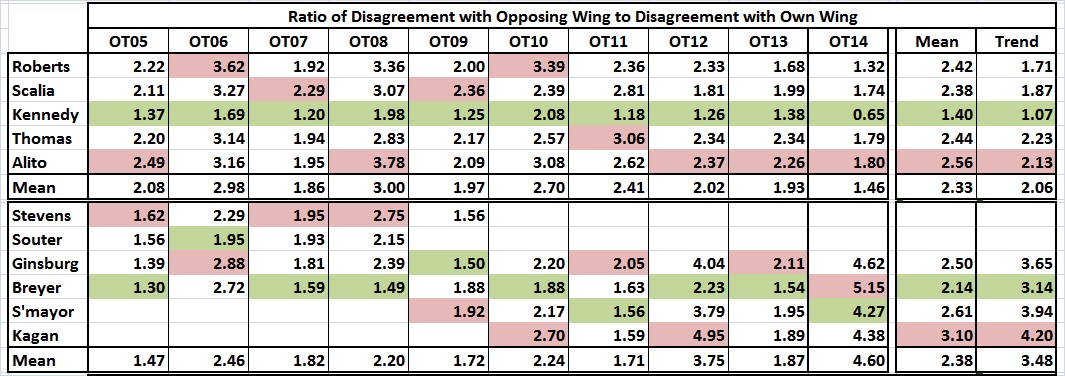
Anthony Kennedy’s authorship of the majority (5-4) opinion in Obergefell v. Hodges confirmed his conversion to the Supreme Court’s “liberal” wing. And I have the numbers to prove the conversion, which occurred in the Court’s October Term 2014 (OT14).

The following analysis is based on the frequency of the justices’ disagreement with their colleagues in non-unanimous cases. (The use of non-unanimous cases highlights the degree of disagreement among justices, which would be blurred if all cases were included in the analysis.) To illustrate the statistics, I’ll take Justice Kennedy’s record in the non-unanimous cases of OT14 as an example:

  • Kennedy disagreed with his former allies — Roberts, Scalia, Thomas, and Alito — a total of 125 percent of the time. His average disagreement with each ally was 31 percent (125 percent divided by 4).
  • Kennedy disagreed with the four “liberals” 81 percent of the time, for an average of 20 percent.
  • Dividing the second average by the first one, I find the ratio of the two averages, which is 0.65 in this case. That is, Kennedy disagreed with his former opponents (the “liberals”) only about two-thirds as often as he disagreed with his former allies.

In sum, the higher the ratio, the more often a justice has agreed with his supposed allies; the lower the ratio, the less often a justice has agreed with his supposed allies. A ratio of less than 1 means that a justice has moved to the other side of the Court’s ideological divide — as Kennedy did in OT14.

The following table summarizes the ratios for each justice in each of the last ten terms, from OT05 through OT14. Justices are grouped by wing (leaving Kennedy in the conservative wing, for purposes of this post) and then listed in order of seniority (the Chief is always first, by virtue of his office). Green and  red shadings indicate the most “agreeable” and most “disagreeable” ratios for each wing and each term. Trends are simple linear estimates of each justice’s performance in OT15, given his or her record in preceding years. (Right-click to open a larger image in a new tab.)

Supreme Court_ratios of disagreements among justices_OT05-OT14
Derived from statistics reported and archived by SCOTUSblog. Specific sources are listed at the bottom of this post. Justice O’Connor’s truncated participation in OT06 is omitted.

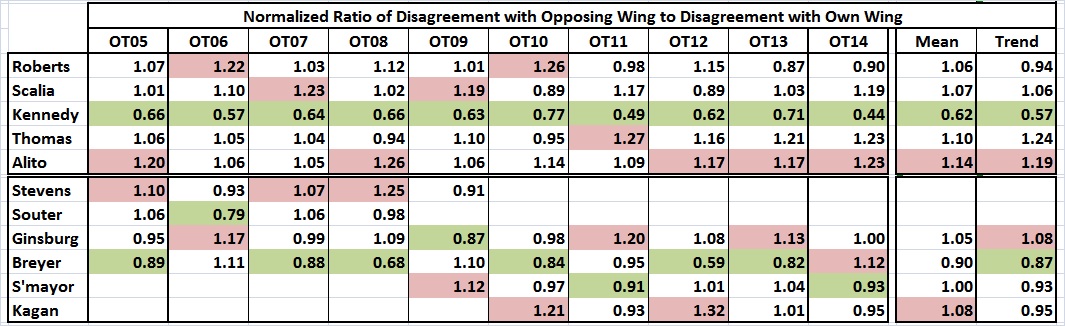
The year-to-year variations in mean ratios suggest that some terms are more fraught with ideologically divisive cases than others. I therefore normalized the year-to-year results by dividing each justice’s ratio for each year by the mean ratio for that justice’s wing. The following table gives the normalized ratios. (Right-click to open a larger image in a new tab.)

Supreme Court_normalized ratios of disagreements_OT05-OT14

Kennedy’s unsurprising but definite lurch to the left is a less compelling story than the degree of cohesion among the the “liberal” justices in OT14. Look again at the first graphic and focus on the range of ratios for OT14:

  • 4.27 to 5.15 for the “liberals”
  • 1.32 to 1.80 among the four conservatives (counting Roberts as one despite his wobbliness).

I take this as evidence that the conservatives tend to think carefully about the cases before them; whereas, the “liberals” are bent on finding clever words to justify their predictable positions. That was certainly true of Kennedy’s fatuous opinion in Obergefell v. Hodges, which the dissenters exposed as a sophomoric flight of fancy.

The left’s cohesion on the Court is of a piece with its (generally successful) political strategy: Agree on a goal, stick together, sing the same tune, ignore the facts, and (usually) win.

*     *     *

Related posts:

The Court in Retrospect and Prospect
The Real Constitution and Civil Disobedience
A Declaration of Independence
First Principles
The Constitution: Original Meaning, Corruption, and Restoration
The Unconstitutionality of the Individual Mandate
Does the Power to Tax Give Congress Unlimited Power?
Does Congress Have the Power to Regulate Inactivity?
A Declaration of Civil Disobedience
Questioning the National Debt
Rethinking the Constitution: “Freedom of Speech, and of the Press”
A Balanced-Budget Amendment and the Constitution
The Repealer
Abortion and the Fourteenth Amendment
Obamacare: Neither Necessary nor Proper
Our Perfect, Perfect Constitution
Constitutional Confusion
Reclaiming Liberty throughout the Land
A New Constitution for a New Republic
Restoring Constitutional Government: The Way Ahead
“We the People” and Big Government
How Libertarians Ought to Think about the Constitution
An Agenda for the GOP
Wrong for the Wrong Reasons
The Court in Retrospect and Prospect (II)
The States and the Constitution
Posner the Fatuous
Getting “Equal Protection” Right
The Writing on the Wall
How to Protect Property Rights and Freedom of Association and Expression
The Principles of Actionable Harm
Judicial Supremacy: Judicial Tyranny
Does the Power to Tax Give Congress Unlimited Power? (II)
The Beginning of the End of Liberty in America

See also U.S. Supreme Court: Lines of Succession for term-by-term and justice-by-justice rates of disagreement in non-unanimous cases.

__________
Sources of statistics about disagreements in non-unanimous cases, by term (in ascending chronological order):

http://www.scotusblog.com/movabletype/archives/GULCSupCtInstituteFinalReportOT2005_30June06.pdf

http://www.scotusblog.com/archives/SuperStatPack.pdf; http://www.scotusblog.com/wp-content/uploads/2008/06/nonunan07.pdf

http://www.scotusblog.com/wp-content/uploads/2009/06/justice-agreement.pdf

http://www.scotusblog.com/wp-content/uploads/2010/07/Final-Charts-070710-JA.pdf

http://sblog.s3.amazonaws.com/wp-content/uploads/2011/06/SB_OT10_stat_pack_final.pdf

http://sblog.s3.amazonaws.com/wp-content/uploads/2012/06/SB_agreement_OT11_final.pdf

http://scotusblog.com/wp-content/uploads/2013/06/agreement_OT12.pdf

http://sblog.s3.amazonaws.com/wp-content/uploads/2014/06/SB_tables_OT13.pdf

http://sblog.s3.amazonaws.com/wp-content/uploads/2015/06/SCOTUSblog_agreement-tables_OT14.pdf

Signature

The Beginning of the End of Liberty in America

SEVERAL ITEMS HAVE BEEN ADDED TO THE LIST OF RELATED READINGS SINCE THE INITIAL PUBLICATION OF THIS POST ON 06/26/15

Winston Churchill, speaking in November 1942 about the victory of the Allies in the Second Battle of El Alamein, said this:

This is not the end. It is not even the beginning of the end. But it is, perhaps, the end of the beginning.

We may have reached the end of the legal battle over same-sex “marriage” with today’s decision by five justices of the Supreme Court in the case of Obergefell v. Hodges. But that decision probably also marks the beginning of the end of liberty in America.

Consider these passages from Chief Justice Roberts’s dissent (citations omitted):

…Today’s decision … creates serious questions about religious liberty. Many good and decent people oppose same-sex marriage as a tenet of faith, and their freedom to exercise religion is—unlike the right imagined by the majority—actually spelled out in the Constitution.

Respect for sincere religious conviction has led voters and legislators in every State that has adopted same-sex marriage democratically to include accommodations for religious practice. The majority’s decision imposing same-sex marriage cannot, of course, create any such accommodations. The majority graciously suggests that religious believers may continue to “advocate” and “teach” their views of marriage…. The First Amendment guarantees, however, the freedom to “exercise” religion. Ominously, that is not a word the majority uses.

Hard questions arise when people of faith exercise religion in ways that may be seen to conflict with the new right to same-sex marriage—when, for example, a religious college provides married student housing only to opposite-sex married couples, or a religious adoption agency declines to place children with same-sex married couples. Indeed, the Solicitor General candidly acknowledged that the tax exemptions of some religious institutions would be in question if they opposed same-sex marriage…. There is little doubt that these and similar questions will soon be before this Court. Unfortunately, people of faith can take no comfort in the treatment they receive from the majority today.

Perhaps the most discouraging aspect of today’s decision is the extent to which the majority feels compelled to sully those on the other side of the debate. The majority offers a cursory assurance that it does not intend to disparage people who, as a matter of conscience, cannot accept same-sex marriage…. That disclaimer is hard to square with the very next sentence, in which the majority explains that “the necessary consequence” of laws codifying the traditional definition of marriage is to “demea[n]or stigmatiz[e]” same-sex couples…. The majority reiterates such characterizations over and over. By the majority’s account, Americans who did nothing more than follow the understanding of marriage that has existed for our entire history—in particular, the tens of millions of people who voted to reaffirm their States’ enduring definition of marriage—have acted to “lock . . . out,” “disparage,”“disrespect and subordinate,” and inflict “[d]ignitary wounds” upon their gay and lesbian neighbors…. These apparent assaults on the character of fair minded people will have an effect, in society and in court…. Moreover, they are entirely gratuitous. It is one thing for the majority to conclude that the Constitution protects a right to same-sex marriage; it is something else to portray everyone who does not share the majority’s “better informed understanding” as bigoted….

Justice Alito puts it more plainly:

[Today’s decision] will be used to vilify Americans who are unwilling to assent to the new orthodoxy. In the course of its opinion,the majority compares traditional marriage laws to laws that denied equal treatment for African-Americans and women…. The implications of this analogy will be exploited by those who are determined to stamp out every vestige of dissent.

Perhaps recognizing how its reasoning may be used, the majority attempts, toward the end of its opinion, to reassure those who oppose same-sex marriage that their rights of conscience will be protected…. We will soon see whether this proves to be true. I assume that those who cling to old beliefs will be able to whisper their thoughts in the recesses of their homes, but if they repeat those views in public, they will risk being labeled as bigots and treated as such by governments, employers, and schools….

…By imposing its own views on the entire country, the majority facilitates the marginalization of the many Americans who have traditional ideas. Recalling the harsh treatment of gays and lesbians in the past, some may think that turnabout is fair play. But if that sentiment prevails, the Nation will experience bitter and lasting wounds.

Erick Erickson drives it home:

Make no mistake — this is not the end of a march, but the beginning of a new march. You will be made to care. You will be forced to pick a side. Should you pick the side of traditional marriage, you can expect left to be ruthless. After all, the Supreme Court has said gay marriage is a not just a right, but a fundamental right. [“The Supremes Decide,” RedState, June 26, 2015]

Erickson counsels civil disobedience:

It’s time to defy the court on this. It’s time to fight back. Nonviolent civil disobedience is the only option we have been left under this terrible ruling. We will be heard. [“It’s Time for Civil Disobedience,” RedState, June 26, 2015]

Most citizens will, of course, attempt to exercise their freedom of speech, and many business owners will, of course, attempt to exercise their freedom of association. But for every person who insists on exercising his rights, there will be at least as many (and probably more) who will be cowed, shamed, and forced by the state into silence and compliance with the new dispensation. And the more who are cowed, shamed, and forced into silence and compliance, the fewer who will assert their rights. Thus will the vestiges of liberty vanish.

That’s how it looks from here on this new day of infamy.

*     *     *

Related reading:

*     *     *

Related posts:

The Marriage Contract
Libertarianism, Marriage, and the True Meaning of Family Values
Same-Sex Marriage
“Equal Protection” and Homosexual Marriage
Marriage and Children
Civil Society and Homosexual “Marriage”
The Constitution: Original Meaning, Corruption, and Restoration
Perry v. Schwarzenegger, Due Process, and Equal Protection
Rationalism, Social Norms, and Same-Sex “Marriage”
Asymmetrical (Ideological) Warfare
In Defense of Marriage
A Declaration of Civil Disobedience
The Myth That Same-Sex “Marriage” Causes No Harm
Liberty and Society
The View from Here
The Culture War
Surrender? Hell No!
Posner the Fatuous
Getting “Equal Protection” Right
The Writing on the Wall
How to Protect Property Rights and Freedom of Association and Expression
The Gaystapo at Work
The Gaystapo and Islam

Signature

Does the Power to Tax Give Congress Unlimited Power? (II)

Today’s opinion of a majority of the Supreme Court in the case of King v. Burwell upholds subsidies to participants in federally established Obamacare exchanges despite the plain language of the Affordable Care Act. In the words of Justice Scalia, whose dissent was joined by Justices Alito and Thomas,

this Court’s two decisions on the Act will surely be remembered through the years. The somersaults of statutory interpretation they have performed (“penalty” means tax, “further [Medicaid] payments to the State” means only incremental Medicaid payments to the State, “established by the State”means not established by the State) will be cited by litigants endlessly, to the confusion of honest jurisprudence.And the cases will publish forever the discouraging truth that the Supreme Court of the United States favors some laws over others, and is prepared to do whatever it takes to uphold and assist its favorites.

I dissent.

And I most vehemently dissent.

Today’s decision is a painful reminder of three posts that I published in December 2010: “The Unconstitutionality of the Individual Mandate,” “Does the Power to Tax Give Congress Unlimited Power?,” and “Does Congress Have the Power to Regulate Inactivity?.” The posts appeared 18 months before Chief Justice Roberts’s twisted logic in NFIB v. Sebelius upheld the Affordable Care Act’s individual mandate by calling it a tax.

In the second of the three posts listed above, I argued that the power to tax is not unlimited. Taxes levied by the central government must be levied for the purpose of executing powers specifically enumerated in Article I, Section 8 of the Constitution. Nevertheless, the majority NFIB v. Sebelius chose not only to distort the individual mandate — which is clearly a penalty, not a tax — but also to willfully disregard the Constitution’s expressed limitations on the powers of Congress. Even if the individual mandate were a tax, Congress cannot constitutionally levy such a tax because the Affordable Care Act isn’t contemplated in its enumerated powers. (ACA derives its supposedly constitutional status from the Court’s decision in 1935 to declare the Social Security Act constitutional, even though it isn’t. See my post of October 31, 2004, “Social Security Is Unconstitutional.”)

In the first edition of this post, I cited James Madison and linked to “The Unconstitutionality of the Individual Mandate,” where I cite many more. But I neglected Henry St. George Tucker III, who in a speech given at a meeting of the Georgia Bar Association in June 1927 put paid to the notion that Congress’s power to tax is unlimited in scope. The speech, “Judge Story’s Position on the So-Called General Welfare Clause,” is quite long, and deserving of quotation at length. (The links are mine, of course):

The words “the general welfare” are to be found in two places in the Constitution—in the preamble thereto and in Article 1, section 8, clause 1. All reputable writers concur in the statement that the words of the preamble to the Constitution consti­tute no grants of power, and therefore our investigation is confined to the words as found in Article 1, section 8, clause 1. which reads,

“The Congress shall have power lo lay and collect taxes, duties, imposts and excises, to pay the debts and provide for the common defense and general welfare of the United States but all duties, imposts, and excises shall be uniform throughout the United States.” …

Hamilton’s fight in the Convention [of 1787] was to give to Congress unlimited power. Pinckney’s plan pre­scribed definite powers to Congress. This was the struggle of the Convention, and while Hamilton’s plan, on this clause, was practically voted down six times in the Convention, either directly or by vot­ing up a distinct opposing proposition, his followers have struggled to show that the words “the general welfare” put into clause 1, section 8, Arti­cle 1. really mean what was specifically rejected by the Convention six times….

Judge [Joseph] Story’s position on this subject can best be seen from quoting his own words on the sub­ject, beginning at Sec. 906 of his Commentaries, page 628, Vol, 1….

The argument of Judge Story  (contained in sections 909 and 910) which demolishes the theory of the Hamiltonians, shows conclusively that the words “the common defense and general welfare,” as found in [Article I, section 8], constitute no substantive grant of power; and he further denies that these words contain any power whatsoever. His argu­ment is irresistible in its conclusion to any un­biased mind, but it furnishes an equally powerful argument against his claim that the words “to pro­vide for the common defense and general welfare” are merely words of limitation on the taxing power, for his argument for the latter claim is based upon the relationship of those words solely to the first clause of section 8, and excludes their relationship to the other seventeen distinct clauses in that sentence. He would thus exclude these words “common de­fense and general welfare” from any participation in the construction of the whole sentence. How can that consist with his language in sections 909 and 910?…

…[T]he framers of the Con­stitution left this  matter  in  no  doubt,  for the eighteenth clause of this section 8, after enumer­ating one by one seventeen grants of power, reads:

“The Congress shall have power to make all laws which shall be necessary and proper for carrying into execution the foregoing posters, and all other powers vested by this Con­stitution in the Government of the United States, or in any Department or Officer thereof.”

This coefficient clause therefore constitutes the constitutional limitation on the taxing power of Congress; but any law passed by Congress to carry out an express grant must be necessary and bona fide appropriate to the end. So Congress, desiring to carry out some regulation of commerce that requires an appropriation, may by law appropriate money for it under this coefficient clause, for the end is legitimate and the appropriation is bona fide appropriate to the end. So as to every other grant of power to Congress that may require money….

The proposition of Mr. Hamilton would have given Congress unlimited power to create recep­tacles and then fill them up with appropriations from the treasury. Judge Story stoutly denies such power as intended to be given in the Constitution, but claims the power in Congress to appropriate money to any persons, associations, or corporations if in their opinion it would conduce to the general welfare of the people. Under this view the courts are without power to obstruct any such measure, as it is to be left to Congress alone to determine, and not the courts. Judge Story denies that the Hamil­tonian claim could be sound because it would make of the Government one of unlimited powers, which he says, as we have seen, was never intended by the Convention; but if Congress is without restraint in selecting objects of appropriation, and the tax power is likewise unlimited, is it not apparent that the union of these two unlimited powers in Con­gress creates a government of unlimited power? The roads may be different that lead to the same end, but it the end, a government of unlimited power, which Judge Story well says, was never in­tended be the same, his construction must be re­jected, as it leads inevitably to the same result, if not to a worse result….

Judge Story’s conclusion that these words “common defense and general welfare” are simply a limitation upon the taxing power of the Govern­ment, while denying to them any constructive power, results in this anomalous condition, that the Federal Government, under these words, can con­struct or create no instrumentality unless the power be granted in the Constitution, but may yet appro­priate the money raised by taxation to such organ­ization constructed by the States or other power; that is, that while the Congress could not create a university in every State, it would have the power, if in its opinion it was for the “general welfare” to appropriate money to run them after being estab­lished by the States….

If Judge Story’s interpretation of this clause be ad­mitted, namely that these words are merely limita­tions on the taxing power of Congress, the real difficulty is still left unsolved, for he assumes, once it is granted that they are merely words of limitation on the taxing power, that Congress is clothed with the power of determining what is the common defense and general welfare. But this is mere assumption. If no definition or description of these words is found in the Constitution, and if the Constitution failed to give their meaning, there might be some reason to adopt his suggestion; but if there be a reasonable construction of the Constitution defining these words, why should that reasonable construction be set aside to give to Congress an unlimited control over the whole Government, which Judge Story has so eloquently decried? What is the common defense? What is the general welfare of the United States, Who is to determine this common defense and general welfare? What authority, under the Constitution, has the power to say what objects come within these two terms’ If taxation can be had legitimately to meet the demands of these two extensive terms where shall taxation end? What are its limits? If the objects to which taxation can be applied are unlimited, then the union of the power of taxation with the power of determining the objects to which it may be applied constitute the most tremendous engine of oppression of a free people every [sic] conceived of by the ingenuity of man. Yet, Judge Story assumes that Congress has the power to de­termine what is the common defense and what is the general welfare of the United States, and that when Congress has determined that a certain object is for the common defense or the general welfare, it may appropriate the tax money which it is authorized to levy, for that purpose. This unites in Congress two great powers, dangerous because unlimited, the one to select the objects of its favor, and the other the power to appropriate money from the treasury for such ob­jects. The unlimited power to tax and the unlimited power to determine their benefactions, are, by Judge Story, united in the Congress, and yet Judge Story (Section 909) affirms that this Government was intended to be a government of limited powers only. The relief from this illogical impasse, into which the learned Judge would drive us, is found in the simple examina­tion of Article I, section 8, clause 1, and the seventeen succeeding clauses, constituting the whole sentence. The manner in which this Article was considered and adopted in the Convention, the care with which each grant was discussed and adopted, constituting the limitations on the powers of Congress, show con­clusively that no one power, which could submerge all other powers, was ever intended by the framers of the Constitution….

…Three times in two days, on the 22nd and 2srd of August [1787], the Convention indorsed a resolution of this nature: That the Congress should “fulfill the engagements and discharge the debts of the United States”. What engagements had the United States? They are chiefly specified in the eighteen specific grants in the Pinckney plan finally adopted August 16th.  Do not the words “fulfill the engage­ments” interpret the meaning of “common defense and general welfare”? Are not those the only engagements of the Government Of the United States? Undoubtedly, having determined for the honor of their country that there should be an express provision to pay the debts some other words would have to be supplied to save to the Congress the right to carry out the grants of power to Congress thereinafter enumerated, and to show that its power to appropriate money was not confined alone to the payment of the debts. What should these additional words be? They selected these words: “To provide for the common defense and general wel­fare” as they embraced all the subsequent [enumerated] grants of power which the Convention had already determined should constitute that amount of common defense and of general welfare which the Federal Government ought to control; and being merely words of general import and without power in the Articles of Confed­eration from which they came, brought with them to the Constitution of the United States the same in­nocuous character [emphasis added]….

Thus we find in our conclusion that there is no general welfare clause in the Constitution; that the power of Congress to legislate for every object which in their opinion might be for the benefit of the people, pressed by Mr. Hamilton in the Convention, was six times, directly or indirectly, rejected by that body; and, in spite of that, his followers have sought to con­strue these words as meaning what the authors of the Constitution had six times successively rejected….

Congress, various presidents, and the Supreme Court have subsequently undone the work of the Framers, most recently on June 24, 2015, in King v. Burwell. The Constitution has become a hollow shell into which the proponents of dictatorial government may pour any meaning that advances their dictatorial whims.

*     *     *

See “The Constitution: Myths and Realities“.

Privilege, Power, and Hypocrisy

The Almighty is not a liberal… The Almighty is the driving force for the entire universe and the universe is not a very liberal place. That is what the modern world seems not to understand….

Simon Mawer, The Gospel of Judas

*     *     *

Complaints about privilege are really complaints about power. How did privilege and power come to be conflated? Let’s begin with an authoritative definition* of privilege:

A right, advantage, or immunity granted to or enjoyed by a person, or a body or class of persons, beyond the common advantages of others; an exemption in a certain case from certain burdens or liabilities.

Are all privileges unjust? Do privileges necessarily confer power or arise from it?

Good Privilege and Days of Yore

There was a time when most privileges were neither unjust nor a sign of power: when younger men ceded their seats on buses to older persons and pregnant women, when a man could hold open a door for a woman and be thanked for it instead of being repaid with a stony glare or silence; when a fit person would cede a seat to a crippled one; and so on.

Was there anything wrong with such behaviors? Only a revisionist who views the world through contemporary mores (of a politically correct hue)  would think so. Such behaviors were in fact widely practiced and accepted as fitting and proper. They were not condescending or demeaning. They did not confer power or arise from it, except to the extent that persons who had the power to grant them did so voluntarily and out of pity or respect for those who received them. But the grantors’ power was only situational, not general. A better word for it would be opportunity, as in the opportunity to do a good deed for a fellow human being.

The Decline of Civility and the Rise of Big Government

Such behaviors have gone out of style, or nearly so, not because they were considered improper but because manners have coarsened. Manners have coarsened because people — not all people but too many of them — have become self-centered and inconsiderate of others. My view is that the rise of the “me” generation in the 1960s curtailed instances of public kindness, thus producing fewer instances of good manners that might be copied and repeated, thus leading to the further recession of good manners, etc.

The “me” generation didn’t arise spontaneously. Its rise was an integral part of the breakdown of the social fabric that big government has abetted and encouraged. What breakdown? Anthony Esolen describes it all too well:

[W]hen we ask, “Why are the churches empty?” we might also ask, “Why are our public buildings so ugly? Why do we no longer have any folk art to speak of? Why do neighbors not know one another? Why are there no dances for everyone of all ages to enjoy? Why is the sight of a young lad and lass holding hands as rare now as public indecency used to be? Why is no one getting married? Why have family trees turned into family sticks, or family briars?

“Why are there so many feral young men and women, tattooed and slovenly, loitering about shopping malls or slouching towards the internet for their porn? Why are there so many old neighborhoods, roads, and bridges crumbling, while millions of young men are unemployed or, worse, unemployable? Why do so many teachers believe it their duty to tear down the glories of their own civilization, calling it ‘critical thinking,’ without a passing thought as to what will remain in their place? Who are what used to be called the ‘leading men’ of an ordinary town? Are there any? Who are what used to be called ‘city fathers’? Are there any?

“Where are the songs of yesteryear? Where are the poems? Where are the holidays? What happened to the parades and the marching bands?

“What virtue do we honor, other than what we call tolerance, which turns out not to be tolerance at all but the ‘virtue’ of demanding that there should be no honor granted to virtue?” [“What Is a Healthy Culture?,” The Imaginative Conservative, June 16, 2015]

Walter Williams puts it this way:

A civilized society’s first line of defense is not the law, police and courts but customs, traditions, rules of etiquette and moral values. These behavioral norms — mostly transmitted by example, word of mouth and religious teachings — represent a body of wisdom distilled over the ages through experience and trial and error. They include important thou-shalt-nots, such as thou shalt not murder, thou shalt not steal and thou shalt not cheat. They also include all those courtesies that have traditionally been associated with ladylike and gentlemanly conduct.

The failure to fully transmit these values and traditions to subsequent generations represents one of the failings of what journalist Tom Brokaw called “The Greatest Generation.” People in this so-called great generation, who lived during the trauma of the Great Depression and fought World War II, not only failed to transmit the moral values of their parents but also are responsible for government programs that will deliver economic chaos….

For nearly three-quarters of a century, the nation’s liberals have waged war on traditional values, customs and morality. Our youths have been counseled that there are no moral absolutes. Instead, what’s moral or immoral is a matter of personal opinion. During the 1960s, the education establishment began to challenge and undermine lessons children learned from their parents and Sunday school with fads such as “values clarification.” So-called sex education classes are simply indoctrination that undermines family and church strictures against premarital sex. Lessons of abstinence were considered passe and replaced with lessons about condoms, birth control pills and abortions. Further undermining of parental authority came with legal and extralegal measures to assist teenage abortions with neither parental knowledge nor parental consent….

If it were only the economic decline threatening our future, there might be hope. It’s the moral decline that spells our doom. [“Culture and Social Pathology,” creators.com, June 16, 2015]

Williams hints at the role of government in the sundering of the social fabric. Let’s spell it out. As government has become all-powerful and crushingly intrusive (with respect to Americans, if not with respect to their enemies) personal responsibility and the civilizing bonds of society have been replaced by dependency on the state and the use of its power to advance the interest of some at the expense of all. (See “The Interest-Group Paradox” for more about this phenomenon and its folly.)

The privileges that are accorded out of kindness, of which I wrote earlier, arise from civil society, and they are dying with it. People seem less willing than they were in the past to accord such privileges to others.

Privilege as a Dirty Word

With the withering away of civil society, privilege is now thought of mainly as something that someone demands or takes because of his rank, socioeconomic status, gender, or race. Privilege-taking was widely scorned until the arrival of the age of identity politics. Consider the phrase “rank has its privileges” (RHIP), which is a term of derogation that applies where persons of high status (judges, elected officials, corporate executives, military “brass”) enjoy perquisites or escape punishments because of their status.

Then there’s the case of the “privileged brat” — a young person who acts haughtily toward others. This is usually someone whose parents are affluent and on whom the parents have lavished money (or the things that it can buy) — someone, in other words, who has come to think of himself as “special” and whose wishes are to be taken as commands by others. I could add examples, but they would be of the same type: the privilege-taker who exploits his status to demand things of others.

Who are today’s dominant privilege-takers?

Unjust Stereotyping

Is a white person — better yet, a straight, white male of European descent (preferably non-Mediterranean) — necessarily privileged in either sense discussed here: a beneficiary of privileges voluntarily accorded by others or a privilege-taker who demands and receives favors based on his race, gender, and ethnicity?

If you select either answer you’re making the grievously wrong generalization that all heterosexual, white males of non-Mediterranean European descent (hetwhims for short) are not alike. Further, many hetwhims who seem to be “privileged” owe their privilege to causes other than gender, race, and ethnicity: Intelligence, other innate traits, and hard work should come to mind. (If you say, factually, that whites of European descent are generally smarter than, say, persons of African descent, you are unlikely to be a person who pigeonholes all hetwhims as “privileged.”)

Let’s make it real by asking if the following types of hetwhim are privileged:

  • a redneck hetwhim of below-average intelligence who comes from a poor Appalachian family
  • any hetwhim of average or below average intelligence who comes from a family with below-average income
  • a hetwhim who has been denied a job or promotion for which he was, objectively, the best candidate because he was competing with non-hetwhims, especially blacks, women, or — nowadays — homosexuals
  • a hetwhim who has a mental or physical condition that makes it impossible for him to enjoy what passes for a normal life
  • a hetwhim who is actively discriminated against in a university setting — as a student, professor, or prospective professor — because of his gender, color, and sexual orientation and not because of his actual beliefs or qualifications
  • one of the tens of millions of hetwhims in the United States who simply does the best he can with his mental and physical endowment, and whose achievements are due to those endowments and his efforts, plain and simple.

Blaming any of them for what befalls others — usually because of their own faults and failings — is nothing less than blaming the blameless. (See my post, “Luck-Egalitarianism and Moral Luck.”)

The Hypocrisy of the Truly Privileged

The stereotyping of hetwims as privileged is laughable when it is done by affluent hetwims in the media and academia. It is especially laughable when it is done by privileged members of the so-called victim groups: the president and his wife, many cabinet members and other high officials, many members of Congress, their counterparts at the State and local levels, a disproportionately high percentage of functionaries at all levels of government, and on and on throughout the ranks of business, the media, and academia. Beginning with the president, these privileged masses include more than a fair share of mediocrities who would not be where they are if they had to rely on their natural endowments, and if they could not exploit the misplaced guilt that underlies political correctness, affirmative action, and other modes of injustice.

“Injustice” is an apt word:

The obsession of seeing everything in race-coloured terms is itself racist. Anti-racism pursed by zealots transforms itself into the very vice it deplores. This is the cost of identity politics, and its close bedmate, victimology enterprises — the desire to judge, define, represent and indict the individual by the group he or she belongs to. Every human being’s experience in its infinite particularities and potentials transcends category. [Rex Murphy, “‘White Privilege’ on the March,” The National Post, May 15, 2015]

Another apt word is “payback.” The non-victims of non-privilege — with the considerable aid of their privileged allies on the left — are in the process of paying back tens of millions of hetwhims for their imagined sins. Payback may be cathartically pleasurable, but it isn’t justice — social, racial, or other. It’s just plain vindictiveness.

What about “fairness,” which is a favorite word of the racism-sexism-social-justice warriors? “Fairness” is the first refuge of the envious and their morally corrupt allies on the left. Whenever I hear “It just isn’t fair to [insert name of “victimized” group],” I think of a petulant child who lost a game because of his own lack of skill.

*     *     *

Related posts:

Refuting Rousseau and His Progeny
Liberty and “Fairness”
The Adolescent Rebellion Syndrome
Academic Bias
The F-Scale Revisited
Intellectuals and Capitalism
Greed, Cosmic Justice, and Social Welfare
Positive Rights and Cosmic Justice
The Interest-Group Paradox
The State of the Union 2010
The Shape of Things to Come
Sexist Nonsense
Inside-Outside
Asymmetrical (Ideological) Warfare
“Intellectuals and Society”: A Review
Government vs. Community
Social Justice
The Left’s Agenda
More Social Justice
The Evil That Is Done with Good Intentions
Luck-Egalitarianism and Moral Luck
The Left and Its Delusions
The Destruction of Society in the Name of “Society”
An Economist’s Special Pleading: Affirmative Action for the Ugly
Nature is Unfair
The Spoiled Children of Capitalism
Politics, Sophistry, and the Academy
Subsidizing the Enemies of Liberty
Our Perfect, Perfect Constitution
Constitutional Confusion
Race and Reason: The Achievement Gap — Causes and Implications
Liberty and Society
The Eclipse of “Old America”
The Capitalist Paradox Meets the Interest-Group Paradox
Genetic Kinship and Society
America: Past, Present, and Future
Defending Liberty against (Pseudo) Libertarians
Left-Libertarians, Obama, and the Zimmerman Case
“Conversing” about Race
The Fallacy of Human Progress
Political Correctness vs. Civility
IQ, Political Correctness, and America’s Present Condition
Defining Liberty
“We the People” and Big Government
Evolution and Race
The Culture War
The Fall and Rise of American Empire
Some Inconvenient Facts about Income Inequality
Modern Liberalism as Wishful Thinking
Mass (Economic) Hysteria: Income Inequality and Related Themes
Getting Liberty Wrong
Romanticizing the State
“Wading” into Race, Culture, and IQ
“Liberalism” and Personal Responsibility
Income Inequality and Economic Growth
Round Up the Usual Suspects
Poverty, Crime, and Big Government
Evolution, Culture, and “Diversity”
A Case for Redistribution, Not Made
Greed, Conscience, and Big Government
Ruminations on the Left in America
The Harmful Myth of Inherent Equality
My View of Libertarianism
Crime Revisited
Getting “Equal Protection” Right
A Cop-Free World?
Nature, Nurture, and Inequality
Tolerance
The Real Burden of Government
No Wonder Liberty Is Disappearing
Diminishing Marginal Utility and the Redistributive Urge
How to Protect Property Rights and Freedom of Association and Expression
Democracy, Human Nature, and the Future of America
The Gaystapo at Work
The Gaystapo and Islam
1963: The Year Zero

__________
* The Compact Edition of the Oxford English Dictionary (New York: The Oxford University Press, Sixth Printing in the United States, September 1973), Volume 2, p. 2307, at 3.

Signature

Judicial Supremacy: Judicial Tyranny

UPDATED 06/25/15

There has been much ado in the legalosphere about “judicial supremacy.” Randy Barnett gives a good summary of (and links to) the views of various constitutional scholars, then puts the power of the judiciary in constitutional context:

In some respects “judicial supremacy”–like “judicial activism”–is a deliberately loaded pejorative term. I agree entirely with the “departmentalist” vision identified by [Michael Stokes] Paulsen and [Ed] Whelan that each constitutional actor has a duty to adhere to the written Constitution that is independent of the opinions of other constitutional actors…. As a separate and co-equal branch of government, the judiciary gets to render its opinion on the constitutionality of a law, but only if the other branches first decide the measure is constitutional. Because, as Evan Bernick points out, the judiciary’s concurrence that a law is constitutional is a function of its equality to the other branches not its supremacy…. In short, the judicial power to invalidate a law because it is unconstitutional is a manifestation of judicial equality, not judicial supremacy. But this necessarily means that the law is void unless the judiciary concurs, and this judgment is then “binding” on the other branches, just as the other branches refusal to enact or sign a law is binding on the judiciary…. So, the “myth of judicial supremacy” is itself a myth. The “judicial power” to nullify unconstitutional laws was no invention of John Marshall in Marbury but was well accepted at the time the Constitution was adopted. All assumed that courts could render a law “void”–indeed that this was their duty–and their judgment would necessarily be binding on the other branches. Nor does this power make the judiciary “supreme.” It merely recognizes the concurrence of a coequal judiciary as the last line of defense of the rights retained by the people. [“In Defense of Judicial Equality,” The Volokh Conspiracy, June 3, 2015]

But when the Supreme Court’s judgments subvert the Constitution  or uphold its subversion, the Court doesn’t defend “the rights retained by the people,” it deletes them. Take three examples of economic legislation:

  • the Wagner Act, which (despite some softening through subsequent legislation) allows labor unions to force themselves on employers and on employees (except where State legislators and governors have mustered the courage to enact right-to-work laws)
  • the Social Security Act, which, as amended, forces Americans to contribute to a Ponzi-like “retirement savings” scheme, and has led to the nationalization and bureaucratization of health care through Medicare, Medicaid, and their expansion under Obamacare.

In each of these monumentally anti-libertarian cases, the Supreme Court failed to defend the “rights retained by the people.” Neither directly nor by implication  does the Constitution empower Congress and the president to do what is done by the three acts cited above; namely:

  • to dictate to workers and employers the terms and conditions of employment
  • to operate a pension plan and force citizens to join it
  • to commandeer the country’s health-care system and dictate the products and services it provides, the prices at which they are provided, and to whom they are provided.

Pardon me while I scoff at the notion that the Supreme Court is “the last line of defense of the rights retained by the people.” Well, it may be the last line of defense, but it has proved time and again to be a porous defense. With defenders like the Supreme Court, the Constitution and the rights of the people need no enemies.

UPDATE 06/25/15: Six of the nine justices of the Supreme Court have just proved my point with their decision in the case of King v. Burwell, wherein the Court upholds subsidies to participants in federally established Obamacare exchanges despite the plain language of the Affordable Care Act. In the words of Justice Scalia, whose dissent was joined by Justices Alito and Thomas:

[T]his Court’s two decisions on the Act will surely be remembered through the years. The somersaults of statutory interpretation they have performed (“penalty” means tax, “further [Medicaid] payments to the State” means only incremental Medicaid payments to the State, “established by the State”means not established by the State) will be cited by litigants endlessly, to the confusion of honest jurisprudence.And the cases will publish forever the discouraging truth that the Supreme Court of the United States favors some laws over others, and is prepared to do whatever it takes to uphold and assist its favorites.

I dissent.

And I most vehemently dissent. Further, I decline to give my allegiance to the government of the United States as it is now constituted, and vow to disobey every unlawful act of that government, to the extent that I can while providing for myself and my family.

*     *     *

Related reading:

*     *     *

Related posts:

When Must the Executive Enforce the Law?
More on the Debate about Judicial Supremacy
Another Look at Judicial Supremacy
Freedom of Contract and the Rise of Judicial Tyranny
Judicial Interpretation
Is Nullification the Answer to Judicial Supremacy?
The Alternative to Nullification
No Way Out? The Wrong Case for Judicial Review
An Answer to Judicial Supremacy?
The Constitution: Who Has the Last Word?
The Slippery Slope of Constitutional Revisionism The Real Constitution and Civil Disobedience
The Constitution: Original Meaning, Corruption, and Restoration
Our Perfect, Perfect Constitution
How Libertarians Ought to Think about the Constitution

See also “The Constitution: Myths and Realities“.

Signature

1963: The Year Zero

[A] long habit of not thinking a thing WRONG, gives it a superficial appearance of being RIGHT…. Time makes more converts than reason.

Thomas Paine, Common Sense

If ignorance and passion are the foes of popular morality, it must be confessed that moral indifference is the malady of the cultivated classes. The modern separation of enlightenment and virtue, of thought and conscience, of the intellectual aristocracy from the honest and common crowd is the greatest danger that can threaten liberty.

Henri Frédéric Amiel, Journal

The Summer of Love ignited the loose, Dionysian culture that is inescapable today. The raunch and debauchery, radical individualism, stylized non-conformity, the blitzkrieg on age-old authorities, eventually impaired society’s ability to function.

Gilbert T. Sewall, “Summer of Love, Winter of Decline

*     *     *

If, like me, you were an adult when John F. Kennedy was assassinated, you may think of his death as a watershed moment in American history. I say this not because I’m an admirer of Kennedy the man (I am not), but because American history seemed to turn a corner when Kennedy was murdered. To take the metaphor further, the corner marked the juncture of a sunny, tree-lined street (America from the end of World War II to November 22, 1963) and a dingy, littered street (America since November 22, 1963).

Changing the metaphor, I acknowledge that the first 18 years after V-J Day were by no means halcyon, but they were the spring that followed the long, harsh winter of the Great Depression and World War II. Yes, there was the Korean War, but that failure of political resolve was only a rehearsal for later debacles. McCarthyism, a political war waged (however clumsily) on America’s actual enemies, was benign compared with the war on civil society that began in the 1960s and continues to this day. The threat of nuclear annihilation, which those of you who were schoolchildren of the 1950s will remember well, had begun to subside with the advent of JFK’s military policy of flexible response, and seemed to evaporate with JFK’s resolution of the Cuban Missile Crisis (however poorly he managed it). And for all of his personal faults, JFK was a paragon of grace, wit, and charm — a movie-star president — compared with his many successors, with the possible exception of Ronald Reagan, who had been a real movie star.

What follows is an impression of America since November 22, 1963, when spring became a long, hot summer, followed by a dismal autumn and another long, harsh winter — not of deprivation, and perhaps not of war, but of rancor and repression.

This petite histoire begins with the Vietnam War and its disastrous mishandling by LBJ, its betrayal by the media, and its spawning of the politics of noise. “Protests” in public spaces and on campuses are a main feature of the politics of noise. In the new age of instant and sympathetic media attention to “protests,” civil and university authorities often refuse to enforce order. The media portray obstructive and destructive disorder as “free speech.” Thus do “protestors” learn that they can, with impunity, inconvenience and cow the masses who simply want to get on with their lives and work.

Whether “protestors” learned from rioters, or vice versa, they learned the same lesson. Authorities, in the age of Dr. Spock, lack the guts to use force, as necessary, to restore civil order. (LBJ’s decision to escalate gradually in Vietnam — “signaling” to Hanoi — instead of waging all-out war was of a piece with the “understanding” treatment of demonstrators and rioters.) Rioters learned another lesson — if a riot follows the arrest, beating, or death of a black person, it’s a “protest” against something (usually white-racist oppression, regardless of the facts), not wanton mayhem. After a lull of 21 years, urban riots resumed in 1964, and continue to this day.

LBJ’s “Great Society” marked the resurgence of FDR’s New Deal — with a vengeance — and the beginning of a long decline of America’s economic vitality. The combination of the Great Society (and its later extensions, such as Medicare Part D and Obamacare) with the rampant growth of regulatory activity has cut the rate of economic growth from 5 percent to 2 percent.  The entrepreneurial spirit has been crushed; dependency has been encouraged and rewarded; pension giveaways have bankrupted public treasuries across the land. America since 1963 has been visited by a perfect storm of economic destruction that seems to have been designed by America’s enemies.

The Civil Rights Act of 1964 unnecessarily crushed property rights, along with freedom of association, to what end? So that a violent, dependent, Democrat-voting underclass could arise from the Great Society? So that future generations of privilege-seekers could cry “discrimination” if anyone dares to denigrate their “lifestyles”? There was a time when immigrants and other persons who seemed “different” had the good sense to strive for success and acceptance as good neighbors, employees, and merchants. But the Civil Rights Act of 1964 and its various offspring — State and local as well as federal — are meant to short-circuit that striving and to force acceptance, whether or not a person has earned it. The vast, silent majority is caught between empowered privilege-seekers and powerful privilege-granters. The privilege-seekers and privilege-granters are abetted by dupes who have, as usual, succumbed to the people’s romance — the belief that government represents society.

Presidents, above all, like to think that they represent society. What they represent, of course, are their own biases and the interests to which they are beholden. Truman, Ike, and JFK were imperfect presidential specimens, but they are shining idols by contrast with most of their successors. The downhill slide from the Vietnam and the Great Society to Obamacare and lawlessness on immigration has been punctuated by many shameful episodes; for example:

  • LBJ — the botched war in Vietnam, repudiation of property rights and freedom of association (the Civil Rights Act)
  • Nixon — price controls, Watergate
  • Carter — dispiriting leadership and fecklessness in the Iran hostage crisis
  • Reagan — bugout from Lebanon, rescue of Social Security
  • Bush I — failure to oust Saddam when it could have been done easily, the broken promise about taxes
  • Clinton — bugout from Somalia, push for an early version of Obamacare, budget-balancing at the cost of defense, and perjury
  • Bush II — No Child Left Behind Act, Medicare Part D, the initial mishandling of Iraq, and Wall Street bailouts
  • Obama — stimulus spending, Obamacare, reversal of Bush II’s eventual success in Iraq, naive backing for the “Arab spring,”  acquiescence to Iran’s nuclear ambitions, unwillingness to acknowledge or do anything about the expansionist aims of Russia and China, neglect or repudiation of traditional allies (especially Israel), and refusal to take care that the immigration laws are executed faithfully.

Only Reagan’s defense buildup and its result — victory in the Cold War — stands out as a great accomplishment. But the victory was squandered: The “peace dividend” should have been peace through continued strength, not unpreparedness for the post 9/11 wars and the resurgence of Russia and China.

The war on defense has been accompanied by a war on science. The party that proclaims itself the party of science is anything but that. It is the party of superstitious, Luddite anti-science. Witness the embrace of extreme environmentalism, the arrogance of proclamations that AGW is “settled science,” unjustified fear of genetically modified foodstuffs, the implausible doctrine that race is nothing but a social construct, and on and on.

With respect to the nation’s moral well-being, the most destructive war of all has been the culture war, which assuredly began in the 1960s. Almost overnight, it seems, the nation was catapulted from the land of Ozzie and Harriet, Father Knows Best, and Leave It to Beaver to the land of the free- filthy-speech movement, Altamont, Woodstock, Hair, and the unspeakably loud, vulgar, and violent offerings that are now plastered all over the air waves, the internet, theater screens, and “entertainment” venues.

Adherents of the ascendant culture esteem protest for its own sake, and have stock explanations for all perceived wrongs (whether or not they are wrongs): racism, sexism, homophobia, Islamophobia, hate, white privilege, inequality (of any kind), Wall  Street, climate change, Zionism, and so on.

Then there is the campaign to curtail freedom of speech. This purported beneficiaries of the campaign are the gender-confused and the easily offended (thus “microagressions” and “trigger warnings”). The true beneficiaries are leftists. Free speech is all right if it’s acceptable to the left. Otherwise, it’s “hate speech,” and must be stamped out. This is McCarthyism on steroids. McCarthy, at least, was pursuing actual enemies of liberty; today’s leftists are the enemies of liberty.

There’s a lot more, unfortunately. The organs of the state have been enlisted in an unrelenting campaign against civilizing social norms. As I say here,

we now have not just easy divorce, subsidized illegitimacy, and legions of non-mothering mothers, but also abortion, concerted (and deluded) efforts to defeminize females and to neuter or feminize males, forced association (with accompanying destruction of property and employment rights), suppression of religion, absolution of pornography, and the encouragement of “alternative lifestyles” that feature disease, promiscuity, and familial instability. The state, of course, doesn’t act of its own volition. It acts at the behest of special interests — interests with a “cultural” agenda….  They are bent on the eradication of civil society — nothing less — in favor of a state-directed Rousseauvian dystopia from which morality and liberty will have vanished, except in Orwellian doublespeak.

If there are unifying themes in this petite histoire, they are the death of common sense and the rising tide of moral vacuity — thus the epigrams at the top of the post. The history of the United States since 1963 supports the proposition that the nation is indeed going to hell in a handbasket.

Read on.

*     *     *

Related reading:

*     *     *

Related posts:

Refuting Rousseau and His Progeny
Killing Free Speech in Order to Save It
The Adolescent Rebellion Syndrome
The Ruinous Despotism of Democracy
Academic Bias
The F-Scale Revisited
The Modern Presidency: A Tour of American History
The People’s Romance
Intellectuals and Capitalism
On Liberty
Greed, Cosmic Justice, and Social Welfare
Positive Rights and Cosmic Justice
Liberalism and Sovereignty
The Interest-Group Paradox
Getting It Wrong and Right about Iran
The Real Constitution and Civil Disobedience
The State of the Union 2010
The Shape of Things to Come
Sexist Nonsense
The Constitution: Original Meaning, Corruption, and Restoration
Delusions of Preparedness
Inside-Outside
Asymmetrical (Ideological) Warfare
A Grand Strategy for the United States
The Folly of Pacifism
The Unconstitutionality of the Individual Mandate
“Intellectuals and Society”: A Review
Does the Power to Tax Give Congress Unlimited Power?
Does Congress Have the Power to Regulate Inactivity?
Is the Anger Gone?
Government vs. Community
Social Justice
The Left’s Agenda
More Social Justice
Why We Should (and Should Not) Fight
Rating America’s Wars
The Public-School Swindle
The Evil That Is Done with Good Intentions
Transnationalism and National Defense
Luck-Egalitarianism and Moral Luck
The Left and Its Delusions
In Defense of Wal-Mart
The Destruction of Society in the Name of “Society”
The Folly of Pacifism, Again
An Economist’s Special Pleading: Affirmative Action for the Ugly
September 20, 2001: Hillary Clinton Signals the End of “Unity”
The War on Terror, As It Should Have Been Fought
Obamacare: Neither Necessary nor Proper
The Spoiled Children of Capitalism
Politics, Sophistry, and the Academy
Subsidizing the Enemies of Liberty
Defense as an Investment in Liberty and Prosperity
Our Perfect, Perfect Constitution
Free Will, Crime, and Punishment
Constitutional Confusion
Obamacare, Slopes, Ratchets, and the Death-Spiral of Liberty
Obamacare and Zones of Liberty
Race and Reason: The Achievement Gap — Causes and Implications
Obama’s Big Lie
Liberty and Society
The Eclipse of “Old America”
The Capitalist Paradox Meets the Interest-Group Paradox
Genetic Kinship and Society
America: Past, Present, and Future
Defending Liberty against (Pseudo) Libertarians
Left-Libertarians, Obama, and the Zimmerman Case
“Conversing” about Race
The Fallacy of Human Progress
Fighting Modernity
Political Correctness vs. Civility
IQ, Political Correctness, and America’s Present Condition
AGW: The Death Knell
The Barbarians Within and the State of the Union
Defining Liberty
The World Turned Upside Down
“We the People” and Big Government
Evolution and Race
The Culture War
Defense Spending: One More Time
The Fall and Rise of American Empire
Some Inconvenient Facts about Income Inequality
Modern Liberalism as Wishful Thinking
Mass (Economic) Hysteria: Income Inequality and Related Themes
Presidential Treason
Getting Liberty Wrong
Romanticizing the State
The Limits of Science (II)
The Pretence of Knowledge
“The Science Is Settled”
“Wading” into Race, Culture, and IQ
“Liberalism” and Personal Responsibility
Income Inequality and Economic Growth
Round Up the Usual Suspects
Walking the Tightrope Reluctantly
Poverty, Crime, and Big Government
Evolution, Culture, and “Diversity”
A Case for Redistribution, Not Made
Greed, Conscience, and Big Government
Ruminations on the Left in America
The Harmful Myth of Inherent Equality
My View of Libertarianism
Crime Revisited
Getting “Equal Protection” Right
McCloskey on Piketty
The Rahn Curve Revisited
The Slow-Motion Collapse of the Economy
A Cop-Free World?
Nature, Nurture, and Inequality
Tolerance
How to Eradicate the Welfare State, and How Not to Do It
Does Obama Love America?
The Real Burden of Government
No Wonder Liberty Is Disappearing
Diminishing Marginal Utility and the Redistributive Urge
How to Protect Property Rights and Freedom of Association and Expression
Obamanomics in Action
Democracy, Human Nature, and the Future of America
Rationalism, Empiricism, and Scientific Knowledge
The Gaystapo at Work
The Gaystapo and Islam
AGW in Austin?

Signature

The Principles of Actionable Harm

I prefer — as a minarchistic libertarian (a radical-right-minarchist, to be precise) — an accountable, constrained state to the the condition of anarchy. This leads to warlordism and thence to despotism. But the state must be held to its proper realm of action, namely, dispensing justice and defending citizens. Its purpose in doing those things — and the sole justification for its being — is to protect negative rights (including property rights) and civil society. (For more about the proper role of the state, go to “Parsing Political Philosophy” and under the section headed “Minarchism,” see “The Protection of Negative Rights,” “More about Property Rights,” and the “Role of Civil Society.”)

Specifically:

1. An actionable harm — a harm against which the state may properly act — is one that deprives a person of negative rights or undermines the voluntarily evolved institutions and norms of civil society.

2. The state should not act — or encourage action by private entities — except as it seeks to deter, prevent, or remedy an actionable harm to its citizens.

3. An actionable harm may be immediate (as in the case of murder) or credibly threatened (as in the case of a conspiracy to commit murder). But actionable harms extend beyond those that are immediate or credibly threatened. They also result from actions by the state that strain and sunder the bonds of trust that make it possible for a people to coexist civilly, through the mutual self-restraint that arises from voluntarily evolved social norms. The use of state power has deeply eroded such norms. The result has been to undermine the trust and self-restraint that enable a people to enjoy liberty and its fruits; for example:

  • Affirmative action and other forms of forced racial integration deny property rights and freedom of association, prolong racial animosity, and impose unwarranted economic harm on those who are guilty of nothing but the paleness of their skin.
  • The legal enshrinement of gay rights leads to the suppression of speech and the denial of freedoms of expression and association, at the expense of citizens who have done nothing worse than refuse to recognize a “lifestyle choice” of which they disapprove, as should be their right.

4. An expression of thought cannot be an actionable harm unless it

a. is defamatory; or

b. would directly obstruct governmental efforts to deter, prevent, or remedy an actionable harm (e.g., divulging classified defense information, committing perjury); or

c. intentionally causes or would directly cause an actionable harm (e.g., plotting to commit an act of terrorism, forming a lynch mob); or

d. purposely — through a lie or the withholding of pertinent facts — causes a person to act against self-interest; or

e. purposely — through its intended influence on government — results in what would be an actionable harm if committed by a private entity (e.g., the taking of income from persons who earn it, simply to assuage the envy of those who earn less). (The remedy for such harms should not be the suppression or punishment of the harmful expressions; the remedy should be the enactment and enforcement of restrictions on the ability of government to act as it does.)

5. With those exceptions, a mere statement of fact, belief, opinion, or attitude cannot be an actionable harm. Otherwise, those persons who do not care for the facts, beliefs, opinions, or attitudes expressed by other persons would be able to stifle speech they find offensive merely by claiming to be harmed by it. And those persons who claim to be offended by the superior income or wealth of other persons would be entitled to recompense from those other persons. (It takes little imagination to see the ramifications of such thinking; rich heterosexuals, for example, could claim to be offended by the existence of persons who are poor or homosexual, and could demand their extermination as a remedy.)

6. It cannot be an actionable harm to commit a private, voluntary act of omission (e.g., the refusal of social or economic relations for reasons of personal preference), other than a breach of contract or fiduciary responsibility. Nor can it be an actionable harm to commit a private, voluntary act which does nothing more than arouse resentment, envy, or anger in others. A legitimate state does not  judge, punish, or attempt to influence private, voluntary acts that are not otherwise actionable harms.

7. By the same token, a legitimate state does not judge, punish, or attempt to influence private, voluntary acts of commission which have undesirable but avoidable consequences. For example:

  • Government prohibition of smoking on private property is illegitimate because non-smokers could choose not to frequent or work at establishments that allow smoking.
  • Other government restrictions on the use of private property (e.g., laws that bar restrictive covenants or mandate public accommodation) are illegitimate because they (1) diminish property rights and (2) discourage ameliorating activities (e.g., the evolution away from cultural behaviors that play into racial prejudice, investments in black communities and black-run public accommodations).
  • Tax-funded subsidies for retirement and health care are illegitimate because they discourage hard work, saving, and other prudent habits — habits that would lead to less dependence on government, were those habits encouraged.

8. It is also wrong for the state to make and enforce distinctions among individuals that have the effect of advantaging some persons because of their age, gender, sexual orientation, skin color, ethnicity, religion, or economic status.

9. Except in the case of punishment for an actionable harm, it is an actionable harm to bar a competent adult from

a. expressing his views, as long as they are not defamatory or meant to incite harm (voice); or

b. moving to a place of his choosing (exit).

(As a practical matter, voice is of little consequence if the state’s power of the lives and livelihoods of citizens has grown so great that it cannot be undone except by revolution. Further, exit becomes meaningless when the central government’s power reaches into every corner of the nation and leaves persons of ordinary means with no place to turn. In the present circumstances, it follows that the state daily commits actionable harms against citizens of the United States.)

10. The proper role of the state is to enforce the preceding principles. In particular,

a. to remain neutral with respect to evolved social norms, except where those norms deny voice or exit, as with the systematic disenfranchisement or enslavement of particular classes of persons; and

b. to foster economic freedom (and therefore social freedom) by ensuring open trade within the nation and (to the extent compatible with national security) open trade with (but selective immigration from) other nations; and

c. to ensure free expression of thought, except where such expression is tantamount to an actionable harm (as in a conspiracy to commit murder or mount a campaign of harassment); and

d. to see that just laws — those enacted in accordance with the principles of actionable harm — are enforced swiftly and surely, with favoritism toward no person or class of persons; and

e. to defend citizens against predators, foreign and domestic.

*     *     *

The principles of actionable harm are not rules for making everyone happy. They are rules for ensuring that each of us is able to pursue happiness without impinging on the happiness of others.

The state should apply the principles of actionable harm only to citizens and legitimate residents of the United States. Sovereignty is otherwise meaningless; the United States exists for the protection of citizens and persons legitimately resident; it is not an eleemosynary institution.

By the same token, those who would harm citizens and legitimate residents of the United States must be treated summarily and harshly, as necessary.

*     *     *

Related posts:

Why Sovereignty?
Parsing Political Philosophy
Negative Rights
Negative Rights, Social Norms, and the Constitution
Rights, Liberty, the Golden Rule, and the Legitimate State
The Golden Rule and the State
The Meaning of Liberty
Positive Liberty vs. Liberty
Facets of Liberty
Liberty and Society
The Eclipse of “Old America”
Genetic Kinship and Society
Liberty as a Social Construct: Moral Relativism?
Defending Liberty against (Pseudo) Libertarians
Defining Liberty
Conservatism as Right-Minarchism
Parsing Political Philosophy (II)
Getting Liberty Wrong
Romanticizing the State
Libertarianism and the State
My View of Libertarianism

Signature

The Gaystapo and Islam

Politics, as usual, makes strange bedfellows. The Gaystapo — which includes a lot of non-gays — wants to punish anyone who declines to endorse same-sex “marriage” by providing such things as flowers, cakes, and pizzas for occasions related to such “marriages.” Islamists want to punish (quite literally) anyone who dares to draw, exhibit, or publish an image of Muhammad.

Here’s where it gets really weird — if you’re a stickler for logical consistency. Islamists are well-known for their condemnation and punishment of homosexuality. But it is safe to say that persons who are sympathetic to Islam and willing to overlook such “peccadillos” as the stoning to death of queers (and unfaithful female spouses) constitute a large fraction of the Gaystapo. Oh, I should have mentioned Shari’ah law, which doesn’t seem to bother the typical member of the Gaystapo, even though it forces Islam down the throats of all who are subject to it — and the goal of Islamists is to subject everyone to it.

Which brings me to the common denominator of Islamism and the Gaystapo (and the left, generally): a strong taste for repression. They’re not such strange bedfellows, after all.

*     *     *

Related reading:

Related posts:

See especially Wrong for the Wrong Reasons

Also:
FDR and Fascism
An FDR Reader
The People’s Romance
Intellectuals and Capitalism
Fascism
Fascism with a “Friendly” Face
Inventing “Liberalism”
The Shape of Things to Come
Fascism and the Future of America
The Indivisibility of Economic and Social Liberty
The Near-Victory of Communism
Tocqueville’s Prescience
Accountants of the Soul
Invoking Hitler
The Left
Our Enemy, the State
“Intellectuals and Society”: A Review
The Left’s Agenda
The Left and Its Delusions
The Destruction of Society in the Name of “Society”
The Spoiled Children of Capitalism
Politics, Sophistry, and the Academy
Subsidizing the Enemies of Liberty
Are You in the Bubble?
Liberty and Society
Tolerance on the Left
America: Past, Present, and Future
The Barbarians Within and the State of the Union
The World Turned Upside Down
The Fall and Rise of American Empire
Presidential Treason
“A Date Which Will Live in Infamy”
The Criminality and Psychopathy of Statism
Romanticizing the State
Ruminations on the Left in America
The Gaystapo at Work

Signature

Democracy, Human Nature, and America’s Future

Like many (most?) persons of a libertarian stripe, I see democracy as an enemy of liberty. Democracy is popularly thought of as

a form of government in which the supreme power is vested in the people and exercised directly by them or by their elected agents under a free electoral system.

There are two things wrong with this view. First, the “supreme power” isn’t just exercised by elected agents but, with their blessing, it is exercised mainly by unelected agents: judges, law-enforcement personnel, regulators of myriad economic activities at all levels of government, and on and on. Many of these appointed functionaries write the very rules that they and others enforce — rules that often are barely recognizable as deriving from ordinances and statutes enacted by elected agents.

In sum, what is called democracy in America can reasonably be called fascism, in the proper meaning of the word. It isn’t called that mainly because neither “the people” nor the elite purveyors of fascism are willing to face facts. And then there are the many (far too many) Americans who don’t seem to object to an intrusive state.

Here’s the second problem with the popular view of democracy: It implies that a majority of voters — or a majority of their elected agents — should have unlimited power to meddle in everyone’s personal and business affairs. The implication has become fact, with the sweeping aside of constitutional checks on the powers of the legislative and executive branches, with the connivance of the judicial branch. The elected agents of “the people” — and those agents’ appointed functionaries — have acquired unlimited power by pandering to “the people,” by appealing to their envy, greed, and deluded faith in central planning.

What all of this illustrates is something that was obvious to the Framers of the Constitution: Even if there were (or could be) such a thing as political equality, democracy is dangerous because it can’t be constrained. Why would anyone expect “the people” or their elected representatives or their appointed functionaries to limit the power of the state to the defense of citizens? “The people” believe — wrongly, in most cases — that the state’s unlimited power makes them better off. In fact, the true beneficiaries of the state’s power are elected officials, appointed functionaries, and their pseudo-capitalist cronies.

True believers will retort that the problem isn’t with democracy, it’s with the way that democracy has been put into practice. They are indulging in the nirvana fallacy, the tendency to believe in “more perfect” systems that can somehow be attained despite human nature. In short, true believers substitute “ought to be” (in their view) for “what can be.”

They are no different than the true believers in socialism, who maintain — despite all evidence to the contrary — that “true socialism” is possible but hasn’t yet been put into practice. It would be possible only if socialism (like democracy) didn’t involve human beings. No system that involves human beings can rise above the tendencies of human nature, among which, as noted above, are envy and greed.

Then, there is power-lust. This may be less prevalent than envy and greed, but it is more dangerous because it exploits envy and greed, and amplifies their effects. Almost no politician, regardless of his rhetoric, is driven by a pure desire to “do good”; he is almost certainly driven by a desire to use his power to do what he thinks of — or rationalizes — as “good.”

And use his power he will, for he believes that it is his right and duty to make rules for others to obey. This is always done in the name of “good,” but is really done in the service of cronies and constituents who enable the politician to remain in power. In short, the last person to trust with high office is a person who seeks it. That is why elections usually come down to a choice among the lesser of evils.

What is to be done about democracy in America? Nothing like the revocation of near-universal suffrage, of course. The natives (of all hues, creeds, genders, and origins) wouldn’t stand for it. The only viable reform is constitutional, that is, a constant chipping-away at the power of the state.

And how is that to be accomplished, inasmuch as the GOP has proved to be an unreliable ally in the fight against statism? Perhaps the GOP would be less faint-hearted if it were to control the White House and Congress. And perhaps the best thing to come of that control would be the replacement of a Ruth Bader Ginsburg by another Clarence Thomas. (I hold little hope for courageous action on entitlements and regulatory excesses.) But, given the electorate’s fickleness, it wouldn’t be many years before an Antonin Scalia is replaced by a reincarnated William O. Douglas. In sum, I hold little hope that the Supreme Court will rescue liberty from democracy.

It’s also possible that GOP control might result in an Article V convention:

…[O]n the Application of the Legislatures of two thirds of the several States, [Congress] shall call a Convention for proposing Amendments, which … shall be valid to all Intents and Purposes, as Part of this Constitution, when ratified by the Legislatures of three fourths of the several States, or by Conventions in three fourths thereof, as the one or the other Mode of Ratification may be proposed by the Congress….

But what would be the thrust of any proposed amendments that leap the high hurdle of ratification, “The Constitution says this, and we mean it”? The Constitution already says this, and it’s ignored.

What’s needed is real action, not the mere placement of words on paper. Thus the best (and perhaps only) hope for a permanent withdrawal from the precipice of totalitarianism is de facto secession:

This has begun in a small way, with State-level legalization of marijuana, which has happened in spite of the central government’s de jure power to criminalize it. It is therefore imaginable that GOP control of the White House and Congress would embolden some GOP-controlled States to openly flout federal laws, regulations, and judicial decrees about such matters as same-sex marriage, environmental emissions, and Obamacare — to name a few obvious targets. The result, if it came to pass, would be something like the kind of federalism envisioned by the Framers of the Constitution.

Beyond that, the only hope for liberty seems to lie in drastic (but unlikely) action.

*     *     *

Related reading:
Hans-Hermann Hoppe, “Natural Elites, Intellectuals, and the State,” Mises Institute, July 31, 2006
Hans-Hermann Hoppe, A Short History of Man: Progress and Decline, Mises Institute, March 5, 2015
Hans von Spakovsky, “Book Review: Mike Lee on the 6 ‘Lost’ Provisions of the Constitution,” The Daily Signal, April 8, 2015
Myron Magnet, “The Dead Constitution,” City Journal, April 10, 2015

Related posts:
The State of Nature
Democracy and Liberty
The Interest-Group Paradox
Fascism and the Future of America
The Near-Victory of Communism
Tocqueville’s Prescience
The Constitution: Original Meaning, Corruption, and Restoration
Our Perfect, Perfect Constitution
Restoring Constitutional Government: The Way Ahead
“We the People” and Big Government
How Libertarians Ought to Think about the Constitution
An Agenda for the GOP
The States and the Constitution
No Wonder Liberty Is Disappearing

Signature

How to Protect Property Rights and Freedom of Association and Expression

Opposition to Indiana’s Religious Freedom Restoration Act is more than another battle in the culture war. It continues a trend that began with the passage of the Civil Rights Act of 1964: suppression of the rights of Americans to use their property as they see fit, to associate with whom they please, and to oppose elite opinion. (UPDATE 04/02/15: John Derbyshire puts a lot of flesh on the bare bones of the preceding sentences. By contrast, Andrew Napolitano — that pseudo-libertarian windbag — manages to get it wrong, as usual, by praising the Civil Rights Act of 1964 and its theft of property rights and denial of freedom of association. UPDATE 04/05/15: Warren Meyer cuts through the baloney.)

It is past time to put a stop to the trend. Liberty-loving Americans should fight back by pushing for a constitutional amendment like this:

1. Neither the United States nor any State, including its political subdivisions and educational institutions, may require any governmental entity or private person, business, or organization to discriminate against any person solely on account of that person’s age, gender, sexual preference, race, color, national origin, mental or physical condition, veteran status, political affiliation, or political views. [This is how Jim Crow laws should have been dealt with. “Solely” is meant to leave room for reasonable exceptions, such as mental qualifications for admission to a university, physical qualifications for jobs, and gender segregation in prisons and restrooms. Clauses of elaboration might be necessary.]

2. Neither the United States nor any State, including its political subdivisions and educational institutions, may require any governmental entity or private person, business, organization to sell property to, do business with, hire, promote, accept as a student, associate with, or give preference to any person, business, or organization on account of income, age, gender, sexual preference, race, color, national origin, mental or physical condition, veteran status, political affiliation, or political views. [This would rule out all kinds of preferences, including favoritism toward often-bogus minority- and women-owned business and relaxed lending practices of the kind that led to the Great Recession.]

3. Neither the United States nor any State, including its political subdivisions and educational institutions, shall initiate or continue in effect any statute, regulation, policy, or judicial decree that penalizes a private person, business, or organization for expressing a view about a person’s age, gender, sexual preference, race, color, national origin, mental or physical condition, veteran status, political affiliation, or political views. [Clauses of elaboration might be necessary to ensure that this doesn’t rule out such things as prosecutions for espionage and treason, or private actions for libel.]

*     *     *

Related posts:
Academic Bias
Intellectuals and Capitalism
“Intellectuals and Society”: A Review
The Left’s Agenda
The Left and Its Delusions
The Spoiled Children of Capitalism
Politics, Sophistry, and the Academy
Subsidizing the Enemies of Liberty
Are You in the Bubble?
Not-So-Random Thoughts
The Culture War
Ruminations on the Left in America
No Wonder Liberty Is Disappearing

Signature

The Writing on the Wall

A headline at Slate puts it this way: “The Supreme Court Just Admitted It’s Going to Rule in Favor of Marriage Equality.” Which is to say that when it comes to the legalization of same-sex “marriage”* across the United States, the writing is on the wall.

Here are some relevant passages from the Slate story:

Early Monday morning [February 9[, the Supreme Court refused to stay a federal judge’s order invalidating Alabama’s ban on same-sex marriage….

Here’s how Monday’s decision reveals the justices’ intention to strike down gay marriage bans across the country. Typically, the justices will stay any federal court ruling whose merits are currently under consideration by the Supreme Court. Under normal circumstances, that is precisely what the court would have done here: The justices will rule on the constitutionality of state-level marriage bans this summer, so they might as well put any federal court rulings on hold until they’ve had a chance to say the last word. After all, if the court ultimately ruled against marriage equality, the Alabama district court’s order would be effectively reversed, and those gay couples who wed in the coming months would find their unions trapped in legal limbo.

But that is not what the court did here. Instead, seven justices agreed, without comment, that the district court’s ruling could go into effect, allowing thousands of gay couples in Alabama to wed. That is not what a court that planned to rule against marriage equality would do. By permitting these marriages to occur, the justices have effectively tipped their hand, revealing that any lower court’s pro-gay ruling will soon be affirmed by the high court itself.

Don’t believe me? Then ask Justice Clarence Thomas, who, along with Justice Antonin Scalia, dissented from Monday’s denial of a stay…. The court’s “acquiescence” to gay marriage in Alabama, Thomas wrote, “may well be seen as a signal of the Court’s intended resolution” of the constitutionality of gay marriage bans….

I suspect that Justice Thomas has it right. (I only hope that the acquiescence of Chief Justice Roberts and Justice Alito is part of a tacit deal in which their support for “marriage equality” is repaid by the evisceration of Obamacare when the Court rules in King v. Burwell.) The Court’s refusal to stay same-sex “marriage” in Alabama seems to be the writing on the wall — the foreshadowing of the Court’s decision in four related same-sex “marriage” cases.

If the Court, as now expected, rules for “marriage equality” under the rubric of “equal protection,” that will only mark the beginning of a push for other kinds of “equality.” What’s next? Here are my guesses:

  • How can polygamy fail to gain legal acceptance if the “partners” are willing adults?
  • When that’s done, the Court’s views will have evolved to the point of allowing pederasty at the urging of  NAMBLA.

Fuddy-duddies — like this one — who oppose the legalization of moral corruption will be silenced by the threat of fines and imprisonment.

Livy, the Roman historian, says this in the introduction to his history of Rome:

The subjects to which I would ask each of my readers to devote his earnest attention are these – the life and morals of the community; the men and the qualities by which through domestic policy and foreign war dominion was won and extended. Then as the standard of morality gradually lowers, let him follow the decay of the national character, observing how at first it slowly sinks, then slips downward more and more rapidly, and finally begins to plunge into headlong ruin, until he reaches these days, in which we can bear neither our diseases nor their remedies.

Livy foretold the fate of the Roman Empire. And I fear that he has also foretold the fate of the American Republic.

The writing is on the wall.
__________
* Why the “sneer quotes”? See “Notes about Usage” in the sidebar.

*     *     *

Related posts:
Same-Sex Marriage
“Equal Protection” and Homosexual Marriage
Civil Society and Homosexual “Marriage”
Rationalism, Social Norms, and Same-Sex “Marriage”
In Defense of Marriage
The Myth That Same-Sex “Marriage” Causes No Harm
Abortion, “Gay Rights,” and Liberty
The Equal-Protection Scam and Same-Sex “Marriage”
Not-So-Random Thoughts (VIII) (first item)
The View from Here
The Culture War
The Fall and Rise of American Empire
O Tempora O Mores!
Murder Is Constitutional
Posner the Fatuous
Getting “Equal Protection” Right

Signature

A Cop-Free World?

Rolling Stone recently turned from rape fiction to nonsense of the kind on display in José Martín’s “Policing Is a Dirty Job, But Nobody’s Gotta Do It: 6 Ideas for a Cop-Free World” (December 16, 2014). Some excerpts and commentary (in bold):

  1. Unarmed mediation and intervention teams

Unarmed but trained people, often formerly violent offenders themselves, patrolling their neighborhoods to curb violence right where it starts. This is real and it exists in cities from Detroit to Los Angeles. Stop believing that police are heroes because they are the only ones willing to get in the way of knives or guns – so are the members of groups like Cure Violence, who were the subject of the 2012 documentary The Interrupters.

It’s real? Wonderful. How effective is it in Detroit, for example? Does it prevent all crime? If not, shouldn’t there also be neighborhood courts? (Yes, says Martin; see #3.) And shouldn’t those courts reflect neighborhood mores, which seem to condone a wide range of anti-social acts, like looting and burning? (And what does the straw man non sequitur about cops as heroes have to do with anything?)

  1. The decriminalization of almost every crime

What is considered criminal is something too often debated only in critical criminology seminars, and too rarely in the mainstream. Violent offenses count for a fraction of the 11 to 14 million arrests every year, and yet there is no real conversation about what constitutes a crime and what permits society to put a person in chains and a cage.

Well, there’s the answer to the problem of crime: Decree that here’s (almost) no such thing as crime. So, there’s really no need for neighborhood patrols, is there? All that’s required is a “conversation” about what constitutes crime. I thought that “conversation” took place several thousand years ago, when God spake to Moses. It also takes place in legislative chambers across the land. What Martin really wants isn’t a “conversation” about what constitutes a crime. Clearly, he wants a definition of crime that suits him. I doubt that his definition would include the theft of cigars from a convenience store.

  1. Restorative Justice

Also known as reparative or transformative justice, these models represent an alternative to courts and jails. From hippie communes to the IRA and anti-Apartheid South African guerrillas to even some U.S. cities like Philadelphia’s experiment with community courts, spaces are created where accountability is understood as a community issue and the entire community, along with the so-called perpetrator and the victim of a given offense, try to restore and even transform everyone in the process.

Yes, let’s “transform” thugs. What a great idea. Rehabilitative justice has such a wonderful track record — just ask the victims of real rapes, real muggings, real thefts, and real murders (oops, can’t ask them). And let’s “restore” property and lives that have been  “transformed” beyond restoration by the acts of violent criminals.

  1. Direct democracy at the community level

Reducing crime is not about social control. It’s not about cops, and it’s not a bait-and-switch with another callous institution. It’s giving people a sense of purpose. Communities that have tools to engage with each other about problems and disputes don’t have to consider what to do after anti-social behaviors are exhibited in the first place.

Reducing crime is about social control — the control that’s exerted through social norms that are taught and enforced in the home and in properly constituted courts of law, with the help of police and prosecutors. The real problem is that certain neighborhoods and communities fail to exert proper social control (in part because of family-destroying government policies), to the dismay of many persons in those neighborhoods and communities. And when local thugs run out of things and people to vandalize, steal, beat, rape, and murder in their neighborhoods and communities, it’s easy for them to take their act elsewhere. That’s one reason I want police in my neighborhood.
  1. Community patrols

This one is a wildcard. Community patrols can have dangerous racial overtones, from pogroms to the KKK to George Zimmerman. But they can also be an option that replaces police with affected community members when police are very obviously the criminals.

Let’s hope that the “affected community members” are armed, so they can defend themselves from thugs like Trayvon Martin and Michael Brown.

Who are the “obvious criminals” among the police? Darren Wilson, who shot Brown in self-defense? Daniel Pantaleo, who was attempting to arrest Eric Garner for breaking a law? Cops aren’t angels, but consider what they’re up against.

  1. Here’s a crazy one: mental health care

In 2012, Mayor Rahm Emanuel closed up the last trauma clinics in some of Chicago’s most violent neighborhoods. In New York, Rikers Island jails as many people with mental illnesses “as all 24 psychiatric hospitals in New York State combined,” which is reportedly 40% of the people jailed at Rikers. We have created a tremendous amount of mental illness, and in the real debt and austerity dystopia we’re living in, we have refused to treat each other for our physical and mental wounds.

Crazy, indeed. Who are the “we” who “have created a tremendous amount of mental illness [etc.]” and who “have refused to treat each other”? I can’t imagine any way in I am responsible for the culture of irresponsibility and violence that prevails in the kinds of “neighborhoods” and “communities” of which Martin writes. If anyone outside those neighborhoods and communities is responsible, it is do-gooders in government and their allies on the left, who have insisted on giving handouts without demanding work in return (handouts that have caused the breakage of countless families), and whose policies (e.g., the minimum wage, anti-business ordinances, anti-school choice) rob people of education, jobs, and the dignity that goes with them.
*     *     *
Martin writes in the usual truth-denying mode of leftism. The world is full of victims, especially victims of white power. The underlying causes of poverty, criminality, and familial dysfunctionality are ignored because they derive from a noxious compound of leftist policies and genetic and cultural heredity.
*     *     *
Related reading:
Fred Reed, “Real-Life Policing“, Fred on Everything, October 10, 2014
Chris Hernandez, “Ferguson, Idiot Cops, and Experts Who Know Nothing At All“, chrishernandezauthor, December 12, 2014
Fred Reed, “Solving the Police Problem“, Fred on Everything, December 31, 2014
Taki Theodoracopulos, “The Year of the Truth Camps“, Taki’s Magazine, January 3, 2015
Derek Cohen, “Ignore Rolling Stone’s Dangerously Naive Ideas about a Cop-Free World“, The Federalist, January 6, 2014
Aaron M. Renn, “Why Policing?“, City Journal, January 12, 2015
Lee Ellis, “Race/Ethnicity and Criminal Behavior: Neurohormonal Influences“, Journal of Criminal Justice 51 (2017) 34–58
*     *     *

Related posts:
The Left and Its Delusions
Are You in the Bubble?
Race and Reason: The Victims of Affirmative Action
Race and Reason: The Achievement Gap — Causes and Implications
“Conversing” about Race
Evolution and Race
“Wading” into Race, Culture, and IQ
Round Up the Usual Suspects
Evolution, Culture, and “Diversity”
Poverty, Crime, and Big Government
Ruminations on the Left in America
Crime Revisited

Signature

Getting “Equal Protection” Right

More than nine years ago, I wrote:

What “equal protection” really means is this:

Any law that is otherwise constitutional is a valid law, which must be applied equally to all persons.

As long as that law is applied equally to all persons, it is irrelevant if the application of the law happens to lead to unequal outcomes for various identifiable groups of persons….

Four years later, I added this about the decision of federal district judge Vaughn Walker in the case of Perry v. Schwarzenegger (later Hollingsworth v. Perry):

Judge Walker goes on to address equal protection:

The Equal Protection Clause of the Fourteenth Amendment provides that no state shall “deny to any person within its jurisdiction the equal protection of the laws.”…

Proposition 8 targets gays and lesbians in a manner specific to their sexual orientation and, because of their relationship to one another, Proposition 8 targets them specifically due to sex. Having considered the evidence, the relationship between sex and sexual orientation and the fact that Proposition 8 eliminates a right only a gay man or a lesbian would exercise, the court determines that plaintiffs’ equal protection claim is based on sexual orientation, but this claim is equivalent to a claim of discrimination based on sex.

The circularity of Judge Walker’s reasoning with respect to equal protection begins much earlier in his decision, where he writes that

The right to marry has been historically and remains the right to choose a spouse and, with mutual consent, join together and form a household. Race and gender restrictions shaped marriage during eras of race and gender inequality, but such restrictions were never part of the historical core of the institution of marriage. Today, gender is not relevant to the state in determining spouses’ obligations to each other and to their dependents. Relative gender composition aside, same-sex couples are situated identically to opposite-sex couples in terms of their ability to perform the rights and obligations of marriage under California law. Gender no longer forms an essential part of marriage; marriage under law is a union of equals.

But the right to marry, historically, has been the right to choose a spouse of the opposite sex, not merely to choose a spouse. Judge Walker even acknowledges that fact, inadvertently, when he puts aside “relative gender composition,” as if it were a mere trifle and not central to a social tradition that dates back millennia and should not be swept aside casually by a judge because he finds it “irrational,” on the basis of spurious social science. Walker then says that “gender is not relevant,” thus circularly assuming that which is to be proved. As if in support of that assertion he asserts, laughably, that “gender restrictions … were never part of the historical core of the institution of marriage.”

In sum, Judge Walker approaches the constitutional matter of equal protection by assuming that gays have the right to marry. Given that assumption, it is easy to assert that Proposition 8 amounts to a denial of equal protection for gays who seek to marry….

I have never doubted the correctness of my interpretation of “equal protection,” but I’m glad to see it supported by a constitutional scholar. This is from Andrew Hyman’s post, “A Comment in Response to Dale Carpenter Regarding Equal Protection,” at The Originalism Blog (November 23, 2014):

Mike Ramsey recently quoted Professor Dale Carpenter as follows: “The Equal Protection Clause is a self-conscious repudiation of exclusion and hierarchy supported by nothing more than ancient practice.”  Perhaps it would have been wise if the clause really said that, but I don’t think it was written that way…. As I understand it, this clause of the Constitution does not endorse unreasonable exclusion and hierarchy, but neither does it authorize the federal judiciary to make such reasonableness determinations all by itself….

[L]et us consider what a few legal luminaries have had to say about the original meaning of this clause of our Constitution….  Professor Laurence Tribe says that “the Constitution lacks a textual basis for much of what is commonly attributed to the very notion of ‘the equal protection of the laws’….[which] was taken to mean less than ‘the protection of equal laws.’”  As far as I am aware, Professor Steven Calabresi has not altered his view that, “the Equal Protection Clause says nothing about equality in the making or implementing of equal laws.” According to Professor Kermit Roosevelt, “the most natural reading of ‘equal protection of the laws’ probably takes it to be about application or enforcement, rather than content.”… Others could be added to the list, which should at least give pause to anyone who suggests, as Professor Carpenter does, that the U.S. Supreme Court was actually given power in 1868 to strike down whatever governmental classifications that it deems unreasonable and/or hierarchical….

So where did Professor Carpenter’s notion come from?  It is certainly not original to him, so where did it originate?  As best I can tell, the historical source most commonly cited for this idea is the speech of Senator Jacob Howard introducing the Fourteenth Amendment in the Senate, in 1866.  According to the Congressional Globe, he said: “This abolishes all class legislation in the states, and does away with the injustice of subjecting one caste of persons to a code not applicable to another.”  Don’t get me wrong, these are excellent sentiments to guide legislative action, but if Howard was correct then the Supreme Court could legitimately (though unwisely) characterize virtually any legislative classification as verboten, whether it be a law that imposes special burdens or disabilities upon kleptomaniacs, or children, or police officers, or what have you….

Exactly. By the “logic” of Dale Carpenter, Judge Vaughan Walker, and their legalistic ilk, it is unconstitutional to discriminate on any basis. Thus no one should be found unfit for a particular job (that saves Carpenter and Walker); no one should be found unfit for admission to a university; there should be no minimum age at which one is permitted to drink, drive, wed, or join the armed forces; there should be no prohibition of marriage between siblings; churches should be required to ordain atheists; and on and on.

Above all — by the same “logic” — the laws should not have any basis in morality. Because the imposition of morality results in “discrimination” against persons who cheat, beat, steal from, rape, and murder other persons.

*     *     *

Related posts:
“Equal Protection” and Homosexual “Marriage”
Perry v. Schwarzenegger, Due Process, and Equal Protection
Murder Is Constitutional
Posner the Fatuous

Signature

Crime Revisited

I last took a comprehensive look at crime seven years ago. That analysis drew on statistics for 1960-2004. The results reported in this post are based on statistics for 1960-2009. The newer analysis doesn’t contradict the older one, but it does add some explanatory power.

Cutting to the chase, the following equation explains the rate of violent and property crimes (VPC) as a function of:

BLK — the number of blacks as a decimal fraction of the population

GRO — the change in the rate of growth of real GDP per capita in the previous year, where the rate is expressed as a decimal fraction

PSQ — the square of the decimal fraction representing the proportion of the population in federal and State prisons

ORA — the number of persons of other races (not black or white) as a decimal fraction of the population.

The equation is highly significant (F = 1.44179E-31), as are the intercept and the coefficients (p-values in parentheses):

VPC =

– 333768 (3.30579E-28)

+ 339535 BLK (1.06615E-29)

– 6133 GRO (0.00065)

-174136761 PSQ (1.00729E-15)

– 27614 ORA (0.0018)

(Values are rounded to the nearest whole number. The adjusted r-squared is 0.96, and the standard error of the estimate is 5.3 percent of the mean value of VPC.)

Here are the actual and estimated values of VPC:

Crime rates (actual vs estimated)_2014

I’m satisfied with the equation, including the negative sign on the coefficient of ORA, which mainly represents Hispanics and Asians. But I will reassess the equation if the difference between actual and estimated VPC continues to diverge after 2007, when they were almost identical.

*     *     *

Related reading: Greg Allmain, “Another Study Links Violence to the Presence of Specific Genes,” Theden, November 11, 2014

Related posts:
Lock ‘Em Up
Estimating the Rahn Curve: Or, How Government Spending Inhibits Economic Growth
Race and Reason: The Achievement Gap — Causes and Implications
Hispanics and Crime
“Conversing” about Race
Evolution and Race
“Wading” into Race, Culture, and IQ
Poverty, Crime, and Big Government

Signature

Not-So-Random Thoughts (XI)

Links to the other posts in this occasional series may be found at “Favorite Posts,” just below the list of topics.

Steve Stewart-Williams asks “Did Morality Evolve?” (The Nature-Nurture-Neitzsche Blog, May 2, 2010). His answer:

[T]here are at least two reasons to think morality bears the imprint of our evolutionary history. The first comes from observations of a class of individuals that psychologists all too often ignore: other animals. Nonhuman animals obviously don’t reason explicitly about right and wrong, but they do exhibit some aspects of human morality. Rather than being locked into an eternal war of all-against-all, many animals display tendencies that we count among our most noble: They cooperate; they help one another; they share resources; they love their offspring. For those who doubt that human morality has evolutionary underpinnings, the existence of these ‘noble’ traits in other animals poses a serious challenge….

…A second [reason] is that, not only do we know that these kinds of behaviour are part of the standard behavioural repertoire of humans in all culture and of other animals, we now have a pretty impressive arsenal of theories explaining how such behaviour evolved. Kin selection theory explains why many animals – humans included – are more altruistic toward kin than non-kin: Kin are more likely than chance to share any genes contributing to this nepotistic tendency. Reciprocal altruism theory explains how altruism can evolve even among non-relatives: Helping others can benefit the helper, as long as there’s a sufficient probability that the help will be reciprocated and as long as people avoid helping those who don’t return the favour. Another promising theory is that altruism is a costly display of fitness, which makes the altruist more attractive as a mate or ally. Overall, the evolutionary explanation of altruism represents one of the real success stories of the evolutionary approach to psychology.

Though I’m disinclined to use the term “altruism,” it’s useful shorthand for the kinds of behavior that seems selfless. In any event, I am sympathetic to Stewart-Williams’s view of morality as evolutionary. Morality is at least a learned and culturally-transmitted phenomenon, which manifests itself globally in the Golden Rule.

*     *     *

Pierre Lemieux decries “The Vacuity of the Political ‘We’” (The Library of Economics and Liberty, October 6, 2014):

One can barely read a newspaper or listen to a politician’s speech without hearing the standard “we as a society” or its derivatives….

The truth is that this collective “we” has no scientific meaning.

In the history of economic thought, two main strands of analysis support this conclusion. One was meant to criticize economists’ use of “social indifference curves” (also called “community indifference curves”), which generally appeared in the welfare analysis of international trade between personalized trading countries. Countries were personalized in the sense that they were assumed to have preferences, just as an individual does. In a famous 1956 article, Paul Samuelson definitively demonstrated that such social indifference curves, analogous to individual indifference curves, do not exist….

A second strand of analysis leads to a similar but more general conclusion. The problem has come to be known as the “preference aggregation” issue: how can we aggregate—”add up” as it were—individual preferences? Can we fuse them into social preferences—a “social welfare function”—that would equally represent all individuals? This second tradition of analysis follows a long and broken line of theorists. The Marquis de Condorcet in the 18th century, Charles Dodgson (a.k.a. Lewis Carroll) in the 19th, and economist Duncan Black in the 20th all discovered independently that majority voting does not provide an acceptable aggregation mechanism.

I’ve discussed the vacuity of the political “we” and the “social welfare function” in many posts; most recently this one, where I make these two points:

1. It is a logical and factual error to apply the collective “we” to Americans, except when referring generally to the citizens of the United States. Other instances of “we” (e.g., “we” won World War II, “we” elected Barack Obama) are fatuous and presumptuous. In the first instance, only a small fraction of Americans still living had a hand in the winning of World War II. In the second instance, Barack Obama was elected by amassing the votes of fewer than 25 percent of the number of Americans living in 2008 and 2012. “We the People” — that stirring phrase from the Constitution’s preamble — was never more hollow than it is today.

2. Further, the logical and factual error supports the unwarranted view that the growth of government somehow reflects a “national will” or consensus of Americans. Thus, appearances to the contrary (e.g., the adoption and expansion of national “social insurance” schemes, the proliferation of cabinet departments, the growth of the administrative state) a sizable fraction of Americans (perhaps a majority) did not want government to grow to its present size and degree of intrusiveness. And a sizable fraction (perhaps a majority) would still prefer that it shrink in both dimensions. In fact, The growth of government is an artifact of formal and informal arrangements that, in effect, flout the wishes of many (most?) Americans. The growth of government was not and is not the will of “we Americans,” “Americans on the whole,” “Americans in the aggregate,” or any other mythical consensus.

*     *     *

I’m pleased to note that there are still some enlightened souls like David Mulhhausen, who writes about “How the Death Penalty Saves Lives” (September 30, 2014) , at the website of The Heritage Foundation. Muhlhausen cites several studies in support of his position. I’ve treated crime and punishment many times; for example:

Does Capital Punishment Deter Homicide?
Libertarian Twaddle about the Death Penalty
Crime and Punishment
Saving the Innocent?
Saving the Innocent?: Part II
More Punishment Means Less Crime
More About Crime and Punishment
More Punishment Means Less Crime: A Footnote
Let the Punishment Fit the Crime
Another Argument for the Death Penalty
Less Punishment Means More Crime
Crime, Explained
Clear Thinking about the Death Penalty
What Is Justice?
Saving the Innocent
Why Stop at the Death Penalty?
Lock ‘Em Up
Free Will, Crime, and Punishment
Left-Libertarians, Obama, and the Zimmerman Case
Stop, Frisk, and Save Lives
Poverty, Crime, and Big Governmen

The numbers are there to support strict punishment, up to and including capital punishment. But even if the numbers weren’t conclusive, I’d be swayed by John McAdams, a professor of political science at Marquette University, who makes a succinct case for the death penalty, regardless of its deterrent effect:

I’m a bit surprised . . . [by the] claim that “the burden of empirical proof would seem to lie with the pro-death penalty scholar.” If we execute murderers and there is in fact no deterrent effect, we have killed a bunch of murderers. If we fail to execute murderers, and doing so would in fact have deterred other murders, we have allowed the killing of a bunch of innocent victims. I would much rather risk the former. This, to me, is not a tough call.

The same goes for fraudsters, thieves, rapists, and other transgressors against morality.

*     *     *

Walter E. Williams asks “Will the West Defend Itself?” (creators.com, October 1, 2014):

A debate about whether Islam is a religion of peace or not is entirely irrelevant to the threat to the West posed by ISIL, al-Qaida and other Middle Eastern terrorist groups. I would like to gather a news conference with our Army’s chief of staff, Gen. Raymond T. Odierno; Marines’ commandant, Gen. Joseph Dunford; chief of naval operations, Adm. Jonathan W. Greenert; and Gen. Mark A. Welsh, the U.S. Air Force’s chief of staff. This would be my question to them: The best intelligence puts ISIL’s size at 35,000 to 40,000 people. Do you officers think that the combined efforts of our military forces could defeat and lay waste to ISIL? Before they had a chance to answer, I’d add: Do you think the combined military forces of NATO and the U.S. could defeat and eliminate ISIL. Depending on the answers given, I’d then ask whether these forces could also eliminate Iran’s capability of making nuclear weapons.

My question to my fellow Americans is: What do you think their answers would be? No beating around the bush: Does the U.S. have the power to defeat the ISIL/al-Qaida threat and stop Iran’s nuclear ambitions — yes or no?

If our military tells us that we do have the capacity to defeat the terror threat, then the reason that we don’t reflects a lack of willingness. It’s that same lack of willingness that led to the deaths of 60 million people during World War II. In 1936, France alone could have stopped Adolf Hitler, but France and its allies knowingly allowed Hitler to rearm, in violation of treaties. When Europeans finally woke up to Hitler’s agenda, it was too late. Their nations were conquered. One of the most horrible acts of Nazi Germany was the Holocaust, which cost an estimated 11 million lives. Those innocents lost their lives because of the unwillingness of Europeans to protect themselves against tyranny.

Westerners getting the backbone to defend ourselves from terrorists may have to await a deadly attack on our homeland. You say, “What do you mean, Williams?” America’s liberals have given terrorists an open invitation to penetrate our country through our unprotected southern border. Terrorists can easily come in with dirty bombs to make one of our major cities uninhabitable through radiation. They could just as easily plant chemical or biological weapons in our cities. If they did any of these acts — leading to the deaths of millions of Americans — I wonder whether our liberal Democratic politicians would be able to respond or they would continue to mouth that “Islam teaches peace” and “Islam is a religion of peace.”

Unfortunately for our nation’s future and that of the world, we see giving handouts as the most important function of government rather than its most basic function: defending us from barbarians.

Exactly. The title of my post, “A Grand Strategy for the United States,” is a play on Strategy for the  West (1954), by Marshall of the Royal Air Force Sir John Cotesworth Slessor. Slessor was, by some accounts, a principal author of nuclear deterrence. Aside from his role in the development of a strategy for keeping the USSR at bay, Slessor is perhaps best known for this observation:

It is customary in democratic countries to deplore expenditure on armaments as conflicting with the requirements of the social services. There is a tendency to forget that the most important social service that a government can do for its people is to keep them alive and free. (Strategy for the West, p. 75)

Doctrinaire libertarians seem unable to grasp this. Like “liberals,” they tend to reject the notion of a strong defense because they are repelled by the “tribalism” represented by state sovereignty. One such doctrinaire libertarian is Don Boudreaux, who — like Walter E. Williams — teaches economics at George Mason University.

A post by Boudreaux at his blog Cafe Hayek caused me to write “Liberalism and Sovereignty,” where I say this:

Boudreaux … states a (truly) liberal value, namely, that respect for others should not depend on where they happen to live. Boudreaux embellishes that theme in the the next several paragraphs of his post; for example:

[L]iberalism rejects the notion that there is anything much special or compelling about political relationships.  It is tribalistic, atavistic, to regard those who look more like you to be more worthy of your regard than are those who look less like you.  It is tribalistic, atavistic, to regard those who speak your native tongue to be more worthy of your affection and concern than are those whose native tongues differ from yours.

For the true liberal, the human race is the human race.  The struggle is to cast off as much as possible primitive sentiments about “us” being different from “them.”

The problem with such sentiments — correct as they may be — is the implication that we have nothing more to fear from people of foreign lands than we have to fear from our own friends and neighbors. Yet, as Boudreaux himself acknowledges,

[t]he liberal is fully aware that such sentiments [about “us” being different from “them”] are rooted in humans’ evolved psychology, and so are not easily cast off.  But the liberal does his or her best to rise above those atavistic sentiments,

Yes, the liberal does strive to rise above such sentiments, but not everyone else makes the same effort, as Boudreaux admits. Therein lies the problem.

Americans — as a mostly undifferentiated mass — are disdained and hated by many foreigners (and by many an American “liberal”). The disdain and hatred arise from a variety of imperatives, ranging from pseudo-intellectual snobbery to nationalistic rivalry to anti-Western fanaticism. When those imperative lead to aggression (threatened or actual), that aggression is aimed at all of us: liberal, “liberal,” conservative, libertarian, bellicose, pacifistic, rational, and irrational.

Having grasped that reality, the Framers “did ordain and establish” the Constitution “in Order to . . . provide for the common defence” (among other things). That is to say, the Framers recognized the importance of establishing the United States as a sovereign state for limited and specified purposes, while preserving the sovereignty of its constituent States and their inhabitants for all other purposes.

If Americans do not mutually defend themselves through the sovereign state which was established for that purpose, who will? That is the question which liberals (both true and false) often fail to ask. Instead, they tend to propound internationalism for its own sake. It is a mindless internationalism, one that often disdains America’s sovereignty, and the defense thereof.

Mindless internationalism equates sovereignty with  jingoism, protectionism, militarism, and other deplorable “isms.” It ignores or denies the hard reality that Americans and their legitimate overseas interests are threatened by nationalistic rivalries and anti-Western fanaticism.

In the real world of powerful rivals and determined, resourceful fanatics, the benefits afforded Americans by our (somewhat eroded) constitutional contract — most notably the enjoyment of civil liberties, the blessings of  free markets and free trade, and the protections of a common defense — are inseparable from and dependent upon the sovereign power of the United States.  To cede that sovereignty for the sake of mindless internationalism is to risk the complete loss of the benefits promised by the Constitution.

Signature